THE SHORT ANSWER
Type the quad's frame VIN into the lookup and read the preview, which costs nothing. The maker and model year should decode. Whether title brands, liens, damage or theft records come back depends on whether the machine was ever titled, insured or reported. The full report is a single purchase for quads you are serious about. No VIN search sees frame cracks, bent axles or a defeated speed limiter.
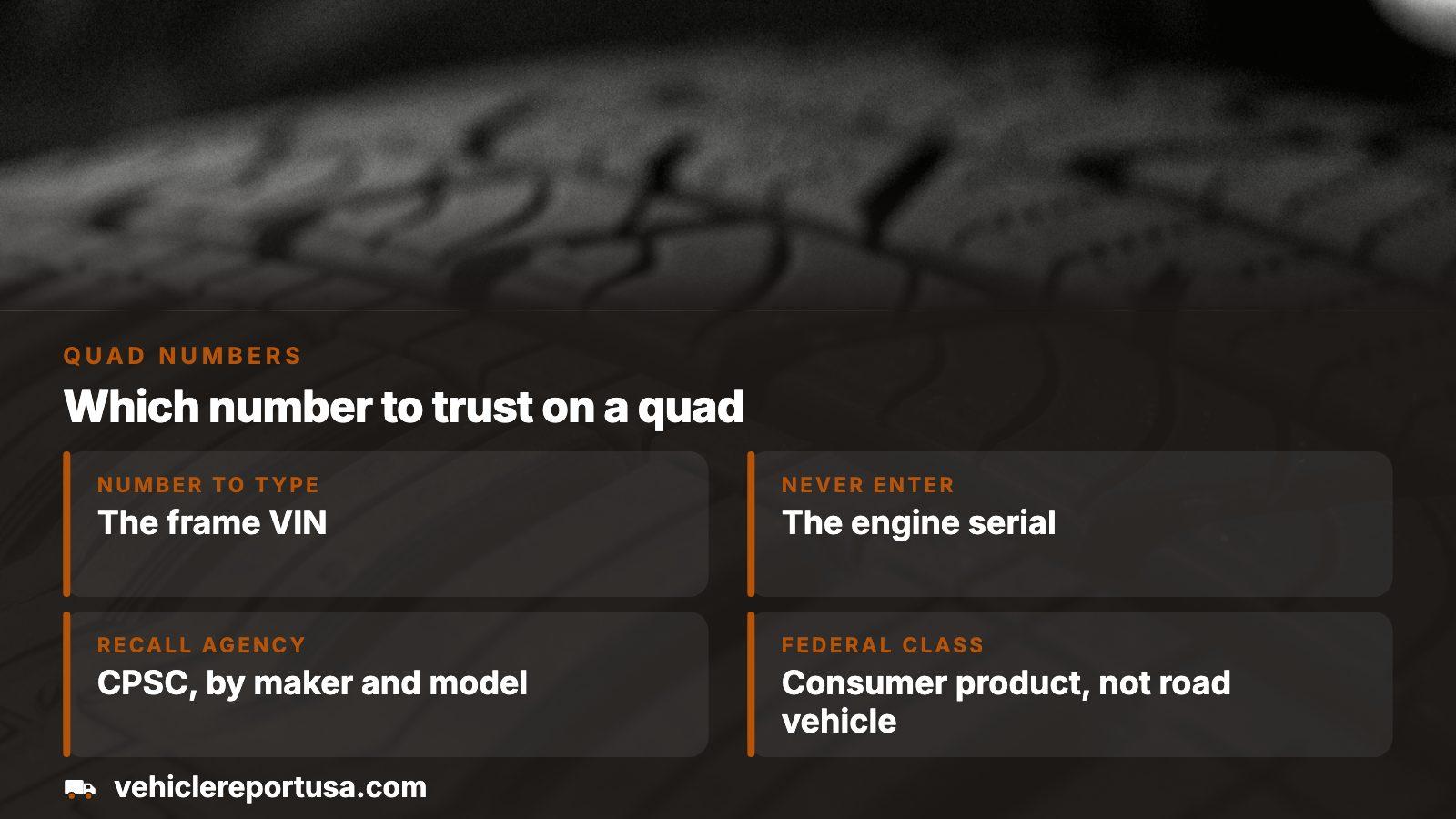
- Number to type
- The frame VIN, never the engine serial
- Federal class
- Consumer product, not a road vehicle
- Recall agency
- CPSC, searched by maker and model
- Preview
- Free, shown before any payment
What the search covers when the VIN belongs to a quad
The lookup is built for vehicles that move through title offices, insurers and auctions: trucks, RVs, motorcycles and trailers. A quad can move through the same places, but many never do. The same record searches run on an ATV VIN, and the result is only as full as the machine's own history.
| Record | On a quad |
|---|---|
| Title brands | Appear only when a state titled the machine |
| Accident and damage | Shown when an insurer, shop or auction reported it |
| Odometer readings | Often thin or absent, so judge wear on the machine |
| Salvage and auction | Sale details and photos, if it sold that way |
| Liens and impounds | Debts or tow-and-hold entries filed against the VIN |
| Theft and insurance | Theft reports and claims tied to the number |
| Open recalls | Road-vehicle data only; quad recalls sit elsewhere |
| Owners, value, specs | Owner and use history where recorded, a value estimate, factory build data |
Titled, registered or bill of sale: the paper trail decides the result
States handle quads in three ways. A titling state issues a certificate of title, just as for a car. A registration-only state logs the machine but issues no title. A third group does neither, and ownership moves on a bill of sale. That split shapes your result more than anything else.
- Titled in a titling state: the fullest result, because brands, liens and ownership changes had somewhere to be recorded.
- Registered with no title: expect the decode plus any insurance, theft or recall entries. Title fields stay empty because none exists.
- Bill of sale only: the report may come back nearly blank. That says little about the quad and a lot about how much you must verify yourself.
Whether a missing title is routine or a real problem depends on where you live. Ask your state agency before you agree a price, since a quad you cannot register is worth less to you.
Finding the frame VIN on a quad, and the other numbers you will meet
Read the number off the machine yourself instead of accepting one in a text message. Look for the stamping on the frame, often toward the rear on the left side or by the steering head, and photograph it with the compliance label before you discuss price.
- Frame stamping: the VIN you type into the lookup.
- Compliance label: names the standard the quad meets and when it was built.
- Engine serial: marked on the case and tied to a different history. Do not enter it.
- Model decal: often under the seat or in a fender well.
Most modern quads carry 17 characters. Older and imported ones vary, and a shorter number is not automatically wrong. On the label, a machine built before January 1, 2025 follows ANSI/SVIA 1-2017 and later builds follow ANSI/SVIA 1-2023. That cut uses the manufacturing date, not the model year.
Running the lookup: preview first, report if the quad stays on your list
- Enter the frame VIN as stamped, with no spaces.
- Read the preview. It is free and shows what the number decodes to.
- Check that the decoded maker and year match the ad. A quad decode does this part well.
- If the machine stays on your list, buy the report: one payment, no subscription. Packs of 3, 5 and 10 exist for anyone comparing several machines.
A mismatch in maker or year is a reason to stop right there. Amounts for a single report and for packs are on the pricing page.

Reading a thin decode: why a quad returns less than a car
The federal decoder was designed for road vehicles. Powersports makers registered identifiers but were never required to report the detail that fills a pickup's decode, so a quad usually returns a maker and a model year with engine and body fields blank. The vehicle-type labels can wander too. The same maker can be listed as a motorcycle builder under one identifier and a low speed vehicle builder under another, because a class of machine that road-vehicle law does not cover got filed under whichever labels fit.
Blank fields are not a failed lookup
A sparse preview reflects what federal records hold for this class of machine. Buying the report will not fill those fields. It adds record searches: title, damage, liens, theft and the rest.
Red flags in a quad's result and on its frame
- A salvage or rebuilt brand, or damage the seller never mentioned.
- A lien on file against the number. Ask for a written release before paying.
- A theft record or an insurer total-loss entry tied to the VIN.
- Frame stamping with grinding, filing, uneven spacing, or a plate newer than the metal around it.
- An engine serial that does not match the paperwork. Swaps are common, but a seller should volunteer one.
An altered frame number ends the deal
Corrosion is normal on a machine kept outdoors. Altered characters are not. If the frame number will not reconcile with the seller's documents, walk away instead of paying to solve the puzzle later.
Recalls and theft: two lookups that run beside the report
Because an ATV is a consumer product, its recalls belong to the Consumer Product Safety Commission, not NHTSA. A blank result from a road-vehicle recall search only means you asked the wrong agency, so search the CPSC list by maker and model.
For theft, the NICB VINCheck page is free and accepts powersports numbers. It draws on theft and total-loss filings from participating insurers, which makes a clean answer helpful but never final. Quads often sit outdoors, and many are light enough to be loaded into a truck, so a few minutes here is well spent.
Youth quads and three-wheelers: when the label matters more than the record
Under 16 CFR 1420.4, new three-wheel ATVs cannot be imported or distributed here unless a mandatory standard is someday issued, and none has been. Any three-wheeler you meet is therefore old, and parts and paperwork are questions before condition. Privately selling an existing one is not what the rule restricts.
On youth models, the maker's written safety undertaking covers age recommendations and rider training, and a private resale has no dealer to deliver either. Read the age recommendation on the machine's label, ask whether the speed limiter is still fitted and untouched, and find the owner's manual. A limiter can be defeated without leaving any record.
After the result: the order that catches most problems
- Take photos of the frame number and the label before negotiating.
- Run the preview and compare the maker and year with the listing.
- Check NICB and CPSC, then confirm your state's title rule.
- Buy the report if the quad is still a candidate. The sample report shows what each section looks like first.
- Then look the machine over, or hire a mechanic to: frame welds, axles, the engine case, the CV boots.
Where this information comes from
- eCFR: 16 CFR Part 1420 — The federal definition of an ATV, the standard editions by build date, and the three-wheeler prohibition.
- CPSC: recalls — The agency that regulates ATVs, so the place to search quad recalls.
- NICB: VINCheck — A theft and total-loss screen that accepts powersports numbers.
- NHTSA: vPIC VIN decoder — The federal decoder whose road-vehicle design explains the thin result on a quad.
Sources and photos: Facts checked against the sources above in November 2026. Photos by Ahmet Yüksek ✪, Anastasiia Nelen and Yvette S on Unsplash; diagrams by VehicleReportUSA.
Keep reading
- Motorcycle VIN Lookup: Check a Used Bike's History Before You PayDirt bikes and road bikes go through the two-wheel check, where the rules change again.
- Trailer VIN Lookup: Check a Used Trailer's History by VIN Before You PayThe trailer that hauls the quad carries its own VIN and its own title rules.
- Sample reportSee how each record section looks before you decide on a full report.
- PricingOne-time prices for a single report or a pack, with no subscription.
Frequently asked questions
Can I run an ATV VIN lookup on a quad from a private seller?
Yes. Read the frame VIN off the machine yourself, type it in and look at the preview. Where the quad was never titled or insured, expect the record sections to be short, and put more weight on the inspection and the seller's documents.
Is an ATV VIN always 17 characters long?
Newer machines usually carry 17, even though federal VIN rules for cars do not require it of a consumer product. Dealers, insurers and state agencies expect the long format, and a shorter frame number on an older or imported machine is not automatically a warning sign.
Is an ATV VIN check different from a motorcycle VIN check?
The steps match: enter the number, read the preview, decide on the report. The rulebook differs. A quad is a consumer product, so its recall path and paper trail differ, while a two-wheeler such as a dirt bike belongs with the motorcycle check.
Will the report show recalls on my ATV?
Treat an empty recall result as inconclusive. Quad recalls are handled by the Consumer Product Safety Commission, not the agency covering cars. Search its recall list by maker and model, and note any open campaign before you agree a price.
Can an ATV VIN check tell me if the quad is stolen?
It searches theft records tied to the number, and the NICB page adds a second look from insurer filings. Neither is a guarantee, so pair them with a close read of the frame stamping and the seller's paperwork.
Now check the car itself
The guide explains what to look for. The report shows what this VIN has on record.