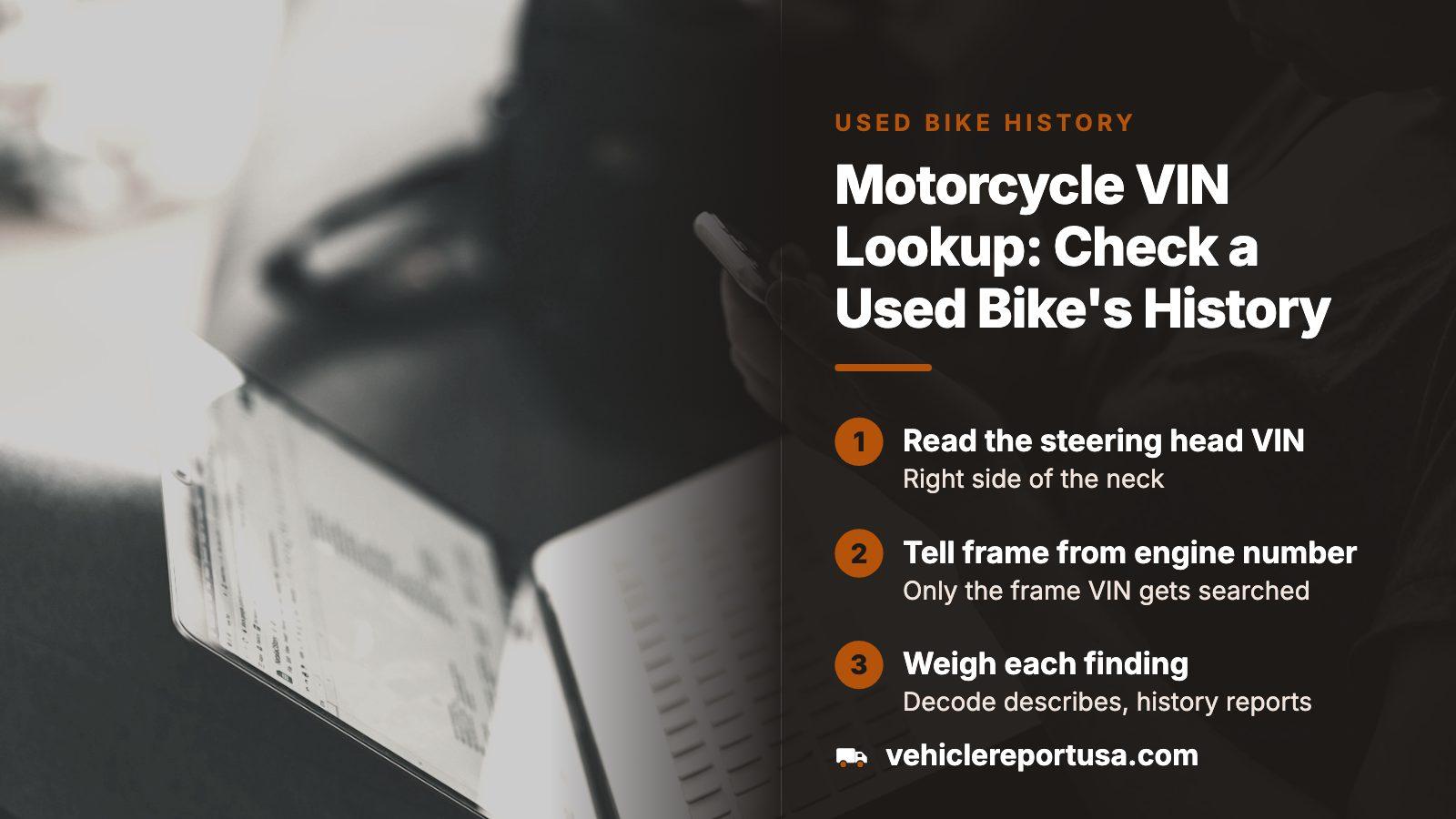
THE SHORT ANSWER
Read the 17-character frame VIN off the bike, usually on the steering head, and enter it into the lookup. You get a free preview of what the number decodes to before paying anything. The full report is a single purchase covering title brands, damage, odometer entries, salvage and auction photos, liens, impounds, theft and insurance records, and open recalls. An engine serial will not work in the box.
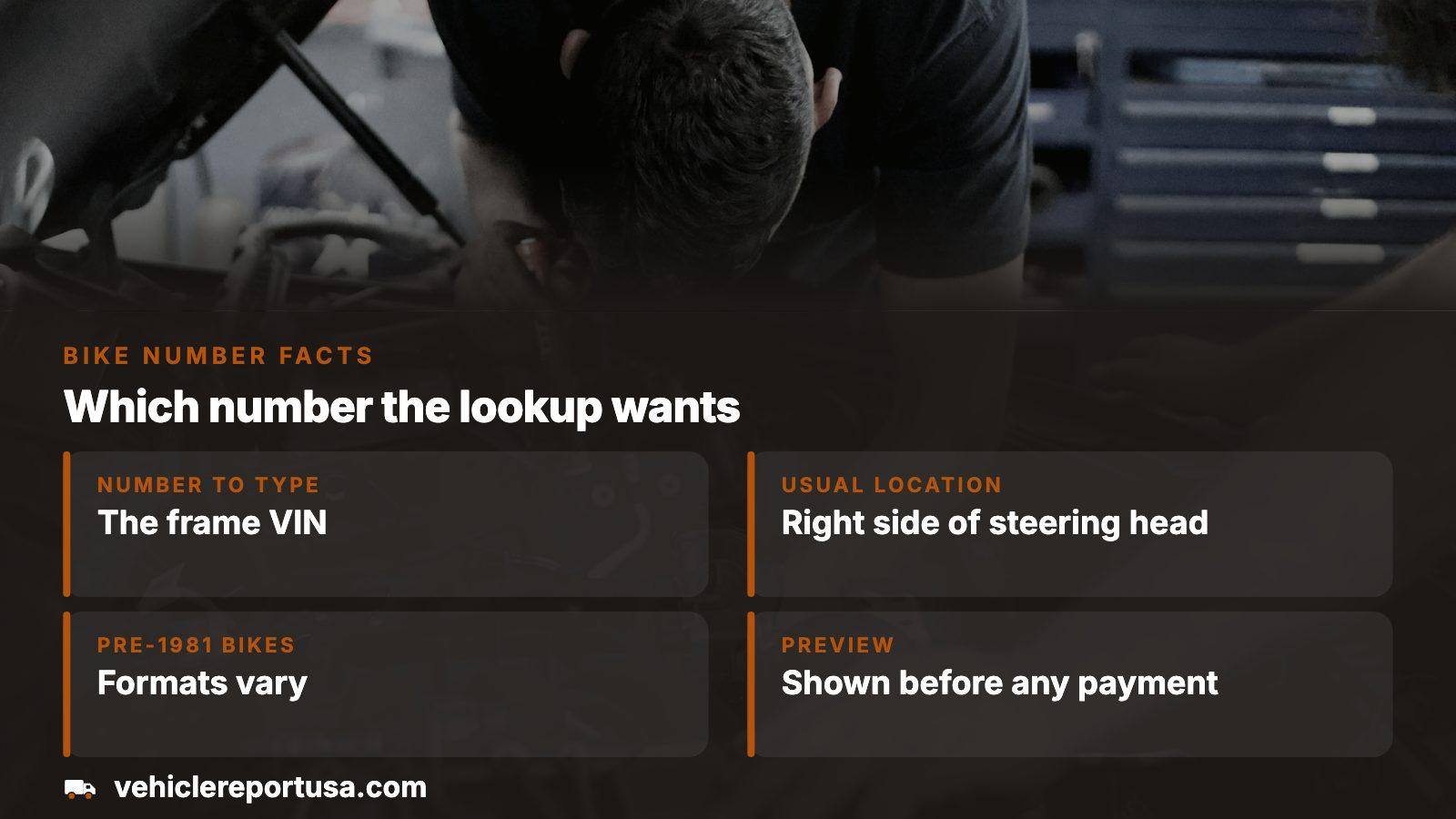
- Number to type
- The frame VIN, not the engine serial
- Usual location
- Steering head, right side of the neck
- Preview
- Free, shown before any payment
- Built before 1981
- Formats vary; federal tools do not decode them
A decode describes the bike, a history report describes its past
The preview tells you what the factory built: maker, model year, engine and body class. That catches an advert with the wrong year, and it is as far as any decoder goes. The paid report then searches the records attached to that VIN, which is where a used bike's real story sits. Motorcycles are modified, dropped and resold more freely than cars, so the distance between the decoded bike and the one in the garage can be wide.
- Title brands such as salvage, rebuilt and flood.
- Accident and damage records, including salvage and auction listings with photos.
- Odometer readings taken on different dates.
- Liens and impounds filed against the number.
- Theft and insurance records.
- Open recalls, owner and use history, a market value estimate and factory specs.
A five-minute walk-around to find and photograph the number
- Park the bike on level ground and bring a flashlight and a rag. Grime hides stampings, and the front wheel throws road dirt at the exact spot you need.
- Start at the neck, where the forks join the frame. Swing the bars to one side and look along the right of the tube. Most makers punch the VIN there.
- No luck? Follow the lower frame tubes toward the engine mounts, since some makers stamp the number down low.
- Look for a printed label too, on the frame near the neck, under the seat or beneath the tank. It is easy to read and shows when the bike was built.
- Photograph every number you find, with enough of the bike in frame to show where it sits.
Then set the photos beside the title. The frame VIN and the paper must agree on every character.
Two numbers on one bike, and which one the lookup wants
Every bike carries a frame VIN and a separate engine serial, and only the first belongs in the lookup box. The frame number is the bike's legal identity: it is the number your title, registration papers and insurer all use. The engine serial is a part number the maker assigns, stamped on the cases. No federal rule sets its length or layout, so it can look odd, and it will never decode as a VIN.
Engines move between frames on bikes far more than on cars, through rebuilds, crash repairs and custom work. An engine number that differs from the frame is therefore not automatically a scam. Ask if the engine has ever been replaced, and ask to see receipts if it has.
Two quick ways to spot a misread
A real VIN has 17 characters and leaves out I, O and Q entirely, so a stray O is almost certainly a zero. On a motorcycle the final four characters are digits. If the lookup rejects your entry, check those two things first.
Running the lookup: preview first, report if the bike stays on your list
- Enter the frame VIN with no spaces and read the preview, which costs nothing.
- Check that the decoded maker, model year and engine size match the advert. A mismatch is a reason to walk away before spending anything.
- If the bike is still a contender, buy the report. It is a single payment with no subscription, and a pack of 3, 5 or 10 is there for shoppers with several bikes in view.
- Read the report against the title and the seller's account before a deposit changes hands.
Amounts for one report and for each pack are on the pricing page, and the sample report shows how each section looks.

Reading the result: what each finding should make you do
| If the report shows | Do this |
|---|---|
| A salvage or rebuilt brand | Pay for a frame alignment inspection before you negotiate, not after. |
| Auction photos with a bent fork or damaged neck | Ask what was repaired and who did the work. |
| Few miles for the model year | Compare the dated odometer entries and look for stored-bike faults: stale fuel, perished rubber, a weak battery. |
| A lien or an impound entry | Require a written release from the lender before money moves. |
| A theft record or an insurer total loss | Stop and ask for a written explanation. A vague answer ends the deal. |
| A clean report | Good news, but still read the stamping against the title in person. |
Frame damage is structural
Many branded bikes took only modest damage. Still, one set of tubes holds the steering geometry and the suspension mounts, so have a mechanic who can judge alignment check it. Paint tells you nothing here.
How federal rules shape a motorcycle's number
A bike follows the same 17-character standard as a car, but a separate row of federal rule governs it. Under 49 CFR 565.15, positions four to eight must describe the bike's power output, engine type, model line, kind of machine and make. A passenger car's row asks for body type and restraint devices instead. The power figure may be up to 10 percent off, so a slight gap against the spec sheet means nothing.
Older bikes are different again. The standard became mandatory in 1981, and a machine from before then uses a shorter maker format with no check digit. NHTSA's decoder does not cover those, so turn to a marque owners' club or the factory parts book, and expect little from any VIN search.
Recalls and theft: free checks to run beside the report
Motorcycle recalls are published through NHTSA, and its VIN lookup costs nothing. Search the VIN, not the model, because campaigns cover VIN ranges and a model search can show recalls that never touched your bike. An open one is repaired by the maker at no cost, whoever owns the bike now, so book the dealer visit and raise it when you talk price.
The NICB VINCheck page is also free. It reads records from participating insurers, so a clean answer helps but is never conclusive. Run it before you plan the trip to see the bike, since a light machine is easy to load into a van and a private cash sale has no dealer to catch the problem.
What the search leaves to you at the viewing
- Drops and low-speed crashes that never produced a claim or a repair record.
- Tire age, chain or belt wear, and when the valves were last adjusted.
- Aftermarket parts, and whether a competent person fitted them.
- Whether the engine fitted is the original or a replacement.
Bring the report to the viewing along with your photos of the stamping. Check the neck for grinding or filing, ask about any engine or frame swap, and take the bike to a mechanic if the brand or the asking price justifies it.
Where this information comes from
- NHTSA: recalls — The free VIN lookup for open safety recalls, which covers motorcycles.
- NHTSA: vPIC VIN decoder — The public decoder that shows what a post-1981 frame number says about the bike.
- NICB: VINCheck — A theft and salvage screen drawn from participating insurers.
- Cornell LII: 49 CFR 565.15 — The federal rule listing what positions four to eight must encode for a motorcycle.
Sources and photos: Facts checked against the sources above in November 2026. Photos by Michal Biernat, Scott Graham and Mustafa Sheikhmouss on Unsplash; diagrams by VehicleReportUSA.
Keep reading
- ATV VIN Lookup: Check a Quad's History by Frame VIN Before You BuyQuads fall under consumer product rules, so their paper trail and recall path differ.
- Trailer VIN Lookup: Check a Used Trailer's History by VIN Before You PayThe trailer that hauls the bike has its own VIN and its own title.
- Sample reportSee how each record section looks before you pay for a full report.
- PricingAmounts for one report or a pack, paid once, with no subscription.
Frequently asked questions
Can I run a motorcycle VIN lookup before I go to see the bike?
Yes, and it saves trips. Request a sharp photo of the neck stamping and the label, enter the frame VIN and read the free preview. If the decoded year or engine does not match the advert, you have your answer without leaving home.
The VIN stamped on the bike differs from the title. What now?
Read both again slowly in daylight, because a misread letter is the commonest cause. If they still differ, ask for papers that explain it, such as a replacement frame record, and check how your state handles one. With no explanation, walk away, since you may be unable to title the bike.
Can I look up a bike with its engine number instead?
No. The lookup needs the frame VIN, and an engine serial will not decode as one. Treat the engine number as a comparison point: what the seller says about the engine should fit the receipts and the displacement shown in the preview.
Will the report show if a motorcycle has been crashed?
It shows crashes and damage that someone reported, along with title brands and any salvage or auction photos. It cannot see a tip-over that never reached an insurer, shop or auction, so look over the forks, frame and bodywork yourself or pay a mechanic to.
Are all motorcycle VINs 17 characters long?
Those built from the 1981 model year on are. Earlier bikes use maker formats that are usually shorter, so a short number on an old machine is not automatically an engine serial. Check the build year first and ask the marque's owner club for help.
Now check the car itself
The guide explains what to look for. The report shows what this VIN has on record.