THE SHORT ANSWER
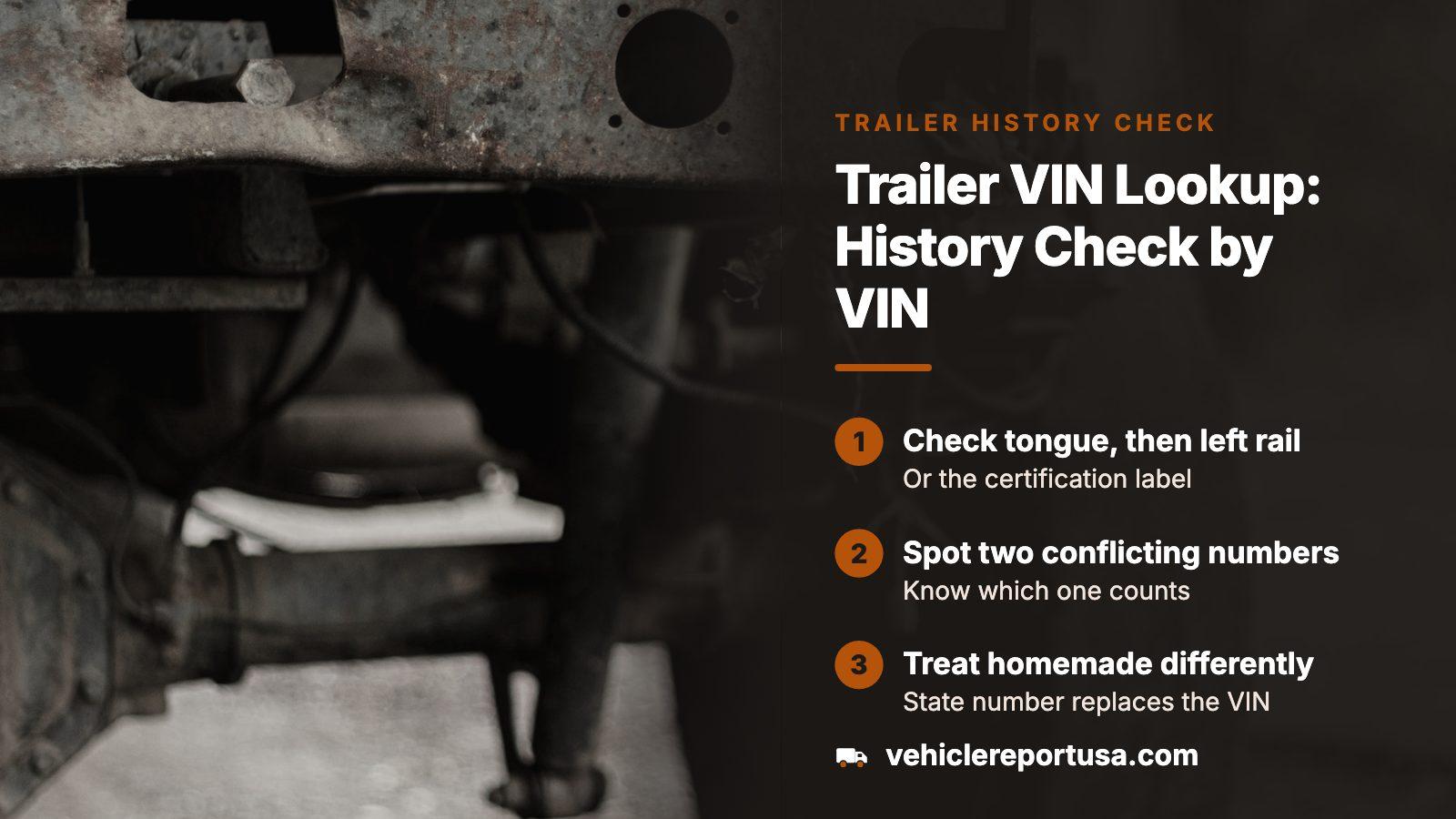
To check a trailer by VIN, read the number from the A-frame tongue, the left frame rail or the certification label and enter it in the lookup. A free preview decodes it first. The paid report, a single payment with no subscription, then searches title brands, damage, salvage and auction records, liens, theft, insurance records and open recalls. A trailer with no VIN needs a number from its state before any lookup can work.
- Look first
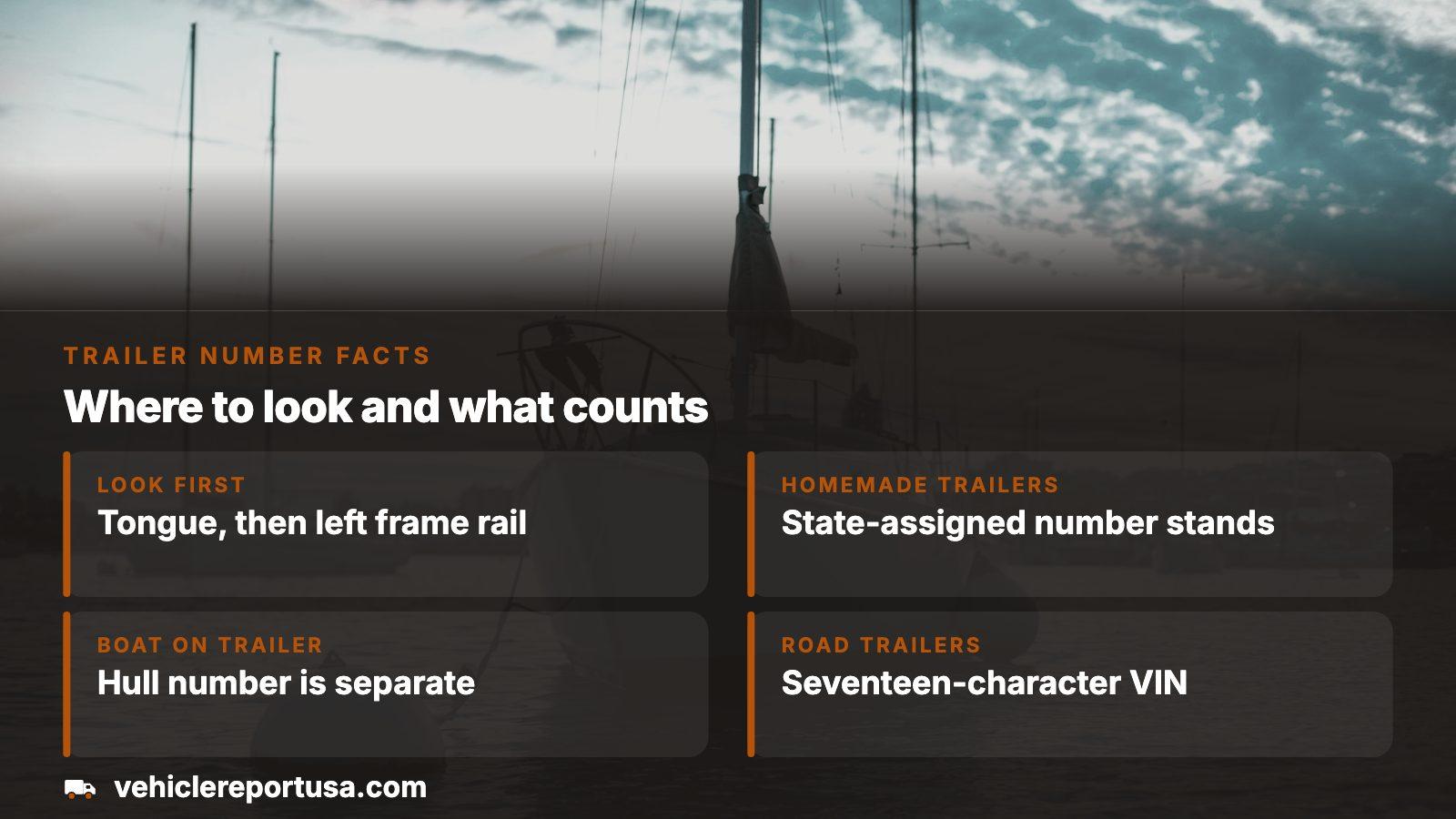
- Tongue or A-frame, then the left frame rail
- VIN length
- 17 characters on road trailers from the 1981 model year
- Homemade trailers
- A state-assigned number stands in for the factory VIN
- Boat on the trailer
- Has its own hull number, outside this lookup
A trailer check reads like a truck history, minus the engine and the odometer
VehicleReportUSA exists for vehicles that car-first tools handle badly: trucks, RVs, motorcycles and trailers. A trailer is searched for the same kinds of record as a pickup, with the VIN as the key. How much comes back depends on whether the trailer was ever titled, insured, financed or sold at auction.
| Record | On a trailer |
|---|---|
| Title brands | Salvage, rebuilt or flood branding on the VIN |
| Accidents and damage | Reported collisions and the damage on file |
| Odometer readings | Usually none, since a trailer has no odometer |
| Salvage and auction history | Past sales, with photos where they exist |
| Liens and impounds | Money still owed, or a past tow-and-hold |
| Theft and insurance records | A theft report and claims on file |
| Open recalls | Safety campaigns not yet repaired |
| Ownership, use type, value, specs | Past owners, recorded use, a market value and factory data |
A short result on a small utility trailer is common. It does not prove a clean past, only that few records exist.
Running the check before you hand over a deposit
Call it a trailer VIN number check or a VIN check on a trailer: it is one search against one number. The steps are the same for a car hauler in Ohio and a horse trailer in Texas, so a trailer VIN check in the USA does not depend on where the trailer was built.
- Enter the 17 characters exactly as stamped, with no spaces.
- Read the free preview. It decodes the VIN before any money changes hands.
- Compare the decode with the listing: builder, model year and trailer type should fit the one in the driveway.
- If the trailer is still a candidate, buy the report: a single payment, no subscription, no renewal.

The kind of trailer decides what else to check
| Trailer | Beyond the VIN |
|---|---|
| Utility and car hauler | Often homemade, so ask whether the frame carries a factory VIN or a state number |
| Enclosed cargo | Add the door frame to the places you search for the number |
| Dump and equipment | Heavier ratings and brakes; weight-class rules are more likely to bite |
| Horse and livestock | The condition of the floor matters more than any record |
| Travel trailer and fifth wheel | Coach-side recalls sit outside a VIN search, as the RV guide explains |
| Boat trailer | The trailer VIN is searched; the boat's hull number is separate |
Finding the number, and what to do when two numbers disagree
A trailer has no windshield plate, so the number is on the steel. Work back from the coupler and read it yourself, because a number sent by text is only as good as the sender's eyes.
- The A-frame or tongue: top and both sides.
- The left frame rail near the front corner, stamped or on a riveted plate.
- The certification label on the left side toward the front. It carries the VIN along with the build date, the weight ratings (GVWR for the loaded trailer, GAWR for each axle) and the tire size and pressure.
- On an enclosed box, the door frame.
Rust buries stampings far more often than it removes them, so scrub the spot before you decide a number is missing. If the label and the frame stamping disagree, or a new-looking label sits above bare steel, hold the deal until the seller explains it. An honest seller usually can.
Reading the 17 characters the way a trailer needs
Federal rule 49 CFR 565.15 gives trailers their own requirement for positions 4 through 8: they must identify the make, the type of trailer, the body type, the length and the axle configuration. A car VIN chart reads those slots as engine and restraint codes, so it misreads a trailer. The ending differs too. Cars and light trucks rated at or under 10,000 pounds must finish with five digits, and trailers finish with four.
NHTSA's public register will confirm the builder behind the first three characters. Compare what it returns with what the seller said.
| Starts with | Register returns |
|---|---|
| 5KT | Karavan Trailers Inc. |
| 1UY | Utility Trailer Manufacturing |
| 4YM | Carry-On Trailer, Inc. |
An unlisted code is no accusation. Small shops and kit builders are often missing, and the label and the title then carry more weight.
Homemade trailers, boat trailers and a frame with no number
A trailer welded up in a garage never had a factory VIN. States issue their own numbers for that case, usually after an inspection and proof of where the parts came from. Once the trailer has one it can be titled and sold, and a lookup has something to search. Until then there is nothing to check.
A boat on a trailer is two items with two numbers. The trailer has a VIN. The boat has a Hull Identification Number, usually on the starboard side of the transom. This lookup reads the trailer's VIN and does not search boat records, so match each number to its own title.
Grinding where the number belongs
A lost or painted-over label is a paperwork problem. Fresh grinding, filing or a welded patch on the frame is something else. Walk away from the deal and consider reporting it.
Red flags in a trailer result and on the frame
- A salvage, rebuilt or flood brand, which follows the VIN through every later sale.
- Auction photos showing a bent frame, axle or coupler that the listing never mentioned.
- A lien or impound entry, since a lender with a claim can block a clean transfer.
- A theft record, or a frame number that differs from the title by one character.
- A recorded use that contradicts the story, such as rental use on a trailer sold as a weekend hauler.
- An open recall the seller did not raise.
Title rules, recalls and theft: the state and two outside lookups
Titling practice differs by state. One may title every trailer, another only the heavier ones, with a plate alone for the rest, so a missing title is routine in one place and a problem in another. Check the rule where you will register the trailer.
Trailer recalls have covered axles, couplers, brakes, lighting and suspension, and NHTSA's free recall search accepts the VIN. Trailers are also easy to steal, since they need no key. NICB's VINCheck is a free theft lookup that draws on participating insurers.
What it costs, and the order that catches most problems
No payment is needed to see the preview. The report is bought once, either alone or in bundles of 3, 5 and 10 when several trailers are on your shortlist. Prices sit on the pricing page, and a sample report shows what you get.
- Photograph the VIN and read the certification label.
- Run the preview, then the recall and theft lookups.
- Buy the report if the trailer is still in the running.
- Confirm your state's registration rules, then inspect the frame, coupler, chains and lights.
Where this information comes from
- eCFR: 49 CFR 565.15, VIN content requirements — Sets what positions 4 through 8 must identify on a trailer and which ending characters must be digits.
- NHTSA: vPIC VIN decoder — The public register for confirming a builder from the first three characters.
- NHTSA: recalls lookup — Open-recall search by VIN, including trailer components.
- NICB: VINCheck — Theft lookup from participating insurers.
Sources and photos: Facts checked against the sources above in November 2026. Photos by Zoshua Colah, Alejandro Escamilla and Johnny killroy on Unsplash; diagrams by VehicleReportUSA.
Keep reading
- RV VIN Lookup: History Check for Motorhomes, Trailers and Fifth WheelsTravel trailers and fifth wheels add coach-side recalls and a few extra traps.
- Motorcycle VIN Lookup: Check a Used Bike's History Before You PayHauling a bike? The bike needs its own check before it goes on the deck.
- Sample reportSee what a finished report looks like before you buy one.
- PricingWeigh a single report against a pack if you are looking at several trailers.
Frequently asked questions
Where is the VIN on a trailer?
Begin at the front: the top and sides of the A-frame tongue, then the left frame rail near the corner. A certification label on the left side repeats it. Clean off any rust or road film first, then photograph what you find so a transcription slip cannot creep in.
Does every trailer have a 17-character VIN?
Road trailers built from the 1981 model year carry 17 characters. Older trailers, homemade ones and some very light units can have a shorter number, a state-assigned number or nothing at all. Anything unnumbered needs a state number before a history search has a key.
Can I run a trailer VIN check if the trailer has no VIN?
No, the search needs a number. A homemade or unnumbered trailer has to go through its state's process first, which usually means an inspection and proof of the parts. If a label was only lost, look for a stamping elsewhere on the frame before assuming the worst.
Does a trailer VIN check also cover the boat on it?
No. A boat carries a Hull Identification Number in a different format, normally on the transom. The lookup searches the trailer's VIN, so a boat and trailer sold together need two matches: VIN to the trailer title, hull number to the boat's own title.
Is a trailer VIN check free?
The preview is free and arrives before any payment. Buying the full report is a one-off charge, not a subscription. NHTSA's recall search and NICB's VINCheck theft lookup cost nothing from their publishers, and both are worth running beside the report on any trailer.
Now check the car itself
The guide explains what to look for. The report shows what this VIN has on record.