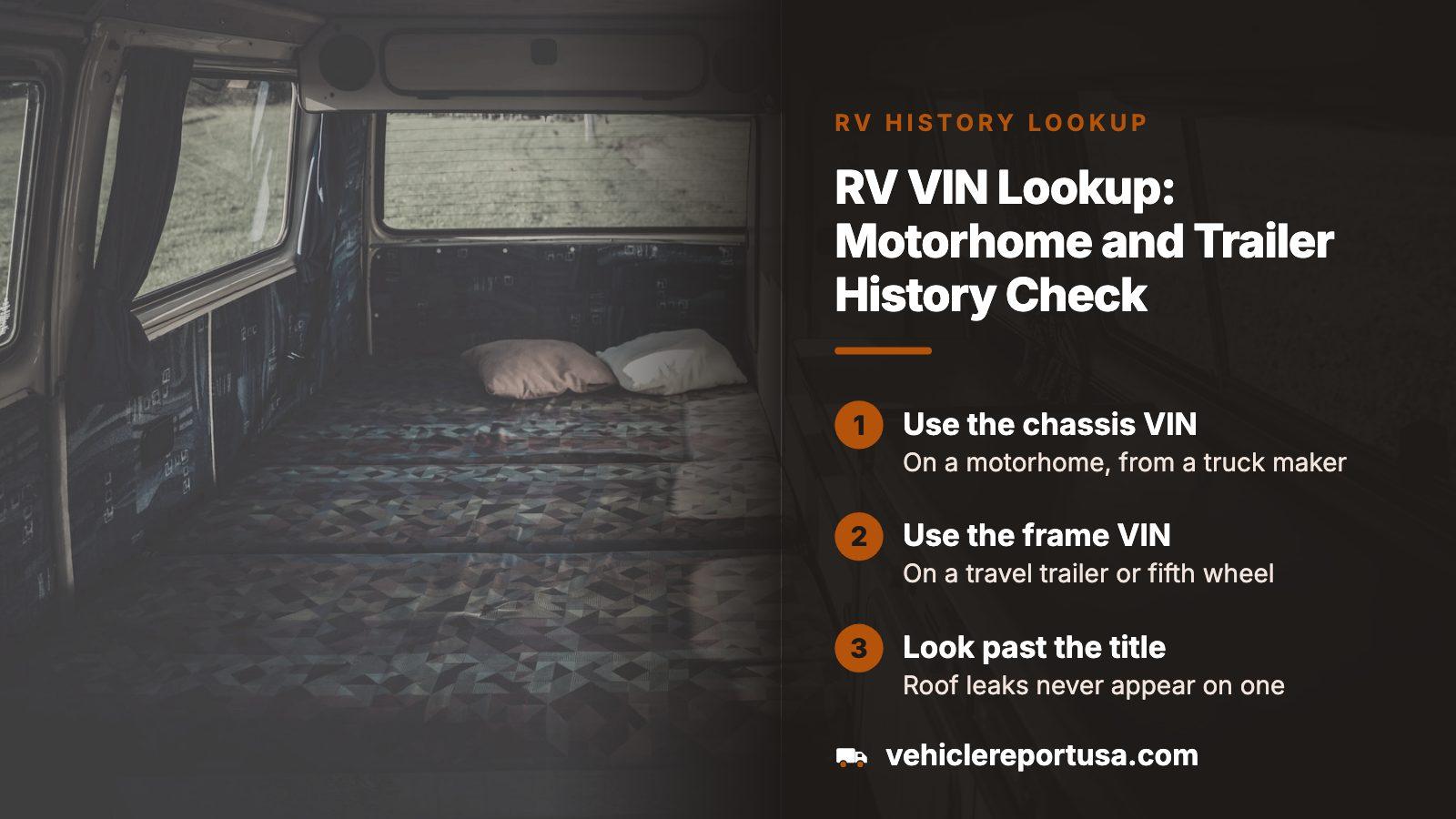
THE SHORT ANSWER
To check an RV by VIN, enter the 17-character number into the lookup. On a motorhome that means the chassis VIN; on a travel trailer or fifth wheel, the frame VIN. The preview is free and comes before any payment. The paid report adds accident and damage records, salvage and auction photos, odometer readings, title brands, liens, theft and insurance records, and open recalls. It cannot see inside the coach, so water damage still needs an inspection.
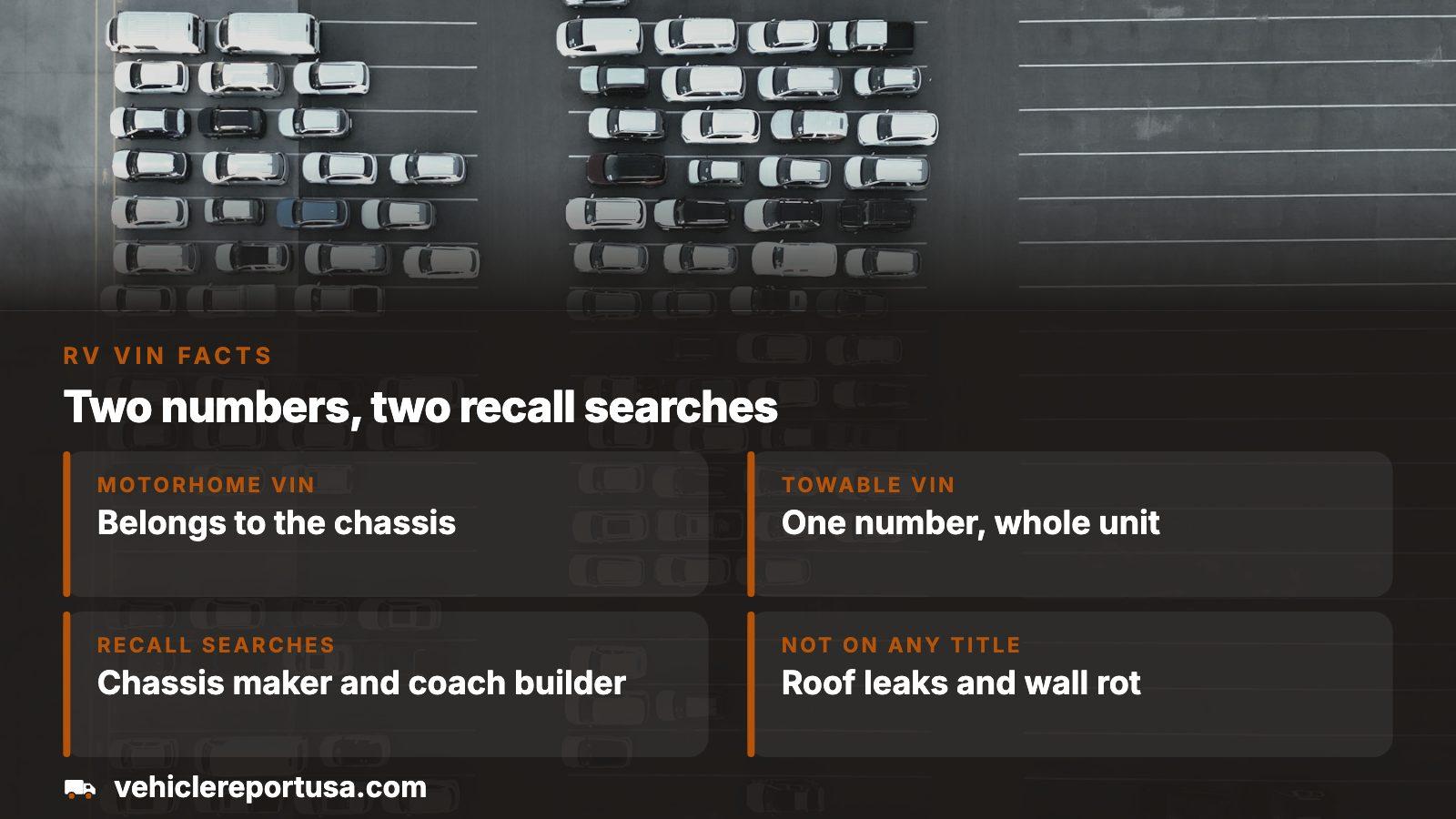
- Motorhome VIN
- Belongs to the chassis, built by a truck maker
- Towable VIN
- One number for the whole unit, from the RV builder
- Recall searches
- Two: the chassis maker and the coach builder
- Not on any title
- Roof leaks and wall rot
What an RV VIN check pulls up for a motorhome or a towable
Specialty vehicles fall into two camps, and the lookup behaves a little differently for each. A motorhome is titled on its chassis VIN, so the result reads like a truck history. A travel trailer, fifth wheel or popup carries one VIN for the entire unit, so the result reads like a trailer history. The same record types are searched either way.
| Record | What it tells you about an RV |
|---|---|
| Title brands | Salvage, rebuilt or flood branding recorded against the VIN |
| Accidents and damage | Reported collisions and the damage on file |
| Odometer readings | Mileage history on a motorhome; a towable has no odometer, so expect none |
| Salvage and auction history | Past sales through those channels, with photos where they exist |
| Liens and impounds | Money still owed on the unit, or a past tow-and-hold |
| Theft and insurance records | Whether the VIN was reported stolen, and claims on file |
| Open recalls | Campaigns still unrepaired against that VIN |
| Ownership and use type | Owner history and the kind of use on record |
| Market value and factory specs | A value figure for the VIN and the factory build of the chassis or frame |
Where the VIN sits on a Class A, Class C, trailer or fifth wheel
Sellers often say, "go ahead and check my RV VIN," and then send a number by text. Read it off the vehicle yourself instead, because a wrong digit or a swapped unit slips through at exactly that step.
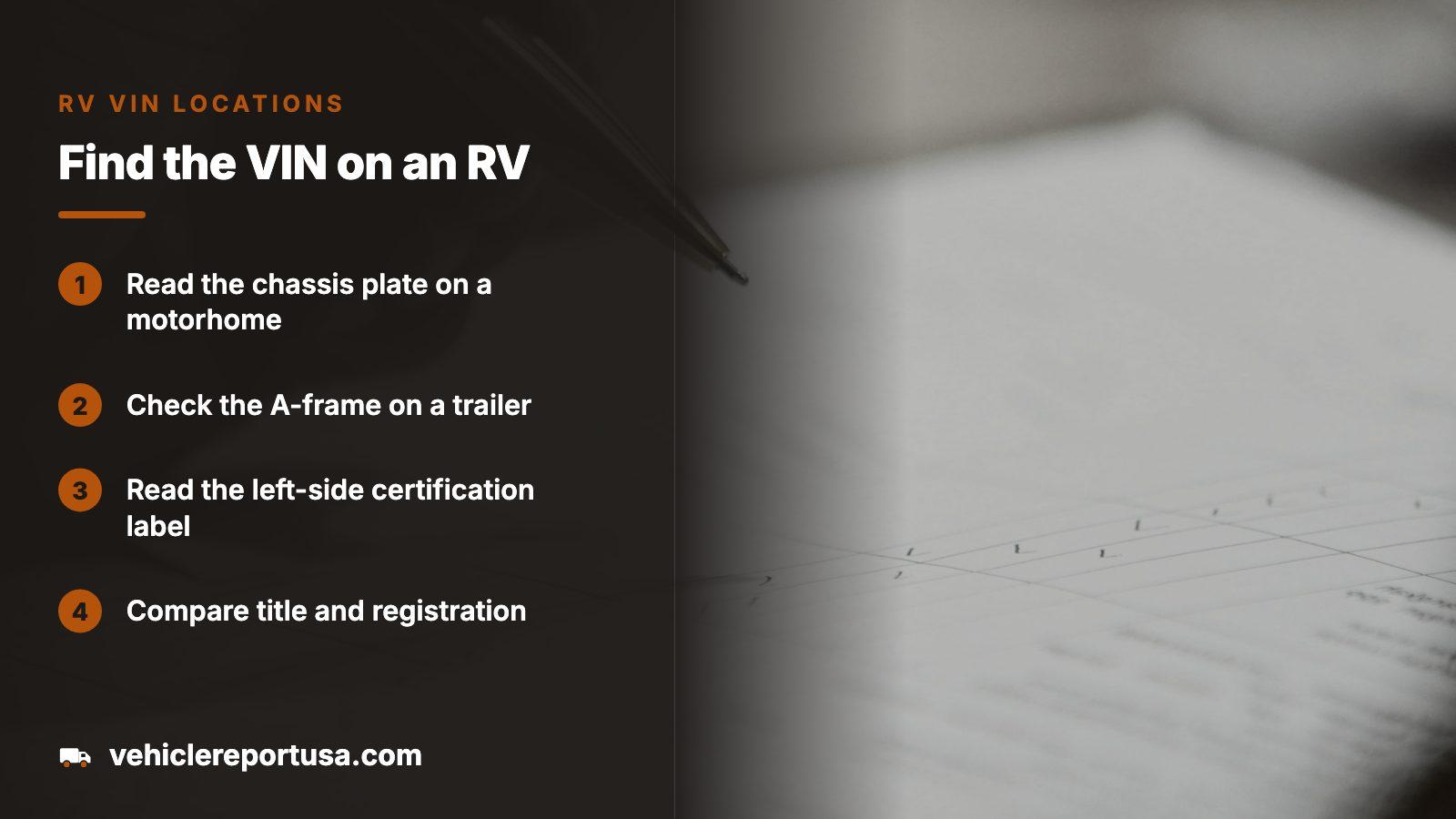
- Motorhome chassis: read the plate at the lower driver-side corner of the glass, then the sticker on the driver's door frame.
- Travel trailer or fifth wheel: the A-frame at the coupler end, or the left rail of the frame near the front.
- Certification label: a left-side sticker toward the front, printed with the weight ratings, the build date and the VIN.
- Paperwork: title, registration and insurance card. On a motorhome these follow the chassis VIN.
- Coach data plate: a separate builder serial, often inside a cabinet or by the entry door. Photograph it, but do not type it into the lookup.
If the number on the frame and the number on the title differ by even one character, treat that as a finding, not a typo.
Running the lookup: preview first, report if the RV stays on your list
Any RV VIN number check online depends on the characters you give it, so the steps are short and most of the care happens on your side.
- Type the 17 characters exactly as stamped, with no spaces.
- Read the preview. It is free and shows what the VIN decodes to before you spend anything.
- Compare the decode with the listing: model year, engine and the chassis maker named should fit the RV in front of you.
- If the unit is still a candidate, buy the full report. It is one payment, with no subscription and no renewal.
Why the result names a truck maker instead of your RV brand
Owners of a Class C or Class B often assume the decode went wrong when it names a commercial van or cutaway manufacturer. It did not. A motorhome is finished in stages: one company builds the chassis and assigns the VIN, and another builds the living quarters on top and sells the finished coach under its own name.
A history report follows the VIN, so it describes the chassis half of the vehicle: engine, drivetrain, title, odometer, damage and liens. That mechanical half is the part that leaves you stuck on a shoulder, so it matters. The coach brand on the sidewall appears on the builder's own data plate instead.
Federal rules for vehicles built in stages also let the final builder certify the coach to standards from any date between the chassis build and completion. That is one reason the year a VIN implies and the model year in a listing can disagree without anything being wrong.
Open recalls: the report covers the chassis, the coach builder covers the rest
An RV can carry recalls from two separate companies, and a VIN search reaches only one of them.
| Recall source | Typical systems | Where to look |
|---|---|---|
| Chassis maker | Powertrain, brakes, steering, fuel delivery | By VIN, in the report or on NHTSA's free recall lookup |
| Coach builder | Slide-outs, LP gas, appliances, wiring, steps, awnings | With the RV builder, using the serial from the coach data plate |
A clean VIN result is half the answer
If the chassis shows nothing open, only the truck maker is clear. Gas and electrical campaigns sit on the coach side, so phone the builder with the data plate serial before you hand over a deposit.
Red flags to look for in an RV history result
- A salvage, rebuilt or flood brand. Brands are tied to the VIN, so they stay on the record when the RV is sold on.
- Salvage or auction photos that show roof, front cap or sidewall damage the seller never mentioned.
- Odometer readings on a motorhome that move backward or stall for years.
- A lien or impound entry. A lender with a claim on the chassis can block a clean transfer.
- A theft record, or a VIN on the frame that does not match the title character for character.
- A use type that contradicts the story, such as commercial or rental use on a unit sold as one family's weekend rig.
- An open chassis recall the seller did not raise.
For theft, NICB's VINCheck is a free second look that draws on participating insurers, and it takes a minute to run.
What the check cannot see, and what to inspect instead
Most expensive RV failures begin as water, and water leaves no entry in any database. Roof vents, skylights, air conditioners, antennas and slide-out seals are all openings sealed with material that breaks down in the sun.
A soaked coach can carry a spotless title
A slow roof leak rarely turns into a claim the way flood damage does, so no brand records it. Inspection finds it, or nothing does.
- A floor that flexes underfoot, mainly beside slide-outs and by the entry step
- Discolored ceiling panels or damp-looking upper cabinets
- A damp odor, or strong deodorizer masking one
- Wall skin that bubbles or lifts from the framing
- Cracked, shrunken or missing sealant at every roof opening
- Hardened or torn slide-out seals, or seals that no longer press shut
Floor plan, appliances and tanks are outside the VIN as well. A dedicated RV inspector covers LP gas, 12-volt and shore power, and the roof, which a car mechanic will not.
What it costs and what to do with the result
There is no charge to run the preview. You pay once for each full report, and a buyer looking at several rigs can save with a bundle of 3, 5 or 10. The pricing page lists current prices, and the sample report page shows the layout before you commit.
With the report in hand, settle any brand or lien question with the seller in writing, call the coach builder about recalls, run the theft lookup, then book the inspection. The records and the inspection catch different problems, so a clean result on one never excuses skipping the other.
Where this information comes from
- NHTSA: vPIC VIN decoder — Public decoder that reads the VIN on a motorhome chassis or a towable and shows what the maker built.
- NHTSA: recalls — Free lookup for open chassis-side recalls by VIN.
- NICB: VINCheck — Free theft lookup fed by participating insurers.
- eCFR: 49 CFR Part 568 — The federal rule for vehicles completed in more than one stage, which explains the chassis and coach split.
Sources and photos: Facts checked against the sources above in November 2026. Photos by Balkan Campers, Masjid MABA and Iain on Unsplash; diagrams by VehicleReportUSA.
Keep reading
- Trailer VIN Lookup: Check a Used Trailer's History by VIN Before You PayA towable carries its own VIN, and state rules decide how trailers are titled.
- ATV VIN Lookup: Check a Quad's History by Frame VIN Before You BuyA toy hauler often brings an ATV along, and the toy deserves a check too.
- Sample reportSee what each record section looks like before you decide on a full report.
- PricingPrices for one report or a bundle, paid once and never billed again.
Frequently asked questions
Can I check an RV by VIN online before I visit the seller?
Yes. Ask for clear photos of the dash-corner plate and the door-frame sticker, or the frame VIN on a towable, then enter the number. The preview costs nothing and often settles whether the drive is worth making. Match the stamped VIN to the title in person.
Does a VIN check work on a travel trailer or fifth wheel?
It runs on the trailer's own VIN. How much it finds depends on whether your state titled the unit, because states differ on which towables need a title. Truck campers are often not titled as vehicles at all, so check local rules first.
Will the report show the floor plan or the coach brand?
No. The VIN identifies the chassis on a motorhome, so factory specs describe the engine and drivetrain rather than the living space. To confirm the coach itself, read the builder's data plate and ask the builder about the model.
The RV passed a professional inspection. Do I still need a VIN check?
Yes, because the two answer different questions. An inspector sees the roof, tanks and wiring, but not a salvage brand, an unpaid lien, an old theft report or auction photos. The history report finds those, and the inspection finds the water.
How many RVs can I check on one purchase?
Each report is for a single VIN. Shoppers with a short list of rigs, and small dealers, tend to buy in threes, fives or tens. There is no subscription, so nothing bills you again after the purchase.
Now check the car itself
The guide explains what to look for. The report shows what this VIN has on record.