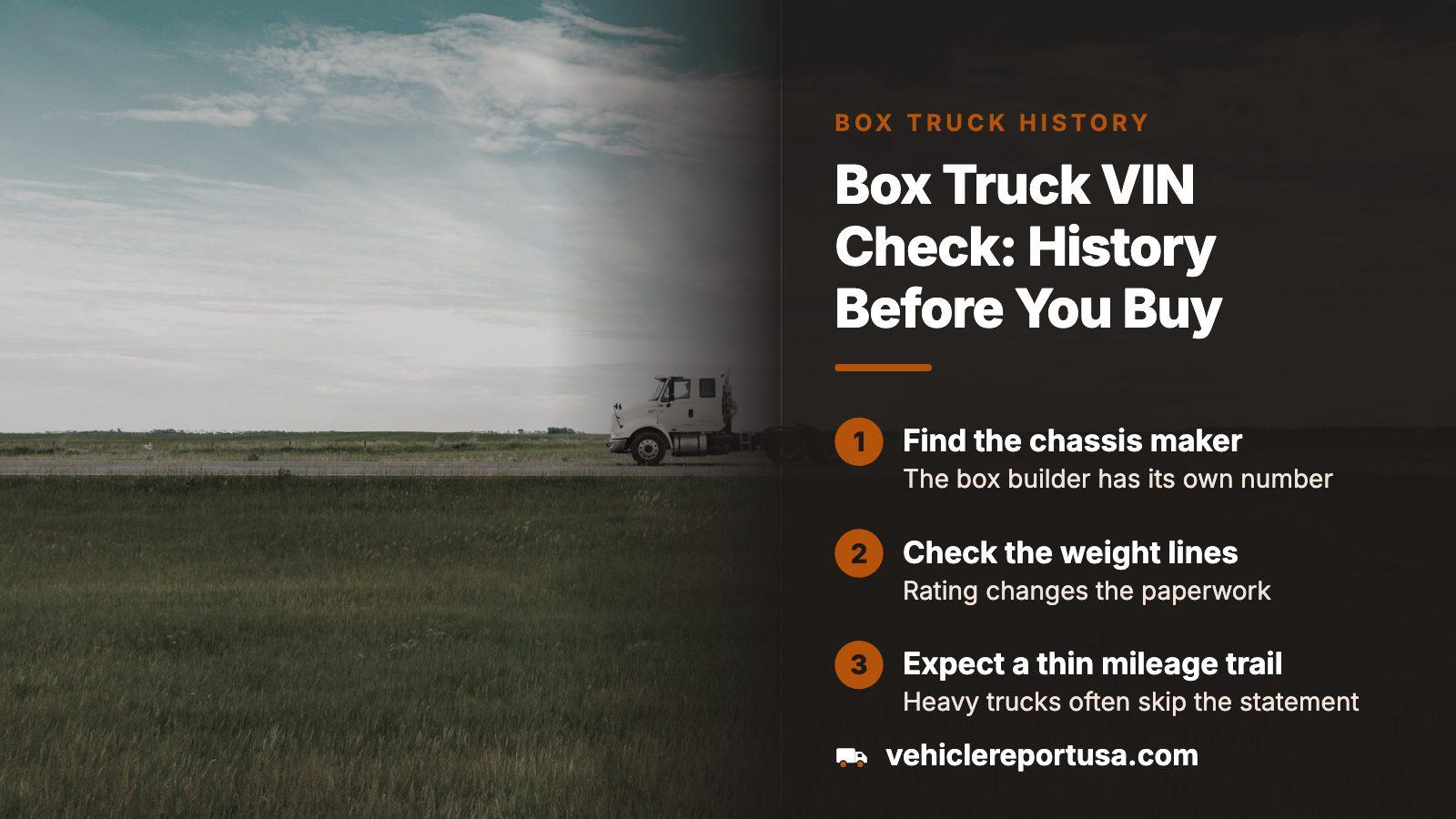
THE SHORT ANSWER
Enter the VIN, read the free preview, then buy the one-time report for trucks still on your shortlist. It lists title brands, damage and auction photos, odometer readings, liens, theft flags, use type and open recalls. A heavy box truck can legally change hands without a mileage statement, and rear guards and box bodies never show in a database, so book a mechanic too.
- Preview
- Free decode before any payment
- Report
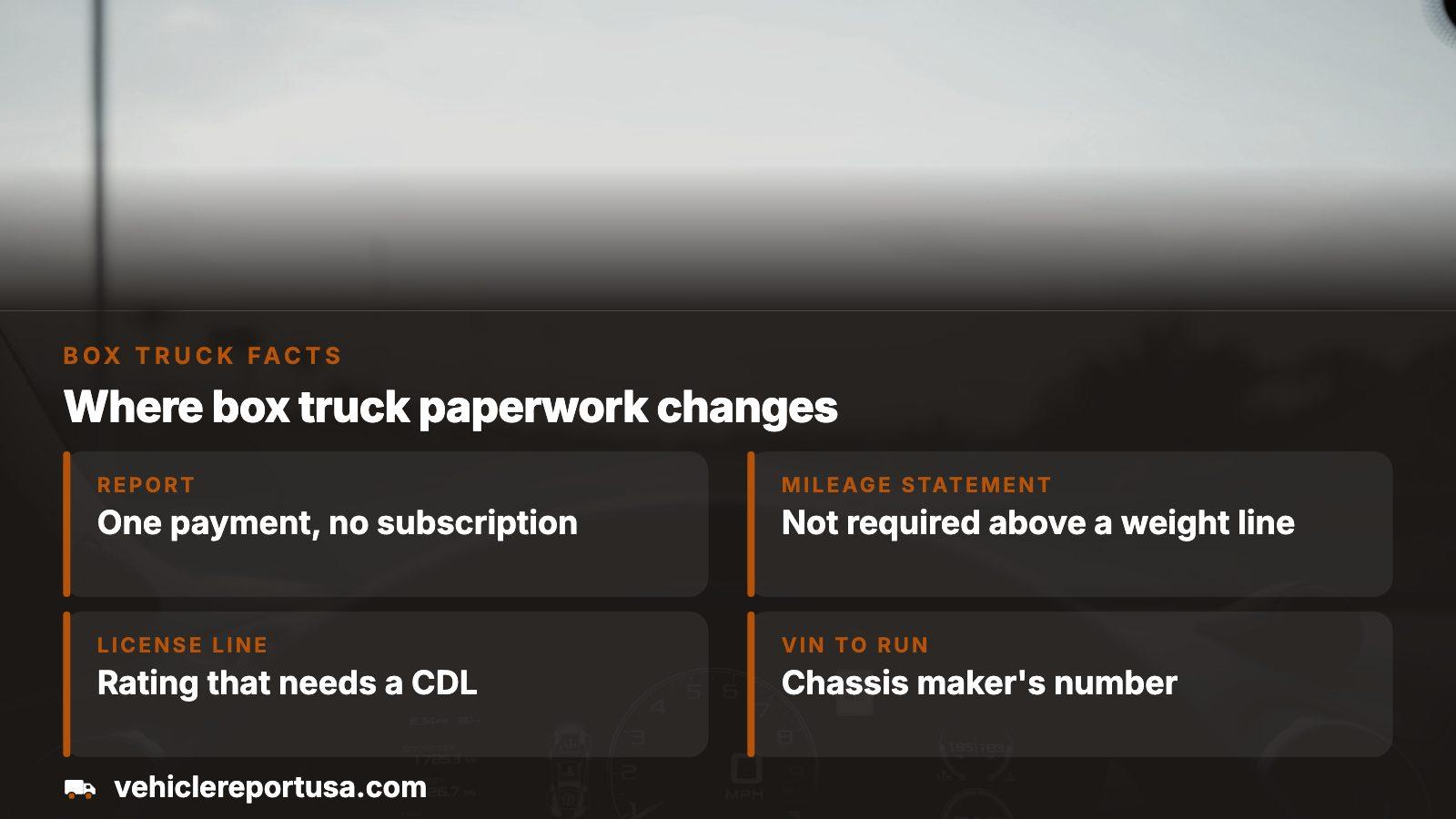
- One payment, no subscription, packs available
- Mileage statement
- Not required above a 16,000 lb rating
- License line
- 26,001 lb rating puts a single truck in Group B
What a history check finds on a box truck
Many box trucks leave the factory as a cab and frame, and a body company adds the cargo box, rear doors and often a liftgate. A history report follows the VIN, so it speaks for the truck's road life, not the box. On a work truck, these entries matter most:
- Use type and ownership: rental, company fleet or one private owner.
- Damage and auction records, with sale photos of the box walls and rear end.
- Title brands such as salvage, flood or junk, plus any insurer total-loss entry.
- Odometer readings from earlier sales, lined up to expose a drop or a long silence.
- Liens, theft flags and open recalls.
Chassis maker and box builder: whose number to run
Run the VIN that matches the title, and compare it with the chassis maker's label on the truck, one character at a time. Ask who built the box and liftgate, since that company handles doors, floors, hinges and gates.
From an NHTSA owner complaint
The owner of a new 2020 Hino 195 with an 18-foot box and aluminum liftgate reported sway at freeway speeds, empty or loaded. The dealer agreed, the owner says, but called it a trait of the model that could not be repaired. The box builder had stayed within Hino's specifications. The owner, who has run commercial trucks like this for more than 25 years, asked NHTSA to investigate.
Two parts can each pass on paper and still drive badly together. Test drive on a highway, loaded if possible.
Weight lines that change the paperwork
The certification label's rating settles which federal rules touch the truck. Box length says little, since identical boxes can sit on chassis with different ratings.
| Rating | What the rules say | Shopping meaning |
|---|---|---|
| Over 16,000 pounds | Seller or lessor need not state mileage | A short odometer history can be ordinary |
| 26,001 pounds or more, single truck | Group B, the heavy straight vehicle group | Confirm the license class with your state |
| Combination rated 26,001 or more, with a towed unit above 10,000 | Group A, the combination group | A heavy trailer changes who may drive |
Mileage: when a thin odometer record is normal
Odometer history comes from readings written down at sales and registrations. Federal rules excuse a seller or lessor from stating mileage on a vehicle with a rating over 16,000 pounds. Age counts too: a 2010 or older model is exempt once 10 years have passed from January 1 of its model year, and a newer one after 20.
So one odometer line on a heavy truck can be ordinary. The same gap on a truck rated 16,000 pounds or less, where disclosure still applies, needs a direct question. Ask for service invoices and compare every reading with the dash.
Recalls differ a lot between box truck chassis
NHTSA's year, make and model lookup lists every campaign naming a chassis, which is not the repair list for one truck. Sample lookups run for this page:
| Chassis and year | Campaigns returned | One example |
|---|---|---|
| 2016 Isuzu NPR | 5 | 17V191000: left rear wheel hub bolts may be under-tightened |
| 2016 Isuzu NPR HD | 7 | 17V105000: transmission mounting studs may snap |
| 2012 Freightliner Business Class M2 | 12 | 16V206000: rear brake caliper may touch the suspension |
| 2019 International MV | 13 | 18V826000: a failing clutch component can cause unintended movement |
| 2016 Ram 5500 | 7 | 21V398000: manual error may over-tighten lug nuts |
| 2016 Ford E-450 | 4 | 16V046000: trailer brakes may fail with one optional controller |
Many campaigns cover only certain build dates or options, so a long list overstates the work on one truck. A VIN search narrows it to open repairs.
Recalls that come from outside the chassis maker
Box trucks carry parts and conversions from other companies, and those recalls land under the same make, model and year. Three kinds show up:
- Equipment makers: a fire extinguisher recall named Isuzu NPR trucks in 2015 and again in 2017 (15V778000, 17V726000), and a similar one covered Dodge, Chrysler and Ram vehicles (17V824000).
- Conversion shops: in 2019 a modifier recalled 2018 and 2019 Isuzu NQR, NRR and NPR trucks fitted with dual steering, since a part could slip and cut right-hand steering (19V663000).
- Body companies: a 2019 recall by one covered backup camera monitors in vehicles including the Isuzu NPR and Hino 155 (19V428000).
The VIN search skips recalls already repaired, recalls older than 15 years unless the manufacturer extends coverage, and campaigns by small vehicle manufacturers, specialty applications included. Ask the seller who modified or built the truck, then search that name too.
The rear guard: a check no database can make
A history report cannot see the steel at the back. Federal equipment rules call for a rear impact guard when the lowest rear edge of the body, or of the frame if it reaches further, sits over 30 inches above the ground on an empty truck. The guard must hang within 30 inches of the ground, sit no more than 24 inches ahead of the rear edge, and reach to within 18 inches of each side.
From an NHTSA owner complaint
The buyer of a new 2016 Freightliner M2 box truck wrote that a state trooper pulled it over for a roadside inspection in November 2017 and failed it over the rear impact guard. The dealer had, in the owner's words, "DOT'd" the truck before handover. When the dealer could not or would not fix it within 2 weeks, the owner went elsewhere, and the dealer pointed at the company that built the box and liftgate.
Even a new truck arrived short here, so on a used one, crouch behind it and look. Check the guard's height, whether it is solidly bolted or welded, and whether a liftgate or body work changed anything.
Red flags, and what a clean result does not prove
- A salvage, rebuilt, flood or junk brand, or an insurer total-loss entry.
- Auction photos of frame, cab or box damage the seller never mentioned.
- A rental or fleet use type on a truck sold as one-owner.
- An odometer reading below an earlier one, or no readings on a truck rated 16,000 pounds or less.
- A VIN that differs from the title's, or an open lien.
A clean result still has gaps. The federal title database notes that mandatory reporting is for common automobiles, that some states add heavy equipment, and that a clean search can hide a problem. Brands can also be washed off when a truck is titled again in a state that does not ask the earlier state.
Running the check, and what it costs
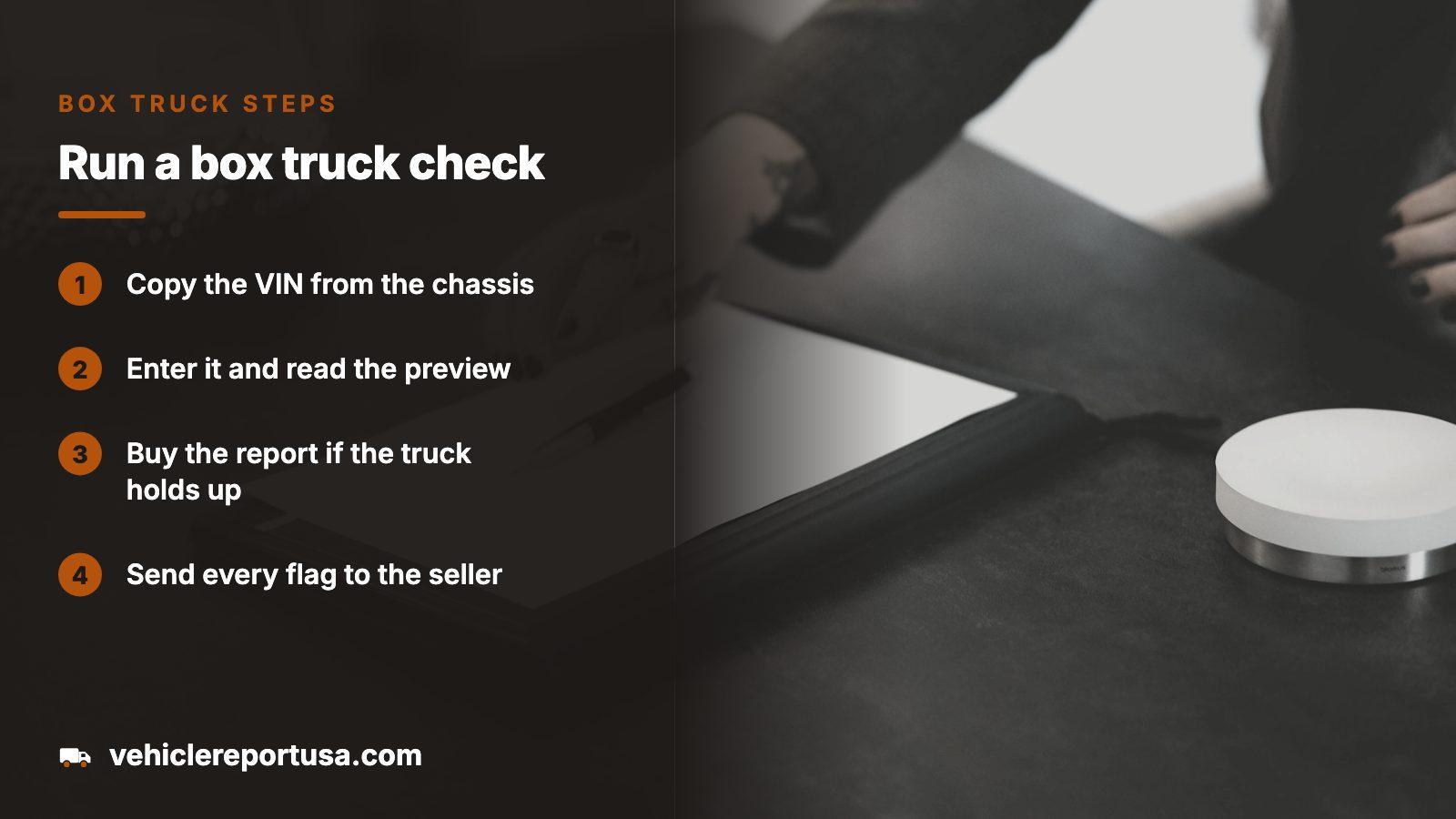
- Copy the 17-character VIN from the chassis maker's label and match it to the title.
- Enter it and read the free preview. Check that make and vehicle type fit the ad.
- Buy the report for trucks still on your list: a single payment, no subscription, with rates for one report or a larger pack on the pricing page.
- Send every flag to the seller in writing, then hire a mechanic who works on medium trucks and put the VIN on the estimate.
The preview costs nothing, so use it to cut the list first.
Where this information comes from
- NHTSA: Check for Recalls — what the VIN recall search shows and omits, the 100-VIN limit, and recall records by make, model and year
- Bureau of Justice Assistance: NMVTIS for consumers — what the federal title database holds and where its coverage falls short
- 49 CFR 580.17, odometer disclosure exemptions (GovInfo) — the weight and age limits on the mileage statement
- 49 CFR 383.91, commercial motor vehicle groups (GovInfo) — the Group A and Group B weight lines for commercial licenses
- 49 CFR 393.86, rear impact guards (GovInfo) — when a straight truck needs a rear guard and how it must sit
- NHTSA owner complaint 11319839 — owner experience, paraphrased
- NHTSA owner complaint 11112178 — owner experience, paraphrased
Sources and photos: Facts checked against the sources above in November 2026. Photos by Peter McCrae-Hokenson, Annika Wischnewsky and Dennis Eusebio on Unsplash; diagrams by VehicleReportUSA.
Keep reading
- International Truck VIN Check: Isuzu, Hino and Dump Truck HistoryInternational, Isuzu, Hino and dump trucks get their own walkthrough there.
- Check a Truck VIN Number: Pickups, Box Trucks and Heavy-Duty RigsStart there for pickups and lighter work trucks.
- Sample reportSee a finished report before you pay for one.
- PricingWeigh a single report against a multi-report pack.
Frequently asked questions
Can I run a box truck VIN check for free?
Partly. NHTSA's recall lookup costs nothing and works from the VIN, and the preview here decodes the truck without payment. Brands, damage, auction photos, liens and theft flags sit in the paid report, a single payment that never renews. NHTSA's tool lists only unrepaired recalls.
Do I need a CDL to drive a used box truck?
It depends on the rating on the certification label. For trucks used in commerce, the license rules put any single truck rated 26,001 pounds or more in Group B. A lighter single truck lands in Group C only if it is built for 16 or more passengers or hauls hazardous materials. Confirm the class with your state licensing agency.
What changes if I tow a trailer with a box truck?
A Group B truck may pull a trailer rated up to 10,000 pounds. Pair a heavy truck with a trailer rated above that, and if the combined rating reaches 26,001 pounds, the setup moves to Group A. Add both ratings before buying a hitch.
Will the report show damage to the box or liftgate?
Only if someone recorded it: an insurer's file, an auction sale with photos, or a salvage entry. Scrapes from daily deliveries that nobody reported never reach a database. Auction photos can show rear doors, box walls and the gate area, so study them.
Can I check several box trucks at once?
For recalls, NHTSA's page takes up to 100 VINs per search. For histories, read the free preview on each and buy the one-time report only for finalists. A pack suits a short list, with rates on the pricing page.
Now check the car itself
The guide explains what to look for. The report shows what this VIN has on record.