THE SHORT ANSWER
To look up a truck by VIN, copy the 17-character number from the certification label beside the driver's seat and enter it into the lookup. The free preview decodes the truck first. The paid report, billed once with no subscription, adds crash and auction records, past mileage readings, debts, theft reports and unrepaired recalls. Above 16,000 pounds a seller may lawfully skip the mileage statement, so a thin odometer record is not automatically a warning.
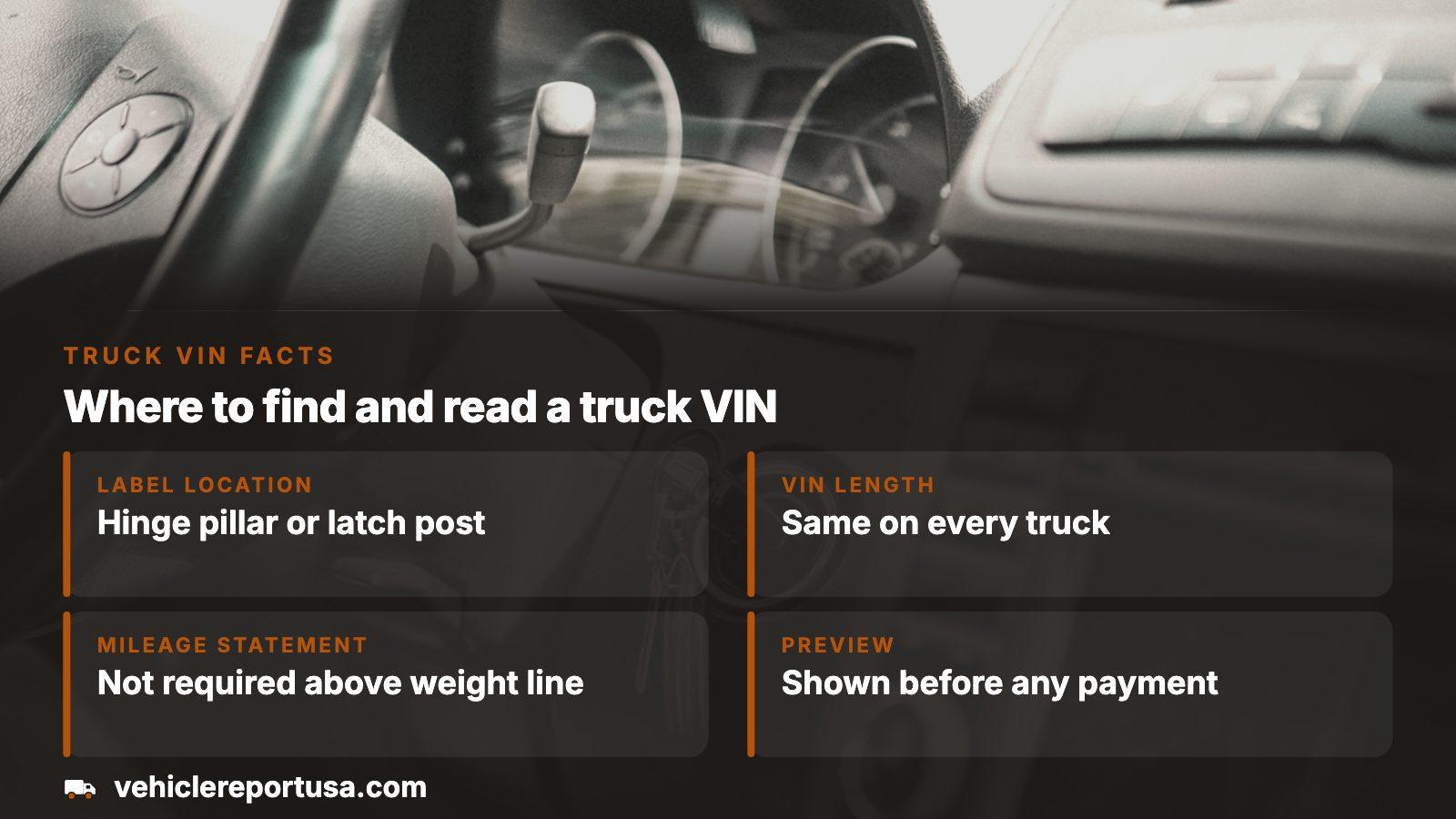
- VIN length
- 17 characters on every truck
- Label location
- Hinge pillar or latch post by the driver's seat
- Mileage statement
- Not required above 16,000 lb rated weight
- Preview
- Free, before any payment
What a truck check covers, and why use history matters here
A truck is bought to work, so the questions differ from a commuter car's. The lookup follows the VIN through title, damage, mileage, lien and recall records, and it shows how the truck was used, from one-owner farm pickup to retired rental.
| Record | What it tells a truck buyer |
|---|---|
| Use type and owners | Private, rental or fleet use, a hint at how hard it was worked |
| Odometer readings | Mileage logged over the years, to set beside what the dash shows |
| Crash and damage records | Collisions reported against the VIN, with notes where they exist |
| Salvage and auction history | Past auction sales and photos of the truck as it sat on the lot |
| Title brands | Salvage, rebuilt, flood or junk labels from a state or an insurer |
| Liens and impounds | Debt still attached to the truck and any time in an impound yard |
Where the VIN sits on a pickup, a box truck or a cab and chassis
The maker's certification label is permanently fixed in the driver's door opening: on the pillar the door hinges to, the post it latches against, or the door's own edge. If none of those works, the rules send it to the left side of the instrument panel. The label prints the VIN beside the weight ratings, the build month and year, and a classification that reads truck.
- Read the label yourself and write the VIN down, rather than trusting a number typed into an ad.
- Match it to the title and registration, character by character, and photograph the weight ratings, which decide how to read the mileage later.
- If a body builder finished the vehicle, as with a box, flatbed or dump body, expect the chassis maker's own label as well; its VIN is the one to compare with the title.
If the label is gone, painted over or at odds with the paperwork, that alone is a finding. Make the seller account for it before you pay anything.
Running the lookup: preview first, report for the trucks that make the shortlist
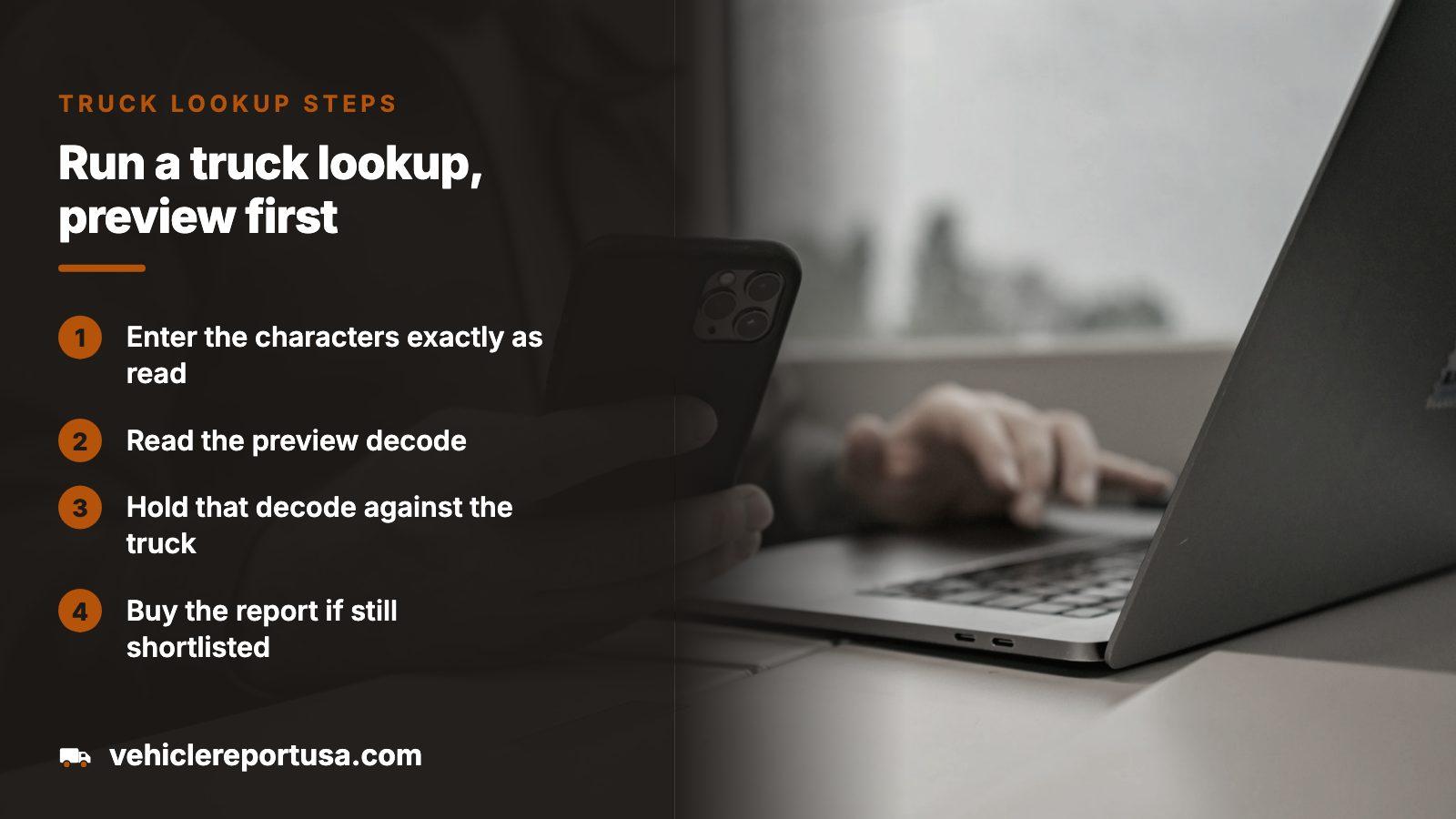
- Enter the 17 characters exactly as they appear on the label, with no spaces.
- Read the free preview. It decodes the truck, so you can confirm that the cab style, engine and weight class fit the listing.
- Hold that decode against the truck in front of you. A crew cab sold as an extended cab is a reason to stop.
- Buy the report only for trucks still in the running. Payment happens once, with no renewal, and multi-truck packs come as 3, 5 or 10 reports.
Position nine holds a check digit worked out from the other sixteen characters, and it exists to catch transcription slips. When a lookup rejects a VIN, re-read the label before suspecting anything worse.
What a truck VIN encodes, and what changes above 10,000 pounds
Characters four through eight describe the truck itself. The maker must be able to turn those five characters into the model line, series, frame type, cab style, engine kind, braking setup and weight rating. Model year sits in position ten, and position eleven records where the truck was assembled.
On a truck rated 10,000 pounds or less, the seventh character must be a letter, the last five characters must be digits, and the engine's maker has to be encoded. Heavier trucks need only four closing digits, and nothing obliges the VIN to name who built the engine. So the decode of a heavy truck describes the chassis; ask the seller who made the engine and confirm it from the engine itself.
Why mileage can be missing on a heavy truck
Mileage history starts with the statement made when a vehicle changes hands, and federal rules excuse some trucks from making one. A seller need not state mileage on anything rated above 16,000 pounds. Age matters too: 10 years for 2010 and earlier model years, 20 years for 2011 and later, and the statement drops away.
| Class | Rated weight in pounds | Mileage statement required? |
|---|---|---|
| 3 and 4 | 10,001 to 16,000 | Yes, unless the age exemption applies |
| 5 | 16,001 to 19,500 | No |
| 6 to 8 | 19,501 and over | No |
A sparse odometer row on a Class 7 tractor can be normal. The same gap on a half-ton pickup deserves a direct question to the seller.
From an NHTSA owner complaint
Someone who bought a used 2018 Ram 2500 reported to NHTSA that the truck was sold showing about 129,000 miles, yet a Chrysler dealer's service record from earlier the same year listed more than 188,000. The selling dealership pointed at the auction it had bought the truck from and offered no fix. The owner says the gap got them refused for extended warranty coverage and left them paying for major repairs out of pocket.
The lesson is to ask for service records and set any earlier readings in the report against the dash before you pay.
Warning signs worth a direct question
- A title brand of any kind: salvage, rebuilt, flood or junk.
- Auction photos that show frame, cab or bed damage the seller never mentioned.
- An open lien, meaning money is still owed against the truck.
- Mileage far below a service record or an earlier reading, with no explanation.
- A rental or fleet use type on a truck the seller calls one-owner.
- A theft flag, or time in an impound yard that nobody can account for.
None of these ends a purchase by itself; each is a question for the seller.
Open recalls on a used truck
An open recall is a safety repair that has not been performed on that exact truck, and NHTSA lets anyone enter a VIN to list them. The report repeats that check, so run one or the other before the test drive.
From an NHTSA owner complaint
One owner bought a used 2016 Ram 1500 in June 2023 and says they did not know an active recall on it carried a "do not sell" marking. About four months later the high-pressure fuel pump failed at highway speed. The dealer said parts were unavailable, and the truck then sat at the dealership for roughly four months with no loaner.
The takeaway is timing. A lookup takes a minute before purchase; the same recall found afterward can cost months without the truck.
What the check cannot see, and what to do next
A spotless report lowers the odds of a bad surprise but does not remove them. NMVTIS, the federal title database, says reporting is uneven across states and other sources, so a truck can come back without a salvage entry that a fuller record would carry. The FTC says no report replaces an independent inspection.
- Pay an independent mechanic to inspect the truck, and ask for a written estimate that names the VIN.
- Put every flag in the report to the seller and keep the answers in writing.
Preview first at no cost; the report is billed once, and the pricing page lists the current rates.
Where this information comes from
- eCFR: 49 CFR part 565, vehicle identification number requirements — what each VIN position carries and how the rules change at 10,000 pounds
- eCFR: 49 CFR part 567, certification labels — where the maker's label goes and what it must state, including vehicles built in stages
- eCFR: 49 CFR 580.17, odometer disclosure exemptions — which vehicles need no mileage statement, by weight and by age
- Bureau of Justice Assistance: NMVTIS for consumers — what the federal title database holds and where its coverage has gaps
- FTC: Used cars — advice on history reports, open recall lookups and independent inspections
- NHTSA owner complaint 11693501 — owner experience, paraphrased
- NHTSA owner complaint 11573123 — owner experience, paraphrased
Sources and photos: Facts checked against the sources above in November 2026. Photos by Zoshua Colah, Anastasiia Nelen and tim on Unsplash; diagrams by VehicleReportUSA.
Keep reading
- Truck VIN Lookup Specs: What the Decode Shows and Where It StopsSee what the VIN decodes to for a truck before you run the history.
- Sample reportLook at a finished report to know what you would be paying for.
- PricingCompare a single report with a pack if you are weighing several trucks.
- Trailer VIN Lookup: Check a Used Trailer's History by VIN Before You PayCheck the trailer the same way if the truck will be towing one.
Frequently asked questions
Can I check a truck VIN number for free?
Partly. NHTSA lets anyone enter a VIN to see open recalls, and the preview here decodes the truck at no cost. Branded titles, damage, liens, theft and auction photos sit in the paid report. Reports drawn from the federal title database are sold by outside providers for a fee.
How do I look up a truck by VIN when a body was added after the chassis was built?
Use the VIN on the chassis maker's label. Federal rules have an incomplete-vehicle maker label the chassis with its name, build date, weight ratings and VIN, and a final-stage maker then certifies the finished truck. Compare that VIN with the title, then run it.
Why does my truck's report show no odometer reading?
A report can only show readings that someone recorded. A truck rated above 16,000 pounds is excused from stating mileage on a sale, as are older vehicles under the age rules, so a gap can be legal. On a lighter or newer pickup, ask the seller about it.
What if a decode lands on the wrong model year?
The same year character can mean two years three decades apart. On a truck rated 10,000 pounds or less, a letter in the seventh position points to 2010 through 2039 and a digit points to 1980 through 2009. That rule covers only lighter trucks, so for heavier ones trust the month and year stamped on the certification label.
Do I need a separate report for every truck I am comparing?
Yes, each report is built on one VIN. A buyer weighing several trucks can buy a pack instead of single reports. The preview costs nothing, so shortlist first and pay for the finalists.
Now check the car itself
The guide explains what to look for. The report shows what this VIN has on record.