THE SHORT ANSWER
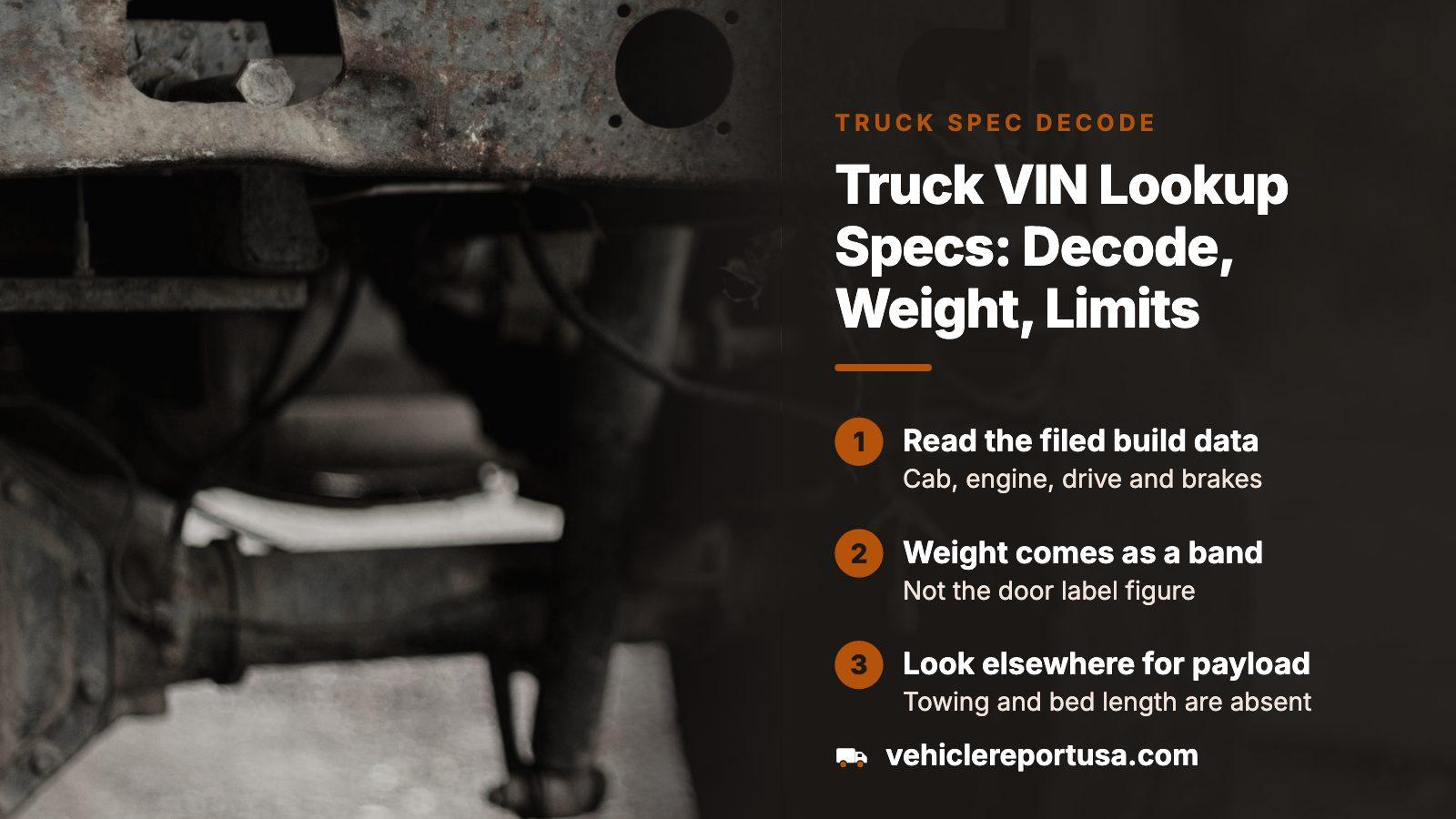
Enter the truck's 17-character VIN and the decode lists the make, model, year, cab style, engine, drive type, brakes and a weight-class band, all as the maker reported them to NHTSA. Federal rules do not require a truck VIN to explain payload, towing or bed length, so read the labels and ask the maker. The preview shows the decode before any payment.
- Decode source
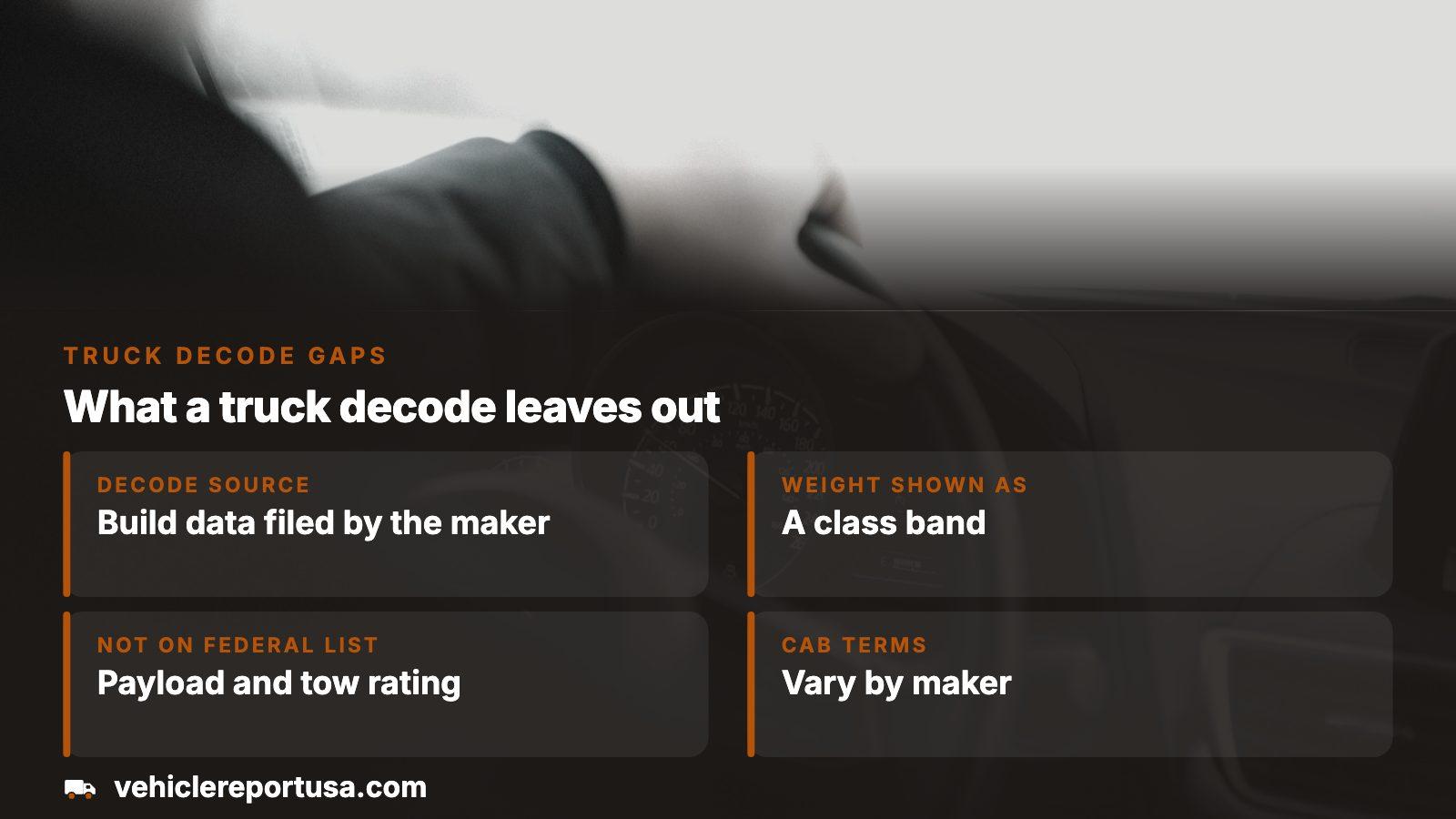
- Build data the maker filed with NHTSA
- Weight shown as
- A class band, such as 10,001 to 14,000 lb
- Not on the federal list
- Payload, tow rating, bed length
- Preview
- Free, before any payment
What a truck decode fills in, and how the answer differs by size
A decode is the maker's own coding read back to you. Federal rules make the build characters of a truck VIN explain the model line, series, chassis, cab, engine, brake system and weight rating, and NHTSA's decoder shows what the maker filed. Treat the result as the truck's baseline, the way it left the factory. Two test patterns show how far the answers spread.
| Field | Heavy-duty pickup pattern (Ram 3500, 2018) | Tractor pattern (Freightliner Cascadia, 2012) |
|---|---|---|
| Body | Pickup, crew cab, long bed | Truck-tractor, conventional cab |
| Engine | 6.7 L Cummins diesel, 385 hp | Detroit DD15, 14.8 L inline-6 diesel |
| Drive | 4WD | 6x4 |
| Brakes | Hydraulic | Air and hydraulic |
| Weight band | Class 3 (10,001 to 14,000 pounds) | Class 8 (above 33,000 pounds) |
Weight arrives as a band, not the figure on the door
The decoder reports gross vehicle weight rating as a class. A 2017 F-350 pattern came back as Class 3, so the exact rating still has to come from the truck's own label. These are the designations makers use when they report to NHTSA.
| Class | Rated weight (lb) |
|---|---|
| 2 (split into letters E to H) | 6,001 to 10,000 |
| 3 | 10,001 to 14,000 |
| 4 | 14,001 to 16,000 |
| 5 | 16,001 to 19,500 |
| 6 | 19,501 to 26,000 |
| 7 | 26,001 to 33,000 |
| 8 | Above 33,000 |
Fuel economy is the other number buyers chase. EPA does not test vans, pickups or SUVs above 8,500 pounds GVWR, so fueleconomy.gov carries no rating for those trucks.
What the lookup leaves out: payload, towing and bed length
NHTSA's variable list has fields for bed length in inches and a combined-weight rating, yet none of the seven pickup patterns tried for this page filled either one. Other fields need a careful read too.
- Curb weight: in all seven, the figure shown matched the top of a range printed in the note beside it, so read it as an upper figure, not this truck's weight.
- Wheel count: a dual-rear-wheel F-350 pattern reported 4 wheels, so count the tires yourself.
- Model year on a partial VIN: the decoder warns it may be wrong, and a year typed into its box overrides the one read from the VIN.
- Towing and payload: read the labels on the truck, then ask the maker to confirm the figures for your VIN.
From an NHTSA owner complaint
An owner of a 2017 Ram 1500 told NHTSA the door sticker gave payload but no tow rating, and the manual's towing section held no figures. Linking the VIN to the maker's owner account returned a message that the information was "not available", leaving the owner with no safe number to tow by.
The label on the truck is a source too, and makers revise it
Every truck carries a permanently fixed certification label, found at the driver's door on the pillar or latch post. It gives the build month and year, the GVWR, a separate rating for every axle with front first, the VIN and the vehicle type. Compare its GVWR with the decoded band.
From an NHTSA owner complaint
A 2020 GMC Sierra 1500 owner told NHTSA the truck was chosen for the 9,300-pound rating on its frame label. After the owner bought a 34-foot travel trailer rated up to 8,995 pounds, GMC sent a notice that the rating had been overstated by 500 pounds and was now 8,800. The owner was offered a replacement sticker from the dealer and refused a refund.
A printed rating is the maker's claim on one date. Ask for the current figure tied to your VIN before you size a trailer or a camper.
Chassis cabs and body builders: when the decode runs thin
A truck finished by a second company reads differently. An F-650 chassis cab pattern decoded as an incomplete vehicle, with only the make, the builder and the year, a note that no detailed data was available, and a caution that it may have been changed after the maker finished it. The federal list for an incomplete vehicle covers cab, engine type and brakes, and leaves weight off.
Each company that works on the truck adds a label of its own. The final-stage maker's label rates the finished truck with its GVWR and axle ratings, so a box, dump or flatbed body means reading both labels. Decode the chassis VIN, then match it to the title.
Reading cab and drive terms on pickups and heavy rigs
The decoder sorts pickup cabs into four fixed labels. Learn them and a listing that calls a crew cab an extended cab stands out.
- Regular: two doors, one row of seats.
- Extended, also listed as Super, Quad, Double or King: two doors, two rows.
- Crew, also Super Crew or Crew Max: four doors, two rows.
- Mega: four doors, two rows, in a bigger cabin.
Heavier trucks are described by where the engine sits. Conventional means the driver sits behind it, while cab over engine puts the driver above the front axle. A truck rated above 10,000 pounds need not name its engine maker in the VIN, and the Cascadia pattern gave an engine model, DD15, with no engine maker field.
Running the lookup and holding it against the truck
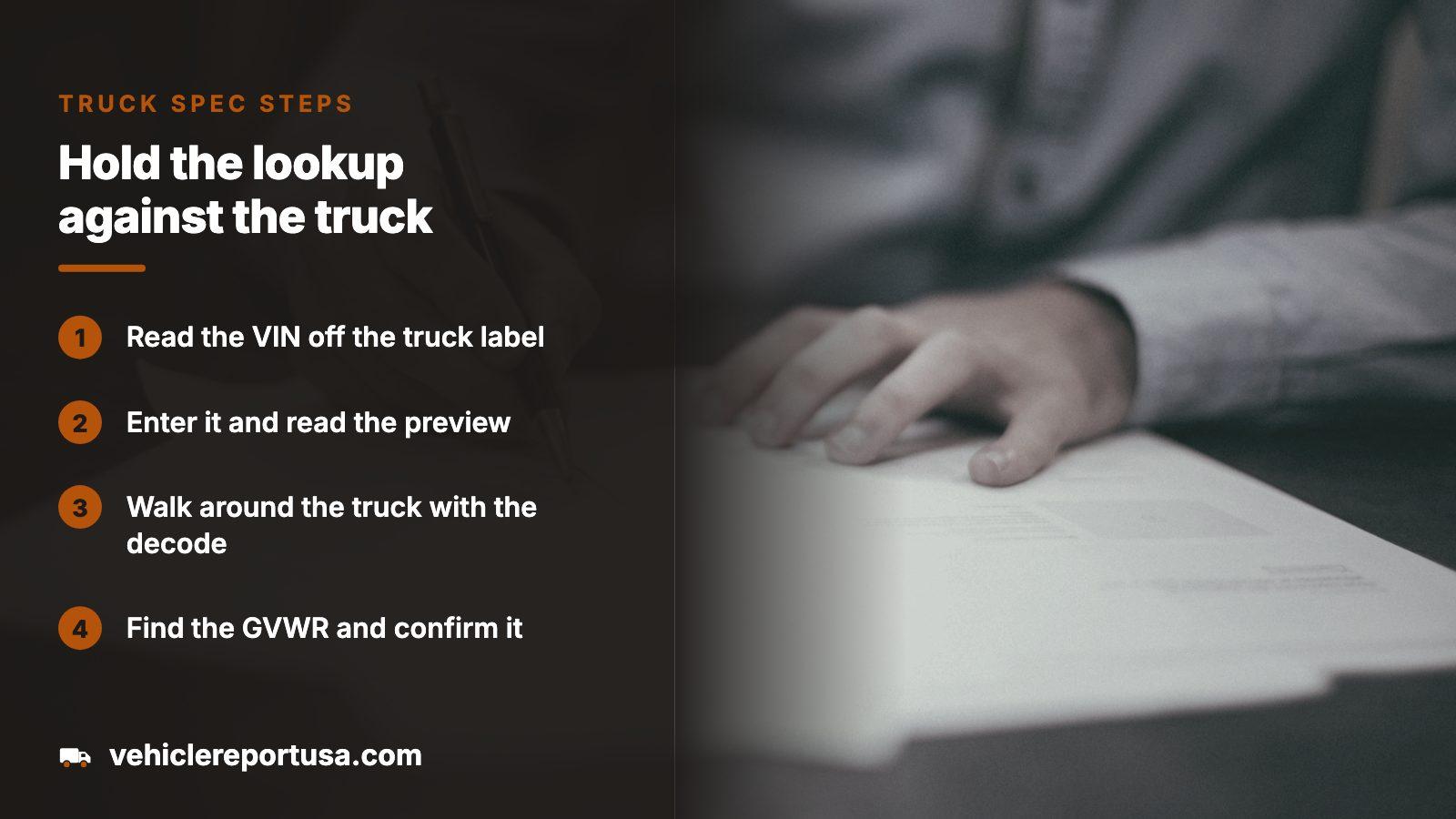
- Read the VIN off the label on the truck and write down all 17 characters rather than copying it from an ad.
- Enter it and read the free preview, which decodes the build before any payment.
- Walk around the truck with the decode in hand: doors and seat rows, drive type, engine size, fuel and brakes.
- Find the GVWR on the label and confirm it falls inside the decoded band.
- If the build matches, buy the report for that VIN. Anything that does not match is a question for the seller.
On trucks rated 10,000 pounds or less, the seventh character is a letter, and that letter places the model year in 2010 through 2039 instead of 1980 through 2009. A decode that lands on an odd year is worth rechecking against the build date on the label.
What the history report adds once the specs match
A spec sheet describes the truck at the factory door and says nothing about what came after. The one-time report from VehicleReportUSA searches for title brands, accident damage, mileage readings logged over the years, auction photos, liens, theft and recalls nobody has fixed, and it shows whether the truck worked for a private owner, a rental company or a fleet.
- A different engine, cab or drive type than the decode: ask who swapped it and whether a repair or damage record explains the change.
- A label that is missing, repainted or carrying a different VIN than the title.
- A weight rating outside the decoded band.
Running the preview costs nothing. The report is one payment with no subscription, and a pack of 3, 5 or 10 helps when you are weighing several trucks. Current prices sit on the pricing page. Whichever you choose, have an independent mechanic inspect the truck and write an estimate naming the VIN, since the FTC advises against treating a history report as a replacement for an inspection.
Where this information comes from
- NHTSA: vPIC VIN decoder API — how partial VINs, wildcards and model years work, and which fields the decoder can carry
- eCFR: 49 CFR 565.15, VIN content requirements — what a truck VIN must explain, the weight-class designations, and the shorter list for incomplete vehicles
- eCFR: 49 CFR part 567, certification labels — what the maker's label states and how labels stack on a truck built in stages
- fueleconomy.gov: frequently asked questions — why vans, pickups and SUVs above 8,500 pounds GVWR have no EPA rating
- FTC: Buying a used car from a dealer — why a history report does not replace an independent inspection
- NHTSA owner complaint 11432679 — owner experience, paraphrased
- NHTSA owner complaint 11528792 — owner experience, paraphrased
Sources and photos: Facts checked against the sources above in November 2026. Photos by Zoshua Colah, Scott Graham and Miles Loewen on Unsplash; diagrams by VehicleReportUSA.
Keep reading
- Check a Truck VIN Number: Pickups, Box Trucks and Heavy-Duty RigsRun the history search once the decoded build matches the truck.
- Trailer VIN Lookup Specs: What the Decode Shows About Weight and PartsCheck the trailer's build and ratings the same way when you plan to tow.
- Sample reportLook at a finished report before you decide to buy.
- PricingCompare a single report with a pack if you are weighing several trucks.
Frequently asked questions
Can I look up truck specs by VIN without paying?
NHTSA's decoder is a government tool and costs nothing, and the preview here shows a decode before any payment. Both report what the maker filed, and neither searches title, damage or lien records. Those sit in the paid report.
Does a VIN tell me a truck's towing capacity?
Not reliably. A tow rating is not among the items federal rules require a truck VIN to explain, and seven test decodes returned no combined-weight rating. Read the labels on the truck, then ask the maker to confirm the figure for your VIN.
Why does the decode show a weight class instead of one number?
The decoder prints the class band the maker reported, such as 10,001 to 14,000 pounds for Class 3. The exact GVWR is on the certification label, beside the axle ratings. When the label sits outside the band, ask the seller to explain.
How do I decode a cab and chassis truck with a body on it?
Decode the chassis maker's VIN, expect thin results, and read the final-stage label too. An F-650 chassis cab pattern returned only the make, the builder and the year. The finishing company's label carries the ratings for the completed truck.
Is a partial VIN enough to decode a truck?
NHTSA's decoder accepts partial VINs and treats an asterisk as an unknown character, but it warns that the model year may be wrong. That suits a rough look at a listing. Before you pay for a truck, read all 17 characters off the label.
Now check the car itself
The guide explains what to look for. The report shows what this VIN has on record.