THE SHORT ANSWER
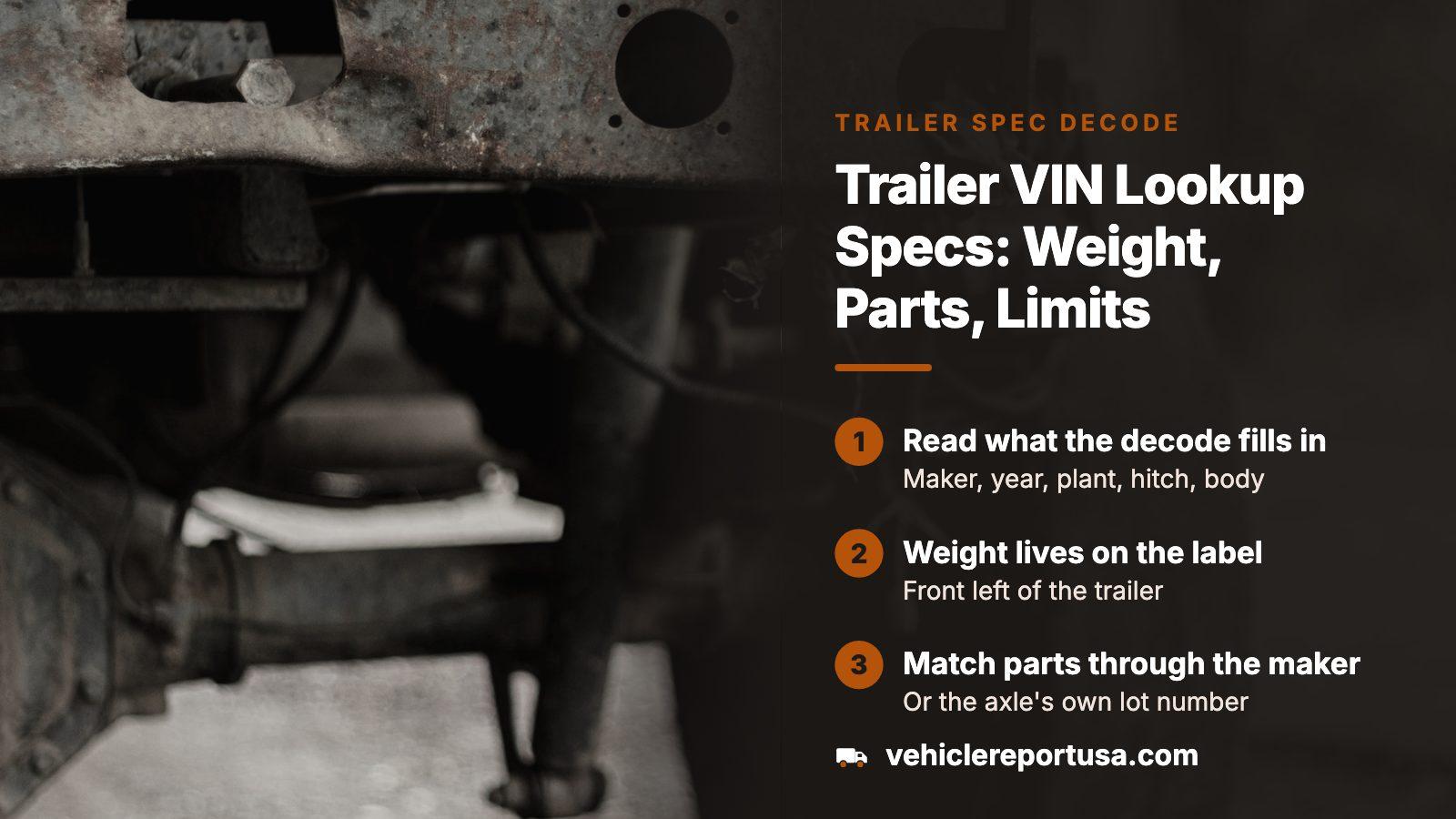
Enter the trailer's 17-character VIN and the decode lists the maker, model year, plant, hitch, body type, length and axle count. Weight is not in it: the gross rating and one rating per axle are printed on the certification label near the front on the trailer's left, and parts go through the maker or the axle's own number. The preview is free; the report adds title, damage, lien, theft and recall records.
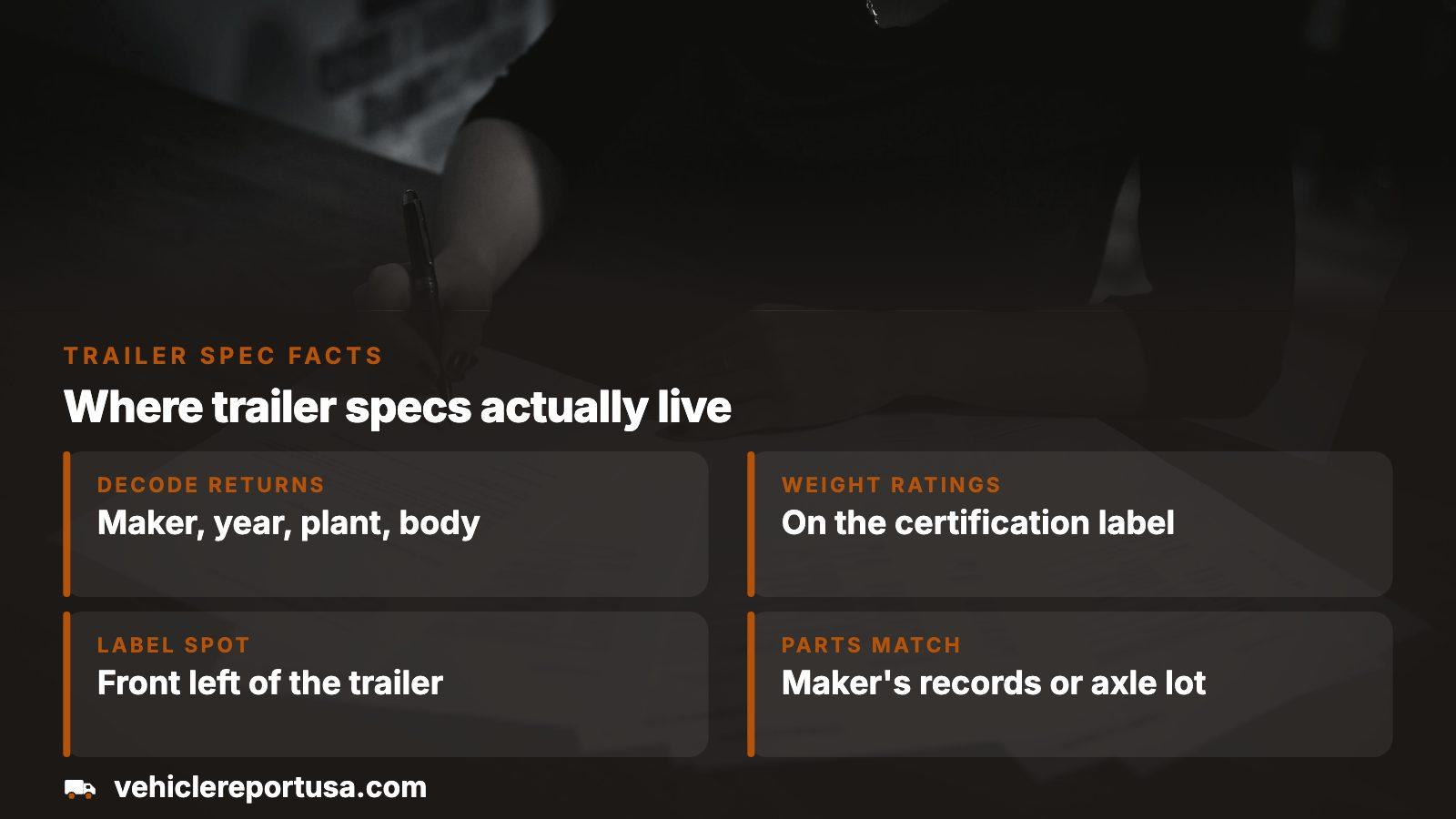
- Decode returns
- Maker, year, plant, hitch, body, length, axles
- Weight ratings
- Certification label, front left of the trailer
- Parts match
- Maker's records or the axle's own lot number
- Preview
- Free, before any payment
What a trailer decode fills in, and why the list is short
Federal rules fix what a trailer VIN must explain, and the list is shorter than a truck's. Characters four to eight must identify the make, what kind of trailer it is, its body style, its length and how the axles are arranged. The maker chooses the characters and files the key with NHTSA, so a decode is the maker's own coding read back to you. Weight, brakes and engines are not on the list.
| Field | What the decoder returns |
|---|---|
| Maker and plant | Builder name, and the plant city from the eleventh character |
| Model year | From the tenth character; may be wrong on a partial VIN |
| Hitch | One of nine connection types, bumper pull to fifth wheel |
| Body type | One of 29 labels, from boat and car hauler to dump and live animal |
| Length and axles | Length in feet, coupler to tail, and an axle count |
Five test decodes: what came back and what did not
To see the limits first-hand, partial VIN patterns from two builders went through NHTSA's decoder with the check digit left as an asterisk. They are test patterns, not anyone's trailer.
| Pattern | Body and hitch | Feet | Axles | Plant, year |
|---|---|---|---|---|
| 16VPX142*F1 | Utility; note field: pipe trailer | 14 | 2 | Odessa, Texas; 2015 |
| 16VGX202*G2 | Utility; gooseneck | 20 | 2 | Mount Pleasant, Texas; 2016 |
| 16VDX142*H1 | Utility; note field: dump | 14 | 2 | Odessa, Texas |
| 16VPX224*H1 | Utility; note field: pipe trailer | 22 | 4 | Odessa, Texas |
| 1UYVS253*K | Box or van; straight semitrailer | 53 | 2 | Year 2019 |
Every Big Tex pattern came back under one body label, utility trailer, dump versions included; the dump detail sat in a note field. For that builder, the digits in positions six to eight read as length, then axles: 142 returned 14 feet and 2 axles, 224 returned 22 feet and 4. No pattern returned a gross weight rating, a curb weight or a brake type.
Weight lives on the certification label, not in the decode
Look toward the front on the trailer's left. The certification label has to be there, attached so that taking it off wrecks it. It states the month and year built, the gross vehicle weight rating, a rating for every axle listed front to back, the VIN and the vehicle type.
| Figure | Where to read it | What it tells you |
|---|---|---|
| GVWR | Certification label | The maker's limit for the trailer fully loaded |
| GAWR | Label, one line per axle | What each axle system is rated to carry |
| Cargo limit | Placard beside the label, on trailers rated 10,000 pounds or less | Cargo weight the trailer should never exceed |
| Empty weight | Ask the maker | Not among the items the label must show |
RV trailers add a yellow cargo-capacity label that repeats the VIN, inside the forward right-side door; water counts as cargo on it. Weight added before the first sale, beyond the lesser of 1.5 percent of the rating or 100 pounds, must be corrected on these labels.
Lining up the label, the VIN and the listing
Where the decode, the label and the listing disagree, the trailer needs an explanation before it needs a deposit.
- Build date: the label gives a month and year, and the tenth VIN character gives a model year.
- Plant: the eleventh character names it. In the Big Tex tests, a 1 returned Odessa, Texas and a 2 returned Mount Pleasant, Texas.
- Maker's name: a company that builds trailers but did not build this one may appear as the responsible manufacturer, which is allowed when the label says so.
- Tires: on lighter trailers the placard lists the tire size fitted at first purchase, so compare it with the sidewall.
Parts: the VIN reaches the maker, the axle number names the axle
A VIN is not a parts catalog. The coded middle section names the type of trailer, its body, length and axle layout, so brakes, hubs, springs and lights go undescribed. The VIN reaches the maker's records; each component needs its own identity. Dexter, an axle builder, asks for the axle's lot number: nine digits on axles built after April 2001, engraved near the middle on the rear side of the beam.
From an NHTSA owner complaint
The owner of a new 2015 Carry-On utility trailer told NHTSA that the two Carlisle ST205/75D15 tires on one axle showed no DOT number or DOT letters. The maker emailed back to put zeros in that field on the warranty form and said the tires would be logged under the trailer's VIN. The owner asked whether such tires were legal and safe.
Take from it that a VIN ties a trailer to the maker's files, while a tire's size and DOT markings sit on the tire. Photograph the VIN, the label and the part before you call anyone.
What the history report adds to a spec decode
A decode describes the trailer as built; the report covers what happened after. A title brand follows the VIN into every later sale. Auction photos can show a bent frame, axle or coupler the listing left out. A lien or impound entry can stall a transfer, and a theft record means the seller may not own what is for sale. Open recalls show whether a maker's fix is still owed.
A short result on a small trailer says little was recorded, not that nothing happened.
Why the weight rating matters at the county office
Titling often turns on weight, and the label's rating shows which side of a line a trailer falls on. Texas is one example, and its rule is one state's. Its DMV defines gross weight as the trailer's own weight plus what it can carry. A manufactured trailer over 4,000 pounds gross must be titled; a used one at or under that figure needs a bill of sale and a registration receipt, or the title when one exists.
A factory-built trailer that lost its paperwork cannot be re-registered as a homemade one, and a trailer over 7,500 pounds gross must pass an annual safety inspection. Ask the office where you will register which weight it reads.
Running the lookup, and the red flags that stop a deal
- Read the VIN from the label and from the frame stamping, and photograph both.
- Run the free preview and note the hitch, body type, length and axle count.
- Walk the trailer with those answers and the label's weight ratings in hand.
- Buy the report if the trailer is still a candidate.
- A decode that says two axles over a frame with three.
- A label that peels off, which the rule forbids, or one that looks newer than the paint.
- A builder on the label that differs from the VIN's builder, with no responsible-manufacturer wording.
- On an RV trailer, axle ratings plus tongue weight that add up to less than the gross rating.

What it costs and where the report fits
Nothing is charged for the preview, which decodes the VIN first. A report is a single purchase, and a pack of three, five or ten reports is there for a shortlist; nothing renews. Prices are listed on the pricing page. If the decode and the label agree, buy the report, then inspect the frame, coupler and tires in person.
Where this information comes from
- eCFR: 49 CFR 565.15, VIN content requirements — What the middle characters, the year character and the plant character must convey on a trailer.
- eCFR: 49 CFR 567.4, certification labels — Where a trailer's label sits and what it must state.
- eCFR: 49 CFR 571.110, tire and cargo information — The cargo statement on lighter trailers, the RV cargo label and the weight-added correction rule.
- NHTSA: vPIC VIN decoder — What the decoder is and who supplies its data; the test decodes ran through the same service.
- Texas DMV: trailers — One state's weight thresholds for titling, used-trailer paperwork and inspection.
- Dexter Axle: How do I identify my axle? — Where an axle's lot number is engraved and why a parts desk wants it.
- NHTSA owner complaint 10781926 — owner experience, paraphrased
Sources and photos: Facts checked against the sources above in November 2026. Photos by Zoshua Colah, Michal Biernat and Dimitri Karastelev on Unsplash; diagrams by VehicleReportUSA.
Keep reading
- Trailer VIN Lookup: Check a Used Trailer's History by VIN Before You PayThe overview: where the number sits on a trailer and what a check covers.
- RV VIN Lookup Specs: What the Number Tells You About the RigTravel trailers add a cargo label and coach-side data of their own.
- Truck VIN Lookup Specs: What the Decode Shows and Where It StopsThe tow vehicle has its own weight class and label to read.
- PricingCompare one report with a pack when several trailers are on the list.
Frequently asked questions
Does a trailer VIN lookup show the weight?
Not in the decodes tested for this page. Weight ratings are printed on the certification label, and lighter trailers add a cargo limit on a placard beside it. For an empty weight, ask the maker with the VIN in hand.
Can I look up trailer parts by VIN?
The VIN identifies the trailer and its builder, but it is not a parts catalog. A maker can work from its own records, and component makers use their own numbers, such as an axle's lot number. Give a dealer the VIN and photos of the label and the part.
Why does the decoder call my dump trailer a utility trailer?
The body-type field uses broad labels, and a builder can file a narrower description in a separate note field. In the Big Tex tests, dump, car hauler and pipe versions all returned utility trailer in the main field. Compare the note with the trailer itself.
What if the certification label is missing or looks replaced?
Treat it as a stop sign until the seller explains. A label is meant to come off only by being destroyed. A homemade trailer has no factory label and needs a state-issued number; Texas issues one after an inspection by an auto theft law enforcement officer.
Is a trailer VIN check free?
The preview, which decodes the VIN, is free and comes before any payment. Paying is a one-time step after it: a single report, or a pack of three, five or ten, with nothing renewing. The pricing page lists amounts.
Now check the car itself
The guide explains what to look for. The report shows what this VIN has on record.