THE SHORT ANSWER
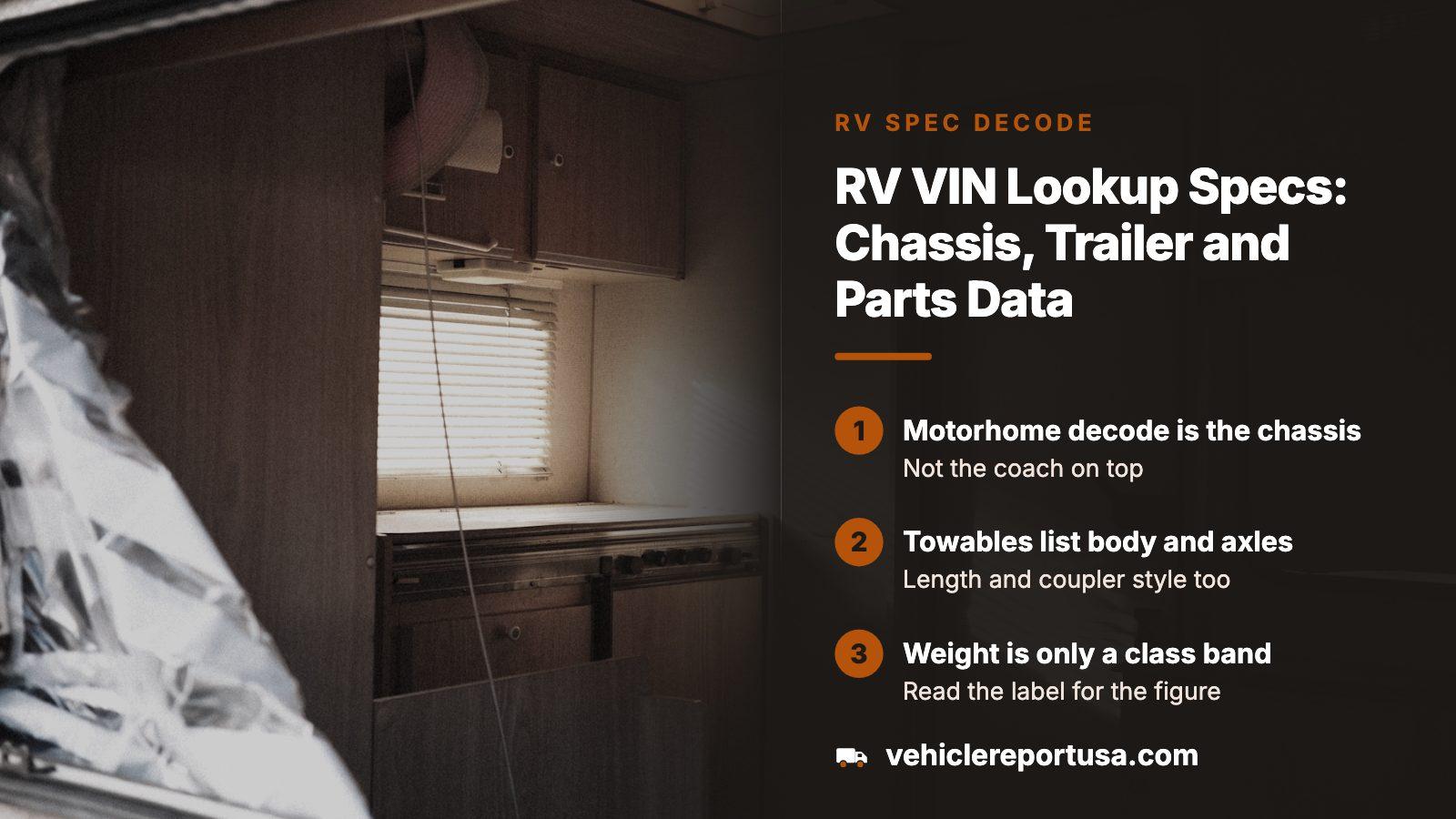
Type in the 17-character VIN and the decode lists what the maker reported. On a motorhome that is the chassis: make, engine, fuel, brake system and a weight class. On a travel trailer or fifth wheel it is body type, length, coupler style and axle count. Floor plans, tank sizes and appliances are not in it, and exact weight ratings are on the labels. For parts, use the chassis VIN for the drivetrain and the builder's serial number for the coach.
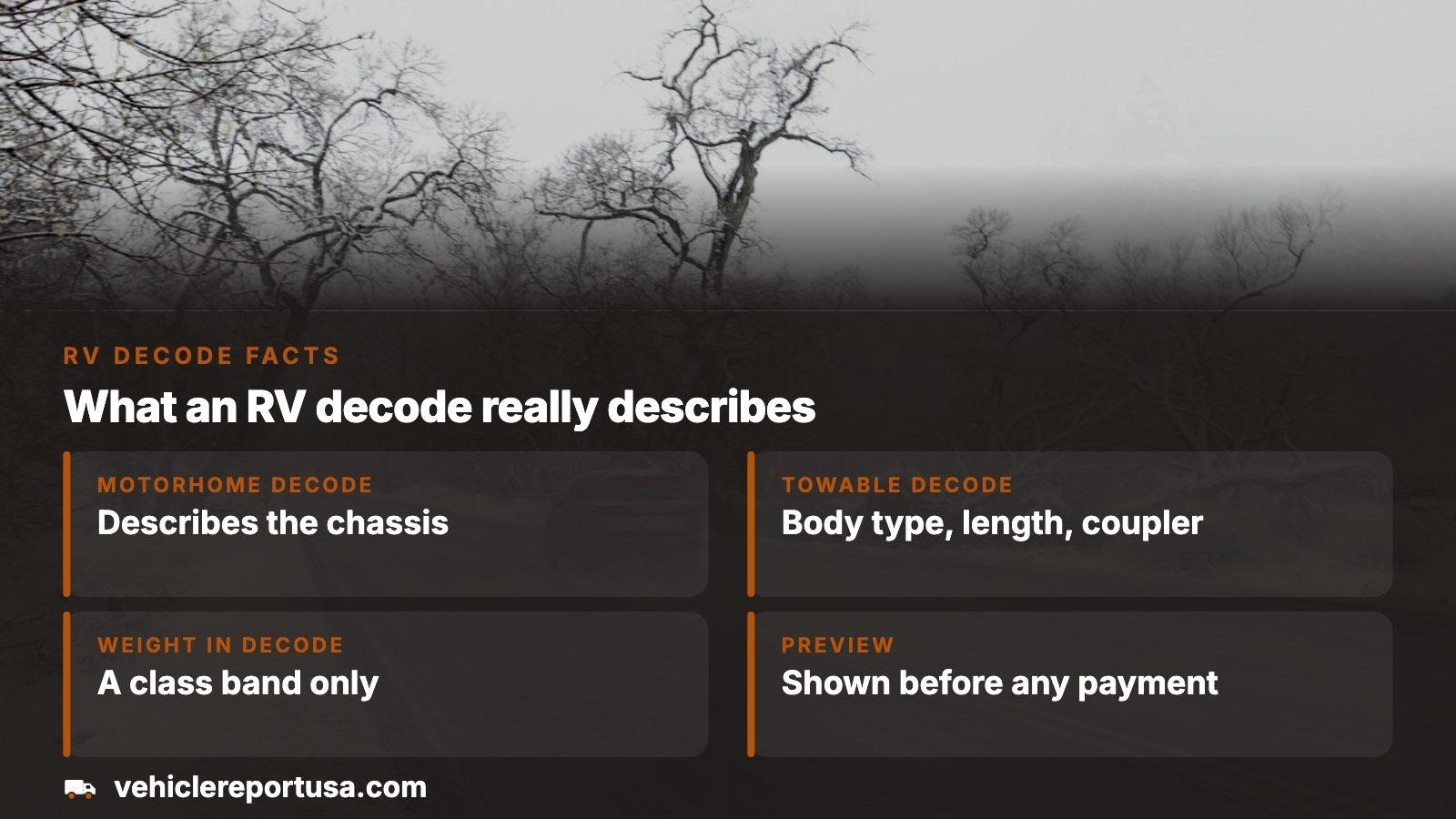
- Motorhome decode
- Describes the chassis, not the coach
- Towable decode
- Body type, length, coupler style, axles
- Weight in the decode
- A class band, not the label figure
- Preview
- The decode is shown before any payment
What an RV spec lookup returns, and which part of the rig it describes
A decode reads back what the maker coded into the VIN, and a maker coded only the part it built. That is why one lookup gives a rich answer on one RV and a thin one on another. The table sorts the usual questions by where the answer lives.
| Spec you want | In the decode? | Where else to look |
|---|---|---|
| Engine, fuel and brake system on a motorhome | Yes, for the chassis | The chassis maker, if a field comes back blank |
| Weight rating | A class band only | The certification labels on the rig |
| Trailer length, coupler style, body type | Yes, as the builder filed them | The builder's literature for that model |
| Floor plan, tank sizes, appliances, slide-outs | No | The coach builder, using its own serial number |
Motorhomes: the decode reads the chassis, not the coach
Federal VIN rules make a maker encode certain facts in positions 4 through 8 so they can be read back later. For an unfinished chassis those are make, model line, series, cab type, engine type and brake system. NHTSA's decoder shows them as plain fields, and its body class list has both Motorhome and Incomplete - Motor Home Chassis, so either label can appear on your coach.
Weight comes back as a class band. Class 3 begins above 10,000 pounds and the bands climb to Class 8. A band can confirm a heavy chassis, but it is a filing category, not a loading limit.
Read the labels for the real ratings
A coach built in stages can wear several labels: the chassis maker's, any intermediate builder's, and a final certification label from the company that finished it. Each lists the gross vehicle weight rating and a rating per axle.
Travel trailers and fifth wheels: one VIN covers the whole unit
A towable has no separate chassis maker, so the builder files everything under a single number. The rules want that number to say what kind of trailer it is, how the body is shaped, how long it runs and how the axles are arranged. The decoder has matching fields: Camping or Travel Trailer among the body types, Fifth Wheel or Ball Type Pull among the coupler styles, length in feet and an axle count.
Ratings and the builder's name come from the certification label, which belongs on the trailer's left side, ahead of the midpoint and readable from outside. A trailer company that sells a unit it did not assemble may be named there as the Responsible Manufacturer, so the badge on the front cap and the name on the label can differ without anything being wrong.
RV VIN model lookup: matching the decode to the listing
A listing offers a brand, a floor-plan name and a year. The decode offers make, model and year as the maker filed them, and the floor-plan name may not appear at all. When they disagree, ask the seller before deciding anything.
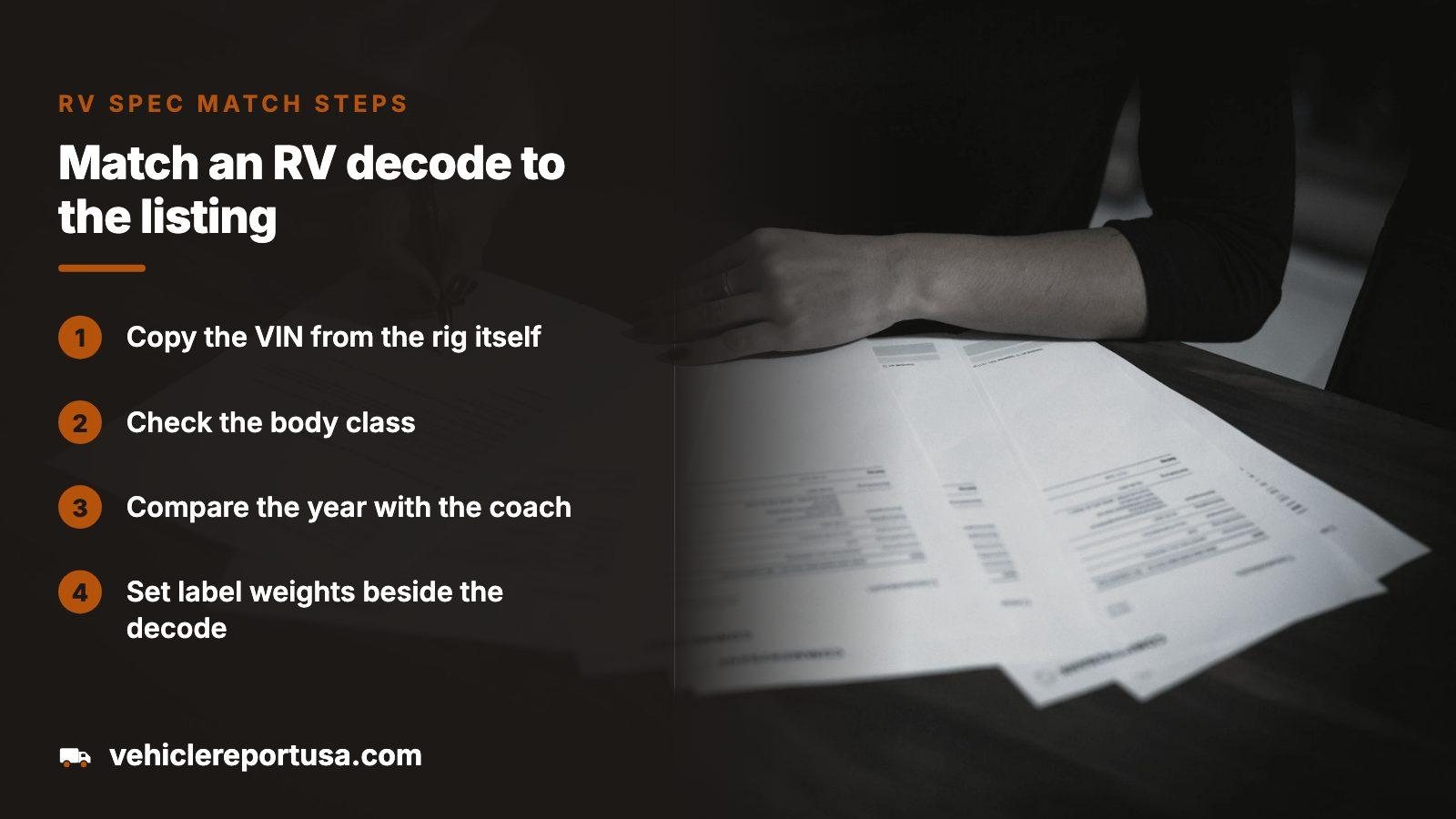
- Copy the VIN from the rig itself, not from the ad or a text message.
- Check the body class: a motorhome should not decode as a travel trailer.
- Compare the year, allowing for a coach certified to a date between its chassis build and final completion.
- Set the label's weight figures beside the decode's class band.
- Ask the builder, giving the VIN, which recalls apply to this exact unit.
From an NHTSA owner complaint
An owner of a 2019 Thor Four Winds told NHTSA that a rear window came loose at highway speed and stayed on only because its locks held. The maker answered that the related recall covered 2020 models, not 2019, and the report notes the VIN was not on hand.
Model year settled that owner's answer, so keep the VIN at hand and ask for the affected range in writing.
RV VIN lookup for parts: which number goes to the counter
A parts counter wants the number that belongs to whoever made the part, and a rig built in stages has several makers.
| Part family | Number to give |
|---|---|
| Engine, transmission, brakes and axles on a motorhome | Chassis VIN, plus model year |
| Cabinets, slide-outs, appliances, plumbing, wiring | Builder's serial number and model name |
| Frame, hitch and axles on a towable | Trailer VIN, builder and model |
| A branded part such as a regulator or tire | The model number on the part itself |
One maker's owner FAQ shows the split: Thor Motor Coach takes its unit serial number in place of the VIN on customer care calls, and points owners to a local service center for help.
From an NHTSA owner complaint
An owner of a 2019 Forest River Cherokee told NHTSA that the rig's two-stage propane regulator was a type other RV builders had recalled. By the owner's account, two calls to Forest River produced the same answer: nothing was recalled against that VIN.
A search by VIN answers for what one builder filed. Read the part's own label and look up that component by name too.
Red flags when the decode, the labels and the seller disagree
- The VIN on the rig differs from the title by even one character.
- Position 9 fails its arithmetic. The check digit comes from the other 16 characters by a published formula, so a wrong one points to a typo or a doubtful number.
- The decode says trailer while the seller says motorhome, or the reverse.
- The weight class sits far from the ratings printed on the label.
- A label looks peeled, painted over or re-glued. The rule says it must not come off without being destroyed, so a loose one needs an explanation.
Several labels are normal on a staged build. One that looks tampered with is not.
Running the lookup: from the plate to the preview to the report
- Find the plate yourself. Thor says a Class A plate is on the wall behind and over the driver's left shoulder or tucked in a kitchen cabinet, and a Class C plate is at the dash and windshield seam on the driver's side or tucked in a kitchen cabinet. On a towable, start with the label on the left side toward the hitch.
- Enter all 17 characters with no spaces.
- Read the free preview against the labels and the listing.
- If the rig stays on your list, order the report, paid once and never renewed.
The report adds what a spec sheet cannot: title brands, damage and auction photos, liens, theft and insurance records, odometer readings on a motorhome, and open recalls tied to the VIN. It cannot see inside the coach, so roof seals, floors and the gas system still need an RV inspector.
Cost, and the next steps once the specs match
Seeing the decode takes no payment. The pricing page lists a one-report option and packs of 3, 5 or 10, which suits anyone comparing several rigs, and nothing renews afterward.
- Photograph every label and the data plate before you leave the lot.
- Lay the final certification label beside the decode before you talk price.
- Ask the builder for the coach serial and model name that go with the VIN.
- Book an RV inspector for the roof, seals, floors and gas system.
Where this information comes from
- NHTSA vPIC: decoder variable list — the body class, trailer length and coupler fields the decoder can return
- eCFR: 49 CFR 565.15, VIN content requirements — what each maker must make decodable, the weight classes and the check digit
- eCFR: 49 CFR 567.4, certification labels — what a maker's label states and where it sits on a trailer
- eCFR: 49 CFR 567.5, vehicles built in stages — which labels a staged build carries and how the final date is limited
- Thor Motor Coach: owner FAQs — where one maker says the VIN plate sits and which number its customer care accepts
- NHTSA owner complaint 11342939 — owner experience, paraphrased
- NHTSA owner complaint 11457343 — owner experience, paraphrased
Sources and photos: Facts checked against the sources above in November 2026. Photos by Alexander Lunyov, Dimitri Karastelev and Zoshua Colah on Unsplash; diagrams by VehicleReportUSA.
Keep reading
- RV VIN Lookup: History Check for Motorhomes, Trailers and Fifth WheelsThe full history check for motorhomes and towables, with the red flags to look for.
- RV VIN Recall Check: Chassis, Coach and Trailer Recalls Before You BuyOpen recalls on the chassis and the coach, and why one search is not enough.
- Travel Trailer VIN Check: Run the History Before You Buy the CamperRun the history on a travel trailer once its decoded build matches the listing.
- PricingCompare a single report with a pack when you are shopping several rigs.
Frequently asked questions
Can an RV VIN show the floor plan or tank sizes?
No. The decode carries what the chassis maker or trailer builder filed: engine, brakes, weight class, length and coupler style. Floor plans, tank sizes and appliances belong to the coach builder, so ask it for the model sheet and quote the unit serial number.
Why does my motorhome's VIN decode name a truck or van maker?
The chassis maker numbered the chassis when it built it, and the coach builder added living space later under its own brand. The decode describes the numbered part, which is why the sidewall badge and the maker in the result differ.
Which number should I give for RV parts, the VIN or the serial number?
Give both, plus the model name and year. Drivetrain, brake and axle parts follow the chassis VIN, and living-quarters parts follow the builder's serial number. Thor's customer care takes its unit serial number in place of the VIN.
Does the RV VIN report show open recalls?
Open recalls tied to the VIN are one section of the report. A recall filed under another builder's name for a part your rig also uses may not show against your number, so check the component's maker too.
Is the free preview enough to decide on an RV?
It confirms the decode, enough to rule out a rig that does not match its listing. Title brands, damage, liens and odometer readings come only with the paid report, and neither replaces an inspection of the roof and the coach structure.
Now check the car itself
The guide explains what to look for. The report shows what this VIN has on record.