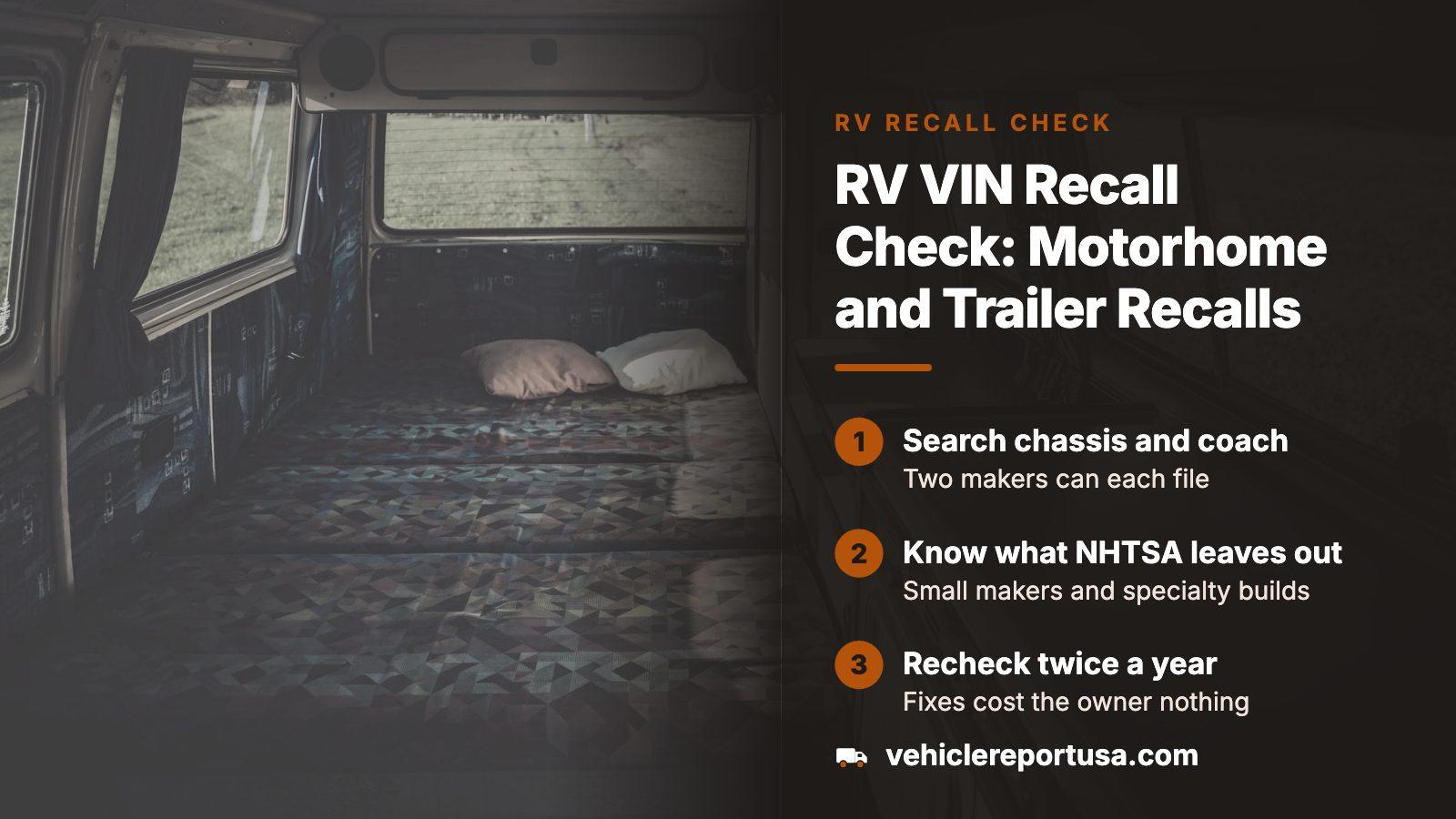
THE SHORT ANSWER
Enter the 17-character VIN from the motorhome chassis or the trailer frame, then read the open-recall line. NHTSA's official lookup shows only unrepaired recalls and leaves out some small makers and specialty builds, so a clean result is a start, not a verdict. Recalls on propane, wiring, hitches and weight placards are often filed by the coach or trailer builder, so call that company too.
- Who files on a motorhome
- The chassis maker or the coach builder, for both
- NHTSA search window
- Most recalls past 15 years drop out
- Cost of a recall fix
- None to the owner, per NHTSA
- Recheck rhythm
- About twice a year
Who files recalls on a motorhome, a trailer or a fifth wheel
A motorhome is finished in stages. One company builds the incomplete vehicle, meaning frame, engine, steering, suspension and brakes, and another turns it into the coach people tour in. Federal rules let either company file a recall on behalf of everyone involved, so a chassis defect can surface under the coach brand and the reverse. Trailers usually carry one builder's name, and a supplied part such as a coupler has been recalled under that builder.
| Unit | Companies that may file | Where to ask |
|---|---|---|
| Motorhome on a truck or van chassis | Chassis maker or coach builder, with engine campaigns riding along | NHTSA's VIN lookup, then the coach builder by phone |
| Travel trailer or fifth wheel | The trailer builder, who also files for bought-in parts | The builder, using the VIN on the left-side label |
Why a single 2019 coach can carry 11 campaigns
NHTSA's model-year record for a 2019 Newmar Dutch Star lists 11 campaigns, every one filed by Newmar. Some concern the coach body, like window vent adhesive and the entry door latch. Others reach the chassis: a rear power distribution module on Daimler Trucks-based coaches, and a fuel rail seal on the Cummins diesel.
Thor Motor Coach shows the same blend. One filing covers rear axle hardware on coaches using a modified Ford E-450 chassis. Another has GM reprogramming an instrument cluster, with Chevrolet and GMC service lines listed next to Thor's own.
From an NHTSA owner complaint
The owner of a 2019 Newmar Dutch Star described a Freightliner chassis fuse block that feeds the rear lights and engine cooling and had been recalled twice. As the owner tells it, the first fix installed the same part, the second moved circuits onto separate fuses, and that workaround is still failing on some coaches. The owner adds that the chassis maker will not pay for that repair through the original campaign.
Read how a campaign was remedied, not only whether one is open. Newmar's own record shows the pattern: a later campaign replaced the module on coaches that had first received an inspection only.
What NHTSA's VIN lookup leaves out on an RV
NHTSA's page is the official starting point, and it states its own limits.
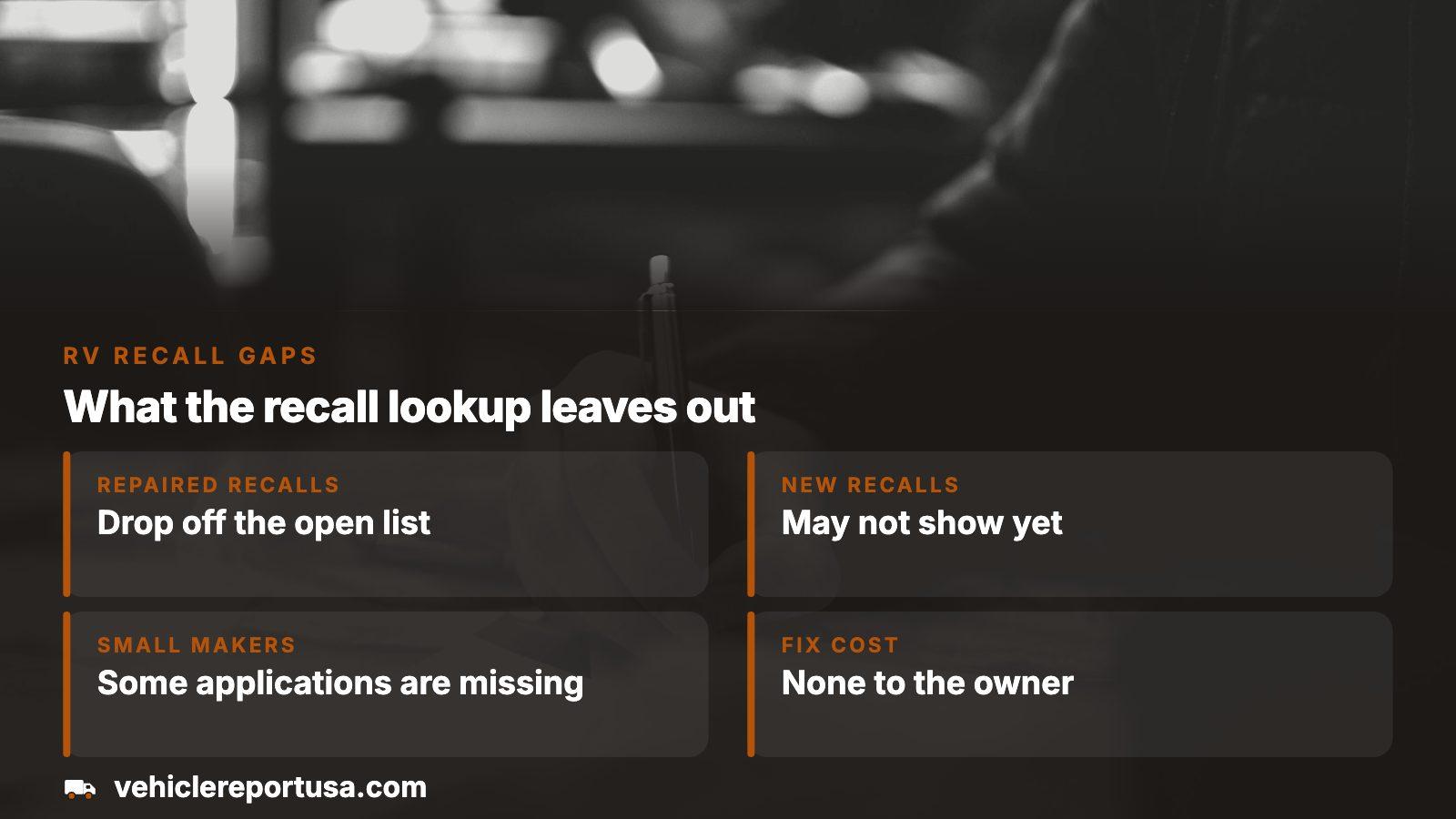
- Anything already fixed drops off the list, so a clean line is silent on past repairs.
- A brand-new recall may not show yet, since affected VINs are added over time.
- Campaigns past their 15th year fall out of the search, except where the maker keeps covering them. Many used coaches are older than that.
- Small makers and specialty applications sit outside the VIN search.
- The lookup covers certain manufacturers. Its list names truck and van brands such as Ford, Freightliner and the Sprinter and ProMaster vans, and no RV or trailer builder appeared on it when this page was written.
From an NHTSA owner complaint
An owner of a 2019 Forest River Cherokee reported that a two-stage propane regulator like the one on the trailer had been recalled by other RV builders, yet nothing arrived from the owner's own maker. The owner phoned that maker twice, a day apart, and each time heard that no recall was attached to the VIN.
A clean VIN line only mirrors the filings tied to that exact number. When a part has been recalled under another brand, ask about the part by name.
The kinds of recall that turn up on RVs
| Area | Example on NHTSA's record | Why a buyer cares |
|---|---|---|
| Hitch coupler | Forest River 19V844000, Airstream 19V753000 | A coupler that lets go sends the trailer off the tow vehicle |
| Propane and wiring | Thor 18V741000 (propane hose), Forest River 20V654000 (shore cord inlet) | Both carry a fire risk |
| Weight placards | Forest River 19V355000 and 19V453000 | A wrong rating invites overloading |
| Chassis parts | Thor 18V385000, rear axle U-bolts on a Ford E-450 build | Loose axle hardware can end in loss of control |
| Safety equipment | Winnebago 17V782000, fire extinguishers | The fix may be a replacement from the equipment maker |
How to run the check on a motorhome or towable
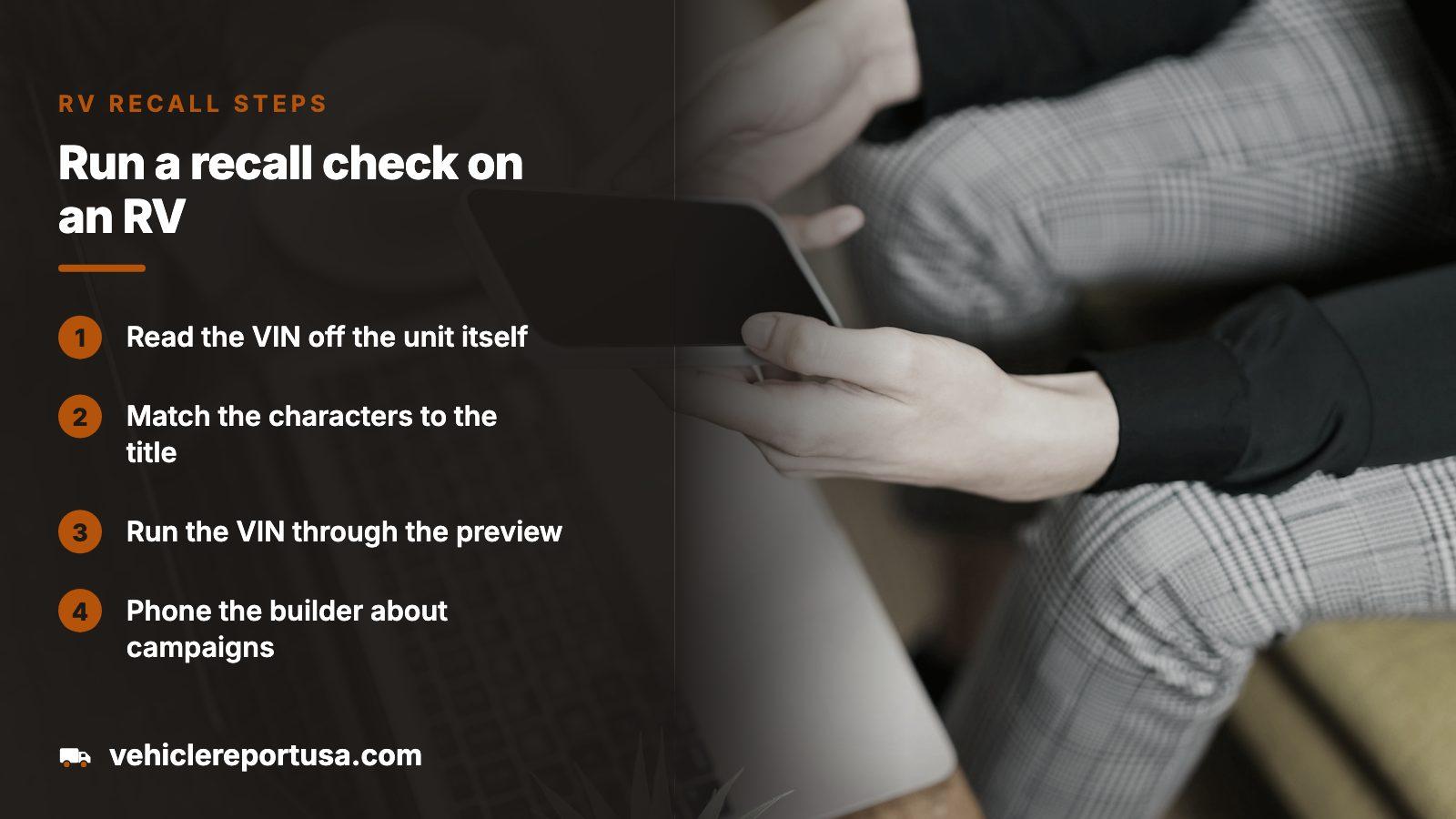
- Read the VIN off the unit itself instead of trusting a listing. On a motorhome, federal rules place the certification label beside the driver's seating position, and NHTSA also points to the lower left of the windshield.
- On a trailer or fifth wheel, look along the forward half of the left side, where the label must be readable from outside.
- Match all 17 characters to the title or registration. A mismatch is a finding on its own.
- Run the VIN through the preview here, then through NHTSA's lookup, and note any open campaign numbers.
- Phone the builder named on the coach or trailer with model, year and VIN, and ask what has been filed beyond the chassis.
- Write down which campaigns were completed and ask the seller for the repair orders.
When a recall is open, or the dealer cannot do the work
NHTSA says the fix is free to the owner. Makers can meet the rule by fixing the part, swapping it, refunding the owner or, in unusual cases, buying the vehicle back. Notices go to the registered owner by first-class mail within 60 days of the maker telling NHTSA about its decision.
From an NHTSA owner complaint
A Forest River Cherokee owner received a notice for the trailer coupler, then struggled to find anyone to do the work. One dealer had no certified welder on site, a second kept a waiting list, and the maker pointed to a third. The trailer had not failed; the owner filed because the delay felt unreasonable.
Free parts still need a service bay and a technician, so ask the seller whether the work is done and ask to see the repair order. Slow down or renegotiate when you see any of these:
- An open campaign on the hitch, axle, brakes or propane system.
- A seller who says every recall was handled but has nothing on paper.
- Two campaigns on one part, where the second corrects the first remedy.
What the full report adds to the recall line
Start with the free preview, which shows what the VIN decodes to and confirms you are asking about the right chassis. The paid report is a single payment and lists open recalls beside records a recall lookup never touches: title brands, damage with auction photos, liens and theft entries.
The federal title database draws the same line: its own page leaves recall and repair data to private providers and urges an independent inspection on top of any report. Coach-side campaigns still need that call to the builder.
Price and next steps once you have a result
The preview costs nothing to start. A report then runs one VIN for a single payment, and a bundle of three, five or ten helps when several units are on your list. No renewal follows. Current figures are on the pricing page.
After the report, settle open campaigns with the seller in writing, call the builder, and book the inspection. Once the RV is yours, recheck about twice a year, as NHTSA advises. Its SaferCar app can also send an alert to your phone.
Where this information comes from
- NHTSA: Check for recalls — What the VIN search shows and omits, how owners are notified, and who pays for the fix.
- eCFR: 49 CFR 573.3 — Lets the chassis maker or a later-stage maker satisfy recall duties for all makers of a staged vehicle.
- eCFR: 49 CFR Part 567 — Defines incomplete and final-stage vehicles and sets where the certification label goes on vehicles and trailers.
- NMVTIS: Understanding a vehicle history report — Lists what federal title data covers and says recall information sits outside it.
- NHTSA owner complaint 11457343 — owner experience, paraphrased
- NHTSA owner complaint 11419397 — owner experience, paraphrased
- NHTSA owner complaint 11620605 — owner experience, paraphrased
Sources and photos: Facts checked against the sources above in November 2026. Photos by Balkan Campers, Jakub Żerdzicki and Owen Michael Grech on Unsplash; diagrams by VehicleReportUSA.
Keep reading
- RV VIN Lookup: History Check for Motorhomes, Trailers and Fifth WheelsThe wider RV lookup, covering title, damage, odometer and theft records beyond recalls.
- Travel Trailer VIN Check: Run the History Before You Buy the CamperHow to check a towable on its own frame VIN.
- RV VIN Lookup Specs: What the Number Tells You About the RigConfirm which chassis and engine the VIN describes before you call a recall line.
- PricingWhat one report or a larger pack costs, paid once and never renewed.
Frequently asked questions
Is there an RV recall check by VIN?
Yes, in two steps. NHTSA's lookup takes the VIN and reports unrepaired recalls for the makers it covers, and the builder's customer line fills the gaps. Run the preview first to confirm the VIN decodes to the right chassis, then call the builder with the model, year and VIN.
Can I look up RV recalls without a VIN?
NHTSA also searches by year, make and model, which returns the general list of recalls, investigations and complaints for that model. It cannot say whether your own unit was repaired, so use it to learn what to ask about, then confirm with the VIN or by phone.
Does a trailer recall check cover its tires?
NHTSA runs a separate Tire tab beside the Vehicle tab, so tires get their own search. Federal rules treat a tire brand owner as a manufacturer with its own recall duties.
Does an RV recall repair cost the owner anything?
No. NHTSA says the dealer fixes a recalled part free, and the maker's options run from repair to refund, with a buyback only in rare cases. The practical limits are time and dealer capacity rather than cost, so ask early about parts and how soon a technician can start.
How often should I recheck an RV I already own?
NHTSA suggests about twice a year. New recalls appear as affected VINs are added, so a clean lookup at purchase says little about next spring. Repeat the call to the builder as well, because its campaigns may not appear in a VIN search.
Now check the car itself
The guide explains what to look for. The report shows what this VIN has on record.