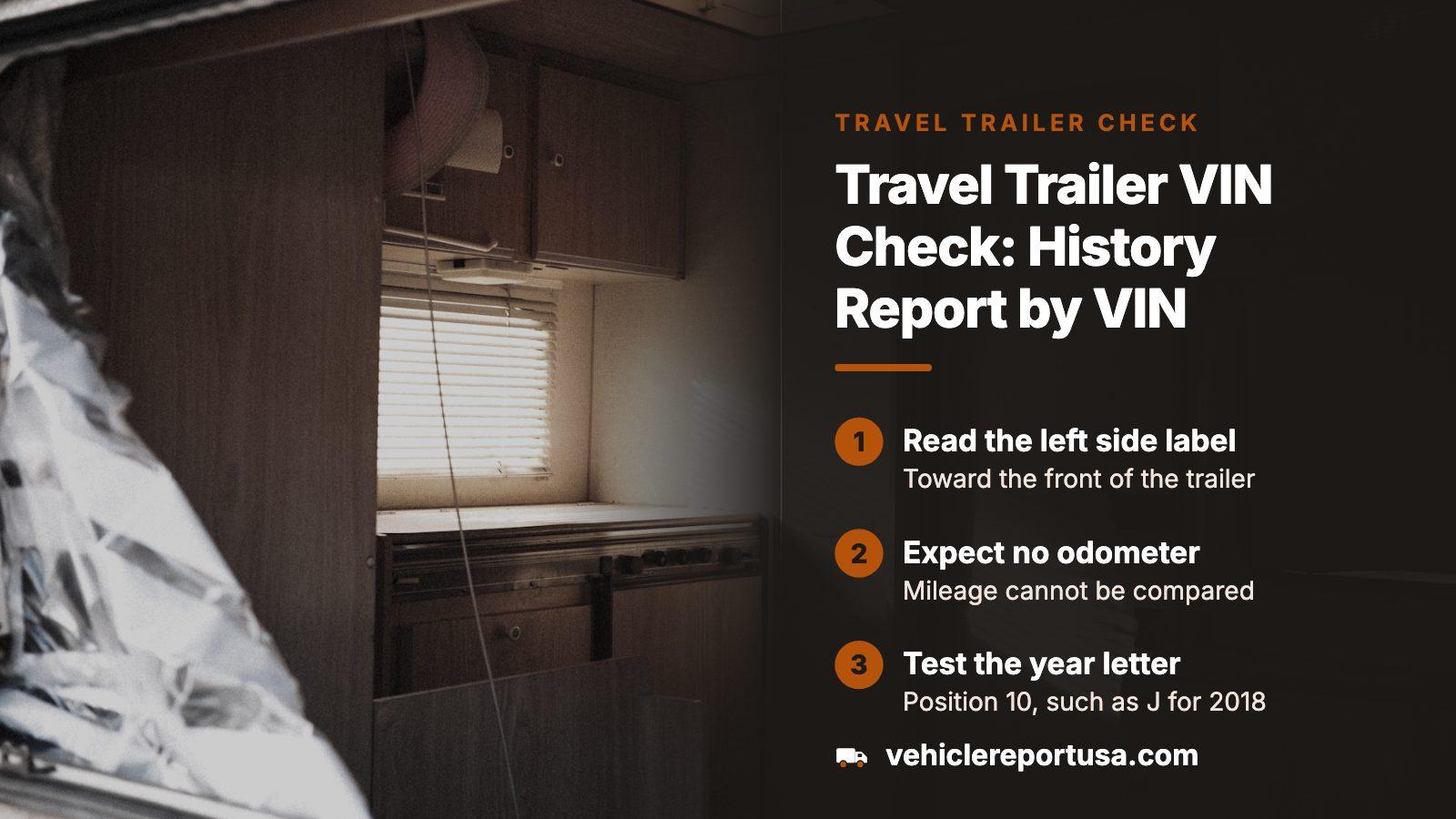
THE SHORT ANSWER
To check a travel trailer by VIN, read the 17 characters from the certification label, found toward the front on the trailer's left side, and enter them. The free preview decodes the number first. The paid report then searches title brands, damage and salvage records, liens, theft, insurance records and open recalls. A trailer has no odometer and campers are thinly reported, so a clean result encourages but does not guarantee.
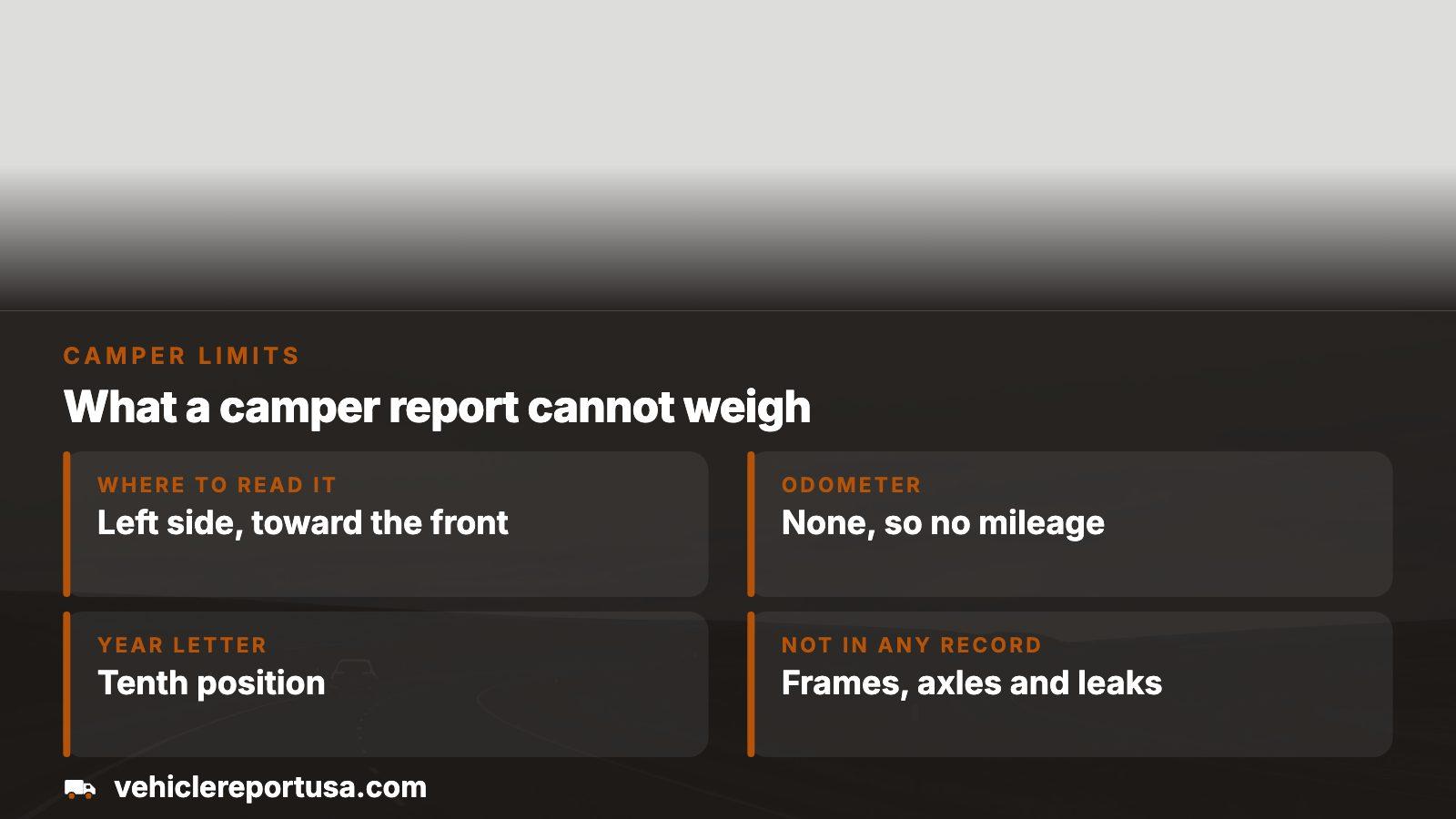
- Where to read it
- Left side of the trailer, toward the front
- Odometer
- None on a trailer, so no mileage to compare
- Year letter
- Position 10, such as J for 2018
- Cost to start
- Preview first, then one payment for the report
What the check looks for on a towable camper
A camper is searched the way a pickup is: the VIN is the key, and whatever was recorded against it comes back. A trailer has no odometer, so that line stays blank. These are the entries worth reading.
| Record | What it can tell you about a camper |
|---|---|
| Title brands | Salvage, rebuilt or flood labels that stay with the VIN |
| Damage and salvage photos | Bent rails, crushed corners or water lines the ad skipped |
| Liens and impounds | Money still owed against the trailer, or a past tow-and-hold |
| Theft and insurance | A stolen-unit report or a paid claim |
| Open recalls | Coupler, wiring or placard campaigns still unrepaired |
| Use type and value | Fleet or rental history, and a market value to test the price |
Coverage is the catch. The Justice Department's NMVTIS page says reporting is required only for common automobiles, with some states adding motorcycles and heavy equipment, and it warns of false negatives where reporting has gaps. Campers are not named, so a short result is normal and an empty one proves little.
Read the number from the trailer's own label
Skip the number typed into the ad and read it from the trailer. Under federal rule 49 CFR 567.4, a trailer's certification label sits on the left-hand side in the front half, readable from outside with nothing moved aside, and the plate has to be riveted or otherwise permanently attached so that removing it wrecks it. Photograph it before talking price.
Besides the VIN, the label names the builder, gives the month and year built, and states the gross weight rating, a rating for each axle and a classification as a trailer.
A different company name can still be legitimate
A firm that sells a trailer it did not build, but does build trailers and accepts a maker's legal duties, may appear on the label as Responsible Manufacturer or Resp Mfr. So the badge on the sidewall and the company on the label can differ. A label newer than the trailer, or stuck over patched wall material, is another matter. Ask why.
Three real 2018 towables, run through NHTSA's decoder
NHTSA's public complaint files show the first 11 characters of the VIN for the units owners write about. NHTSA's own decoder read three of them like this.
| VIN as filed | What the decoder returned | Built in |
|---|---|---|
| 4X4TCKU2XJK | Forest River Cherokee, 2018, ball-hitch travel trailer, 19 feet, two axles | Topeka, Indiana |
| 5ZT3CKXB4J2 | Forest River Cherokee, 2018, fifth wheel, 32 feet, tandem axles | LaGrange, Indiana |
| 573TE3025J6 | Grand Design Imagine, 2018, ball-hitch travel trailer, 30 feet, two axles | Middlebury, Indiana |
Three details are worth borrowing. The first three characters name a company, and a company can hold several codes: the two Forest River rows start differently, and NHTSA's register lists four for that maker. Position 10 is a model-year letter, J for 2018 in every row. For trailers, positions 4 through 8 must encode the make, the kind of trailer, its body, its length and its axle arrangement, which is why a decoder can state a length at all. Compare each field with the camper, and decode all 17 characters, since the decoder flags 11 as incomplete.
Recalls on campers: what NHTSA's lookup shows and what it skips
NHTSA's recall page takes a VIN and reports unrepaired recalls, though only for vehicles from certain makers. It will not list repaired ones, recalls issued over 15 years ago apart from makers who extend coverage, campaigns from small vehicle makers, or non-safety service programs. Tires and equipment sit under their own tabs. When the VIN comes up empty, a search by year, make and model still lists the campaigns on file.
NHTSA's data returns eight campaigns for the 2018 Cherokee alone, among them a hitch coupler rated below the trailer's weight rating on certain units, placards showing wrong axle and tire figures, and wiring that could be pinched between frame and body.
From an NHTSA owner complaint
An owner of a 2018 Grand Design Imagine told NHTSA in 2021 that a recall notice had arrived but the dealer could not yet supply the part. The owner felt the repair was overdue, though the trailer had not failed.
An open recall is a repair you may be waiting on. Ask the seller whether it was done, and price the delay if not.
What no report can weigh: frames, axles and leaks
A history report is paperwork. It will not straighten a frame, weigh an axle or find the soft floor under a leaking window, so treat the label's ratings as numbers to test against the trailer itself and your tow vehicle's limits.
From an NHTSA owner complaint
An owner of a 2018 Forest River Cherokee told NHTSA the unit turned "hard to drive, fishtailing and swaying" within months of purchase, and the dealer found nothing wrong. After a near rollover, an alignment shop reported a badly bent frame and an axle far too small for the rig. Working from the sticker's weight figures, the owner argued the axles and wheels were rated for less than the load, and said the maker would not upgrade the axles or tires.
A single story proves nothing on its own, but the steps it suggests are sound: weigh the loaded trailer if you can, compare the reading with the label, and pay a shop to inspect frame, axles and springs before the seller gets your money.
Red flags in the result and on the lot
- Any salvage, rebuilt or flood brand, whatever repairs the seller describes.
- Damage or auction photos showing bent rails, a crushed front corner or a twisted axle.
- A lien or impound entry, because a lender's claim can stall a clean transfer.
- A theft record, or a label VIN that differs from the title by one character.
- A decode that disagrees with the listing on length, hitch type or year.
- A label that was replaced, painted over or fixed to fresh metal.
Paperwork: three numbers that must agree
Lay the label's VIN, the title or bill of sale VIN and the report's VIN side by side. All three must match to the last character. A mismatch means stop, not fix the typo.
The Justice Department's consumer page points out that states disagree about brands: damage that earns a salvage brand in one may earn none in the next, and a flood label may not exist at all in some states. It also says a national report holds only part of a state title record, so ask your motor vehicle agency how to pull the state's own record on the trailer.
What it costs, and the order that works
Nothing is charged to start, because the preview is free. The report is paid for once and covers one trailer; sets of 3, 5 and 10 cover a shortlist, and nothing renews. Amounts are on the pricing page, and the sample report shows a finished example.
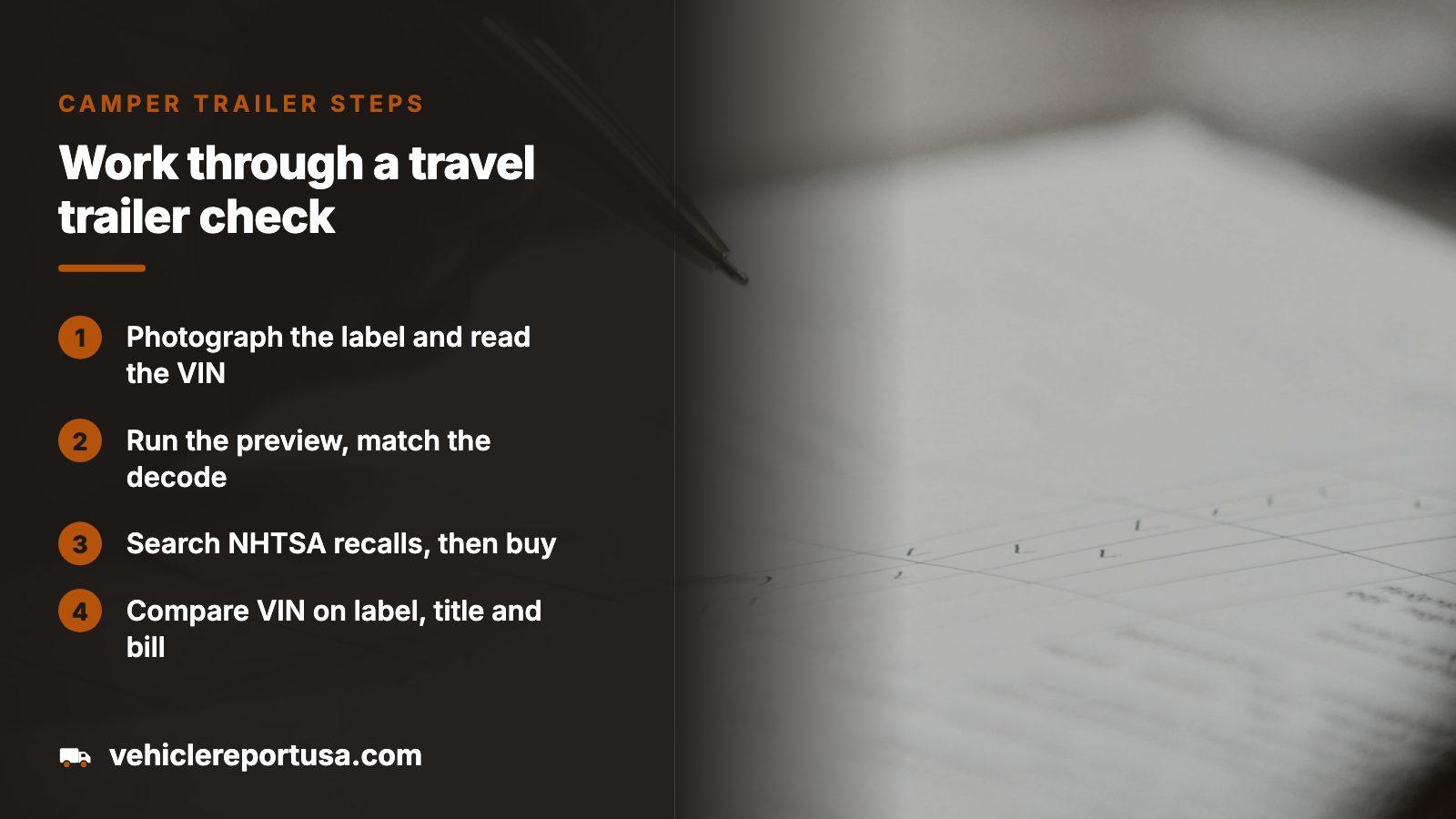
- Photograph the label and read the VIN yourself.
- Run the preview and match the decoded length, hitch type and year to the trailer.
- Search NHTSA's recall page, then buy the report if the camper is still a candidate.
- Compare the VIN across label, title and report, then book an inspection of frame, axles and roof.
Where this information comes from
- eCFR: 49 CFR 567.4, certification label — Where a trailer's label goes, how it is fixed and what it must state, including the Responsible Manufacturer wording.
- eCFR: 49 CFR 565.15, VIN content requirements — What positions 4 through 8 must encode on a trailer, and the model-year code in position 10.
- NHTSA: vPIC VIN decoder — Source of the three decodes, the maker codes and the trailer body-type and hitch fields.
- NHTSA: recalls search — What the VIN recall lookup shows and what it leaves out; recall data for the 2018 Cherokee.
- U.S. Department of Justice: NMVTIS for consumers — Who must report, the coverage gaps, and how state brand rules differ.
- NHTSA owner complaint 11428806 — owner experience, paraphrased
- NHTSA owner complaint 11130421 — owner experience, paraphrased
Sources and photos: Facts checked against the sources above in November 2026. Photos by Alexander Lunyov, Masjid MABA and John Kakuk on Unsplash; diagrams by VehicleReportUSA.
Keep reading
- Trailer VIN Lookup: Check a Used Trailer's History by VIN Before You PayThe wider guide to trailers of every type, including homemade ones.
- RV VIN Recall Check: Chassis, Coach and Trailer Recalls Before You BuyGo deeper on recalls and what to do when one is open.
- Trailer VIN Lookup Specs: What the Decode Shows About Weight and PartsWhat the decode and the label say about length, axles and ratings.
- Sample reportSee a finished report before you buy one.
Frequently asked questions
Where does a travel trailer keep its VIN?
Look on the left side, toward the front, for the certification label: a riveted plate that shows the VIN beside the weight ratings. If it is missing or looks replaced, ask the seller to explain and call your state agency before paying.
Can I check a travel trailer by VIN for free?
The preview is free and arrives before any payment. The report is paid for once, on one trailer or a set, and nothing renews. NHTSA's recall page is a public government tool, so run it as well.
Why did my travel trailer check come back almost empty?
What comes back depends on whether the trailer was ever insured, financed, auctioned or branded, and national title reporting is required only for common automobiles. A short result means a thin paper trail, not a clean history. Inspect the unit and ask to see the title.
Does a clean report mean the camper has no water damage?
No. A history search sees records, and a slow leak seldom leaves one. A flood brand shows up only if a state or insurer recorded it. Soft floor panels, stained ceilings and a musty cabinet need your own eyes and hands.
Is a travel trailer checked differently from a motorhome?
Yes. A towable has its own VIN and NHTSA's decoder files it as a trailer, while a motorhome is a separate body class built on a chassis. On a towable the label's weight ratings and hitch type matter more than any engine record.
Now check the car itself
The guide explains what to look for. The report shows what this VIN has on record.