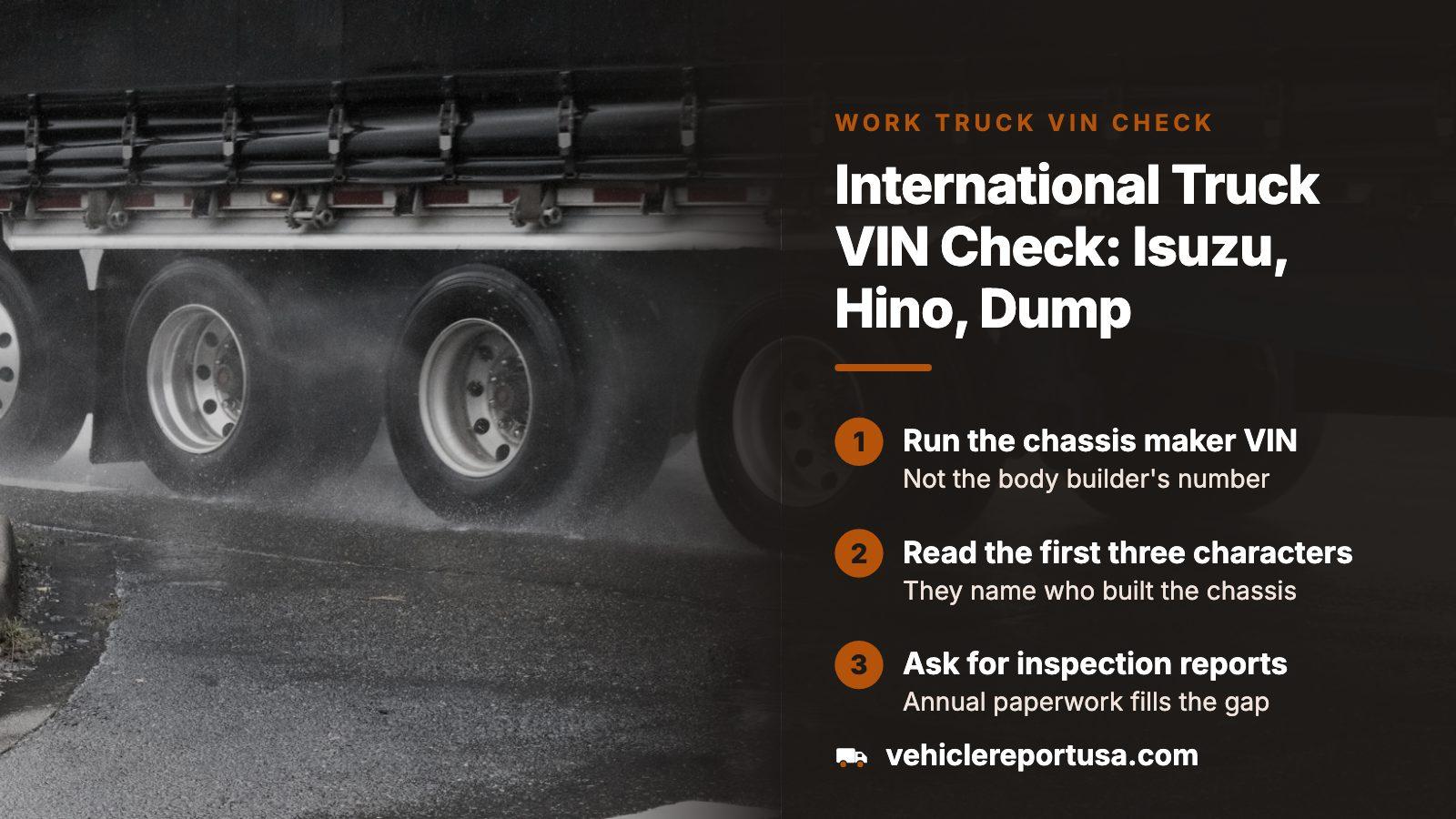
THE SHORT ANSWER
Enter the truck's 17-character VIN to see the free preview, which decodes what was built. The one-time report then adds title brands, damage, auction photos, mileage readings, liens, theft flags and open recalls. A truck rated above 16,000 pounds can be sold without a mileage statement, so a short odometer history calls for questions, not an accusation. If a body was added to the chassis, run the chassis VIN.
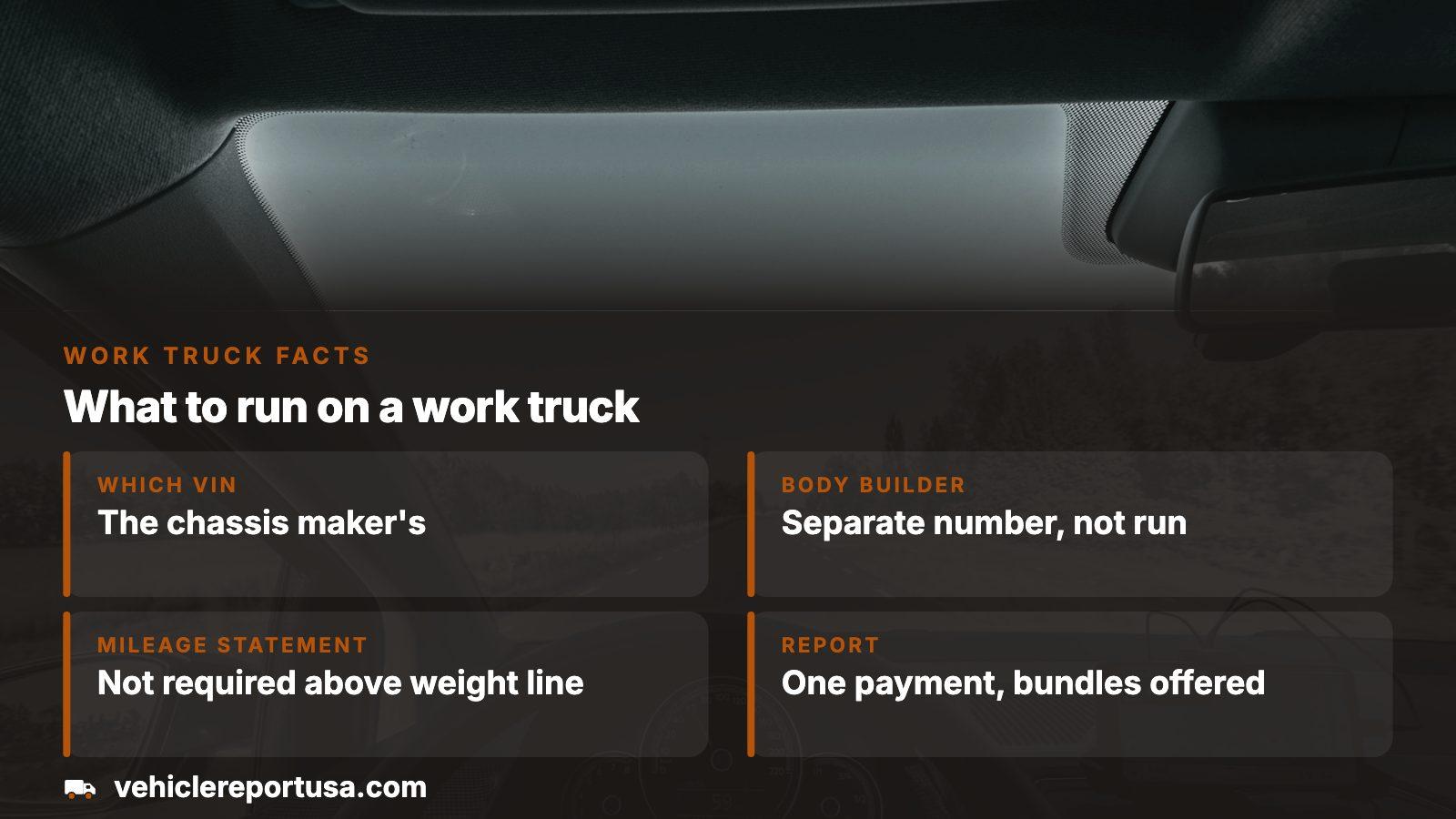
- Preview
- Free decode before any payment
- Report
- One payment, no subscription; bundles of three, five or ten
- Mileage statement
- Not required above 16,000 lb rating
- Which VIN
- The chassis maker's, not the body builder's
How a work truck's past differs from a commuter car's
A pickup bought by a family and a cab-over bought by a landscaping firm live different lives. The firm's truck may start on a lease, pass to a contractor, cross an auction lot and change hands again. A VIN check lays those hand-offs out, and these entries do most of the talking:
- Ownership and use type, which tell you if it worked as a rental, in a company fleet or for one private owner.
- Auction and salvage entries, with photos of the truck as it was sold.
- Damage and title brand records, since body work on a heavy truck hides easily under fresh paint.
- Liens, meaning money still owed against the truck.
What the first three characters say about an International, Isuzu or Hino
The opening three characters name the builder and the kind of vehicle, as NHTSA's vPIC register records them. They reveal nothing about its past, but show whether the VIN fits the truck in the listing.
| Maker | Registered as a truck | Registered as an incomplete vehicle |
|---|---|---|
| International and Navistar | 1HS, 3HS, 93M, 93S, 2HP, 2HS | 1HT, 1HV, 3HT, 3HV, 2HT, 2HV |
| Isuzu | JAA, J8Z, 4S1 | JAL, J8B, J8D, JAM, 4S5, 722 |
| Hino | JHA, JH7, 7H4, 2AZ | JHH, JHB, JH8, JH6, 5PV, 2AY |
Two quirks are worth knowing. The register ties International's identifiers to several brand names, among them Navistar and IC Bus, so a decode that says Navistar is not a mismatch. And Isuzu also holds prefixes for cars and multipurpose passenger vehicles, so confirm that the decode says truck.
Dump truck VIN check: run the chassis VIN, not the body's
Many medium and heavy trucks leave the factory as bare cab-and-chassis units, the incomplete column above, and a body company adds the dump box, hoist or utility body afterward. Federal rules make each stage's maker fix its own label. The chassis maker's label lists who built it, when, its weight ratings and the VIN; the last stage adds a certification, the VIN and the vehicle type.
- Find the chassis maker's label and copy its VIN.
- Compare it with the title and the registration, character by character.
- Ask who built the body, and whether any paperwork for it came with the truck.
The last step matters because body and equipment companies file recall campaigns of their own. A lookup for a 2010 International 4300 returned notices from Dueco and Geo. Heiser Body Company beside the chassis maker's.
Mileage: when a thin record is normal on a heavy truck
Odometer history is built from readings that someone wrote down at a sale, a service visit or an inspection. Under federal disclosure rules, nobody selling a vehicle with a rating over 16,000 pounds has to state its mileage. Age ends the duty too: once 10 years have passed for a 2010 or older model, or 20 for a 2011 or newer one.
A heavy dump truck with two odometer lines can be perfectly ordinary. The same gap on a lighter box truck, rated at 16,000 pounds or less, is not covered by the weight exemption and earns a direct question. Ask for service invoices, and set any earlier reading against the dash before you talk price.
Recalls: counts by model year, and what they leave out
NHTSA's recall data can be searched by make, model and year, and it returns every campaign naming that combination. Sample lookups run for this page show how much lists vary:
| Truck and year | Campaigns returned | One example |
|---|---|---|
| 2018 International LT | 17 | 22V691000: connecting rod wrist pin may crack |
| 2014 International DuraStar | 8 | 14V062000: steering gear mounting bolts may fail |
| 2010 International 4300 | 6 | 10V104000: parking brake may release |
| 2016 Isuzu NPR | 5 | 21V194000: loose rear axle U-bolt nuts |
| 2016 Hino 268 | 1 | 15V208000: front axle U-bolt may be overtightened |
A model-year count overstates the work owed on one truck, because many campaigns cover only certain build dates or equipment. Entering the VIN narrows the list to repairs still open.
From an NHTSA owner complaint
The owner of a 2018 International LT wrote that several shops billed for what proved to be a recall calibration job, and the engine fault stayed. Only later, searching NHTSA's site, did the owner find a connecting rod recall that seemed to match the symptoms. The truck had been bought about a year earlier.
Run the recall lookup on the VIN before you pay, not after the second shop visit.
Annual inspection paperwork: ask for the report behind the sticker
A truck that a motor carrier runs in interstate commerce must show a passed inspection from the preceding 12 months, and the proof has to be on the vehicle. The rule accepts the inspection report or a decal built from it, showing the date, who holds the report, and a certification that the truck passed.
From an NHTSA owner complaint
A lessee of a 2015 Isuzu box truck says the dealer billed over $1000 for a tire and further repairs needed to clear federal inspection. The truck came back with a new sticker that, the owner says, went on in under five minutes. A technician then found the steering pulling to the right.
The lesson is that a decal shows someone certified the truck on a date, not what was looked at. Ask the seller for the report behind it, then have your own mechanic go over the truck.
Red flags on a work-truck report
- A salvage, rebuilt, flood or junk brand. States set their own thresholds, so one may brand a truck that another would not.
- Auction photos showing frame, cab or body damage the seller never mentioned.
- A chassis VIN that differs from the VIN on the title.
- An open lien, which has to be settled before money changes hands.
- A rental or fleet use type on a truck sold as a one-owner unit.
- An odometer reading that sits below an earlier record.
Keep the limits in view. NMVTIS, the federal title database, says its mandatory reporting targets everyday automobiles, that some states also send heavy equipment data, and that not every state reports. A search can show no salvage history even when a problem exists, so even a clean result leaves some risk standing.
Running the check, and what it costs
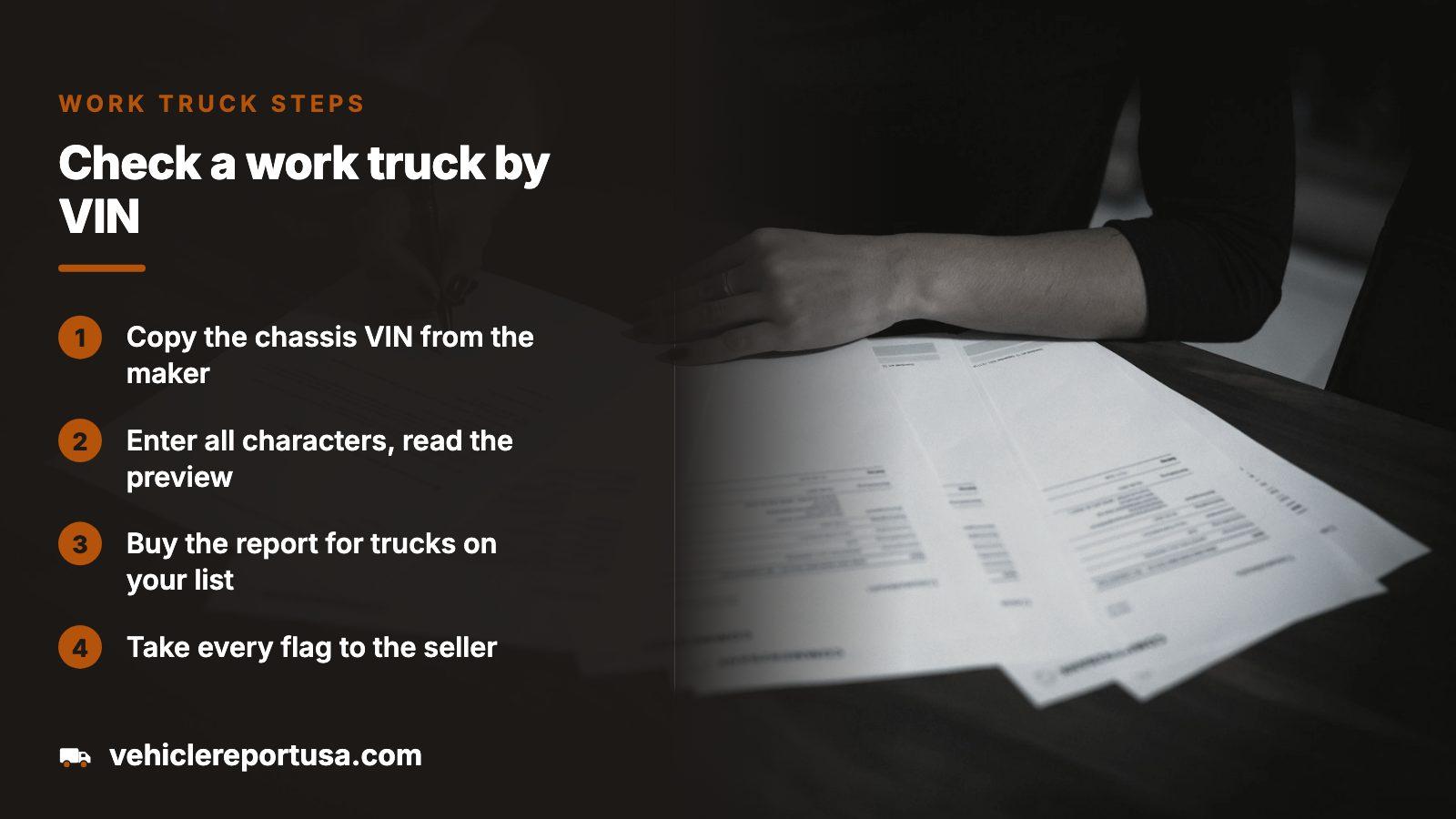
- Copy the chassis VIN from the maker's label, not from the advertisement.
- Enter all 17 characters and read the free preview. Confirm that the maker and vehicle type match the truck you were told about.
- Buy the report for trucks still on your shortlist. It is one payment with no subscription, sold alone or as a bundle of three, five or ten, with current rates on the pricing page.
- Take every flag back to the seller in writing. Then hire an independent mechanic to go over the truck, with the VIN printed on the estimate.
A pack suits a buyer weighing several trucks. The preview costs nothing, so narrow the list first.
Where this information comes from
- NHTSA: vPIC VIN decoder and recall data — prefixes held by International, Isuzu and Hino, and the make-model-year recall counts
- eCFR: 49 CFR 567.5, vehicles built in two or more stages — which label each stage's maker must fix to a chassis and a finished truck
- eCFR: 49 CFR 580.17, odometer disclosure exemptions — weight and age limits on the mileage statement
- eCFR: 49 CFR 396.17, periodic inspection — the 12-month inspection rule and what proof may be on the vehicle
- Bureau of Justice Assistance: NMVTIS for consumers — what the federal title database holds and where its coverage has gaps
- NHTSA owner complaint 11610070 — owner experience, paraphrased
- NHTSA owner complaint 11271094 — owner experience, paraphrased
Sources and photos: Facts checked against the sources above in November 2026. Photos by fr0ggy5, Dimitri Karastelev and Sander Jeurissen on Unsplash; diagrams by VehicleReportUSA.
Keep reading
- Semi Truck VIN Check: Run a History on a Used Class 8 TractorTractors and sleeper cabs raise their own questions, covered there.
- Check a Truck VIN Number: Pickups, Box Trucks and Heavy-Duty RigsStart there for pickups and lighter work trucks.
- Sample reportSee a finished report before you pay for one.
- PricingWeigh one report against a bundle of three, five or ten.
Frequently asked questions
Can I run an International truck VIN check for free?
Partly. NHTSA's recall lookup costs nothing and works from the VIN, and the preview on this site decodes the truck without payment. Title brands, damage, auction photos, liens and theft flags sit in the paid report, which is bought once and never renews.
Does the check work on a truck with a dump body or another upfit?
Yes, if you run the VIN from the chassis maker's label, since that is the number that should match the title. The body company has a label of its own and may have filed its own recall notices, so ask who built the body and ask to see its paperwork.
Why would a heavy truck show only one or two odometer readings?
Readings come from sale and service records, and a vehicle rated over 16,000 pounds can change hands with no mileage statement. Age matters as well: the rule's own example puts a 2011 model, or any older one, outside the requirement for a sale in 2031. A lighter truck with the same gap needs an explanation.
What does it mean when the decode says incomplete vehicle?
Nothing is wrong. NHTSA files cab-and-chassis units under that type because they still need more manufacturing, and many box, dump and utility trucks start that way. It tells you a body company finished the job, so find its label beside the chassis maker's and ask who it was.
Can a VIN check replace an inspection on a used dump truck?
No. A history report shows what was recorded, such as damage, brands and auction sales, and it typically does not show mechanical problems. The hoist, frame, brakes and engine need a mechanic's eyes. Have the inspector write findings with the VIN on them, then use the estimate to negotiate.
Now check the car itself
The guide explains what to look for. The report shows what this VIN has on record.