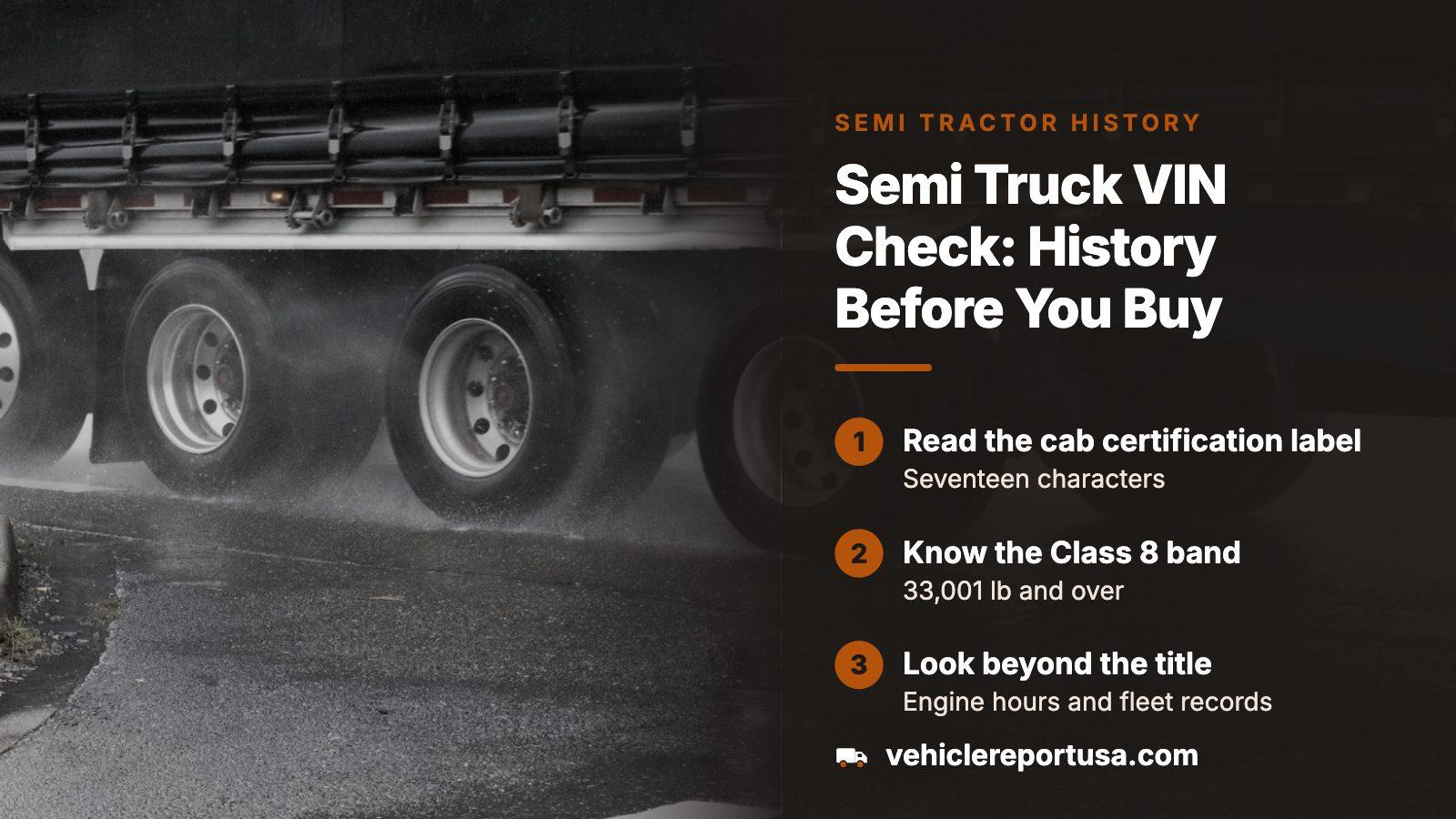
THE SHORT ANSWER
To run a VIN lookup on a semi truck, read the 17-character VIN off the tractor's certification label and enter it into the search. The preview is free and confirms make, model year and weight class. The one-time report then adds title brands, damage and auction records, earlier odometer readings, liens and theft flags. Federal rules let a seller skip the mileage statement on heavy trucks, so earlier readings in a history count for more.
- VIN length
- 17 characters
- Class 8 weight
- 33,001 lb and over
- Mileage statement
- Not required above 16,000 lb
- Preview
- Free, with the report a one-time payment
What a history report shows on a Class 8 tractor
A used tractor is a working asset, so the questions are financial: was it wrecked, has it been auctioned, did the mileage once read higher, is money still owed on it. A VIN search follows the number through the records that answer them.
| On the report | Why it matters on a tractor |
|---|---|
| Earlier odometer readings | A second opinion on the dash, useful when a sale needed no mileage statement |
| Auction and salvage history | Past sale dates, listed mileage and photos of the tractor in the yard |
| Title brands | Salvage, rebuilt, flood or junk labels set by a state or an insurer |
| Liens and use type | Debt still attached, and whether it ran for a fleet, a lease or one owner |
One limit: the federal title database behind many reports was built around ordinary automobiles. The Justice Department says only some states add heavy-equipment records and a search can miss a salvage history, so a clean search is good news, not a guarantee.
Finding the VIN on a tractor before you search
Start at the driver's door opening. The maker's label sits beside the seat, where the door hangs, where it latches or along its edge, and it cannot come off without being destroyed. It lists the VIN, build month and year, the gross weight rating, a rating per axle and the vehicle type.
- Photograph the label and read the 17 characters back from the photo.
- Compare the VIN and build date with the title and registration. A mismatch needs a written explanation before money moves.
- Treat the cab-door lettering as a clue, not an identity. Federal marking rules put the operating carrier's name and USDOT number on both sides of trucks they cover, so the door names who ran the tractor.
The trailer is separate: a semitrailer wears its own label on the forward half of its left side, so a rig is two checks.
What the decode shows, and what it leaves out
Three characters at the front point to the maker. NHTSA's decoder returns these for the large tractor builders:
| First three characters | Maker in the decoder |
|---|---|
| 1FU | Freightliner |
| 1XP | Peterbilt |
| 1XK | Kenworth |
| 4V4 | Volvo trucks |
| 1HS | International |
| 1M1 | Mack |
Class 8, the top weight band, starts at 33,001 pounds. In trial runs, five tractor VINs from 2015 to 2021 each decoded as a Class 8 truck-tractor with a 6x4 drive, an engine model and a displacement, but none listed a transmission. Makers supply those fields, and above 10,000 pounds the federal rule does not oblige them to encode who built the engine. Treat the decode as a description of the chassis, and ask for the transmission and axle specs.
A new model year can still hide an old engine: EPA counts a glider, a new truck finished with a used or remanufactured engine, as a new vehicle.
Mileage: the gap that federal paperwork leaves open
Sellers need not state mileage on any vehicle rated above 16,000 pounds, which takes in every Class 8 tractor and many lighter box trucks. Age is a second exit: a 2010 or older model year after 10 years, a 2011 or newer one after 20. A recent semi can therefore change hands with no mileage statement, which makes any earlier recorded reading valuable.
From an NHTSA owner complaint
A buyer of a used 2020 Freightliner Cascadia says the seller represented the mileage as 395,204, backed by photos and video. The owner then learned the same tractor had gone through an online auction about four weeks earlier showing 843,194 miles, and that it was a badly damaged salvage unit nobody had mentioned. The seller offered a buyback, then said he could not reach his own supplier and gave inconsistent answers. The owner says it cannot be sold for now.
The takeaway: an earlier auction record and a salvage flag are what a VIN history exists to surface, and they appear before the bill of sale, not after.
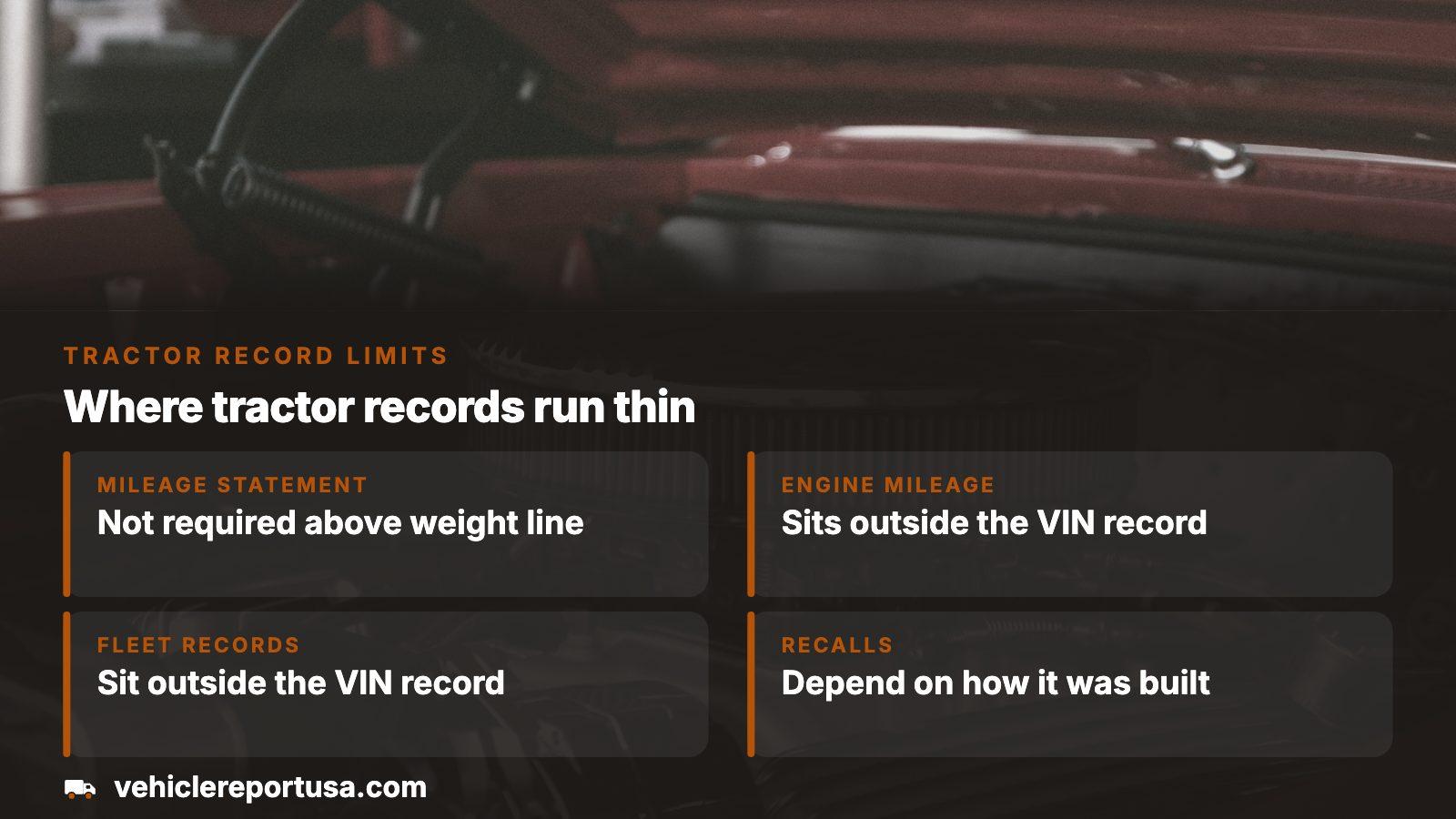
Engine mileage and fleet records sit outside the VIN
A history is keyed to the chassis VIN, but the engine wears on its own clock, and the dash and the engine can tell different stories.
From an NHTSA owner complaint
A buyer of a used 2015 Freightliner Cascadia says it was sold showing about 28,000 miles. After roughly six weeks of repeated trouble and heavy smoke, a Freightliner dealer told the owner the engine's own odometer read 293,662. The dealer put the overhaul at a five-figure sum, the seller said it could not help, and the owner says the seller suggested a second loan to cover it.
Ask for paper, not a figure. Each commercial vehicle must pass an inspection at least every 12 months, with proof on the truck as a report or dated decal, and the carrier keeps its copy of the report for 14 months. A carrier selling a tractor should produce it, plus maintenance records, which it must hold for at least six months after the tractor leaves its control, so ask soon.
Open recalls on a tractor depend on how it was built
NHTSA's recall data lists 29 campaigns against a 2019 Freightliner Cascadia and 21 against a 2021. Many apply to one fitted part only: certain Cummins-equipped 2021 and 2022 trucks whose flywheel bolts may be improperly tightened, sleepers on particular steer tires paired with a specific air dam, and some 2013 to 2016 trucks with Hendrickson front axles.
Open recalls show on the report, and NHTSA's own VIN lookup is free to use, so check it before the test drive. Read the engine and tire markings as well, since several campaigns name a supplier's part.
Red flags to put to the seller
- Mileage in an auction listing or older record far above the dash.
- A salvage, rebuilt, flood or junk brand, or auction photos showing cab, frame or axle damage.
- An open lien.
- A use type that contradicts the pitch, such as owner-operator in the ad and fleet or lease on the report.
- A certification label that is absent, painted over, or at odds with the title on VIN or build date.
- A seller who ran the tractor in a fleet yet has no inspection papers or service records.
Each is a question, not a verdict. Keep the answers in writing.
Running the VIN search: preview, report, inspection
Start with the preview, which decodes the VIN at no charge, so a mismatched tractor can be dropped before you pay anything. The report itself is billed once, with nothing recurring, and covers one VIN; multi-report packs come in sizes of three, five and ten. See the pricing page for current rates.
- Preview every tractor on the shortlist.
- Buy reports for the finalists, and read the odometer and auction lines first.
- Put each conflict to the seller and keep the replies.
- Pay a shop that services heavy trucks to inspect the tractor, and ask for written findings under its VIN. A history cannot stand in for that, and it seldom records mechanical faults.
- Run the trailer's VIN as its own check.

Where this information comes from
- eCFR: 49 CFR 580.17, odometer disclosure exemptions — the weight and age limits past which a seller need not state mileage
- eCFR: 49 CFR 567.4, certification labels — where the maker's label goes and what it must state, trailers included
- eCFR: 49 CFR 396.17, periodic inspection — the 12-month inspection rule and the proof that must ride on the vehicle
- Bureau of Justice Assistance: NMVTIS for consumers — what the federal title database holds and where its coverage falls short
- NHTSA recalls API: Freightliner Cascadia, model year 2019 — campaign counts and the equipment conditions named in recall summaries
- NHTSA owner complaint 11717630 — owner experience, paraphrased
- NHTSA owner complaint 11318785 — owner experience, paraphrased
Sources and photos: Facts checked against the sources above in November 2026. Photos by fr0ggy5, Scott Graham and Victor Hughes on Unsplash; diagrams by VehicleReportUSA.
Keep reading
- International Truck VIN Check: Isuzu, Hino and Dump Truck HistoryCompare box trucks and other work trucks that share these weight classes.
- Semi Trailer VIN Check: History Before You Buy a Used Van or ReeferCheck the trailer behind the tractor, which has its own VIN.
- Check a Truck VIN Number: Pickups, Box Trucks and Heavy-Duty RigsRead the pickup and box-truck version of this check.
- Sample reportSee a finished report before you pay for one.
Frequently asked questions
Do semi trucks have 17-character VINs like cars?
Yes, a tractor's VIN uses the same federal 17-character format as a car's. One difference comes at the end: a heavy truck's last four characters must be digits, against five for a car or light truck. Position nine is a check digit that catches typing errors.
Can I do a semi truck VIN lookup for free?
Partly. The preview decodes the truck at no cost, and NHTSA lets anyone enter a VIN to see open recalls. Title brands, damage, auction photos and earlier mileage sit in the paid report. Federal NMVTIS reports come from approved providers, each with its own fee.
Does a VIN search show engine hours or idle time?
No. A history report draws on titles, auctions, insurance and similar records, not on what the engine logged. Ask for service invoices, and have a dealer read the engine's own mileage before you sign.
What does a USDOT number tell me about a tractor?
It identifies the motor carrier, not the vehicle. The number is lettered on the cab beside the operator's name, but title brands, auctions and mileage follow the VIN. It still tells you which fleet ran the tractor, so you can request its inspection records.
Do I need a separate report for the tractor and its trailer?
Yes. Each report covers one VIN, and a semitrailer has its own. Someone checking several rigs can buy a multi-report pack instead of singles. The preview costs nothing, so shortlist first and pay for the finalists.
Now check the car itself
The guide explains what to look for. The report shows what this VIN has on record.