THE SHORT ANSWER
Read the 17-character VIN from the certification label on the forward left side of the semi trailer and enter it for the preview, which costs nothing. The one-time report then searches the records that matter on a trailer: title brands, damage and salvage history, liens, theft and open recalls. Expect no mileage line, since a trailer has no odometer, and treat a short result as thin coverage rather than proof of a clean past.
- Where to look
- Forward half of the left side
- VIN length
- 17 characters
- Annual inspection
- Each unit in a combination counts on its own
- Preview
- Free, with the report a single payment
The trailer has its own record, apart from the tractor
Federal rules define a semitrailer as a trailer built so that a large share of its weight rests on another motor vehicle. The dependence is physical only. On paper the trailer stands alone, with its own VIN, title, insurance claims and recalls, so a report on the tractor tells you nothing about it. VehicleReportUSA runs history checks on trucks, RVs, motorcycles and trailers, and a semitrailer gets the same search as the rig that pulls it.
| Record searched | What it means on a trailer |
|---|---|
| Liens and impounds | Money still owed, or an earlier tow and hold |
| Title brands | Salvage, rebuilt or flood labels set by a state or an insurer |
| Open recalls | Safety campaigns on this build that nobody has repaired |
| Damage and auction history | Past collisions, sale dates and yard photos where they exist |
| Theft and insurance claims | A theft report or a claim tied to the VIN |
| Ownership and use type | Earlier owners and how the trailer was put to work |
Finding the label and reading what it prints
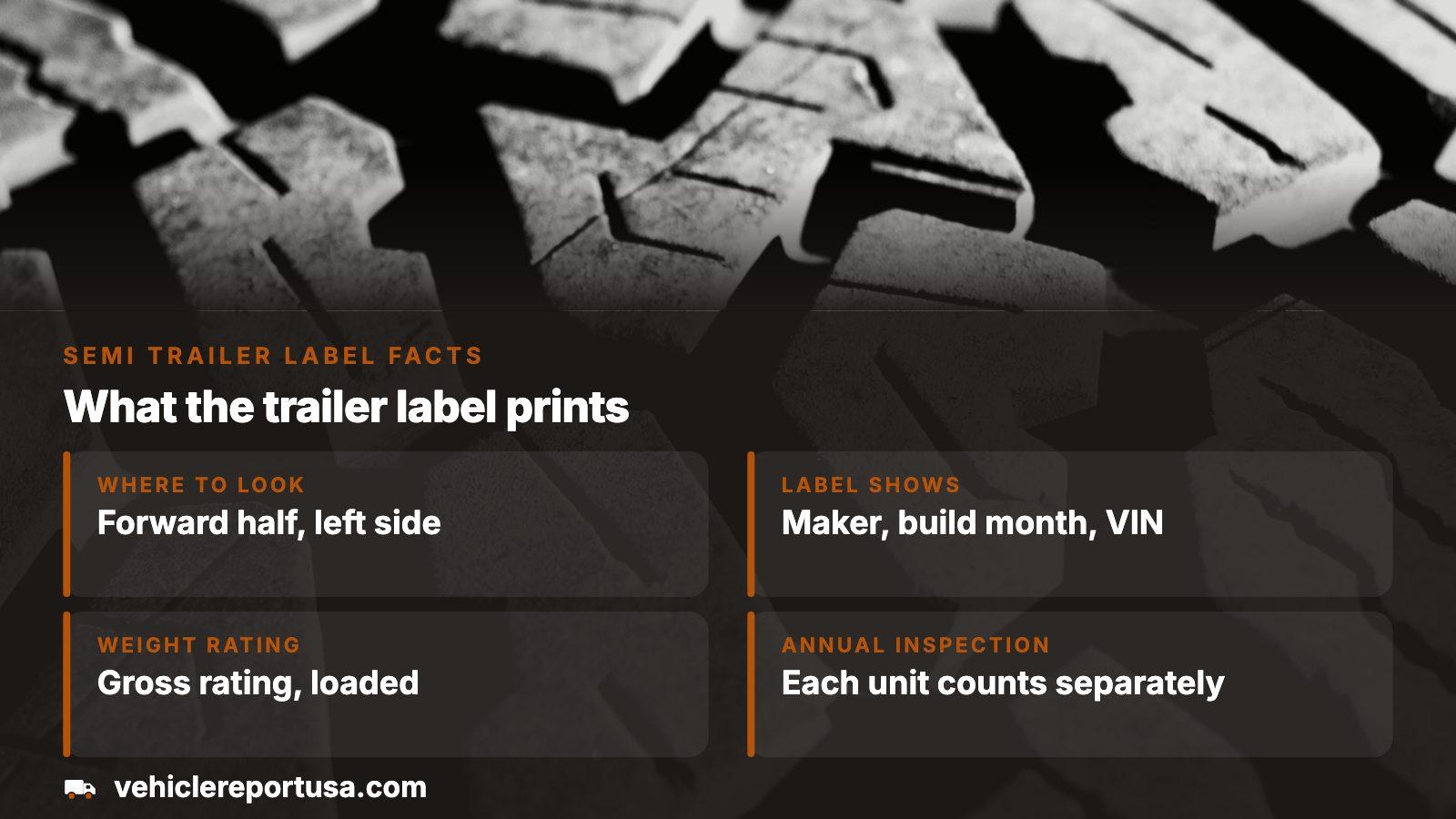
Walk to the front of the trailer's left side. The federal rule puts the maker's label there, readable from outside, and requires it to be attached so that removing it destroys it. A label that is loose, glued on or riveted over bare metal deserves a direct question. Reading across, it prints:
- The maker's name, with the month and year the trailer was built.
- A gross weight rating for the loaded trailer, then one rating per axle, listed from the nose backward.
- A statement that the trailer met federal safety standards on its build date.
- The VIN and the vehicle type.
Photograph it and read the characters from the photo, then match them against the title and registration before you pay anything.
What the decoder returns for a 53-foot van
For a trailer, positions four to eight must describe the make, the trailer type, the body type, the length and the axle layout. Position nine is a check digit, position ten a year code, and the last four characters must be digits. A car-style chart misreads every one of those slots. NHTSA's decoder accepts partial VINs and shows what the maker reported. Three partial numbers typed as tests, check digit left blank, came back like this:
| Typed | Maker in the decoder | Body, size and year |
|---|---|---|
| 1UYVS253*K | Utility Trailer Manufacturing Company | Van, 53 ft, 2 axles, 2019 |
| 1JJV532D*KL | Wabash National Corporation | Van, 53 ft, 2 axles, 2019, plant at Lafayette, Indiana |
| 3H3V532C*KT | Hyundai de Mexico | Van, 53 ft, 2 axles, 2019, plant at Tijuana, Baja California |
None returned a weight rating, so read capacity off the label. A model year typed into the decoder box also overrides the one inside the VIN, so leave that box empty.
The build date points to the recalls that apply
Recalls are written for ranges of production, so the build month and year on the label matter more than the paint. NHTSA lists four campaigns against Wabash vans of model year 2019, and they reach well beyond that year:
- Upper rear corner limb deflectors that may detach, on 2014 to 2019 vans.
- Fuel tank brackets that may let the tank separate, on 2018 to 2022 vans.
- Aerodynamic skirts that may come loose, on 2019 to 2021 flat-bottom vans.
- A rear impact guard mounted too far forward, on 2009 to 2024 dry vans with rail-style lift gates.
A Hyundai Translead campaign covers 2018 and 2019 dry vans whose air hose clip can detach and let the hoses drag on the ground. The remedies are dealer repairs at no cost to the owner. Open recalls appear on the report, so ask the seller for proof that each remedy was done.
What a history cannot see: landing gear, frame and brakes
A history is built from records, not parts, and a trailer's risk sits in the parts that carry the load. The federal annual inspection list covers brakes, coupling, frame, suspension, tires, wheels, lighting and the rear impact guard. Cracked or sagging frame members and sliding subframe pins that are missing or not engaged are listed failures.
From an NHTSA owner complaint
A worker loading a 2017 Great Dane refrigerated trailer with a forklift says the trailer was unhitched, locked at the dock and chocked when a bracket holding the landing gear gave way. The leg collapsed and the nose dropped, throwing the worker against the inside wall and injuring the neck and back. Two driver inspection reports filed that day had marked the landing gear as no defect.
The takeaway: a clean sheet is not a hands-on check. Crank the gear through its travel, look at its mounts, and pay a heavy-truck shop to check the frame and brakes, with findings written out under the VIN.
Paper to ask for: inspection proof and a matching title
Each vehicle in a combination needs its own annual inspection, so a trailer used by a carrier should carry proof. That is either the full report or a decal showing the inspection date, where the carrier keeps the report, the vehicle's identification if it is not marked on the trailer, and a certification that it passed. Ask to see it, and who holds the copy.
Titling is handled state by state, so confirm yours with the motor vehicle agency before the deal. Whatever the state, the VIN on the title, the label and the registration should agree character for character.
Red flags to put to the seller
A short result is common on a trailer, since federal title reporting is built around ordinary automobiles. None of the items below is a verdict, but each one earns a written answer.
- A label that is missing, riveted over bare metal, or different from the title on VIN or build date.
- A salvage, rebuilt or flood brand, or yard photos showing damage to the frame, floor or rear structure.
- Money still owed, a past impound, or a theft report that no one closed out.
- Auction photos that show a trailer in far worse shape than the ad.
- No inspection proof or service records from a seller who ran the trailer in a fleet.
- An open recall on the build, especially one touching brakes, hoses or the rear guard.
Running the check: preview, report, inspection
Start with the preview. It decodes the VIN at no charge, so a trailer whose maker, length or year does not match the listing can be dropped before money moves. If it fits, the full report is billed once, for a single VIN, and nothing renews afterward. Someone comparing several trailers can pick a multi-report pack, offered as bundles of 3, 5 or 10 reports, with rates on the pricing page.
- Preview every trailer on the shortlist.
- Buy reports for the finalists and read the title, damage and recall lines first.
- Put each conflict to the seller and keep the replies.
- Have a heavy-truck shop inspect the trailer and write up what it finds.
- Run the tractor as its own check if you are buying the whole rig.

Where this information comes from
- eCFR: 49 CFR 567.4, certification labels — where a trailer's label goes, how it is fixed and what it must list
- eCFR: 49 CFR 565.15, VIN content — what positions four to eight, the check digit and the final digits must hold on a trailer; section 565.13 sets the 17-character length
- eCFR: 49 CFR 396.17, periodic inspection — the 12-month rule, each unit counted separately, and what the proof on the vehicle must show; the appendix lists the inspected parts
- NHTSA vPIC VIN decoder — partial VINs, maker-reported data and the model-year override; the test decodes came from its API
- NHTSA recalls API: Wabash National van, model year 2019 — the four campaigns and the build ranges they name
- BJA: NMVTIS information for consumers — which vehicle types states must report and why a search can come back falsely clean
- NHTSA owner complaint 11741673 — owner experience, paraphrased
Sources and photos: Facts checked against the sources above in November 2026. Photos by Peter McCrae-Hokenson, Carrie Allen www.carrieallen.com and Marvin Sagisi on Unsplash; diagrams by VehicleReportUSA.
Keep reading
- Semi Truck VIN Check: Run a History on a Used Class 8 TractorRun the tractor that pulls the trailer, which has its own VIN and records.
- Trailer VIN Lookup: Check a Used Trailer's History by VIN Before You PayRead the wider guide to trailers, including homemade ones with no factory number.
- Sample reportSee a finished report before you pay for one.
- PricingSee how one report and the multi-report packs are priced.
Frequently asked questions
Where is the VIN on a semi trailer?
Look on the maker's certification label at the front of the trailer's left side. Photograph it and read all 17 characters from the photo. If the label is missing, or looks newer than the trailer around it, hold the deal until the seller explains it with the title in hand.
Does a semi trailer VIN check show mileage?
No. A trailer has no odometer, so that line stays empty. Mileage questions belong to the tractor, whose history can include earlier odometer readings. Use the trailer preview to confirm the make and year match the listing, then run the tractor as a separate search.
Can I run a semi trailer VIN check for free?
Partly. The preview decodes the number at no charge, and NHTSA's decoder reads partial VINs. Title brands, damage, salvage, lien and theft records sit in the paid report, a single payment. NHTSA publishes its recall data openly, so that part costs nothing either.
Does the tractor's report cover the trailer behind it?
No. Each report searches a single VIN, and the trailer carries its own number, title and recalls. Pairing a used tractor with a used trailer means checking both before you commit, and a multi-report pack suits that case.
What does an empty result on a trailer mean?
Often just thin coverage. The federal title database says states must report common automobiles only, though several add motorcycles and heavy equipment, and its consumer page does not mention trailers. Reporting gaps can produce a falsely clean result, so lean on the label, the title, recalls and an inspection.
Now check the car itself
The guide explains what to look for. The report shows what this VIN has on record.