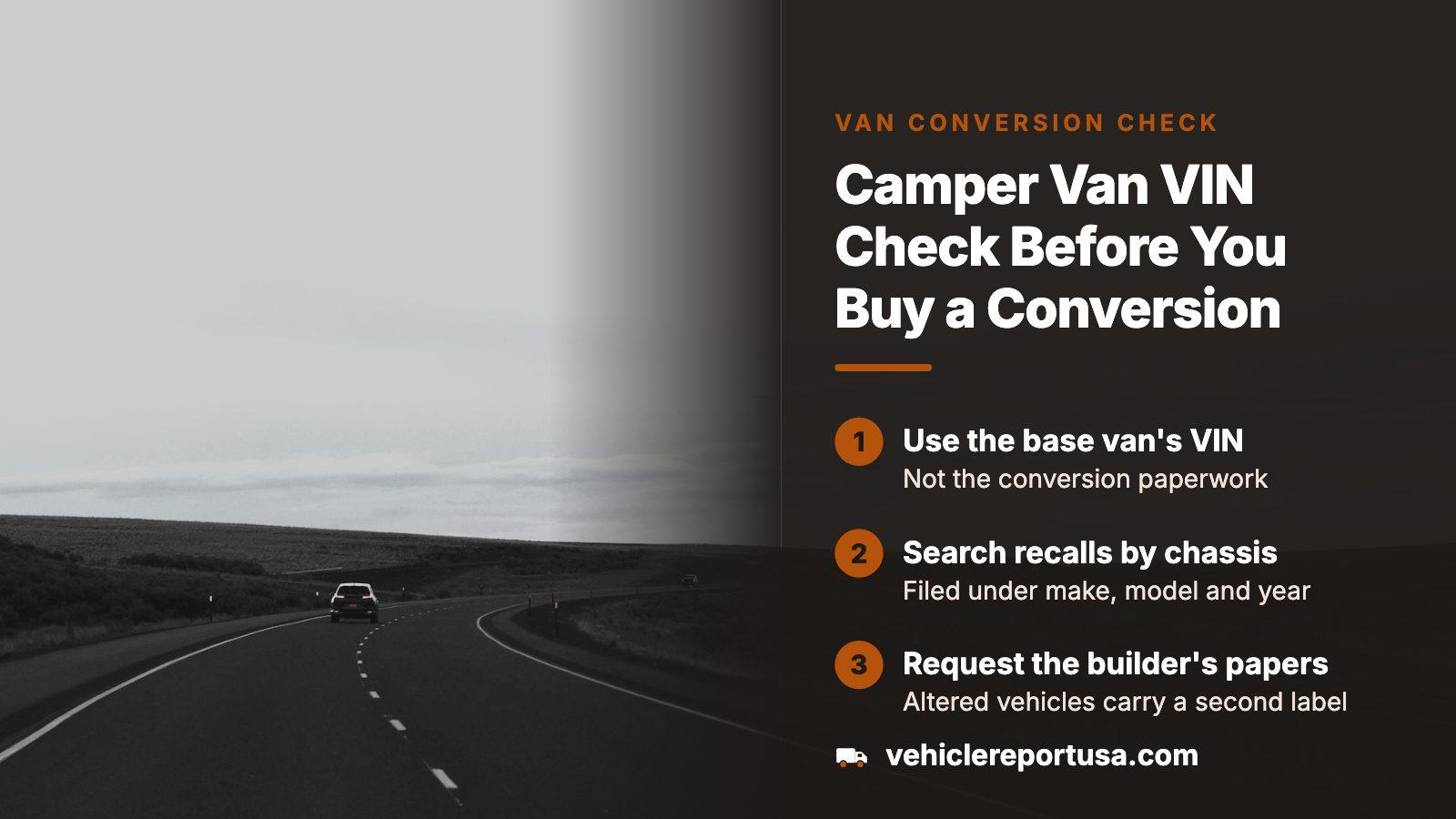
THE SHORT ANSWER
Find the 17-character VIN on the chassis, not on the conversion paperwork, and run the preview. If the van stays on your list, buy the report and read the title brands, damage and salvage entries, mileage readings and liens. Check recalls under the chassis maker and ask the builder for its own papers, since no VIN record covers the build-out.
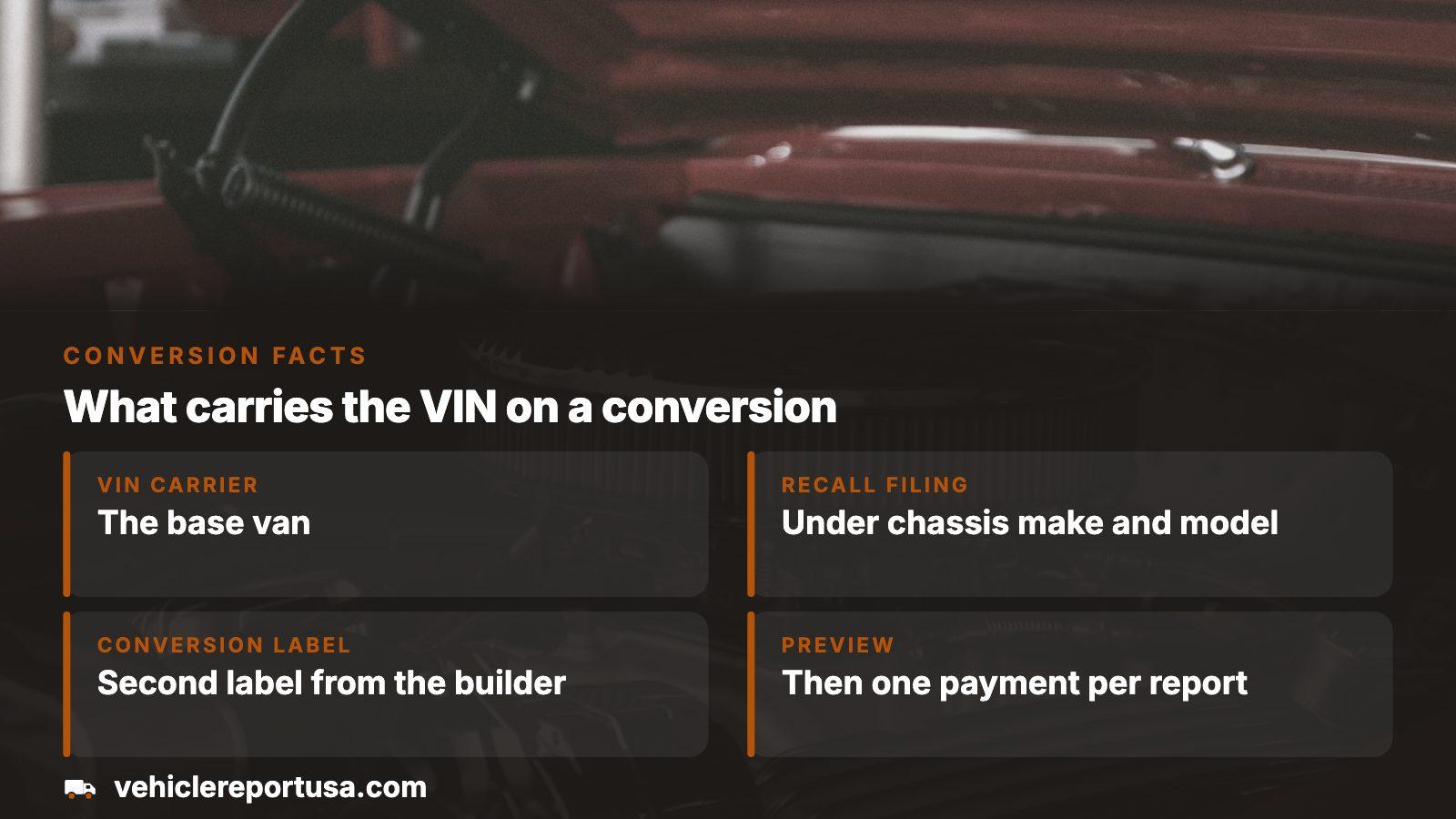
- What carries the VIN
- The base van, not the conversion
- Recall filing
- Under the chassis make, model and year
- Conversion label
- Altered vehicles get a second label from the builder
- Preview
- Free, then one payment per report
The history sits under the build-out
Most camper vans start life as a cargo or passenger van, usually a Sprinter, Transit or ProMaster. A builder or a weekend owner then adds the bed, the kitchen, the battery bank and the roof vent. The VIN stamped at the factory stays with the metal, which means every title, insurance claim and mileage reading belongs to the van that was there before the cabinets went in.
That is the reason to run the check early. A polished interior can sit on a van that was a rental, a fleet workhorse or a total loss two owners ago, and screwing a countertop into the floor does nothing to the record.
What the check finds on a converted van
For a camper van the useful parts are few and specific. Title brands come first, because a salvage or flood label changes what the van is worth and whether a lender or insurer will touch it. Damage and salvage entries come next, with auction photos where they exist, since a collision van is sometimes rebuilt and then converted so the buyer never sees the frame work.
- Any title brand, plus which state applied it.
- Accident, damage and salvage or auction entries.
- Odometer readings over time, to spot a rollback or a long gap.
- Liens, impound records and theft flags.
- Ownership count and use type, such as fleet, rental or private.
- Open recalls on the chassis.
The federal title system keeps every brand any state ever applied to a vehicle, so a label from a previous state does not vanish when the van is retitled elsewhere. Its own reports are intentionally short and leave out repair and maintenance detail.
Running it from the VIN
- Photograph the VIN from the van itself: look at the plate below the windshield and the maker's label by the door.
- Match that number against the title and the bill of sale. A mismatch ends the conversation.
- Run the preview and see what the record holds.
- Pay for one report on a van you are serious about, or a pack if you are shopping several.
- Read the entries below before you talk money.
Current prices sit on the pricing page. You pay once per report, nothing recurs, and only the preview costs nothing.

The builder's paperwork is a separate document
Federal rules treat a person who alters a certified vehicle as responsible for that alteration. Under the alterer rule the builder must fix a second label to the van, beside the maker's original, naming who did the work, the month and year it was finished and a conformity statement. If weight ratings changed, the new figures belong on it too.
Ask to see the second label
A professional conversion should carry the alterer's label next to the original. A van with a finished interior and no such label, or a label that gives no builder and no date, deserves a hard question before any money moves.
A VIN report will not tell you who built the interior or whether the wiring is sound. For that you need the builder's invoice, photos of the work in progress and an inspection by someone who does this for a living.
Recalls follow the chassis, and sometimes the coach
Federal recall data is filed by make, model and year of the base van. The 2018 Ford Transit alone shows 14 campaigns in the recalls API, from seat and emergency exit issues to a driveshaft and a parking brake cable. A converted van of that year can be caught by any of them, so the VIN lookup is worth doing even when the interior looks new.
Some equipment recalls land under another name altogether. One example is the Forest River campaign 19V202000, covering a back-up camera monitor that could flip the image, which NHTSA files under the coach maker rather than Ford. If the build used branded appliances or electronics, search those brands as well.
| Where to look | What it tells you |
|---|---|
| Chassis make, model, year | Recalls on the van itself |
| Conversion or coach brand | Campaigns on the build and its fittings |
| Appliance or equipment maker | Stoves, monitors and similar parts |
What owners of converted vans report
From an NHTSA owner complaint
An owner of a 2018 Ford Transit conversion van complained that the shoulder belt was anchored to the seat rather than the pillar, which they felt could slow getting out in an emergency. The dealer passed the concern to the conversion designer, who did not accept it, and the van was not changed.
From an NHTSA owner complaint
Another owner of a 2018 Transit conversion described a battery that kept draining, wiring found incorrect, a coolant smell and a fuel door that had to stay open while filling. The van spent another month at the shop, and a state investigator pointed them to the fuel and battery layout.
Both complaints are about the build, not the chassis, which is the point: the VIN record would have been clean on either and still told them nothing. Put a hands-on inspection of the conversion next to the report.
Red flags worth walking away from
- A title brand the seller left out.
- Odometer readings that stall, drop or jump without a reason.
- An open lien on a van the seller says is paid off.
- Paperwork showing a VIN unlike the one on the van.
- A conversion label missing, or the builder unwilling to name itself.
- A fresh interior on a van with damage or salvage entries.
A single one is a reason to ask questions. Two is usually a reason to leave.
Is it a van or a motorhome on paper
The federal definition of a motor home needs at least four of six features: cooking, refrigeration, a self-contained toilet, heating or cooling, a potable water system with a sink, and a separate 110 to 125 volt supply or propane. A bed and a cooler do not get there. How your state titles and insures the van, as cargo, passenger or motorhome, is the state's call, so read the title the seller holds and confirm the classification with your motor vehicle agency before you register.
What to do next
Run the preview on every van you are considering. If one holds up, buy the report, read it against the title and the builder's papers, and have the conversion inspected. Truck, RV and trailer checks are this site's focus, so the same report logic carries over if you end up comparing a van with a motorhome or a camper trailer.
Where this information comes from
- eCFR 49 CFR 567.7: persons who alter certified vehicles — what the added alterer label must state
- eCFR 49 CFR 571.3: motor home definition — the four-of-six facilities test
- NMVTIS: understanding the vehicle history report — brands, salvage history and the short report format
- NHTSA recalls data: 2018 Ford Transit — campaign list for the chassis
- NHTSA owner complaint 11365124 — owner experience, paraphrased
- NHTSA owner complaint 11181999 — owner experience, paraphrased
Sources and photos: Facts checked against the sources above in November 2026. Photos by John Kakuk, Jakub Żerdzicki and Victor Hughes on Unsplash; diagrams by VehicleReportUSA.
Keep reading
- Ford Transit VIN Check: Cargo, Passenger and Cutaway Van History Before You BuyChassis-level history for the most common conversion base.
- Mercedes Sprinter VIN Check: Work Van, Camper and Cutaway History Before You BuyThe same check for Sprinter-based builds.
- Ram ProMaster VIN Check: Read a Used Cargo Van's History Before You BuyFor vans built on a ProMaster body.
- RV Title Check: Read the Title History Before You Pay for a RigHow titles and brands work once a van is treated as an RV.
Frequently asked questions
Does a camper van VIN check cover the conversion?
No. The VIN belongs to the base van, so the record shows its titles, damage, mileage and recalls. The cabinets, wiring, plumbing and bed platform are the builder's work. Ask for the builder's invoice and the alterer label, and have the conversion inspected separately.
Which VIN do I use on a self-built van?
Use the one on the chassis, the same number that appears on the original title. A home build has no separate VIN for the interior. If the van has been retitled as a motorhome, the number should still match the maker's label.
Can a camper van have recalls from more than one company?
Yes. The chassis maker files recalls under the van's make and model, while appliance or equipment makers may file their own, sometimes under their own name. Search the van by VIN, then search any named brands in the build.
Is the preview enough to decide?
The preview costs nothing and shows whether a record exists. Before paying for a van, read the full report for brands, damage, readings and liens. One payment buys one report, and packs exist if you are comparing several vans.
What if the title says cargo van but it is set up as a camper?
That happens, because titling follows state rules. Read the title the seller holds, compare it with the VIN on the van and ask your motor vehicle agency how it classifies the unit before you register or insure it.
Now check the car itself
The guide explains what to look for. The report shows what this VIN has on record.