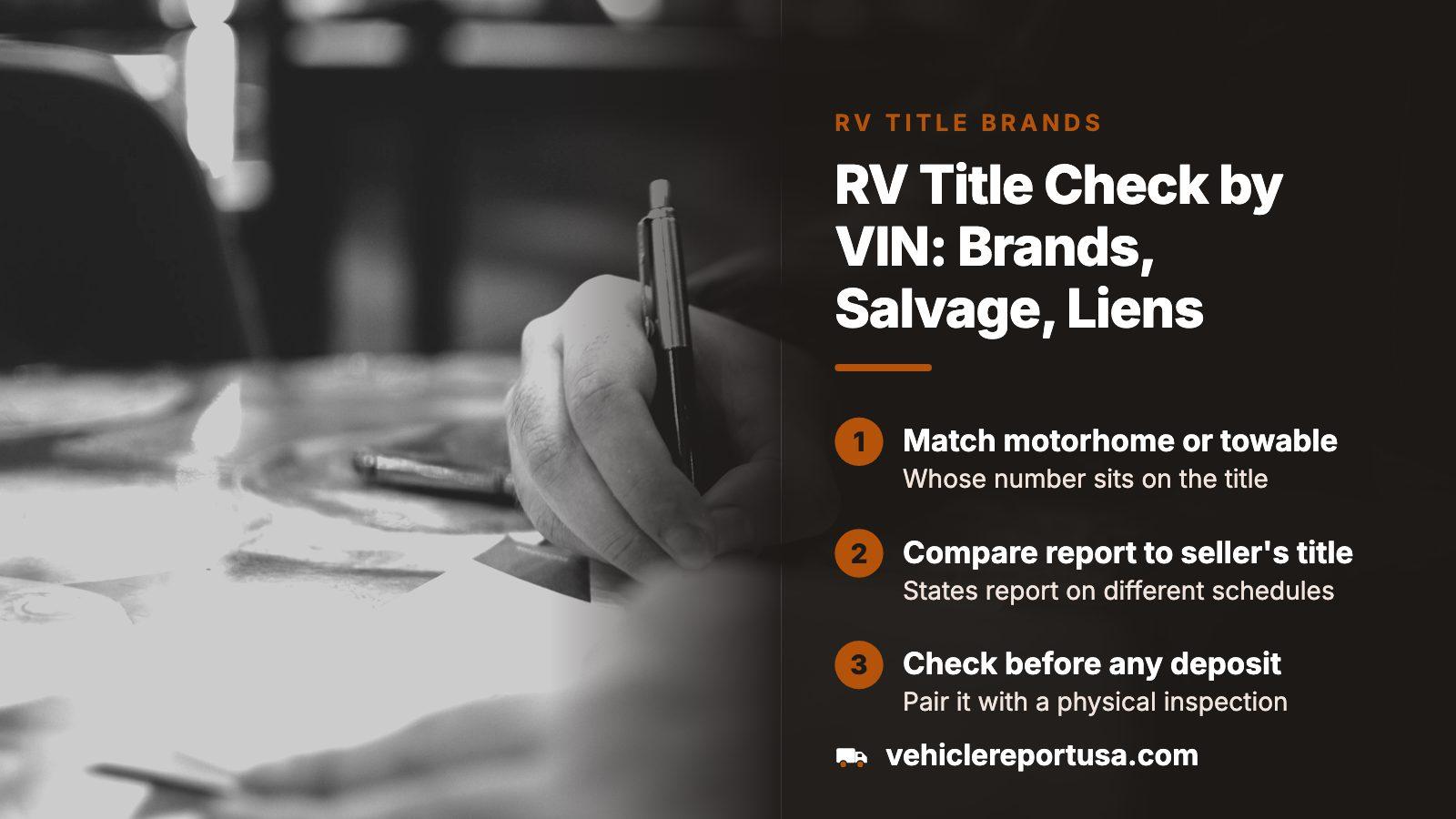
THE SHORT ANSWER
Find the VIN on the rig, enter it for the free preview, and read the paid report for title brands, salvage and insurance records, liens, theft and recalls. Treat a clean result as one input, not a verdict. Federal title data covers RVs, but states report on different schedules, so match the report against the seller's actual title and an in-person inspection.
- Federal title data
- Names RVs and motor homes among its vehicle types
- Coverage caveat
- 87 percent of vehicles in the system; not every state reports
- Free step
- The VIN preview; the full report is one payment
- Best use
- Before a deposit, alongside a physical inspection
What a title check turns up on a camper or coach
Big rigs change hands quietly. A fifth wheel can pass through three owners and two states between a hailstorm and the listing you are reading, and none of that shows in the photos. A title check pulls the recorded trail attached to the VIN.
| Report section | Why it matters on an RV |
|---|---|
| Title brands | Salvage, rebuilt, flood or junk labels, with the date each was applied |
| Total-loss and salvage records | An insurer wrote the unit off, or a yard took it in |
| Damage and auction photos | Roof, sidewall or frame damage the seller never mentioned |
| Liens | A lender who still has a claim on the rig |
| Theft and impound | A past theft report or a tow-and-hold |
| Mileage readings (motorhomes) | A trail that should rise steadily, never step backward |
Motorhome or towable: whose number is on the title
A motorhome comes from two builders. One company, usually a truck or van maker, supplies the chassis, and a coach company adds the living space. NHTSA's manufacturer register shows the result: code 1FD returns Ford Motor Company, typed as an Incomplete Vehicle. A coach with an RV badge can therefore carry a chassis maker's identity in its VIN.
Towables are simpler. Prefix 4X4 returns Forest River, typed as Trailer, and 1UJ returns Jayco. The builder assigns one VIN to the whole unit. Either way, title, registration and history report all hang on that number, so copy it carefully and compare it with every document.
Running the VIN through the preview and report
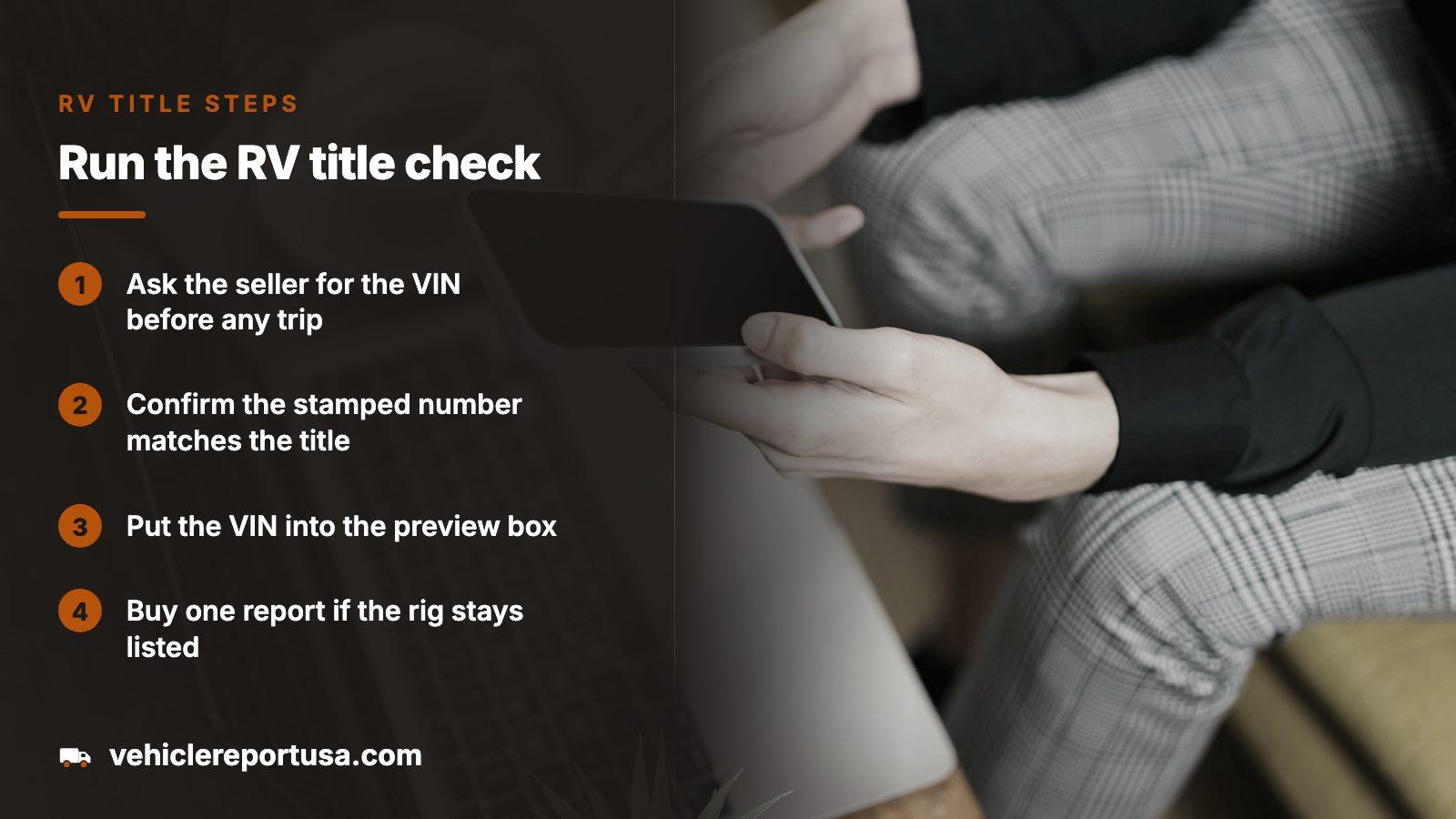
- Ask the seller for the VIN ahead of any trip, and for photos of the plate and the title.
- Confirm the number stamped on the rig matches the paperwork. A mismatch ends the conversation.
- Put the VIN into the preview box on this site; it shows whether records exist.
- Buy one report if the rig stays on your list. It is a single payment, with no subscription.
- Read brand, salvage, lien and theft lines first, then recalls and ownership history.
- Compare each date and state in the report with the title the seller shows you.
Typing errors cause more empty results than anything else. One wrong character sends the search to the wrong vehicle, or to none.
How to read what comes back
A brand is a label that a state attaches to flag a vehicle's condition, now or earlier. Federal guidance lists junk, salvage and flood as examples. Each state sets its own thresholds, so identical damage can earn a label in one place and nothing elsewhere. That is how a normal-looking title can sit on top of an older branded record.
Federal title data holds on to brands a state reports, so moving a rig does not wipe them. Read the sequence: where it was titled, when each change happened, and whether a label followed an insurance event.
A write-off can follow a theft
Federal guidance notes that an insurer can write off a stolen unit that is never found, and the label can remain if it later reappears undamaged. Ask the seller what happened. The record shows an event occurred, not what the damage looked like.
Where title data runs thin for RVs
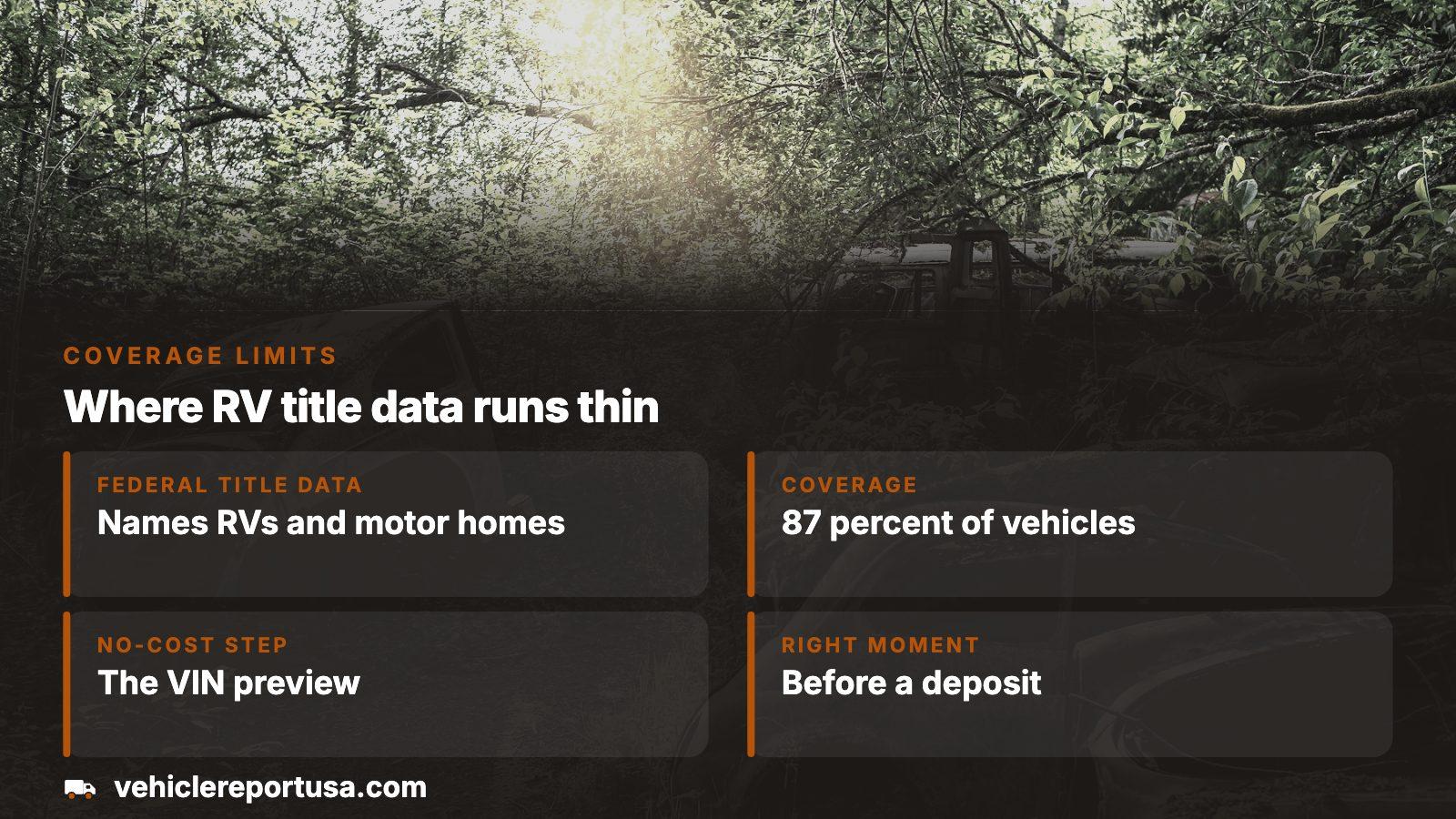
The federal system names recreational vehicles and motor homes among its types. Its reporting duties, though, are written around automobiles, generally four-wheelers rated below 10,000 pounds gross weight, so a large coach or heavy fifth wheel may fall outside. Some states report beyond the minimum and others do not. Commercial units can be absent when a state's separate agency holds them.
That federal page also puts 87 percent of the vehicle population in the system, with only a bit over half of states reporting, so false negatives happen. An empty return most likely means the states sent nothing for that VIN.
- Treat a blank brand line as 'nothing reported', not 'nothing happened'.
- Ask for the title and read its brand box yourself.
- On a heavy coach, hire an inspector who knows RV roofs and slides, because repair history is not in federal data.
The paperwork to ask for, with one state as an example
Rules differ by state, so take Texas as a sample of how specific they get. Its DMV requires a title for a manufactured trailer above 4,000 pounds gross weight. A new unit is proven by the Manufacturer Certificate of Origin, which the DMV calls the trailer's birth certificate. A used unit over that weight needs a certificate of title. The application, Form 130-U, goes to the county tax office.
A lighter used trailer can be registered with a bill of sale and a registration receipt when no title was ever issued. That is lawful there, but it leaves you a thin paper trail. In any state, ask which document the seller holds and read your own DMV's page before paying.
Texas also describes how to contest a brand carried in from elsewhere: obtain a letter, on the other state's official letterhead, stating its records lack the brand or that it was a mistake, then file it with a removal request.
Recalls belong in a title check too
A title shows who owns the rig. It cannot show an unrepaired safety defect. NHTSA's recall data can, and RVs collect plenty. Its API returned 7 campaigns for the 2015 Winnebago Vista alone.
Campaign 16V598000, received 12/08/2016, concerned an electrical connection at the automatic transfer switch that might be loose; dealers were to tighten it, swapping the switch box where needed. Campaign 24V733000, received 01/10/2024, covered turn signals with too small a lens area, across many Winnebago lines and years. One campaign can span a long list of model years, so search by VIN, not by year.
Open recalls are repaired free by the maker's dealers, so an open item is a bargaining point and a to-do, not a deal breaker.
Red flags that should slow you down
- The VIN on the rig does not match the title or the registration.
- The seller will not share the VIN, or only sends a cropped photo.
- A salvage or flood brand appears in the report but the seller says 'clean title'.
- A lien shows and the seller cannot name the lender.
- Fresh interior panels, new carpet or a strong cleaning smell on a rig with no explanation.
- A title issued very recently in a state the seller has never lived in.
- A price far below comparable units, paired with pressure to pay quickly.
One flag is a question. Two or three together, with a seller who gets short with you, is a reason to walk.
Cost, and your next move
The VIN preview costs nothing. A full report is a single payment, one report or a pack if several rigs are on your shortlist, with current prices on the pricing page. Nothing renews afterward.
Run it before a deposit, before a transport company is booked and before you sign the bill of sale. A clean result still calls for a physical inspection. A brand or lien gives you a concrete question for the seller and a documented reason to renegotiate or leave.
Where this information comes from
- NMVTIS: frequently asked questions — Which vehicle types are included, the automobile definition and what a title report shows.
- NMVTIS: information for consumers — Brands, coverage figures, false negatives and the total-loss caveat.
- Texas DMV: title check before you buy — A state's advice on running a title check and challenging an out-of-state brand.
- Texas DMV: trailers — Titling thresholds, the certificate of origin and proof-of-ownership documents.
- NHTSA vPIC: manufacturer lookup — How the first VIN characters identify a chassis maker or trailer builder.
- NHTSA recalls API — Recall campaigns, dates and remedies used in the Winnebago example.
Sources and photos: Facts checked against the sources above in November 2026. Photos by Owen Michael Grech, Jakub Żerdzicki and Patrick von der Wehd on Unsplash; diagrams by VehicleReportUSA.
Keep reading
- RV VIN Lookup: History Check for Motorhomes, Trailers and Fifth WheelsThe wider picture of how an RV VIN is read.
- RV VIN Recall Check: Chassis, Coach and Trailer Recalls Before You BuyGo deeper on open recalls and what a dealer will fix.
- Travel Trailer VIN Check: Run the History Before You Buy the CamperThe same history check for towables.
- Sample reportSee a finished report before you buy one.
Frequently asked questions
Does an RV title check work on a motorhome and a trailer?
Yes for both, since federal title data lists recreational vehicles and motor homes among its types. Coverage depends on what each state reports, though. Heavier coaches can fall outside the automobile definition, so a short result is not proof of a clean past. Match it to the seller's title and an inspection.
What does a salvage brand on an RV mean for me?
A state or insurer decided the damage was severe enough to label it. It can affect financing, insurance and resale. It does not always mean the rig is unsafe, but you need repair records and a thorough inspection before deciding. The price should reflect it, and some lenders will not finance branded units at all.
Can a seller hide a brand by retitling in another state?
Federal title data keeps brands that states report, so a move should not erase them. But standards differ, and not every state reports. That is why a recorded history plus the seller's physical title are both worth checking. Odd gaps between title dates and states deserve questions.
Is it better to run the check before an inspection?
Before. It costs far less than an inspector's time, and a brand, lien or VIN mismatch can end the deal early. Run it before you visit if you can, then bring the findings to the inspection so the inspector knows where to look.
What if the report finds nothing at all?
Federal guidance says the likeliest cause is that no participating state sent anything for that VIN. Recheck the characters first. If they are right, request the title and the prior state from the seller, and call that state's motor vehicle agency for its own record before committing.
Now check the car itself
The guide explains what to look for. The report shows what this VIN has on record.