THE SHORT ANSWER
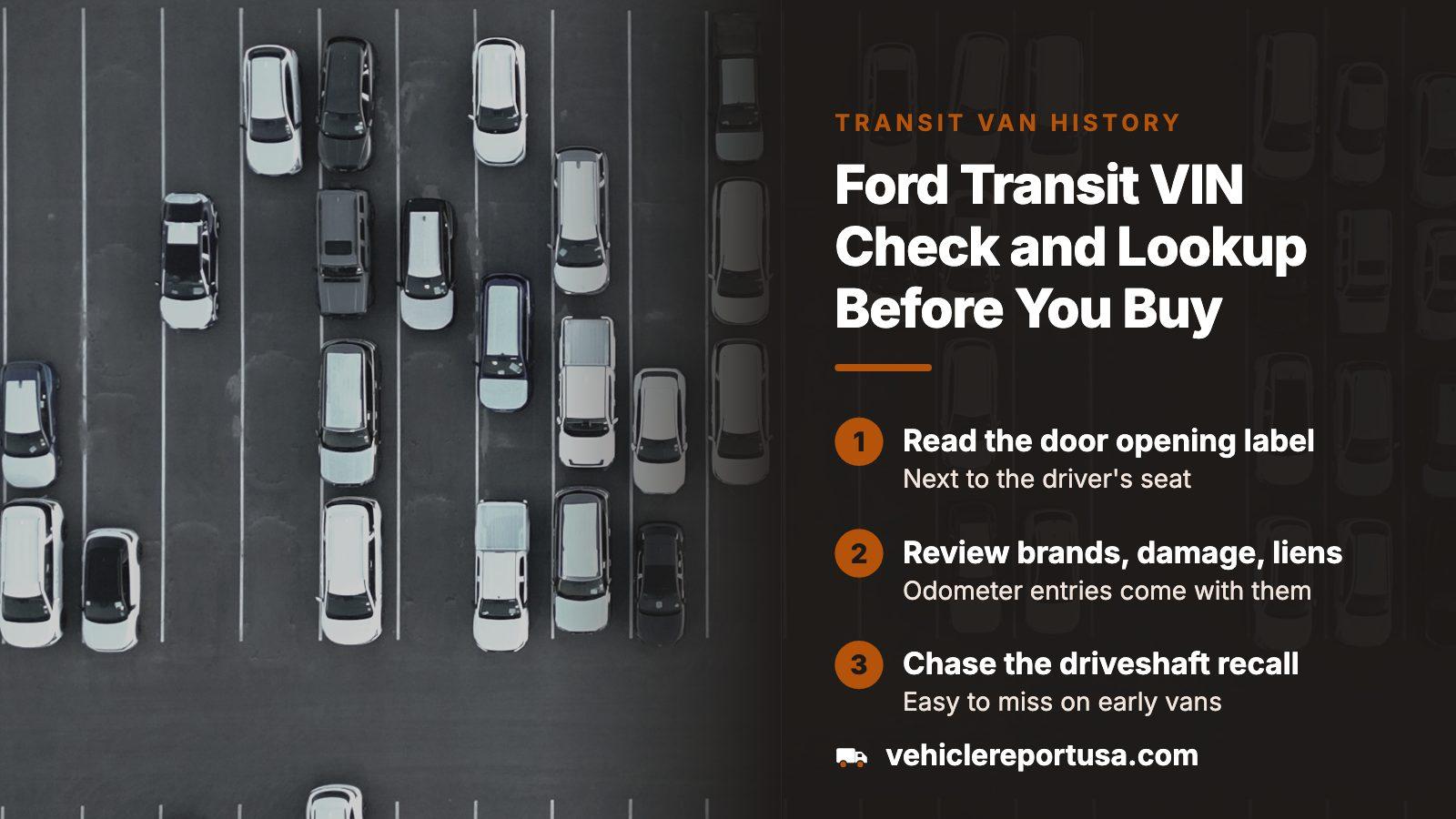
To check a Ford Transit by VIN, copy the number from the label in the driver's door opening, enter it for the free preview, then buy the one-time report if the van is still on your list. Review title brands, damage, odometer readings and liens, and check federal recalls separately, because 2015 to 2017 vans carry a driveshaft campaign that is easy to miss.
- Best fit
- Cargo, passenger, cutaway and converted Transit vans
- VIN label
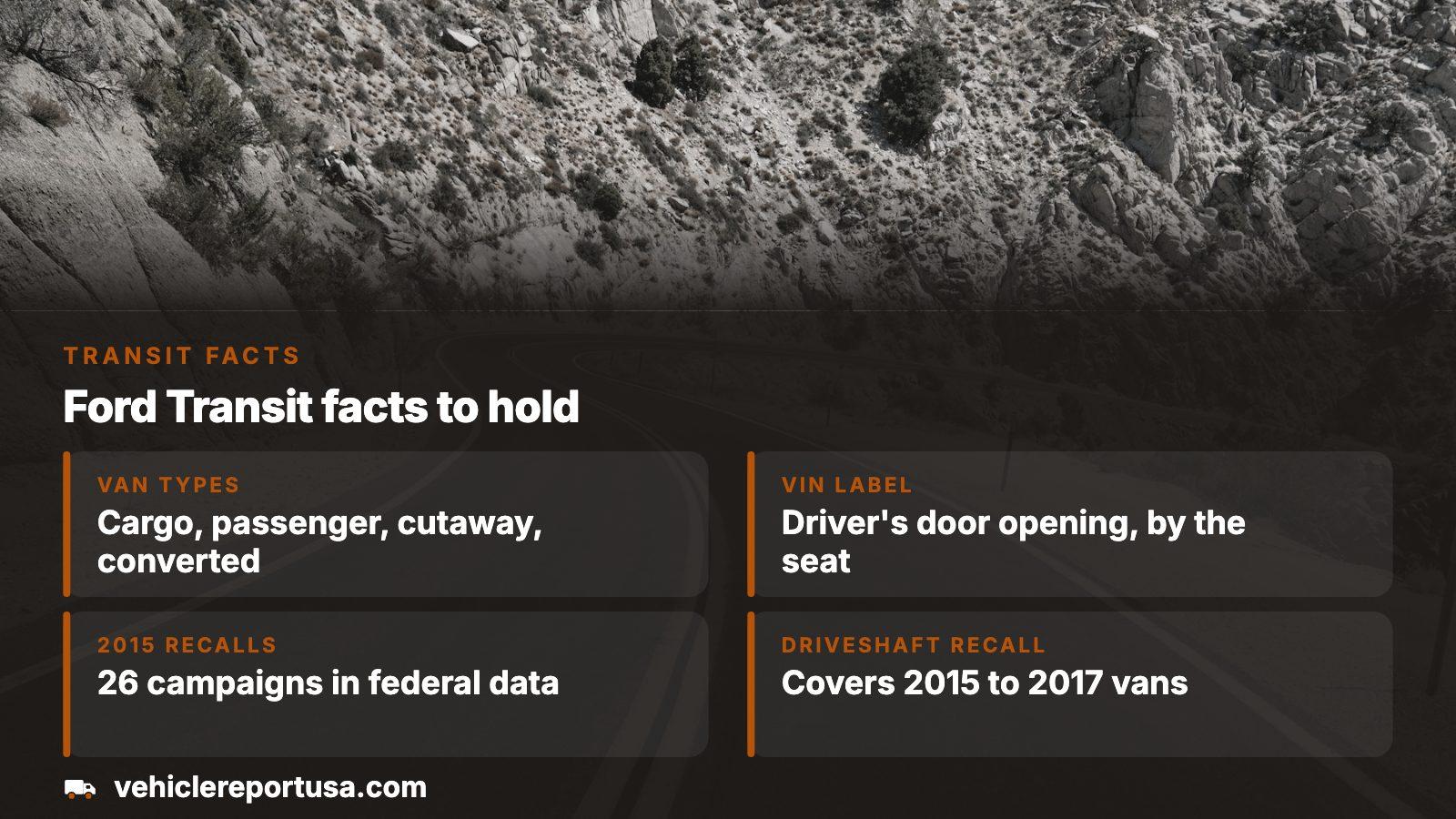
- Driver's door opening, next to the seat
- 2015 recall count
- 26 campaigns in the federal data
- Preview
- Free, before any payment
Why a used Transit deserves a record, not a hunch
Plumbers, couriers, rental yards, church groups and shuttle operators all run Transits, and the vans often change hands after a hard first life. The odometer can look modest while the engine has idled through more stop-and-go than a pickup sees in a decade.
That makes the van's paper trail the thing to read first. Ownership and use type often tell you more than the paint: a van that came out of a delivery fleet and one that sat with a single retiree are not the same purchase, even at the same price.
What the lookup finds on a work van
The free preview decodes the van and lets you compare it with the listing. The paid report then follows the same VIN through records that count for a commercial vehicle.
| Record | What it tells a van buyer |
|---|---|
| Title brand | Salvage, rebuilt or flood labels that change the value and the insurance terms |
| Damage and accident entries | Rear-end hits, loading-dock scrapes and rollover claims that a fresh coat of paint covers |
| Odometer readings | Dated mileage that should climb at a believable pace for a delivery or trade van |
| Auction and salvage photos | Pictures taken when the van sold, sometimes before repairs |
| Liens and impounds | Money still owed on the van, or a stay in a tow yard |
| Use type and owner count | Fleet, rental or private, and how many hands it passed through |
A clean result does not clear the van. It tells you that nothing was reported against this VIN, which is a start.
Where to copy the VIN from
Start at the driver's door. The maker's certification label belongs on the body structure beside the driver's seat, at the door hinge side or the latch side, and it must be fixed so firmly that removing it ruins it. When that spot is impractical, the rule falls back to the left end of the dash.
- Read the VIN yourself from the van, then match it to the title and registration.
- Photograph the label, because the weight ratings printed there help when you ask a seller about payload.
- Treat a missing, re-glued or mismatched label as a reason to walk away.
- On a cutaway or chassis cab finished by a body builder, the general label rule excludes two-stage vehicles, so compare the chassis number with the paperwork from both builders.
Take the VIN from the van, not from the ad. Typos in listings are common, and a check on the wrong number tells you about a different vehicle.
The 2015 to 2017 driveshaft recall and what a check cannot settle
If the van is a 2015, 2016 or 2017, one recall deserves your attention above the rest. Ford campaign 17V408000, received in June 2017, covered a flexible coupling between the transmission and the driveshaft that could fail early. A failed coupling leaves the van unable to move on its own, and the loose shaft can damage brake and fuel lines.
Campaign 19V767000 followed in October 2019 and superseded it. The interim fix in that campaign was a new coupling every 40,000 miles until a redesigned front shaft carrying a solid universal joint was ready, all at no cost to the owner. Chassis cab and cutaway models with 156 or 178 inch wheelbases were left out.
Ask for proof of which repair a given van received. A recall history on a report shows an open campaign; it does not show that a dealer fitted the final part, and it will not show a shop that did the work unrecorded.
What an owner who inherited the problem reported
From an NHTSA owner complaint
A new owner of a 2015 Transit told NHTSA in January 2024 that the flexible coupling snapped, taking out a fuel line and brake lines. The Ford dealer offered to cover the coupling only, saying notices had gone to the previous owner, and quoted about $3,100 for the rest. The owner said no notice ever arrived.
The lesson is practical. Recall letters follow the first owner, not the van, so a buyer often learns about an open campaign from a mechanic or from the VIN. Another owner with a 2015 van wrote that the dealer was told to skip the recall work since the van had gone beyond 100,000 miles, which is the sort of detail worth settling in writing before you pay.
Conversions carry their own recalls
The federal database returned 26 campaigns for 2015 Transit vans, 21 for 2016, 18 for 2017 and 14 for 2018. Counts for later years were lower, with 9 for 2019 and 9 for 2020, then 16 for 2022 and 19 for 2023.
Companies that build wheelchair-lift vans, shuttles, hybrid conversions and camper or generator setups file recalls on the chassis they modified. Examples in the data include foldaway seat cushions that might not stay locked, a wheelchair lift cam, a hybrid conversion driveshaft joint and a generator fuel hose on 2020 to 2023 vans.
If the van you are shopping has seats, a lift, a generator or a converted interior, ask who did the build, then search for recalls under that company as well as Ford. A VIN lookup surfaces the Ford side; the upfitter's paperwork covers the rest.
Newer Transit vans and repeat recalls
Recent model years have software-heavy recalls. A 2022 Transit shows campaigns for the 360-degree camera, the rearview camera prep kit, the instrument cluster and the defrost controls of the climate system. Several of those drew a later campaign for vans where the first repair had not fixed the fault.
- Confirm every campaign on the van shows as completed, not just the first one.
- Check the camera, cluster warning lights and defrost on the test drive.
- Keep the dealer's repair order for each recall visit.
- Do not assume a Transit Connect record applies; that is a different model name in the federal data.
Complaint counts look different by year too. Owners filed 194 complaints for 2015, 156 for 2016, 98 for 2017 and 58 for 2018, with power train the biggest group for the early years.
Mileage, weight ratings and the odometer statement
Most cargo and passenger Transit vans fall under the 16,000 pound cutoff in the federal odometer rule, so a seller normally has to state the mileage on the title paperwork. A heavier cutaway or chassis cab may sit above it, and then the seller can skip the statement.
Age exempts a van too, but a model year 2011 or newer vehicle is excused only after 20 years.
Use the odometer readings in the report to test the number on the dash. A van with a long gap between readings, or a mileage figure that drops from one entry to the next, needs an explanation before money changes hands.
Run the check, then decide
Start with the free preview to confirm the van matches the ad. If it does, buy the single report for that VIN; the cost is a one-time payment and the current amounts are on the pricing page, with larger bundles for shoppers comparing several vans. There is no subscription.
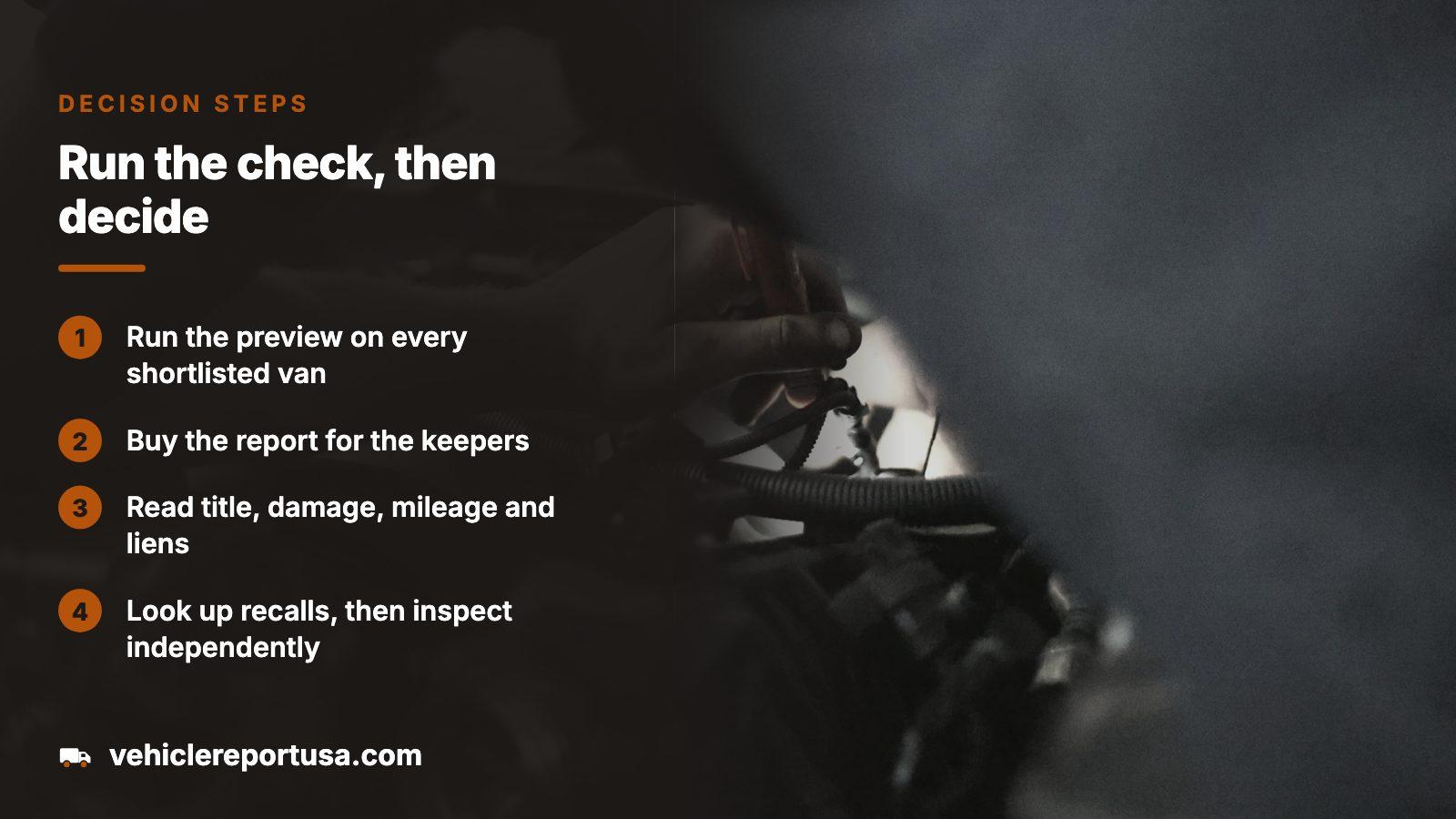
- Run the preview on every van on your shortlist.
- Buy the report for the ones you would still consider.
- Read title, damage, mileage, lien and use entries.
- Look up recalls on the federal NHTSA site and ask for proof of each repair.
- Take the report to an independent inspection before you pay.
A van that passes all five steps has earned a closer look. One that fails any of them has saved you a trip.
Where this information comes from
- NHTSA recalls data: 2015 Ford Transit — driveshaft, axle, fuel and upfitter campaigns for early vans
- NHTSA recalls data: 2022 Ford Transit — camera, cluster and climate control software campaigns
- NHTSA owner complaint 11564579 — owner experience, paraphrased
- NHTSA owner complaint 11432362 — owner experience, paraphrased
- eCFR 49 CFR 567.4: certification label — where the VIN label goes and how it is attached
- eCFR 49 CFR 580.17: odometer exemptions — weight and age limits for the mileage statement
- VehicleHistory.gov: NMVTIS — federal title data system aimed at title fraud
Sources and photos: Facts checked against the sources above in November 2026. Photos by Iain, Mustafa Sheikhmouss and Will Truettner on Unsplash; diagrams by VehicleReportUSA.
Keep reading
- Mercedes Sprinter VIN Check: Work Van, Camper and Cutaway History Before You BuyThe same questions for the Sprinter van you may be cross-shopping.
- Ram ProMaster VIN Check: Read a Used Cargo Van's History Before You BuyCheck the ProMaster side of a cargo van shortlist.
- Box Truck VIN Check: Run the History Before You Buy OneFor cutaway Transit buyers moving up to a box body.
- Check a Truck VIN Number: Pickups, Box Trucks and Heavy-Duty RigsThe general check for pickups, vans and heavier trucks.
Frequently asked questions
Is a Ford Transit VIN lookup free?
The first step is: the preview decodes the van so you can compare it with the listing. The full report is a single paid purchase, with no subscription. Federal recall lookups through NHTSA are free as well, and worth running alongside it.
Where is the VIN on a Ford Transit?
Look in the driver's door opening for the maker's label beside the seat. Copy it yourself and match it to the title.
Which Transit years had the most recalls?
In the federal data pulled for this page, 2015 shows 26 campaigns and 2016 shows 21, many from upfitters. Later years run lower, though 2022 shows 16 and 2023 shows 19. Counts change as filings arrive, so look up your exact VIN.
Does a VIN check show the driveshaft recall repair?
It shows whether a campaign is open or completed, not the quality of the work. For a 2015 to 2017 van, ask for the repair order and confirm whether the interim coupling or the final u-joint section was fitted.
Can I run a check on a converted passenger or wheelchair van?
Yes, the chassis VIN is the same. The conversion company may have filed recalls of its own, so ask who built the interior and look those up separately. Request the builder's paperwork when you inspect the van.
Now check the car itself
The guide explains what to look for. The report shows what this VIN has on record.