THE SHORT ANSWER
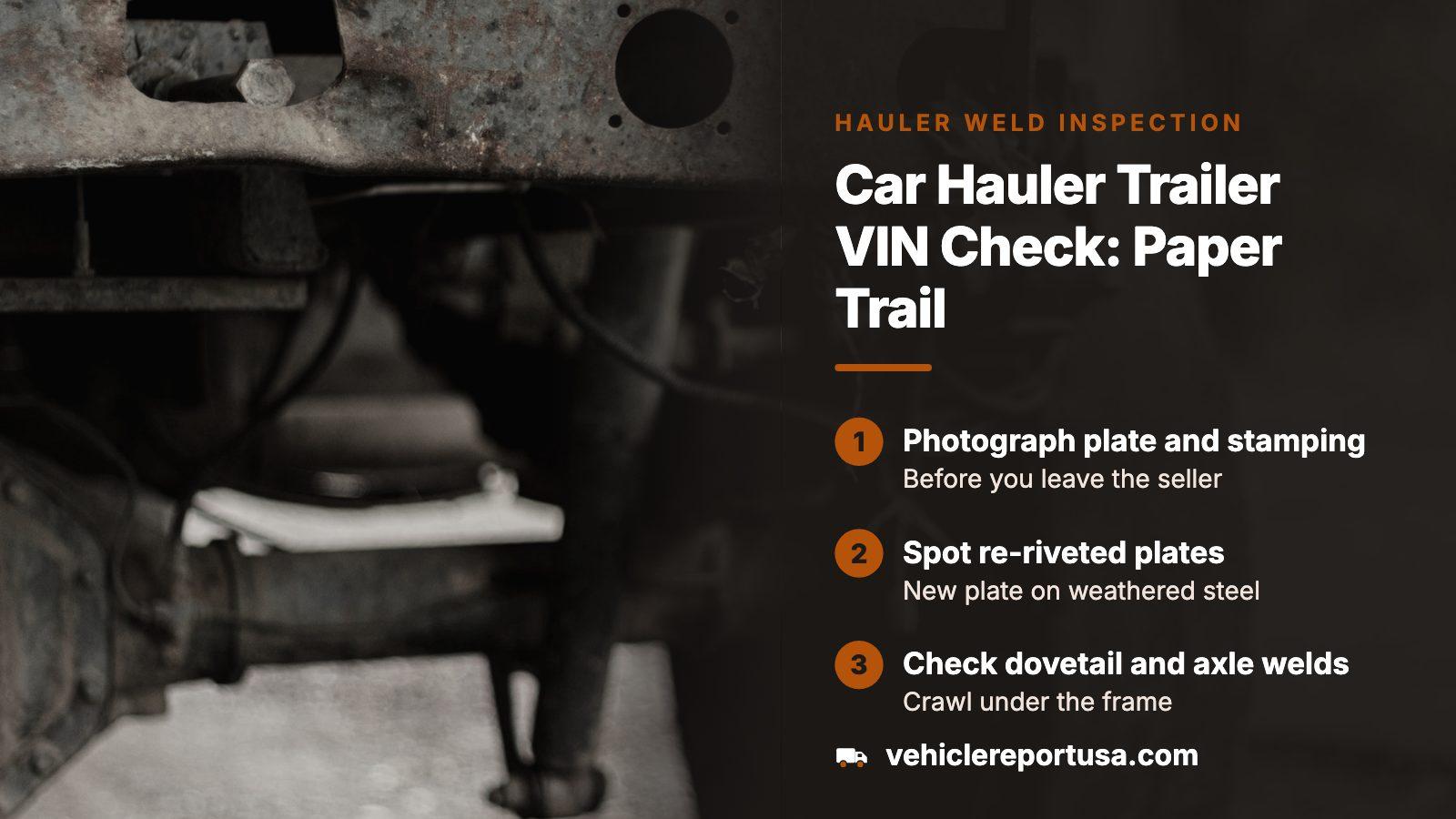
Find the VIN on the label at the front left of the trailer, type all 17 characters into the search, and study what the no-charge preview returns. The paid report then adds brands, liens, theft entries, damage and open recalls. Because haulers carry heavy loads, crawl under the frame and check the dovetail and axle welds yourself.
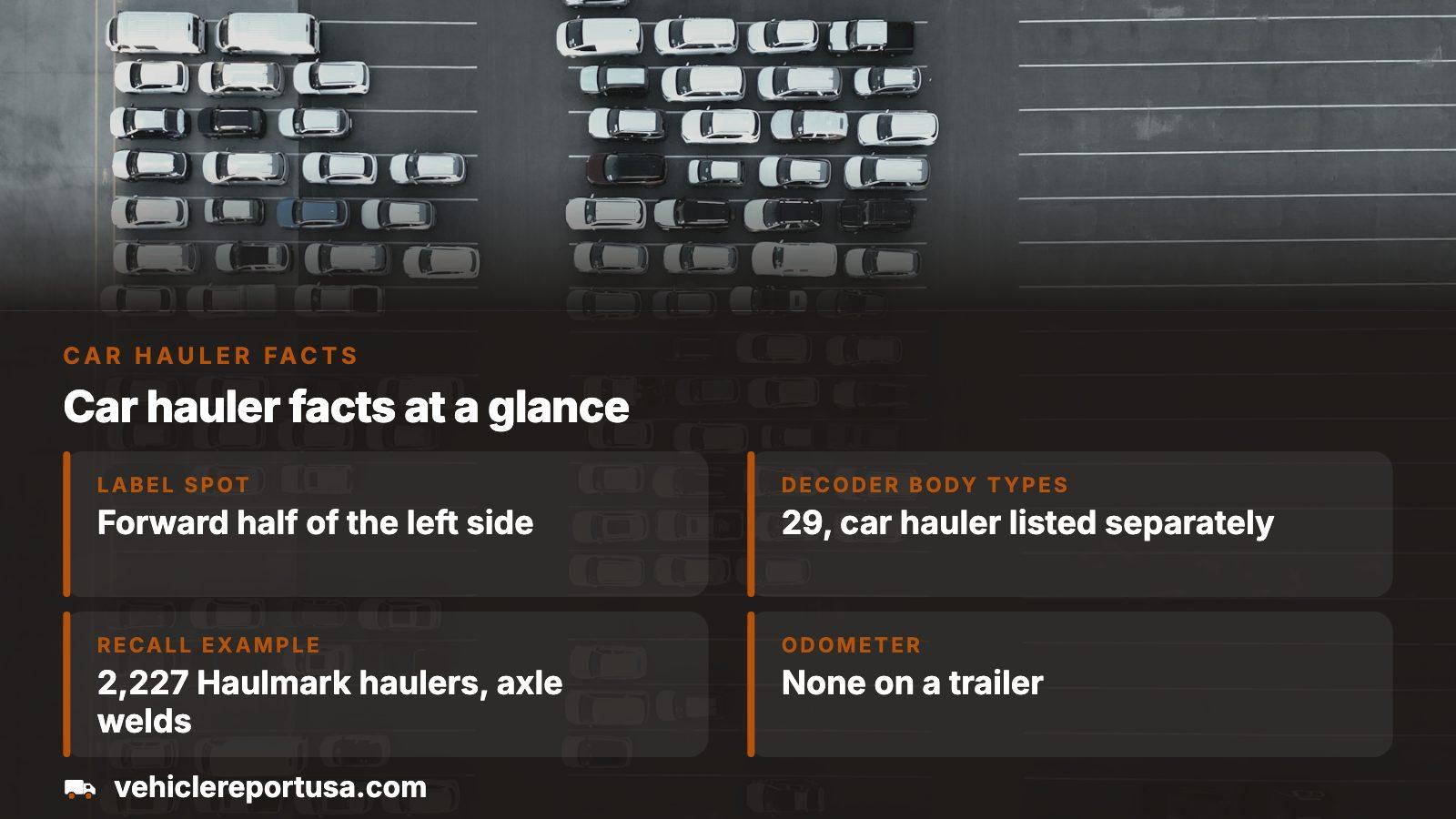
- Label spot
- Forward half of the left side
- Decoder body types
- 29, with car hauler and auto transporter listed apart
- Recall example
- 2,227 Haulmark haulers, axle bracket welds
- Odometer
- None on a trailer
Why a hauler deserves its own history check
Most trailers sit in a yard and carry a lawn tractor. A car hauler spends its life under a vehicle weighing a few tons, bounced down interstates behind a dually or a one-ton pickup, and that load finds every weak weld. Sellers often describe a hauler as barely used, yet a trailer has no odometer to confirm it.
What a VIN search offers instead is a paper trail. Titles, loans, insurance claims, auction sales, theft reports and safety recalls all get filed against a number, so a hauler that touched any of them leaves entries behind. Ask for the number early, because a seller who stalls on it is telling you something.
What the search can turn up on a hauler
| Record | Why a hauler buyer cares |
|---|---|
| Title brand | A salvage or junk label left by a wreck or fire, but only if a titling state recorded it |
| Lien or impound | Unpaid loan or an earlier tow-and-hold; either can stall your title transfer |
| Theft entry | Haulers are easy to hitch and drive off, so a report filed against the number matters |
| Damage and auction photos | Photos from earlier losses or sales, when they exist |
| Open recall | Safety campaigns never repaired, most often structural ones on frames and axles |
| Odometer | Nothing useful, since the trailer has no gauge |
The Justice Department's NMVTIS title system answers a FAQ about what it includes, and the answer runs from cars and buses through RVs to tractors. Trailers are not in it. A sparse result for a hauler is therefore ordinary. Read it as a shortage of records, which is different from a trailer with nothing to hide.
Finding the number on a hauler
The federal certification label for a trailer is meant to sit on the front half of the driver's side of the unit, legible to someone standing next to it. On an open hauler that points you to the front left of the frame near the tongue, so begin at the coupler and work rearward.
- Shoot clear photos of the plate and of any number stamped into the steel while you are still at the seller's place.
- Confirm the plate calls the unit a trailer and that the builder named on it matches the brand on the deck.
- Be wary of a shiny new plate riveted onto weathered, rusty steel.
- Count the characters: a short entry decodes with errors, so enter all 17.
A resale shop that did not build the trailer may appear on the label as the responsible manufacturer, so an unfamiliar name is not a warning on its own. A number that disagrees with the paperwork is.
A decoder quirk: the hauler that decodes as a utility trailer
NHTSA's decoder offers 29 trailer body types, and it lists car hauler trailer and auto transporter as separate entries. Real records do not always follow that tidy split. I decoded the partial VIN printed in a public owner complaint about a 2023 Primo that the owner called a car hauler, and the decoder answered Utility Trailer, 18 feet long, two axles.
It also flagged errors in a few positions and an incomplete VIN, which is what a partial number earns. No weight rating or hitch type came back. The takeaway is practical: treat the decoded body type as the maker's filing, and check length and axle count against the trailer in front of you. The label's weight ratings, not the decode, tell you what the deck and axles are built to carry.
Recalls and weld failures on haulers
NHTSA campaign 09V182000 shows how a hauler defect is described. The maker Haulmark pulled in 2,227 transport and car hauler trailers sold as 2008 and 2009 models, with a production window running from mid-August 2007 into May 2009, because the structure where the axle bracket meets the frame rail was not reinforced enough. Metal fatigue could crack the welds and let the axle separate from the frame, which NHTSA's text says could lead to a crash. Dealers were to repair the trailers free of charge.
From an NHTSA owner complaint
An owner hauling a 2023 Primo car hauler behind a Ford F-550 stopped at a rest stop and saw that the welds holding the dovetail had broken away. The local dealer did not diagnose or repair it, though the maker was told, and the trailer had about 26,400 miles on it. NHTSA's own note says its VIN tool judged the owner's VIN invalid.
That story fits what a search cannot see. A cracked weld leaves no title brand and no theft entry. Recall status follows the make, model and year, and a campaign usually covers a build window, so run the full VIN and then crawl under the trailer with a flashlight.
Paperwork, weight and who can title it
Each state writes its own trailer title rules, so read the one for the place you will register the hauler. Texas shows how weight changes things. Its DMV defines gross weight as the trailer plus its carrying capacity, and says a manufactured trailer above 4,000 pounds gross has to be titled.
For a used unit over that line, a certificate of title is the proof. Lighter ones can pass with a sales receipt and a registration slip. A hauler rated to carry a car sits well past the heavier line, so a seller with no title and a tale about a lost one deserves a polite goodbye. A homebuilt trailer with no number needs a law enforcement inspection and an assigned-number notice first.
Signs to walk away
- Any salvage, junk or flood brand, however old.
- A theft entry, or a stamped number one character off from the bill of sale.
- A lien or impound line nobody told you about.
- Decoded length or axle count that disagrees with the deck in front of you.
- Fresh grinding or weld patches where the stamping should be.
- Mismatched weight ratings, such as a label rated far below what the axles and tires suggest.
The first four justify stopping the deal until the seller explains. The last two call for a scale ticket or a trailer shop's opinion before cash changes hands.
Running the search here
The preview comes first, charges nothing, and shows the decoded VIN. The paid report is a single purchase that never renews, and packs of 3, 5 or 10 help when you are comparing a few haulers. Amounts are on the pricing page.
- Take photos of the plate and the frame stamping.
- Enter every character and compare the preview's length and axle count with the trailer.
- Request the title and confirm your own state's rule.
- Buy the report if the hauler is still on your list.
- Go over the dovetail, axle brackets and every weld before paying.

Where this information comes from
- eCFR: 49 CFR 567.4, certification label — Where a trailer's label sits, and how a reseller may appear on it.
- NHTSA: vPIC VIN decoder — The decoder used for the body type and length test on a partial VIN.
- NHTSA recall 09V182000, Haulmark car hauler trailers — A structural axle bracket recall for haulers built in a set window.
- NMVTIS: frequently asked questions — Lists the vehicle types held in the national title database; trailers are absent.
- Texas DMV: trailers — One state's weight line and proof-of-ownership rules for manufactured trailers.
- NHTSA owner complaint 11651821 — owner experience, paraphrased
Sources and photos: Facts checked against the sources above in November 2026. Photos by Zoshua Colah, Masjid MABA and Iain on Unsplash; diagrams by VehicleReportUSA.
Keep reading
- Trailer Recall Check: Find Open Safety Recalls by VINHow to look up open safety campaigns on a trailer by make, model and year.
- Where Is the VIN Number on a Trailer? Label, Frame and TongueWhere to hunt for the number when rust or paint hides it.
- What If a Trailer Has No VIN Number? A Buyer's ChecklistWhat to do with a hauler that has a stripped or missing number.
- PricingOne report or a pack, if several haulers are on your shortlist.
Frequently asked questions
Does a car hauler trailer VIN check show mileage?
Nothing meaningful: there is no odometer on a trailer to read. Judge age from the month and year on the label, then judge use from the deck, tires, hitch and welds. Heavy loads leave marks on a hauler that no database records.
Will the check say the trailer is a car hauler?
Not reliably. The decoder repeats what the maker filed, and one 2023 hauler decoded as a utility trailer. Compare the decoded length and axle count with the trailer, and read the label's type line instead.
Can I check a hauler that has no VIN?
Not until it has a number. A homebuilt or stripped trailer needs one assigned through your state, which in Texas follows a law enforcement inspection. Treat a newly assigned number as a number with little history behind it.
Does a clean result mean the hauler is safe to buy?
No. Records only exist where a state titled, a lender, insurer or auction touched the trailer, and a cracked frame weld never shows up in them. Use the result for paperwork risks, then inspect the structure yourself.
Is a car hauler VIN check free?
Only the preview costs nothing, and it appears before payment. The full report is a single charge with packs available for several trailers; see the pricing page for amounts. NHTSA publishes its recall records at no charge to anyone.
Now check the car itself
The guide explains what to look for. The report shows what this VIN has on record.