THE SHORT ANSWER
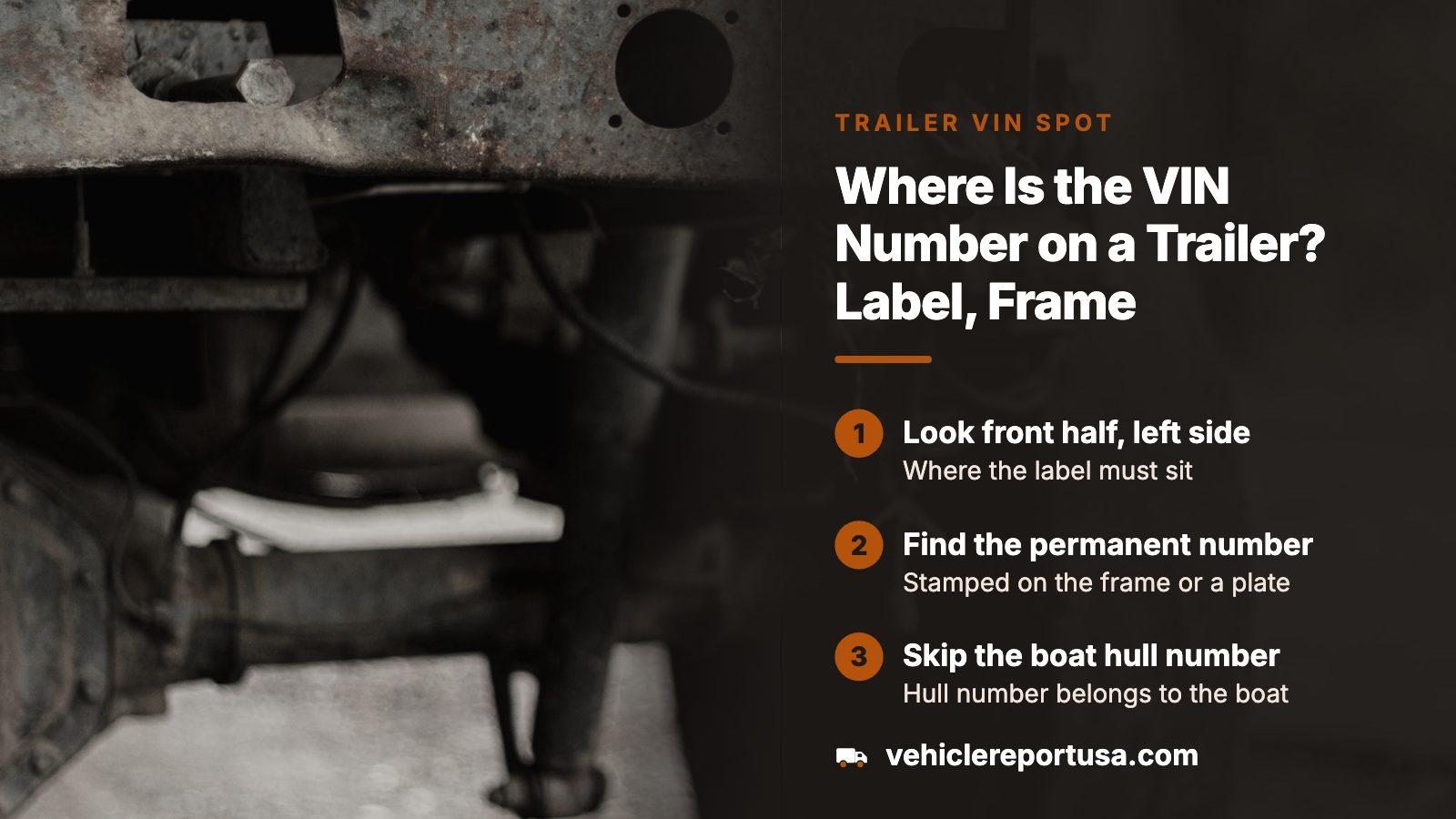
Start on the left side, toward the hitch end. Federal rules place the certification label there, legible from outside and fixed so it cannot be lifted off intact, and the label prints the VIN. The rule also wants the number on a lasting component or a plate attached to one, so check the tongue and each frame rail for a stamping or plate. Label, frame and title should all agree.
- Label
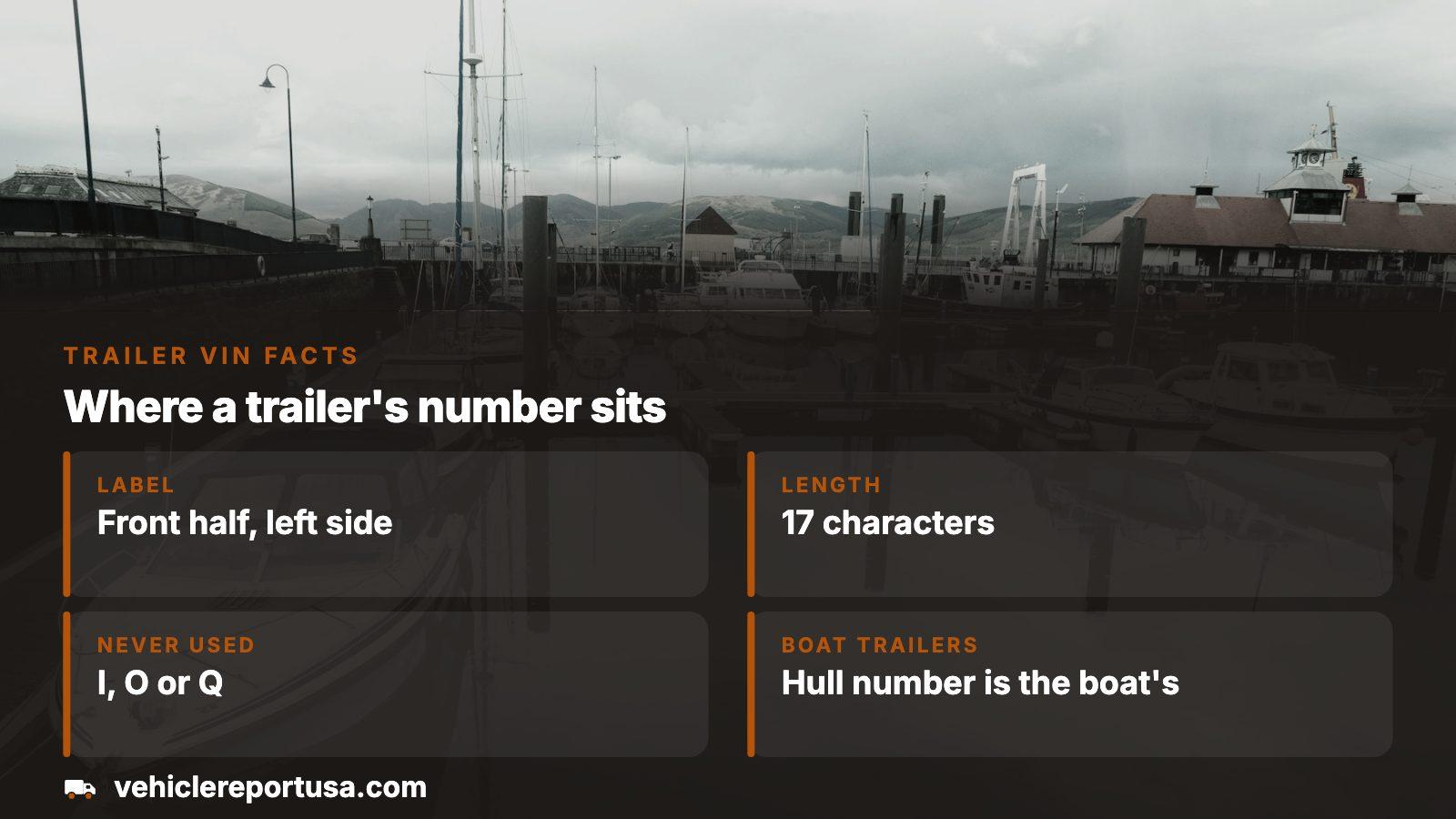
- Front half, left side
- Length
- 17 characters, never I, O or Q
- Boat trailers
- The hull number is not the trailer VIN
- Preview
- Free; the report is bought once
The rule gives a trailer's number no fixed address
The VIN must be clear and lasting, and the builder may put it on any component that is not meant to be detached, repairs aside, or on a plate or label permanently attached to one.
Cars get a stricter rule, a number visible from outside through the glass by the left windshield pillar. That paragraph covers passenger cars, light trucks and similar vehicles, and trailers are not named in it. So hunt for two things, the label and the permanent number. Only the label has a mandated address.
The label has an address: the trailer's front left
On a trailer the certification label goes on the left side, in the front half, readable from outside without moving anything. Rivets or equally lasting fixings must hold it, so taking it off ruins it, and the block-capital lettering must contrast with the background. It lists:
- The builder's full name after Manufactured By or Mfd By. A seller that builds trailers and answers for them legally may appear as Responsible Manufacturer or Resp Mfr.
- The completion month and year at the main assembly point. Treat it as a build date, which may differ from the model year the VIN encodes.
- A weight rating for the whole trailer, then one per axle starting at the hitch end. Neighboring axles with identical ratings and the same tire size may share one line saying which axles it covers.
- A statement that the trailer met the federal safety standards in force on the build date, plus the VIN and the vehicle type, which should say trailer.
Count the axles under the trailer and compare them with the lines listed.
Finding the permanent number on the frame
If the label is the only copy in sight, keep looking. The stamped number or riveted plate can show up on the tongue, a frame rail or another structural member, since the rule asks only for a part that stays put. Texas's motor vehicle agency calls the tongue the likeliest place for the builder's name, which also hints at a factory build.
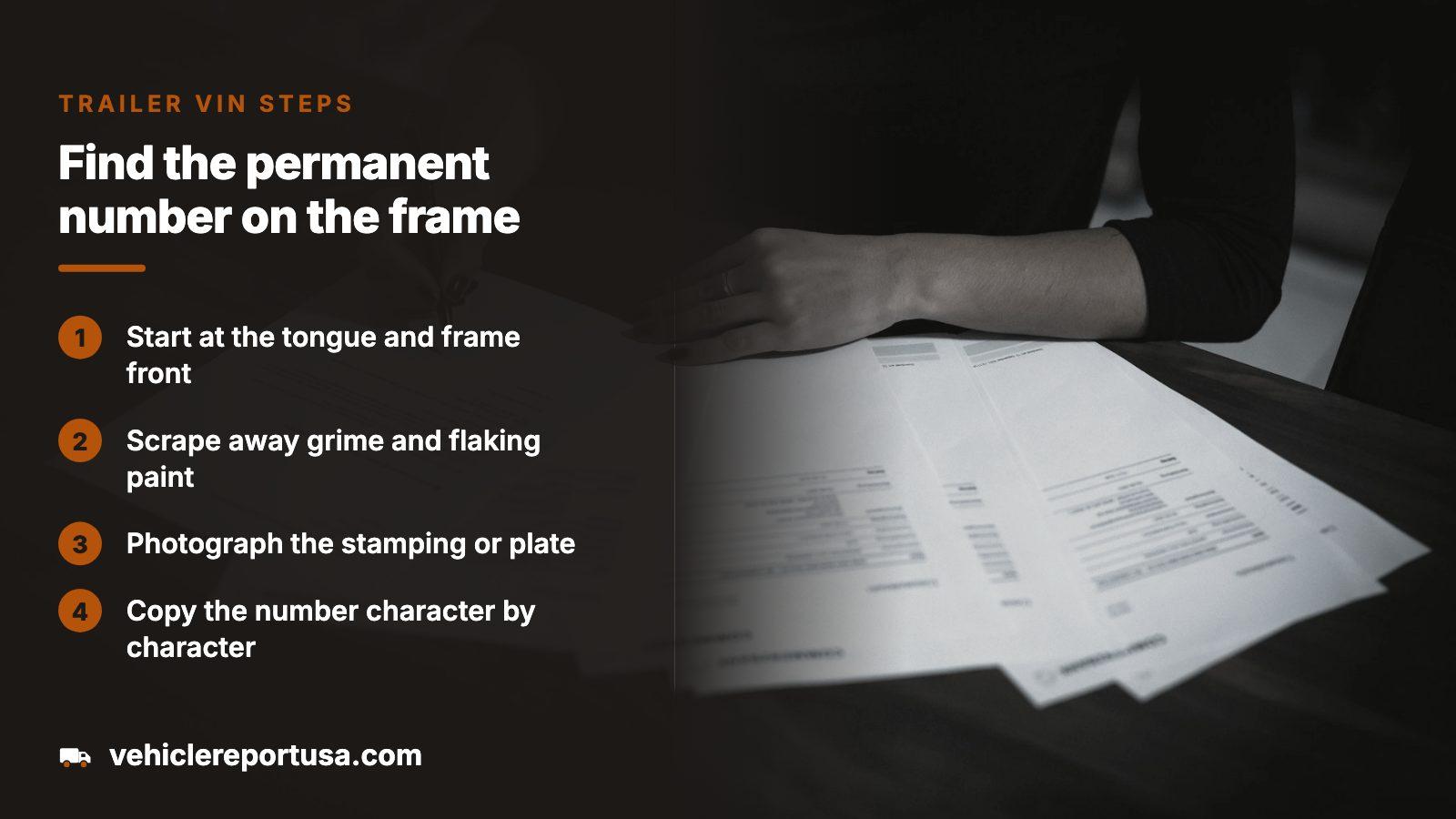
- Start at the tongue and the front of the frame, then follow each rail toward the axles.
- Scrape away grime and flaking paint. Hold a flashlight almost flat against the metal so shallow characters throw shadows.
- Photograph the stamping or plate, the label, and one wide shot showing where each sits.
- Copy the number a character at a time and count to 17. An I, O or Q you think you see is probably a 1 or a 0.
Boat trailers: the hull number belongs to the boat
A boat carries a hull identification number, and the trailer under it carries a VIN. Sellers mix the two up.
| Detail | Boat hull number | Trailer VIN |
|---|---|---|
| Belongs to | The boat | The trailer |
| Length | 12 characters with no spaces or hyphens | 17 characters, check digit in position nine |
| Main spot | On a boat with a transom, the starboard outer face, near the top edge | The label up front on the left, plus any stamped number or plate on the frame |
| Backup | A duplicate tucked out of sight inside the hull or beneath hardware | The frame number and the label cover for each other |
A seller reading you the hull number has not given you the trailer's VIN. Ask to see the trailer's own label.
What the 17 characters say about this trailer
Trailer VINs follow the federal layout, and the rule lists what a trailer's number must let you work out.
| Positions | What a trailer buyer reads there |
|---|---|
| 1 to 3 | Maker and vehicle type. A 9 in position three signals a longer maker code. |
| 4 to 8 | Make, trailer type, body style, overall length and axle layout. |
| 9 | Check digit: one number or the letter X. |
| 10 | Model year code. |
| 11 | Plant that built it. |
| 12 to 17 | Serial run. On a trailer the final four characters are digits only. |
A maker turning out under 1,000 trailers of one type per year counts as low-volume and also uses positions 12 to 14 for its code. NHTSA linked 9,611 makes to the trailer type in November 2026, so the field of builders is wide.
A worked decode: eleven characters of a travel trailer
Take 4X4TCKC27KX, the first eleven characters of a travel-trailer VIN printed in a public NHTSA complaint record. NHTSA's decoder accepts a partial number, flags it as incomplete and warns that the model year may be wrong. The tenth character, K, codes for 2019.
It returns a Forest River Cherokee, body class trailer, two axles, a length of 27 feet counted from the front of the hitch connector to the tail, a ball-type pull connection and a plant in Topeka, Indiana. The maker reported all of it, so if the axle count or length disagrees with what you counted and measured, tell the seller.
Older, homemade and kit trailers
Not every trailer has a modern number. California's handbook wants a 17-digit VIN that survives the check-digit math on trailers of model year 1985 and later, and exempts park trailers, so an older trailer can carry a shorter one. That is not a verdict. The decoder says less and the paperwork says more.
A kit that arrives unassembled lets the fabricator name itself as manufacturer on the label. A trailer assembled from parts is a separate case: Texas requires a VIN on each newly assembled one, issued after an inspection by an auto theft law enforcement officer. A separate guide here covers trailers with no VIN.
When the label, the frame number and the title disagree
Metal and paper should read alike. California treats the label as a second public source for checking a VIN. Removal is supposed to wreck a label, so one that lifts off whole deserves a question, as does one that disagrees with the frame stamping on even one character. Two agencies react like this:
| What turns up | What the agency does |
|---|---|
| The VIN on the papers differs from the VIN on record | California requires a physical verification. |
| The label is missing or illegible | California sends its own staff to locate another accessible VIN. |
| Nobody can say if the trailer was factory-built or assembled | Texas sends it to an auto theft law enforcement officer for inspection. |
Other states set their own rules, so ask your state's motor vehicle office before paying.
Once you have the number, see what it carries
Decode the number first, at no cost, then look at the history. VehicleReportUSA runs the VIN and shows a free preview. The full report is bought once, never billed monthly, and the amount sits on the pricing page. Where a trailer has a title record, it can bring up brands, liens, theft and insurance entries, and open recalls.
A thin result is possible. Texas requires a title for factory-built trailers over 4,000 pounds gross, while a newly assembled trailer of 4,000 pounds or less may stay untitled. A short history on a small utility trailer is no flaw alone. A number that fails the decode, or disagrees with the metal, is the red flag.
Where this information comes from
- eCFR 49 CFR 567.4: certification label — Where a trailer's label goes and what it has to show.
- eCFR 49 CFR part 565: VIN requirements — How a VIN must be fixed to a vehicle and what each position holds for a trailer.
- NHTSA vPIC VIN decoder — Partial VINs and maker-reported results; the same service supplied the trailer fields in the worked decode.
- TxDMV: trailers — The tongue as the place for the builder's name, inspections and titling weights.
- California DMV: vehicle verifications — The label as a second VIN source and when a physical verification is required.
- California DMV: 17-digit VINs — The model-year cutoff for trailers and the park trailer exemption.
- eCFR 33 CFR part 181 subpart C: hull identification numbers — The length of a boat's own number and where it is displayed.
Sources and photos: Facts checked against the sources above in November 2026. Photos by Zoshua Colah, Dimitri Karastelev and A P on Unsplash; diagrams by VehicleReportUSA.
Keep reading
- What If a Trailer Has No VIN Number? A Buyer's ChecklistWhat to do when a trailer has no number to find.
- Trailer VIN Lookup: Check a Used Trailer's History by VIN Before You PayEnter the number you found and see what the preview returns.
- Utility Trailer VIN Check: What the History Shows Before You BuyThe same hunt for a utility trailer, with the buyer's checks.
- Trailer VIN Lookup Specs: What the Decode Shows About Weight and PartsWhat the number says about length, axles and body type.
Frequently asked questions
Is the VIN on a trailer on the tongue or the frame?
Either is possible, since the rule asks only for a lasting part. The label is the fixed item, at the front of the left side. Texas names the tongue as the likeliest spot for the builder's name.
Why does my trailer have a shorter VIN?
Older trailers can carry a shorter number. California asks for a full 17-digit VIN on model year 1985 and later trailers and exempts park trailers. A short number proves nothing alone. The decoder will say less, so the title, label and any state inspection matter more.
Is a boat trailer's VIN on the boat?
No. The boat has its own 12-character hull number, usually on the starboard side of the transom, with a duplicate hidden inside. The trailer is a separate vehicle whose VIN is on its label and frame, so a number read off the boat does not identify it.
What if the certification label is missing or unreadable?
A missing or unreadable label is a flag, not a verdict. California has its own staff locate another accessible VIN in that case. Find the frame number, ask the seller what happened to the label, and ask your state's motor vehicle office about an inspection before you pay.
Can I run a VIN check on a trailer before I buy it?
Yes. Type the 17 characters into VehicleReportUSA for a free preview, and weigh the full report after seeing it; the pricing page has the amount. Photograph the label and frame number first, so you type what is really on the trailer.
Now check the car itself
The guide explains what to look for. The report shows what this VIN has on record.