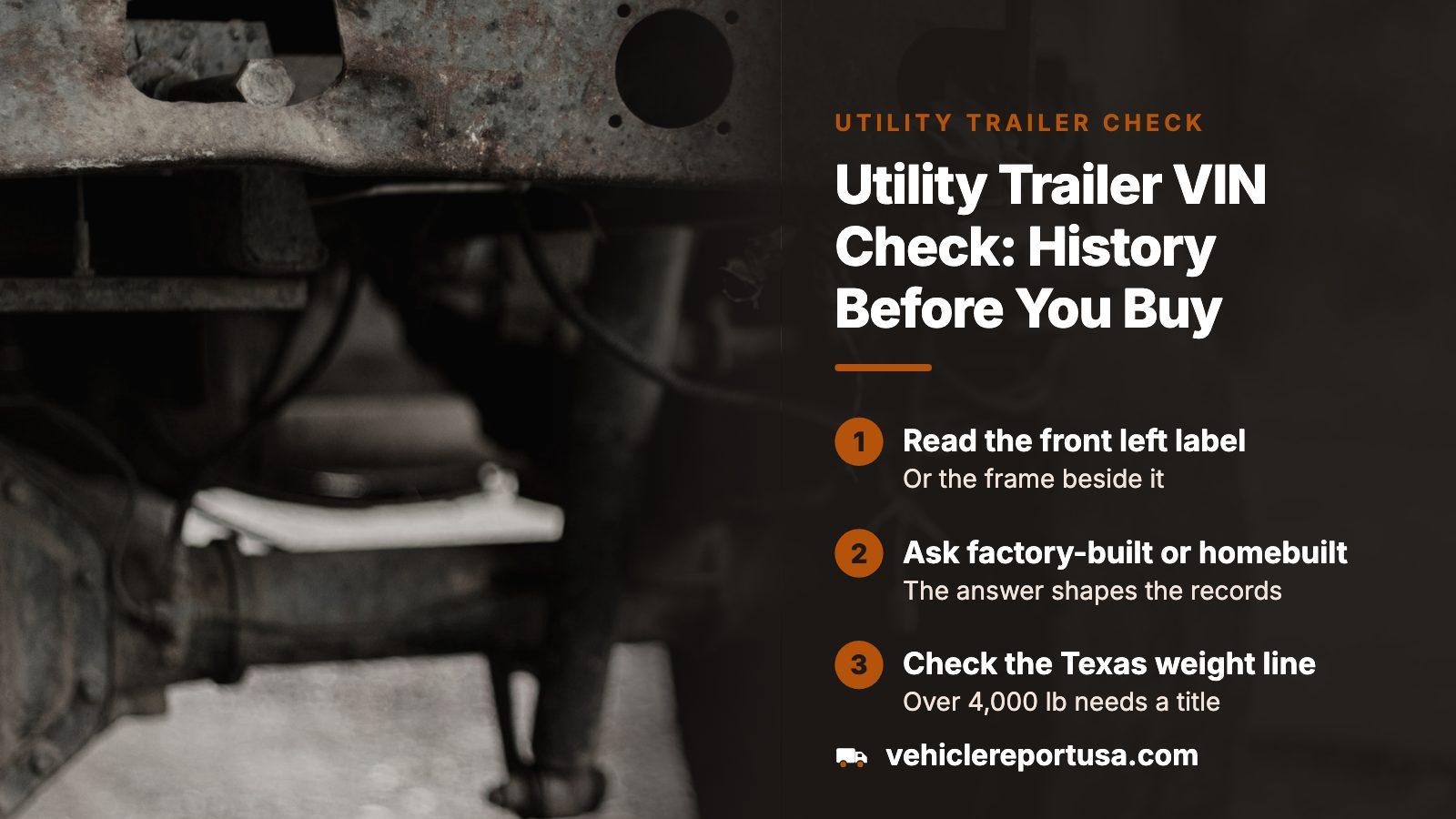
THE SHORT ANSWER
Read the VIN from the label or frame at the front left of the trailer, enter it, and look over the free preview before paying. The paid report then searches title brands, liens, theft, damage, auction photos and open recalls. A utility trailer never titled, insured or auctioned may return little, so add the paperwork and a look at the frame.
- Label location
- Front half of the left side
- Odometer
- None on a trailer, so the field stays empty
- NHTSA body types
- 29 trailer values, several for open decks
- Texas title line
- Manufactured trailers over 4,000 lb gross weight
What a VIN search can and cannot find on an open trailer
An open utility trailer leaves a thinner paper trail than a pickup. A record exists only if the trailer was titled, financed, insured, auctioned, reported stolen or recalled, and whatever exists is filed under the VIN.
| Record | On a utility trailer |
|---|---|
| Title brand | Salvage, junk or flood, but only where a state titled and reported it |
| Liens and impounds | A lender still owed, or an earlier tow-and-hold |
| Theft record | A report filed against this VIN |
| Damage and auction photos | Past losses and sales, with pictures where they exist |
| Open recalls | Safety campaigns not yet repaired, such as a ramp latch fix |
| Odometer | Almost always blank |
The Justice Department's FAQ on NMVTIS spells out which vehicles that title database includes: cars, buses, trucks, bikes, motor homes and tractors among them. A trailer is not named, so a short result is ordinary. It says few records exist, not that the past is spotless.
Finding the VIN and the label that backs it up
Begin at the coupler and work back along the left side: the tongue, then the front of the left frame rail. A trailer's federal label belongs on that side, in the front half, where someone standing beside the trailer can read it, and it must be attached so firmly that removing it ruins it.
- The builder's name and the month and year the trailer was finished.
- A weight rating for the loaded trailer, then one for every axle, listed from the tongue backward.
- The VIN, followed by the vehicle type, which should read trailer.
Compare the label with the steel. A plate can be peeled or swapped, while a stamping in the frame is harder to fake. If they disagree, or a bright new plate sits above bare metal, ask why before talking price. Wire-brush the rust off and photograph the number.
Factory-built or homebuilt: the question behind the paperwork
In a classified photo, a driveway-welded trailer can pass for a factory one. Texas sorts utility trailers into manufactured (built by a trailer maker) and assembled (built by a hobbyist), and its DMV says to look on the tongue for the maker's name. If nobody can say which it is, an officer from an auto-theft unit has to examine it.
Two details matter to a buyer. A factory trailer with missing papers cannot be registered as homemade, Texas says. And kits blur the line: a company shipping a trailer unassembled may name itself as maker on the label, so a small shop's name is no warning sign alone.
A homebuilt trailer with no number
Texas requires every newly assembled trailer to carry a VIN. Where none was ever stamped, the owner needs a police inspection and a notice of assigned number before titling. Until then a search has nothing to key on.
How NHTSA's decoder labels an open trailer
NHTSA's decoder repeats what the maker filed. Its trailer body-type field holds 29 values, and several describe open decks, among them utility, car hauler, flatbed or platform, and equipment. To see how that plays out, I decoded the partial VINs that appear in three public NHTSA owner complaints.
| Trailer in the record | Body type returned | Hitch | Length, axles |
|---|---|---|---|
| 2014 Aluma 5410T | Utility Trailer | Not returned | 10 ft, 1 axle |
| 2023 Carry-On, 5.5 by 10 | Utility Trailer, open | Ball | 10 ft, 1 axle |
| 2022 Load Trail model S flatbed | Flatbed or Platform Trailer | Pintle hook | 24 ft, 2 axles |
No weight rating came back in any of the three, so the label's figure stays the one to trust. A partial VIN is flagged as incomplete, with a warning that the model year may be wrong, so type all 17 characters. Then compare length and axle count with the trailer itself: a listed 14-foot tandem that decodes as 10 feet on one axle needs an explanation.
Title, bill of sale and the weight line in one state's rules
In Texas the dividing line is gross weight, meaning the trailer plus what it can carry.
| Trailer | Gross weight | What proves ownership |
|---|---|---|
| Used, manufactured | Over 4,000 lb | A certificate of title |
| Used, manufactured | 4,000 lb or less | A bill of sale and the registration receipt, or a title where the state issued one |
| Newly assembled | 4,000 lb or less | Titling is optional |
Other states draw their lines elsewhere, so check the rule where you will register the trailer, not where the seller lives. A search can report a title only if one exists, which is why an untitled trailer is routine in one state and a dead end in another.
Recalls follow the build date; owners report what records miss
A recall rarely covers a whole model year. NHTSA campaign 13V508000 named Big Tex utility trailers with a fold-flat ramp gate, built from March 2013 through September 30, 2013. Towing vibration could make the latches fail and let the ramp drag behind, and dealers fitted an extra latch at no charge. The same model built later sat outside the campaign, so a recall lookup needs the VIN, not just the year.
From an NHTSA owner complaint
The owner of a 2014 Aluma 5410T was bringing a golf cart and a spare tire home from Florida behind an RV. Crossing a speed bump in a mall lot at 3 or 4 mph, the trailer split in two: the deck, axle and load snapped free of the front arm that stayed chained to the RV. Nobody was hurt.
A split like that hides from title and theft searches. Look hard at the tongue joint and cross-members, and treat fresh paint over them as a question.
Red flags in the result and on the frame
- A salvage, junk or flood brand of any age.
- A theft report, or a frame number one character off from the paperwork.
- A lien or impound entry the seller never mentioned.
- A decoded length or axle count that does not fit the trailer in the driveway.
- Grinding, filing or a fresh weld patch where the stamping should be.
- A factory trailer sold with no papers and a homebuilt story.
From an NHTSA owner complaint
An owner towing a 2022 Load Trail flatbed behind a Toyota Tundra at 55 mph felt the truck jerk and heard a bang as the trailer came loose. The safety chains had broken, and so had the weld on the coupler. A dealer told the owner that weld was done incorrectly, and the owner said the manufacturer gave no help.
That trailer had covered 9,000 miles at most, yet the weakness sat in the coupler, a place no record reaches. Inspect the coupler, chains and welds yourself.
Running it: the preview, the report and the order that works
The preview costs nothing and decodes the VIN before any payment. You pay once for a report, with no renewal, and bundles of 3, 5 or 10 suit a shortlist of several trailers. Prices sit on the pricing page.
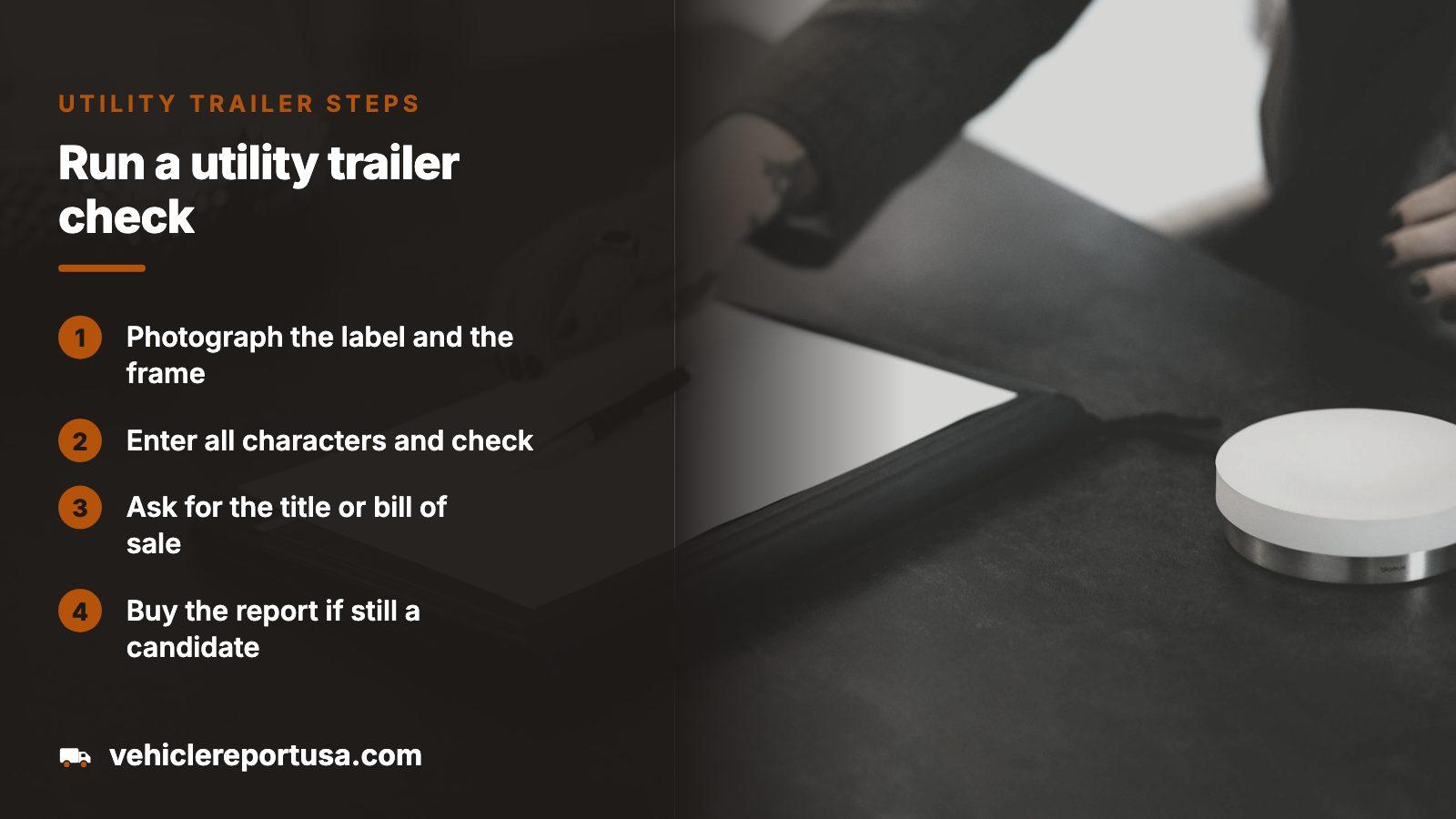
- Photograph the label and the frame stamping.
- Enter all 17 characters and check the preview's body type, length and axles against the trailer.
- Ask for the title or bill of sale and confirm what your state requires.
- Buy the report if the trailer is still in the running.
- Inspect the frame, coupler and chains before money moves.
Where this information comes from
- eCFR: 49 CFR 567.4, certification label — Says where a trailer's label goes, what it must show, and who may name themselves as maker.
- NHTSA: vPIC VIN decoder — The decoder behind the three test decodes; it reports maker-filed data and accepts partial VINs.
- NHTSA recall 13V508000, Big Tex utility trailers — Shows a ramp-gate latch recall limited to a build window.
- NMVTIS: frequently asked questions — Lists the vehicle types in the national title database; trailers are not among them.
- Texas DMV: trailers — Manufactured versus assembled trailers, the weight line and proof-of-ownership rules.
- NHTSA owner complaint 10701070 — owner experience, paraphrased
- NHTSA owner complaint 11518664 — owner experience, paraphrased
Sources and photos: Facts checked against the sources above in November 2026. Photos by Zoshua Colah, Annika Wischnewsky and Rob Wingate on Unsplash; diagrams by VehicleReportUSA.
Keep reading
- Where Is the VIN Number on a Trailer? Label, Frame and TongueA closer look at the tongue, rail and label when the number is hard to find.
- What If a Trailer Has No VIN Number? A Buyer's ChecklistWhat to do when a homebuilt or stripped trailer has no number at all.
- Trailer VIN Lookup Specs: What the Decode Shows About Weight and PartsWhat the decode fills in about length, axles and hitch, and what it leaves blank.
- PricingCompare a single report with a pack if several trailers are on your shortlist.
Frequently asked questions
Where is the VIN on a utility trailer?
Check the tongue first, then the front of the left frame rail, then the label on the left side. Rust and old paint hide stampings, so clean the spot before deciding a number is missing, and photograph what you find so the characters you enter match the steel.
Can I run a VIN check on a homemade utility trailer?
Only once it has a number. A trailer built at home has no factory VIN, so the state assigns one, which in Texas follows a law enforcement inspection. A recently assigned number has little history behind it, so ask to see the assignment notice.
Does a utility trailer VIN check show mileage?
No useful figure, because a trailer has no odometer. Judge age from the month and year on the label, which also lists the weight ratings that decide what can tow it. Wear on the deck, tires and hitch says more about use than any report field.
Why does the decoder call my open trailer a flatbed?
It repeats what the maker filed, and the body-type field offers several open-deck words. In three test decodes a Load Trail flatbed came back as Flatbed or Platform, while an Aluma and a Carry-On came back as Utility. Compare length and axles instead.
Is a utility trailer VIN check free?
The preview is free and arrives before you pay. Each full report is a one-off charge (prices on the pricing page), and buying a pack suits anyone checking several trailers. NHTSA publishes its recall records at no charge to anyone.
Now check the car itself
The guide explains what to look for. The report shows what this VIN has on record.