
THE SHORT ANSWER
Scrub the tongue and the front of the left frame rail, look for a riveted label, and compare any number with the title or bill of sale. If nothing turns up, the trailer was homebuilt, lost its number, or was altered. Homebuilt and stripped trailers need a state-assigned number after an inspection. Never restamp one yourself, because altering a vehicle number is a federal offense. Run a history search only after a verified VIN exists.
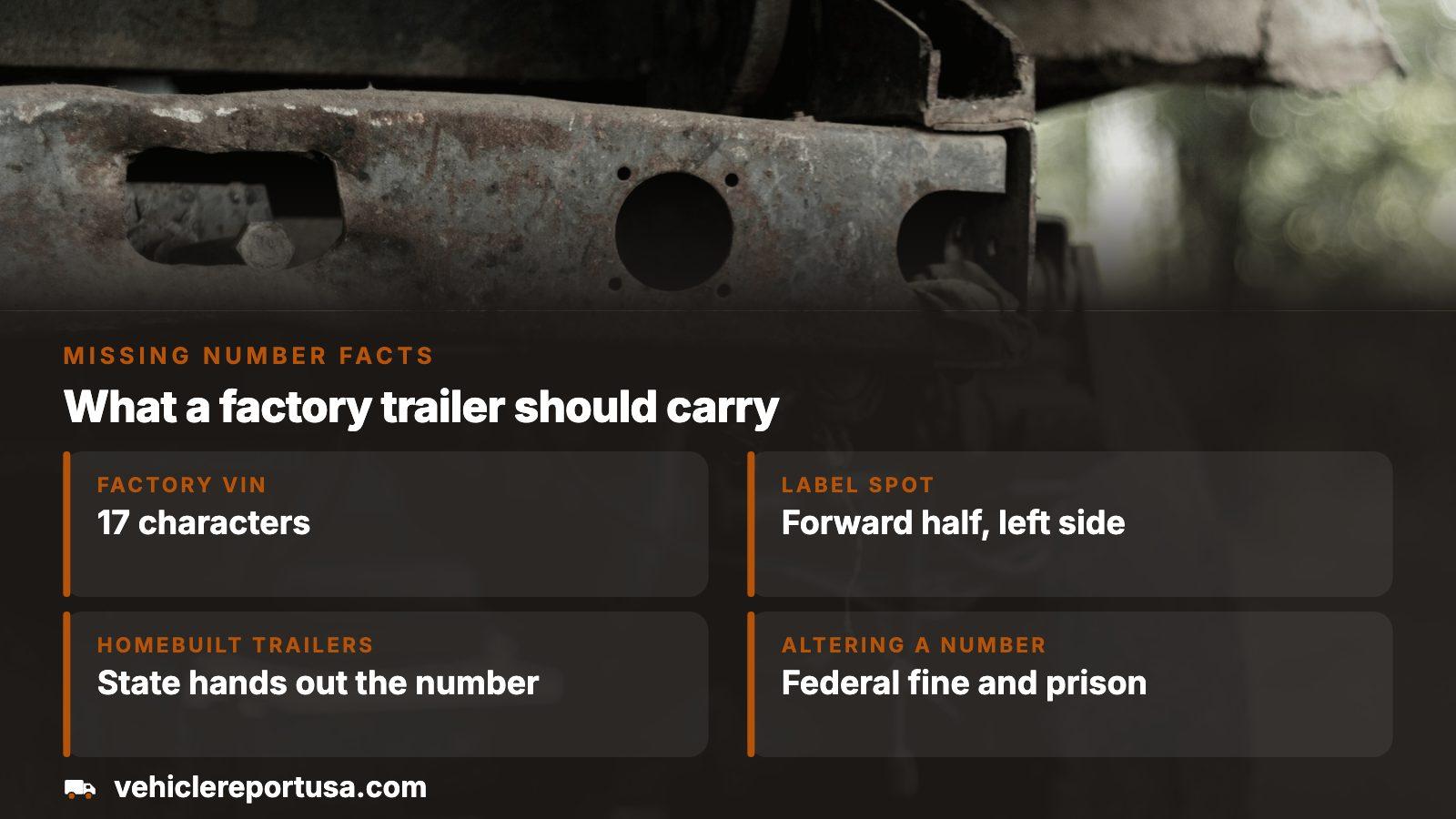
- VIN length
- 17 characters on a factory-built trailer
- Label spot
- Forward half of the left side
- Federal penalty for altering a number
- Fine, up to 5 years in prison, or both

What a factory trailer is supposed to carry
A trailer built by a company, from a big plant to a small shop, is meant to leave with a 17-character VIN that the builder assigned. The rule asks for the number to be clear and permanent: marked on a part that is not designed to come off, or on a plate or label fixed to such a part. The label adds the builder, the month and year, the weight ratings and the vehicle type. Kit sellers, and companies that vouch for a trailer another shop built, can appear as the maker. A trailer that came from a builder yet carries no number anywhere did not leave the way the rules intend, and the seller owes you an explanation.
Four situations, four different next steps
What you find on the trailer points to what happened to it.
| What you see | What it usually means | Next step |
|---|---|---|
| Stamping on the frame, label gone | The label was lost or removed; the steel is the evidence | Photograph the stamping, match it to the paperwork and ask why the label is missing |
| Label present, stamping unreadable | Worn or painted-over steel | Clean it; if the two numbers still disagree, treat it as an altered-number case |
| Nothing anywhere, built by a trailer company | A number removed, or never applied | Go to the state; inspectors, not owners, decide what the original number was |
| Nothing anywhere, built at home | A homebuilt trailer that never had a number | The state assigns one after an inspection, then titling continues |
Homebuilt trailers: the state hands out the number
A trailer welded together in a garage carries no builder's VIN, because no manufacturer ever assigned one. The state fills the gap. In Texas the trailer goes first to an authorized inspector, such as a law enforcement officer, who completes Form VTR-68-A and records that it was assembled from parts. The owner then takes that form, proof of ownership, a photo and the $2.00 fee listed on the state's page to a TxDMV Regional Service Center and receives Form VTR-68-N, the notice of the assigned number. Titling happens afterward at the county tax office. Where ownership papers are thin, Texas allows a bonded title for a homemade build.
California divides the work by weight. DMV assigns and fixes the plate for trailers under 6,000 pounds unladen, while the Highway Patrol handles heavier commercial trailers and any vehicle whose identity is in doubt.
A factory trailer whose number was removed
Texas separates two outcomes. If officers can work out the maker's original number even though it was removed or altered, the department can reassign that number. If they cannot, it can assign a new one. Either way the inspection comes first, and the inspector has to name the year and make; without those, there is no number and no title. A factory trailer with no acceptable ownership proof needs a court order, which must match the year, make and VIN on the inspection form. California sends a vehicle to the Highway Patrol when its label is missing or illegible and no second number can be found, or when a number looks tampered with.
Do not restamp it yourself
Federal law makes it an offense to knowingly remove, obliterate, tamper with or alter a motor vehicle's identification number, with a fine, up to 5 years in prison, or both. The definition covers a vehicle drawn by mechanical power, which fits a trailer built for the road. Restoring or replacing a number in line with state law is an exception, which is why the state process matters. A seller who offers to stamp a fresh number into the frame on the spot is skipping that route.
When the offer is to move a number instead of finding one
A missing or unusable number invites shortcuts. Owners sometimes report them to NHTSA, and one public record shows what a shortcut can look like.
From an NHTSA owner complaint
The owner of a 2023 Tomahawk container chassis reported it to NHTSA in December 2022, listing bad and missing welds and badly fitted locking pins. He wrote that one option he was offered was to take the VIN off his chassis and fit it to another one whose origin nobody knew. He did not think that was legal and kept the chassis to support his report.
Take from it that a VIN identifies one frame. If anyone proposes moving a number from another chassis, or stamping a new one, wait until the state has inspected the trailer.
What a history search can and cannot do without a number
History databases are indexed by VIN, so a trailer with no number returns nothing, and a mistyped one may match nothing at all. NHTSA's recall page offers a way around part of the problem: search by year, make and model instead, and it lists recalls, investigations, complaints and maker bulletins for that model. A VIN search shows only unrepaired recalls and usually skips campaigns older than 15 years, along with some from small builders. A state-assigned number is also young. Whatever was recorded earlier would sit under the previous number, if the trailer ever had one, so ask the seller for it and for any earlier titles.
When running a search on the trailer makes sense
Once the number is settled, enter it at VehicleReportUSA and read the free preview first. You pay for the report one time, never monthly; amounts are on the pricing page. On a trailer, the parts worth reading are title brands, liens and impounds, theft records, and salvage or auction entries with photos, because those follow the VIN even after a trailer sat in a field for years. A newly assigned number may show little. That thinness tells you the older history has to come from the seller's papers.
Where this information comes from
- Texas DMV: VIN assignment and reassignment process — The six steps, forms, inspector role and ownership evidence for an assigned or reassigned number, trailers included.
- California DMV: VIN plate assignments — Which trailers DMV plates itself, which go to the Highway Patrol, and when a vehicle must be verified.
- eCFR copy on govinfo: 49 CFR Part 565 — The maker's duty to assign a 17-character VIN and keep it permanent on the vehicle.
- eCFR copy on govinfo: 49 CFR Part 567 — Where a trailer's certification label goes, how it is fixed and what it lists.
- U.S. Code: 18 U.S.C. 511 — The federal offense of removing or altering a vehicle number, its penalty and its exceptions.
- NHTSA: Check for recalls — What a VIN search shows and leaves out, and the year, make and model search.
- NHTSA owner complaint 11496762 — owner experience, paraphrased
Sources and photos: Facts checked against the sources above in November 2026. Photos by Scott Graham, Jakub Żerdzicki and Zoshua Colah on Unsplash; diagrams by VehicleReportUSA.
Keep reading
- Where Is the VIN Number on a Trailer? Label, Frame and TongueEvery spot on the tongue, rail and label to check before you call a number missing.
- Trailer VIN Lookup: Check a Used Trailer's History by VIN Before You PayRun the number once you have it and see what a trailer search returns.
- Utility Trailer VIN Check: What the History Shows Before You BuyHow open utility trailers leave thin records and how to read the result.
- PricingCompare a single report with a pack if several trailers are on your list.
Frequently asked questions
Can I title a trailer that has no VIN?
In the two states checked, the route runs through an inspection. Texas has an authorized inspector fill out a form, then issues a notice of the assigned or reassigned number, and the county office titles the trailer. California refers heavier trailers and doubtful identities to the Highway Patrol. Other states differ, so ask yours before paying the seller.
Can I run a VIN check on a trailer with no VIN?
No. A search needs a number to look up, and a guessed or partly remembered one will match nothing or match a different trailer. Find the number on the steel, the label or the paperwork first. If the state is assigning one, wait for the notice, then search that number and the earlier one if the trailer had it.
Can I check recalls on a trailer without a VIN?
In part. NHTSA's recall page also searches by year, make and model, which lists recalls, investigations, complaints and maker communications for that model. The results are general, so they cannot say whether your particular trailer still needs a repair. Call the builder with whatever identifying details you have.
What if the trailer's builder is long gone?
The inspection still applies. For a factory-built trailer, Texas expects the inspector to identify the year and make, and without them it cannot issue a number or a title. Photos, the frame design and any builder name on the steel help the inspector, so gather them before the appointment.
Does a homemade trailer need a VIN plate?
The state supplies the number. In Texas the owner receives a notice of the assigned number after the inspection. California's DMV assigns and fixes a plate for lighter trailers. Ask your own agency how the number must be shown on the frame, and never stamp one in yourself.
Now check the car itself
The guide explains what to look for. The report shows what this VIN has on record.