THE SHORT ANSWER
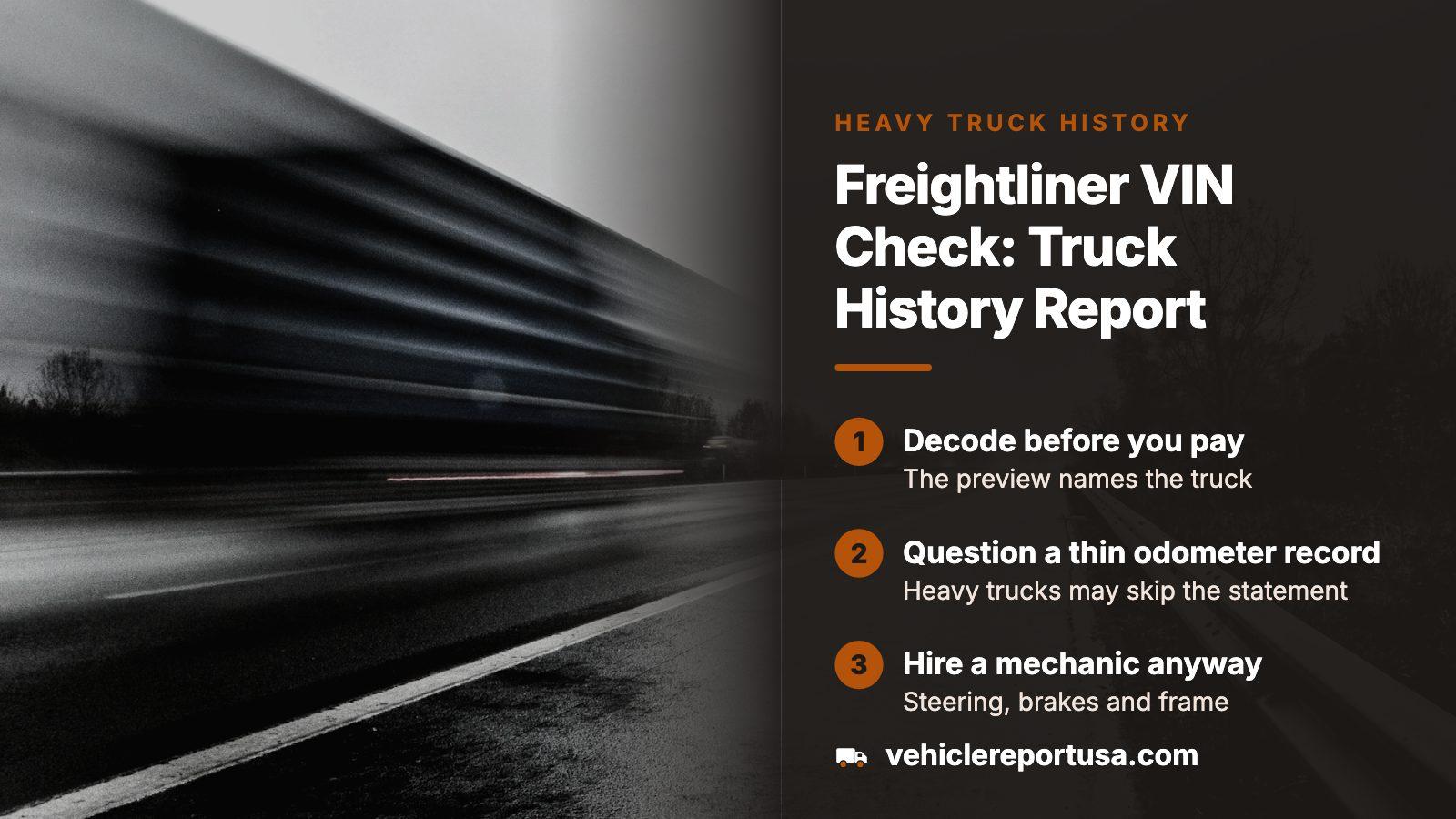
Decode the VIN at no cost, then pay once for the full report on any truck you still like. It covers branded titles, wreck records with sale photos, mileage entries, lender claims, theft flags, how the truck was used and unfixed recalls. Heavy trucks may legally sell without a mileage statement, so a thin odometer record calls for questions. A mechanic should still inspect steering, brakes and frame.
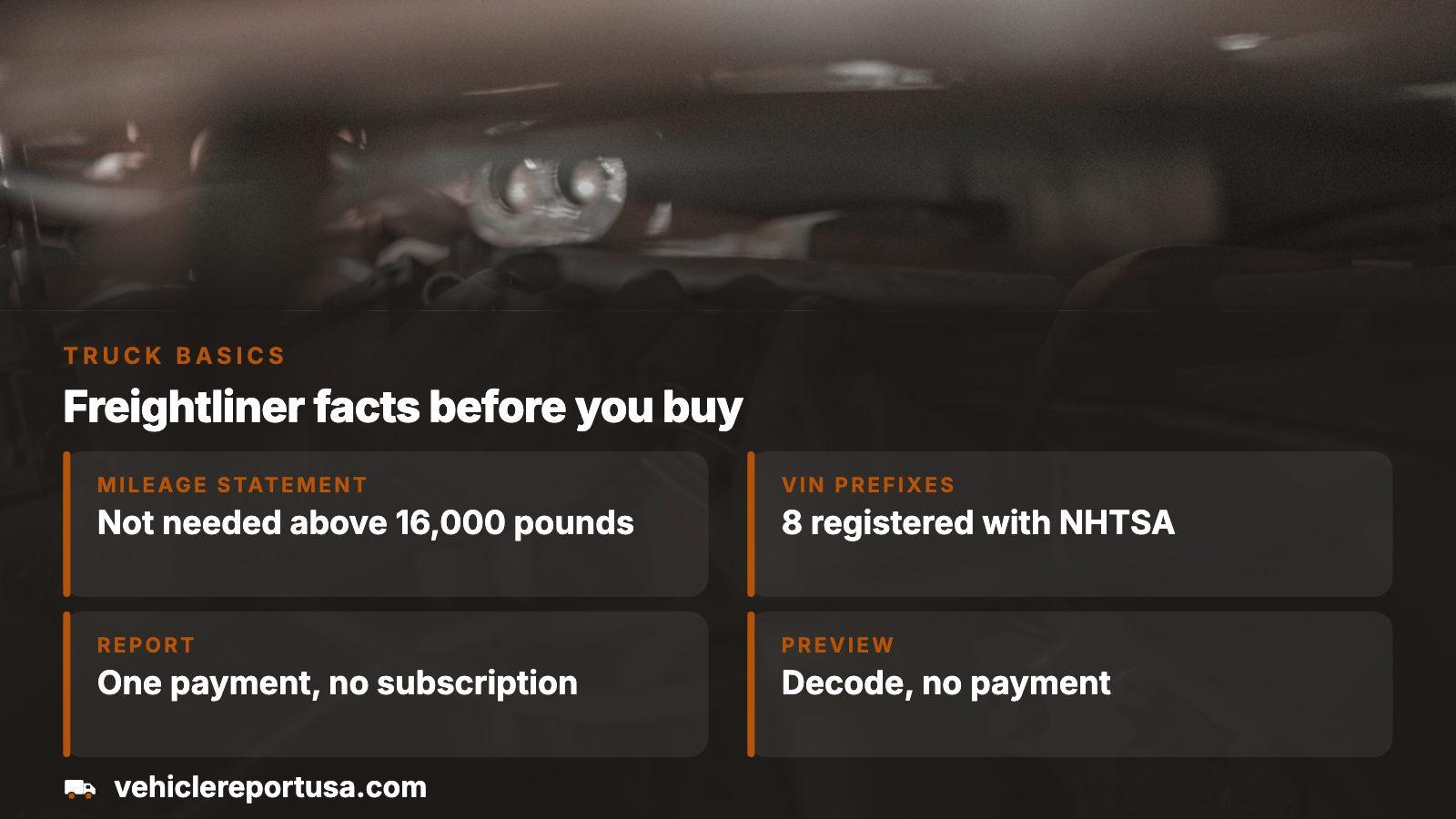
- Preview
- Free decode, no payment
- Report
- One payment, no subscription
- Mileage statement
- Not required above 16,000 pounds GVWR
- Freightliner VIN prefixes
- 8 registered with NHTSA
What the check finds on a Freightliner
Used Freightliners come as tractors, straight trucks or bare chassis finished by someone else. Each is tied to one VIN, and the report follows that number from first sale to today. For a working truck, these entries carry the most weight:
- Branded titles (salvage, junk, flood) and any insurer write-off entry.
- Damage records and auction listings, with sale photos of the cab, frame rails and bumper area.
- Odometer readings taken at sales and registrations, so you can spot a drop or a long silence.
- Liens, impound entries and theft flags that could stop a clean transfer.
- Use type and owner count, which separates one fleet from three private hands.
- Open recalls that a dealer has not yet repaired.
It cannot show how the engine was maintained or whether a frame was straightened. Use it to weed out bad trucks before paying for a road test and shop inspection.
Which Freightliner VIN you are holding
NHTSA's vehicle identifier register shows 8 prefixes for Freightliner, and they split into two kinds. Four describe completed trucks. Four describe incomplete vehicles, meaning a chassis that left the factory without a body.
| Prefix | Registered as | Where it points |
|---|---|---|
| 2FU | Truck | Canada |
| AFV | Truck | South Africa |
| KFB | Truck | Israel |
| RSB | Truck | Saudi Arabia |
| 4UZ | Incomplete vehicle (Freightliner Custom Chassis) | United States |
| 2FV | Incomplete vehicle | Canada |
| 3FF | Incomplete vehicle | Mexico |
| RSA | Incomplete vehicle | Saudi Arabia |
The split matters because a motorhome, shuttle or step van can carry a Freightliner VIN while a different company's badge sits on the body. Federal rules give the VIN to the chassis maker on a multi-stage build, and an alterer keeps it. Run the number printed on the title, then read it against the plate on the truck itself.
Finding the number on a heavy truck
Buyers expect to read the VIN through the windshield, as on a sedan. That dash-corner rule covers cars and light trucks, so a Class 8 tractor is exempt from it. For a heavy truck, federal law only asks that the number be stamped or printed durably on a component that stays put, or on a label permanently attached to one.
Check three places and make sure they agree: the certification label, the title, and any stamping on the frame. Any disagreement between them is grounds to leave. A valid VIN runs 17 characters with a check digit in slot nine, and I, O and Q never appear in one, so a number that violates this is a typo or a doctored record.
Mileage and inspection records on trucks
Federal odometer disclosure does not apply to a vehicle rated above 16,000 pounds, so a seller may skip the mileage statement on a loaded tractor. Age exemptions also exist: 10 years for a 2010 or older model, and 20 years for a newer one. A heavy Freightliner can therefore carry a thinner odometer history than a pickup of the same age, and that gap alone does not signal fraud.
What you should ask for in its place is service paperwork. Commercial trucks run under the periodic inspection rule, which requires a pass within the preceding 12 months, with proof such as a report or decal on the vehicle. Read the decal, and ask the seller for the full inspection report, not only the sticker.
Reading the readings
Line up every odometer entry in the report with the dash, the ECM hours and the shop invoices. When the three sources disagree, get an explanation in writing before discussing price.
Recalls differ a lot by model year
Freightliner models cover many years under the same campaign, and a recall entry can name several models together. NHTSA's lookup by make, model and year returned these campaign counts for the Cascadia and for the M2 Business Class when I pulled them:
| Model year | Cascadia campaigns | M2 Business Class campaigns |
|---|---|---|
| 2008 | 22 | 14 |
| 2012 | 19 | 12 |
| 2016 | 12 | 16 |
| 2019 | 29 | 23 |
The count describes the campaigns that name that year, not unrepaired work on your truck. Examples that apply to a 2016 Cascadia include campaign 15V613000 on under-tightened steering arm bolts and 19V093000 on tie-rod tubes that can fail early on trucks with certain front axles. In both, the dealer fix is free. Ask the seller for proof that each one was done, then confirm with the VIN-level recall search.
What an owner reported after buying used
Complaints filed with NHTSA are public, and some come from people who bought a truck second hand. One of them is worth reading before you buy a high-mileage Cascadia.
From an NHTSA owner complaint
An owner who bought a 2016 Cascadia in October 2021, with a little under half a million miles on it, wrote that the steering locked on a mountain grade near Ely, Nevada, and would not turn right. He braked gently and reached the shoulder. It happened 3 times, each cleared by a light turn right then left, and he asked NHTSA to look at the steering column. His words: "my steering wheel was locked".
The takeaway is practical. A history report will not show a steering fault, but it will show open recalls, prior damage and use type. Test any used tractor on a grade, with the wheel turned both ways at low rpm, and ask what steering work has been done.
Buying from a fleet sales lot
Fleet lots sell trucks that ran on a tight schedule, and the paperwork often looks neat. A neat file is still not a repaired truck.
From an NHTSA owner complaint
Someone buying a 2019 Cascadia from a Pennsylvania fleet dealer described rusted, badly worn shocks at the cab and rear axles. The dealer could not say whether a federal roadside inspection covers such parts, and an open recall had been left undone. The buyer wanted everything replaced first.
Before you sign, run the VIN, read the open recall list, and make worn suspension parts and unrepaired recalls written conditions of the sale.
Red flags worth walking away from
- A brand or write-off entry the seller never brought up.
- Odometer readings that fall between two entries, or a long stretch with none.
- A lien or impound entry that the title in your hand does not show.
- A VIN that differs between the certification label, the title and the frame.
- An open recall on steering, brakes or axles with no repair record.
- A use type that says rental or heavy vocational duty when the seller described light local hauling.
One flag does not condemn a truck, but each one needs a written answer. If the seller will not give it, you have learned something about the deal.
Cost, and the order of steps
Reading the preview takes no payment. Buying the report is one transaction with nothing recurring after it, and a multi-report pack suits a buyer shopping several trucks. Current rates are on the pricing page.
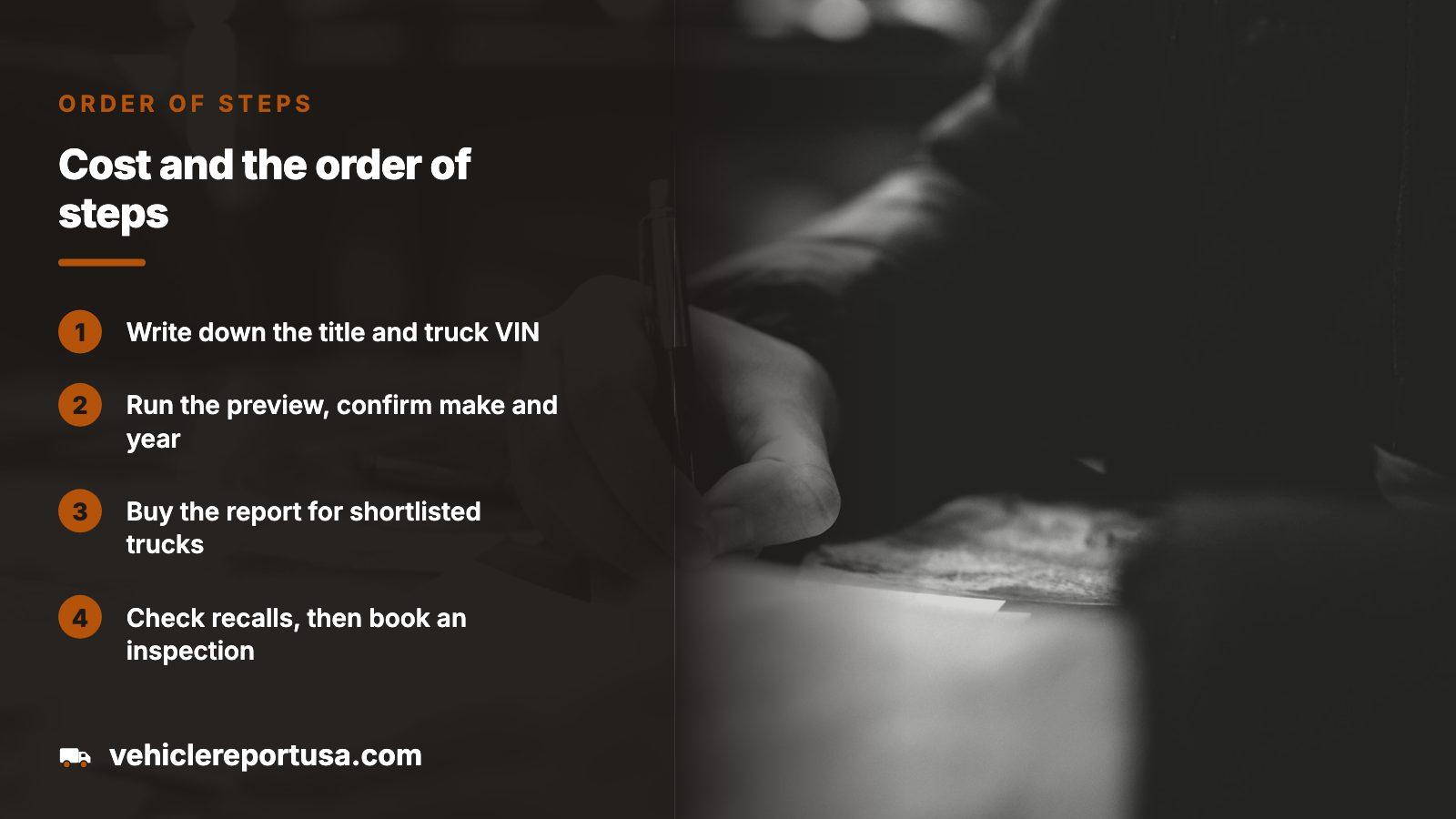
- Write down the VIN on the title and on the truck, and confirm they match.
- Run the preview and confirm the make, model and year.
- Buy the report for the trucks still on your shortlist.
- Check open recalls, then ask the seller for repair proof.
- Book a shop inspection before you pay.
A report bought on a truck that later fails the road test costs far less than a title problem found after the sale.
Where this information comes from
- NHTSA vPIC: Freightliner manufacturer identifiers — the 8 registered prefixes and which are trucks versus incomplete vehicles
- NHTSA recalls API: Freightliner Cascadia 2016 — campaign counts and the steering and axle campaigns named on the page
- Bureau of Justice Assistance: NMVTIS for consumers — the federal title database's contents and how state brand rules differ
- 49 CFR 565.13, VIN requirements (eCFR) — VIN length, check digit, letters excluded and where heavy trucks must carry it
- 49 CFR 580.17, odometer disclosure exemptions (eCFR) — weight and age cutoffs for the odometer statement
- 49 CFR 396.17, periodic inspection (eCFR) — the annual inspection and the proof a truck must carry
- NHTSA owner complaint 11476588 — owner experience, paraphrased
Sources and photos: Facts checked against the sources above in November 2026. Photos by Ümit Yıldırım, Owen Michael Grech and Nina Mercado on Unsplash; diagrams by VehicleReportUSA.
Keep reading
- Semi Truck VIN Check: Run a History on a Used Class 8 TractorTractor-trailer checks for any make, with the same title and mileage questions.
- International Truck VIN Check: Isuzu, Hino and Dump Truck HistoryVocational and fleet trucks get their own walkthrough.
- Western Star VIN Check: History Report for a Used Heavy TruckSeveral recall campaigns name Western Star trucks alongside Freightliners.
- PricingCompare one report with a pack before you buy.
Frequently asked questions
Is a Freightliner VIN check free?
Only the preview carries no charge. NHTSA also offers a free recall search by VIN. The full report, with brands, damage, auction photos, liens and odometer readings, is bought once and never renews.
Why does my Freightliner VIN decode as something else?
Freightliner Custom Chassis builds incomplete vehicles that coach, bus and van companies finish. The VIN follows the chassis, so a motorhome or step van can decode with the Freightliner name while another company's badge sits on the body.
Will a report show the mileage on a heavy truck?
It shows readings that were recorded at sales, registrations and similar events. Above 16,000 pounds a seller may legally leave out the mileage statement, so a heavy Freightliner can show few entries. Ask for service invoices and inspection reports.
Does the check show open recalls on a Cascadia?
The report lists open recalls tied to the VIN. Many campaigns cover several models and years, so get proof from the seller that every repair happened, and confirm on NHTSA's recall page using the VIN.
Can I check a Freightliner from a fleet sale?
Yes. Run the VIN before you commit, read the use type and recall list, and put any repair promises in writing. Fleet paperwork is often neat, but neat records do not prove a part was fixed.
Now check the car itself
The guide explains what to look for. The report shows what this VIN has on record.