THE SHORT ANSWER
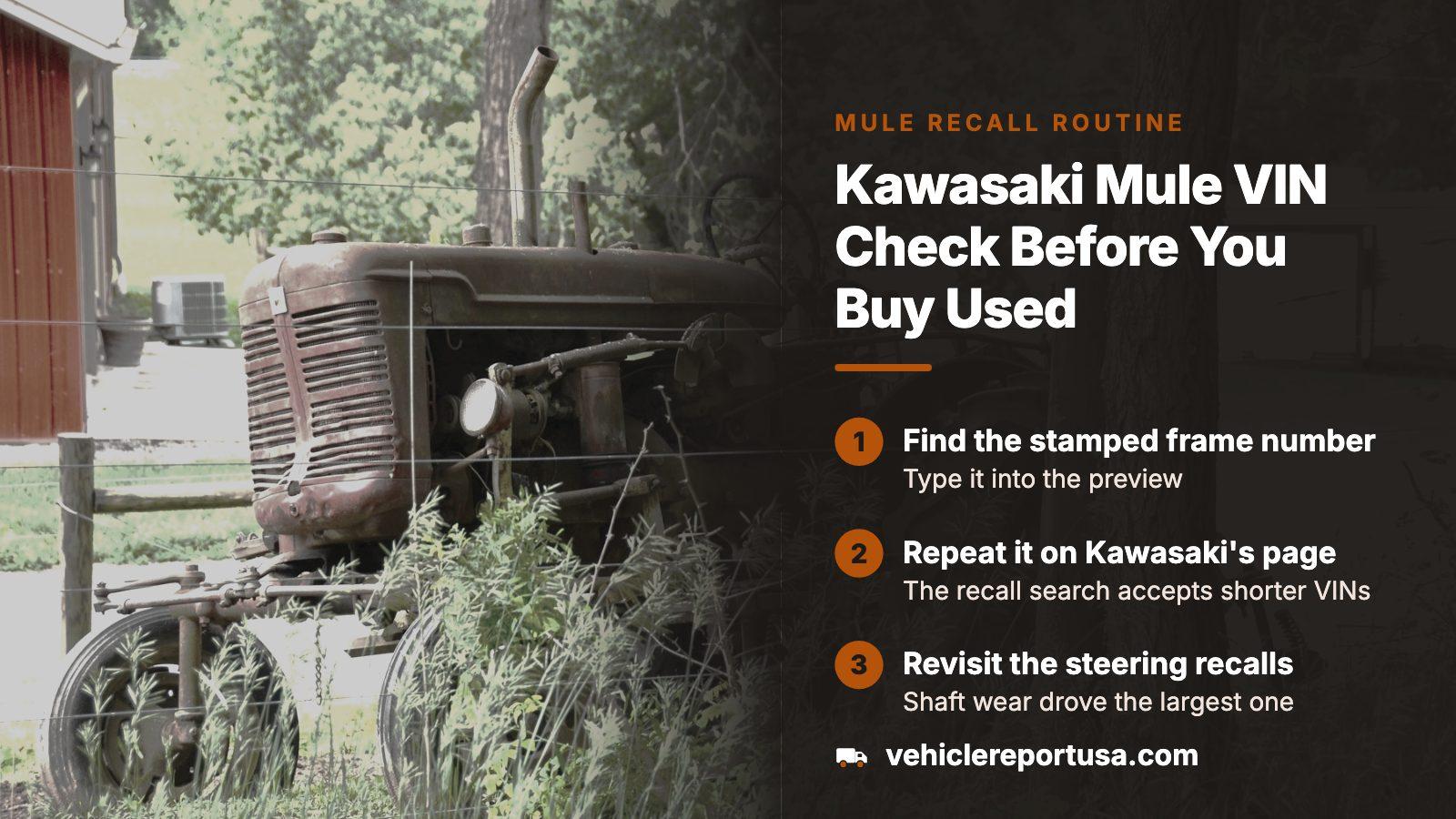
Find the stamped number on the Mule's frame, type it into the preview, and read what comes back. Then put the same number into Kawasaki's recall page. Mule recalls went through the Consumer Product Safety Commission, a different agency from NHTSA. A Mule that never had a title may return little, so sparse results call for the seller's paperwork.
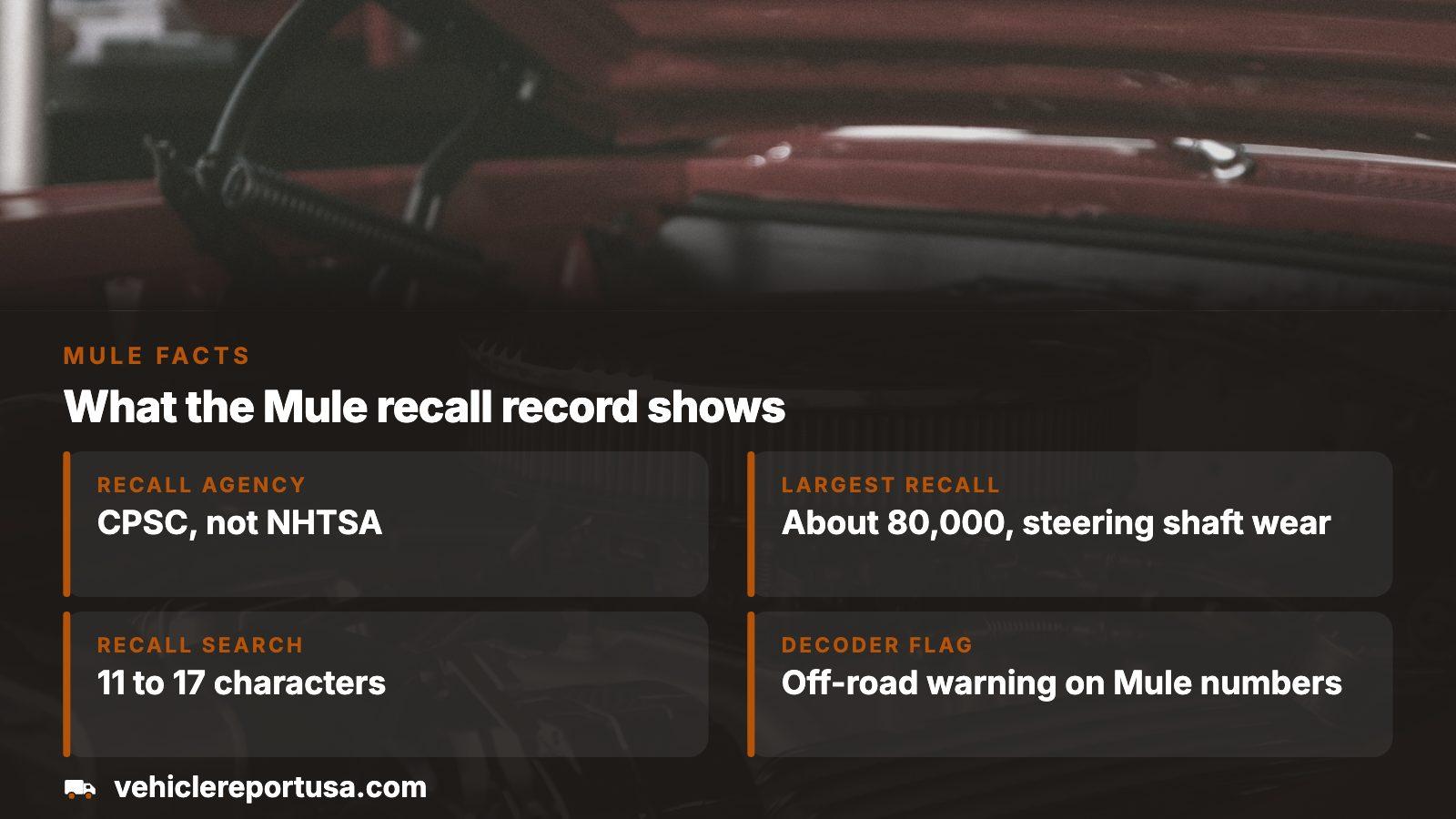
- Recall agency
- CPSC, not NHTSA
- Largest Mule recall
- About 80,000 vehicles, steering shaft wear (2020)
- Recall search length
- 11 to 17 characters on Kawasaki's page
- Decoder flag
- Off-road warning (error 10) on Mule numbers
What a number check can and cannot say about a Mule
Mules do hard, unglamorous work. They haul feed, drag fence posts and spend years on a ranch or a job site, and plenty of them change hands for cash in a driveway. That matters, because a history report only holds what someone filed. Where a Mule was titled, financed, insured after a loss or sold through a salvage auction, those events can show up under its number.
Sparse output neither clears the machine nor condemns it; all it says is that no theft or brand is on file. If a lien, theft entry or insurance loss does appear, hold your wallet and make the seller account for it.
Preview first, then decide
Type the number in and a preview appears with no charge. The report's cost is on the pricing page, and nothing renews afterward. Pay only if the Mule still looks right once you have seen the preview.
Finding the number on the machine
Kawasaki says each Mule carries its own 17-character number, and that numbers built before 1981 may differ. The spot depends on the generation. Recall notices for Mule Pro vehicles put it low on the frame, right side, near the front lower A-arm mounts. For the 2024 Pro-FX 1000 family the recall notice places it on the forward frame rail under the seat.
- Wipe the frame with a rag before reading; mud and rust hide stamped characters.
- Photograph the number so you can compare it with the seller's listing and bill of sale.
- If the frame number and the paperwork disagree, stop there. Do not run a check on a number you cannot match to the machine.
If all you have is a partial number, Kawasaki's recall search accepts anything from 11 to 17 characters, which is enough to start a recall search but not enough for a history report.
The Mule recall record, year by year
A search of NHTSA's recall data for Kawasaki Mule returned nothing for model year 2019. The campaigns are filed with the CPSC instead, and the CPSC database lists eight of them for Mule products. Every one tells owners to stop using the vehicle until a dealer repair is done, and every repair is free.
| CPSC no. | Date | Models | Problem |
|---|---|---|---|
| 06525 | 2006-01-11 | 2005-2006 Mule 600, about 15,200 | Steering knuckle can twist or break |
| 06582 | 2006-09-27 | Mule 3000 and 3010 variants, about 400 | Steering knuckles can break |
| 16221 | 2016-07-07 | 2015-2017 side-by-sides, about 25,000 | Front floor cover can be punctured |
| 19722 | 2018-12-06 | 2018-2019 Mule Pro, about 1,000 | Rollover structure can fail |
| 19728 | 2019-03-14 | 2019 Mule Pro-MX 700, about 2,600 | Hose separation, fuel leak, fire |
| 20726 | 2020-03-19 | Pro-FX, FXR, FXT, DX, DXT, about 80,000 | Steering shaft wear |
| 20727 | 2020-03-19 | 2015-2020 Pro-FX, FXR, FXT, about 72,000 | Oil leak and exhaust debris fire |
| 24312 | 2024-07-25 | 2024 Pro-FX, FXR, FXT 1000, about 19,100 | Improper combustion at start, fire |
Why the steering recalls deserve a second look
Three of the eight campaigns involve steering parts. The 2020 shaft-wear recall is the big one: about 80,000 Mule Pro vehicles from 2015 through 2020, with 453 incident reports of steering problems and no injuries reported when the notice went out. The notice lists number ranges by model code, so a seller cannot wave it away as a rare batch.
Kawasaki says it contacts known purchasers directly. A second or third owner may not be on that list, and a Mule bought at a farm sale probably is not. Running the number is how you find out whether the repair was ever done. Federal law prohibits selling a product covered by a CPSC-ordered or CPSC-consulted recall, which gives you solid ground to raise an open one.
What one owner reported
From an NHTSA owner complaint
The owner of a 2014 Mule 610 wrote that the throttle pedal, pressed all the way down, jams against the floor board and the machine keeps running at full speed until the pedal is lifted by hand. The owner said it repeated every time. No crash, fire or injury was recorded.
That is the only Mule complaint I found in the model years I searched, so it proves nothing about the whole line. What it shows is the kind of defect a test ride catches and a paper check does not. Push the pedal to the floor and let it return before you agree on a price.
Why free decoders mislabel a Mule
NHTSA's decoder knows Kawasaki as a motorcycle maker, and its only listed vehicle type for the make is Motorcycle. Feed it a partial Mule number and you get a Mule 610 from 2014, a 401 cc engine and a Lincoln, Nebraska plant, plus a type field that still says motorcycle. It also returns an off-road warning, error 10, meaning Kawasaki never certified the product against the federal motor vehicle safety standards.
Do not read that warning as a fault with the machine. It is how the decoder describes every off-highway utility vehicle. Use the decoded year, engine and plant as a cross-check against the listing, and treat the vehicle type as noise.
Red flags worth walking away over
- A frame number that has been ground, re-stamped or covered with paint.
- A recall repair the seller claims but has no dealer record of.
- A lien or theft entry on the report that the seller never mentioned.
- A salvage or junk brand, which signals a total-loss event somewhere in the past.
- A bill of sale from a person who is not the name on the title, where a title exists.
- A price far below similar listings with no explanation of why.
The federal title database, NMVTIS, is described on the Justice Department's consumer page as holding brand history (junk, salvage, flood), the newest odometer reading and records of transfers to salvage yards. Not every Mule was ever titled, so absence from that system is common.
Running the check and what to do next
- Copy the number from the frame and match it to the seller's papers.
- Paste it into the preview box here and skim the headline findings.
- Open Kawasaki's recall page and search the same number for open campaigns.
- Decide whether to buy the full report, which sits behind a single payment.
- Book a test ride or inspection before any deposit changes hands.
Kawasaki's own recall data goes back only to November 2011, so an older Mule needs the CPSC notices above as well. Price details live on the pricing page. Compare this with sibling checks for UTVs, Polaris side-by-sides and ATVs if you are still choosing between machines.

Where this information comes from
- CPSC: Kawasaki Mule Pro steering shaft recall 20726 — model years, number ranges, incident count and remedy
- CPSC: Kawasaki Mule Pro 1000 fire hazard recall 24312 — 2024 recall and where the number sits on that model
- CPSC: Kawasaki Mule Pro-MX recall 19728 — fuel leak campaign on the 2019 Pro-MX
- Kawasaki: Owner center recalls — recall search by number and its date limit
- NHTSA: vPIC decoder — decoder behavior on Mule numbers
- NHTSA owner complaint 11022226 — owner experience, paraphrased
- NMVTIS: Vehicle history for consumers — what federal title data covers
Sources and photos: Facts checked against the sources above in November 2026. Photos by Roger Starnes Sr, Michal Biernat and Victor Hughes on Unsplash; diagrams by VehicleReportUSA.
Keep reading
- UTV VIN Check: Run the Side-by-Side's Number Before You PayThe wider side-by-side check, with decoder and recall background.
- Kawasaki Motorcycle VIN Lookup: Decode the Bike, Then Search Its PastKawasaki numbers on motorcycles and ATVs.
- Polaris RZR VIN Check: History Report Before You Buy a Used RZRCompare a Mule with a recreational side-by-side.
- PricingWhat one report or a pack costs.
Frequently asked questions
Does a Kawasaki Mule have a real VIN?
Yes, Kawasaki stamps a unique number on each Mule, and it is normally 17 characters. The decoder flags it as an off-road product since Kawasaki never tested it against the federal motor vehicle standards. That flag is expected and says nothing about whether this particular machine has a problem.
Where do I look up Mule recalls?
Use Kawasaki's recall page, which searches by number, and the CPSC recall database. NHTSA returned no Mule campaigns when I searched model year 2019. Kawasaki's page says its data only reaches back to November 2011, so older machines need the CPSC notices read by model and year.
Will the check show a title for my Mule?
Only if one was ever filed. Many Mules were sold without a title, especially on farms. When a title brand, lien or loss record exists under the number, it can appear. When none does, ask for the bill of sale and the seller's proof of ownership instead.
Is the Mule Pro steering recall still worth checking?
Yes. The 2020 notice covered about 80,000 vehicles from 2015 through 2020, and owners who bought used may never have been contacted. Search the number on Kawasaki's page and ask the seller for the dealer repair record.
Is the report free?
Only the preview costs nothing. The report that follows is billed once and never renews; the pricing page has the amount. Read the preview first and decide whether the Mule justifies the next step.
Now check the car itself
The guide explains what to look for. The report shows what this VIN has on record.