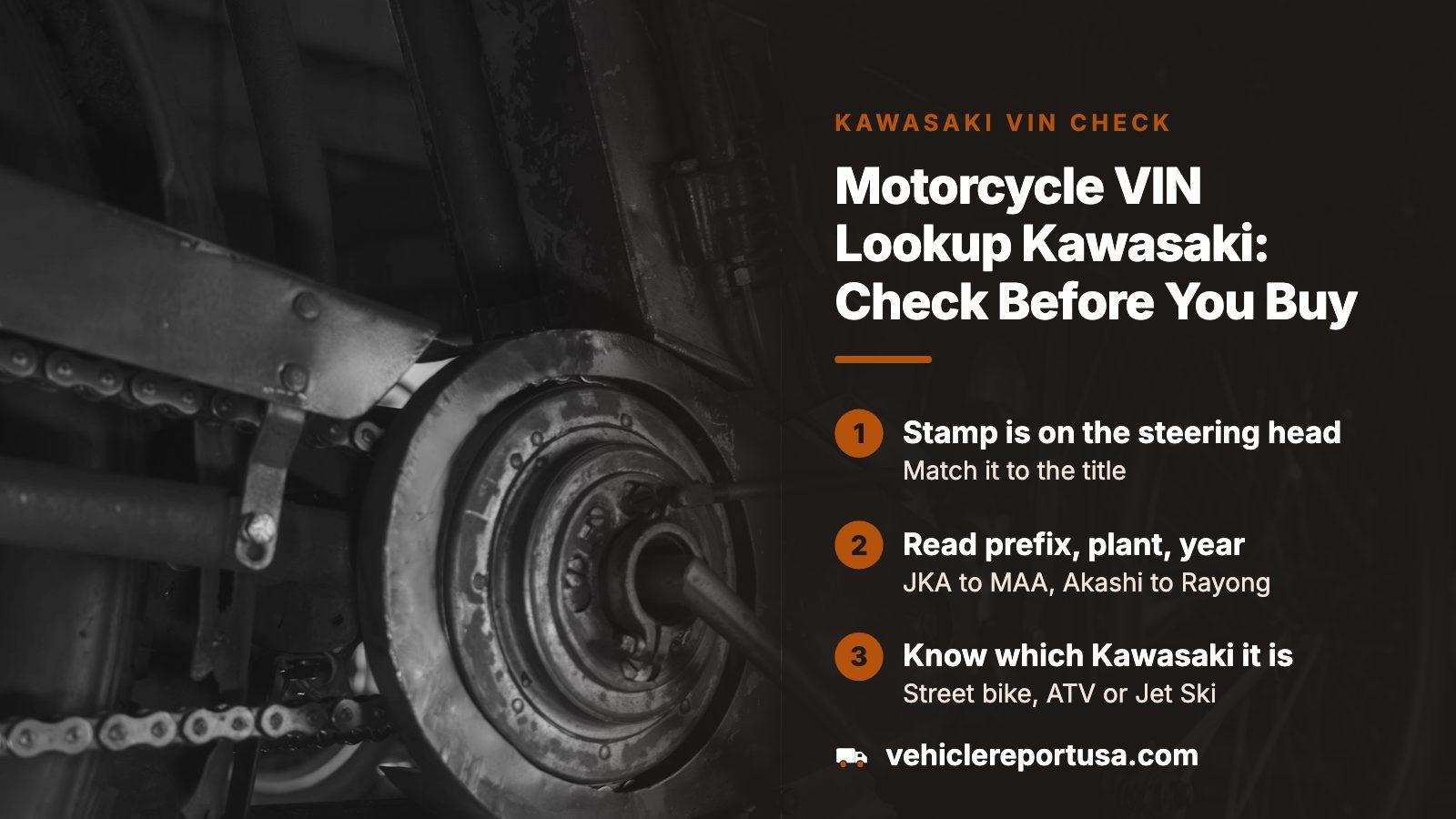
THE SHORT ANSWER
Photograph the VIN where Kawasaki stamps it, on the steering head below the bars, and match it to the title character by character. The free preview decodes model, year and engine size. The one-time report adds title brands, damage and salvage entries, odometer history, liens, theft flags and open recalls. Compare the tenth character with the advertised year, and ask for paperwork on any open recall.
- Prefixes
- JKA, JKB, JK1, JK8, MH4, ML5, MAA
- Year letter
- Tenth character, newest bikes: R (2024), S (2025), T (2026)
- Plant
- Eleventh character: A read as Akashi, D as Rayong
- Preview
- Free, shown before any payment
Reading a Kawasaki number: prefix, plant and model code
NHTSA lists seven manufacturer prefixes for Kawasaki motorcycles: JKA, JKB, JK1, JK8, MH4, ML5 and MAA. Owner-complaint numbers are mostly JKA or JKB, with ML5 on later KLR650s and MH4 on the KLX230. A prefix does not say where a bike was assembled. Federal rules give that job to character eleven, and the plant in NHTSA's decode changed with it in these samples.
| Bike and year | Number begins | Plant returned |
|---|---|---|
| Ninja 300, 2013 | JKAEX | Rayong, Thailand |
| KLR650, 2023 | ML5KL | Rayong, Thailand |
| Vulcan 900, 2017 | JKAVN | Akashi, Japan |
| Concours 14, 2012 | JKBZG | Akashi, Japan |
| Ninja ZX-6R, 2025 | JKBZX | Akashi, Japan |
| KLX230, 2022 | MH4LX | Cikarang Barat, Indonesia |
Characters four and five often echo Kawasaki's model code: EX for the Ninja 300 and 400, VN for Vulcans, ZX for the ZX-6R, ZG for the Concours 14, KL for the KLR650. An ad that says ZX-6R above a number reading EX deserves a question.
Year letter, check digit and characters that never appear
Character ten carries the model year: S for 2025, R for 2024 and T for 2026, then P, N and M back through 2023, 2022 and 2021. Of 381 VIN stubs on Kawasaki owner complaints, 369 held the letter for the year NHTSA filed them under and most of the rest were a year off, so a one-letter gap is a question for the seller. Character nine is a check digit, I, O and Q do not occur anywhere in the number, and the last four characters of a motorcycle VIN must be digits.
Street bike, ATV or Jet Ski: know which number you hold
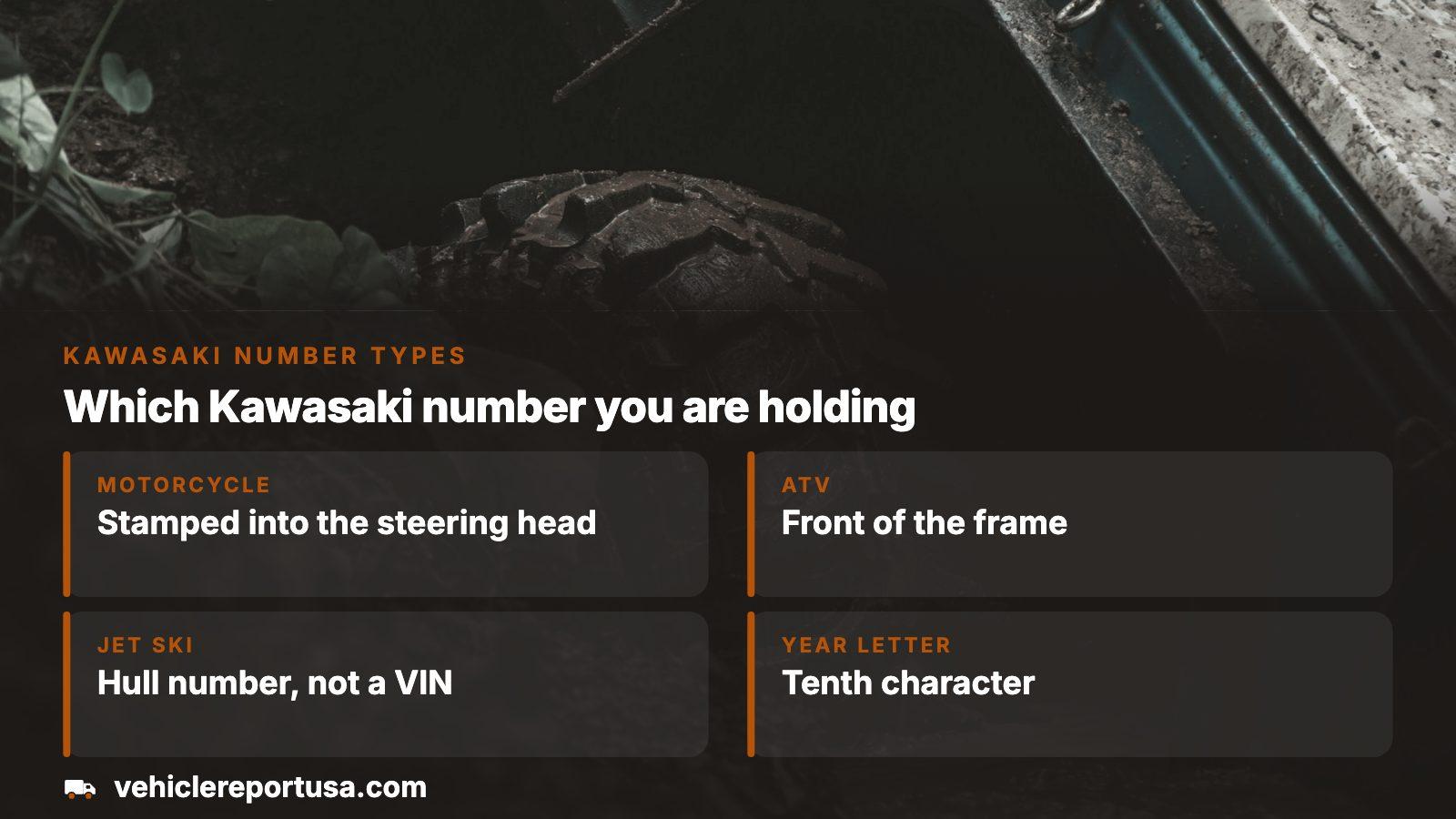
Kawasaki also builds ATVs, utility vehicles and personal watercraft, with the number in a different spot on each. The sample VIN on Kawasaki's recall page decodes to a 1997 Prairie 400 ATV, and NHTSA's decoder flags it twice: a check digit that does not calculate, and a note that the maker did not certify the machine to federal road standards. Both flags are expected on off-road machines. On a street bike, retype the number from the frame and compare it with the title.
- Motorcycle: stamped into the steering head, under the handlebars.
- ATV: at the front of the frame, centered beneath the radiator.
- Jet Ski: carries a 12-character hull number instead, which a VIN search does not cover.
Recall campaigns that follow a Kawasaki's VIN
Each campaign names a production span, and only the VIN shows whether a bike was built inside it. A sample from NHTSA's files:
| Campaign | Bikes covered | Fault |
|---|---|---|
| 09V059000, 09V062000 | 2008 to 2009 KLR650, 16,167 bikes | Muffler bolts can loosen; wiring harness can rub through |
| 12V343000 | 2008 to 2012 Concours 14 | Trapped debris can drag or lock the rear brake |
| 15V550000 | 2009 to 2015 Vulcan 1700 Voyager | Ignition wire can chafe and stall the engine |
| 20V676000 | 2018 to 2020 Ninja H2 SX family | Gear misengagement can break 4th or 5th gear; do not ride until fixed |
| 25V798000 | 2024 to 2026 Ninja ZX-6R | Crankshaft bushing can seize; do not ride until fixed |
Dealers repair these at no cost to the owner, except 07V244000, a 2007 notice on 2008 KLR650s, where Kawasaki offered a buy-back. Kawasaki's own VIN search takes 11 to 17 characters but its recall data starts in November 2011, so the 2009 KLR650 campaigns predate it. Older bikes need NHTSA's records too.
Recall paperwork and what the bike actually does
Two owner complaints on file with NHTSA show why a recall line is a lead.
From an NHTSA owner complaint
A buyer of a used 2012 Concours 14, picked up from a dealer, told NHTSA in May 2021 that the rear brake pedal began locking within a week and sometimes dropped to the floor. The owner listed replaced rear brakes and front pads and about 32,000 miles, and thought the rear master cylinder rod recall should apply. The filing does not say whether that repair was done.
That rod-end campaign, 12V343000, covers 2008 to 2012 Concours 14 bikes. If a report shows it open, ask for the dealer work order.
From an NHTSA owner complaint
An owner of a 2025 ZX-6R told NHTSA in December 2025 that the bike went through the first crankshaft bushing recall and sat unused for about two months. In November a second campaign said the earlier repair might not have worked, told owners to park their bikes again, and offered no parts or timeline.
NHTSA's record for the later campaign says bikes already fixed under the first need the new remedy too, so rerun the VIN close to the day you pay.
Ex-police bikes and other use-type surprises
Kawasaki issued four campaigns for police versions of the Concours 14 (12V134000, 13V370000, 13V387000 and 15V117000), covering model years 2009 to 2013. The added accessories and wiring could blow the 30-amp main fuse and stall the engine, and 13V387000 adds fuel leaks and weaker braking. The last two called for factory staff to visit police departments, so a retired patrol bike may never have seen a retail dealer for them. A use-type entry in a report, where one exists, is where that past would show.
Running the check with the bike in front of you
- Wipe the steering head and photograph the stamping, then photograph the title's number beside it. Federal rules put the number on a component built to stay on through repairs, or on a plate attached to one for good, so a number on a bolt-on piece needs an explanation.
- Type all 17 characters into the preview. A flag on character nine, or a letter I, O or Q, usually means a typing slip.
- Read the decode: model, year and engine size, plus the plant where shown. Match each against the advert and the badges.
- If it fits, order the report. You pay once, with no subscription.
- Weigh each finding against the seller's story, and test any recalled system on the ride.

Findings that should change your offer
| The report shows | What to do next |
|---|---|
| A salvage, flood or rebuilt brand | Have a mechanic check frame, steering head and forks before discussing price. |
| Odometer readings that fall or stall | Ask for service receipts and match the dates. |
| An open recall | Book the dealer repair, or make it a condition of sale. |
| A lien or impound entry | Get the lender's written release before paying. |
| A theft record or insurer total loss | Ask for the story in writing; a recovered bike can keep the label. |
| A decode that disagrees with the ad | Make the seller explain before money moves. |
A blank is not a guarantee. NMVTIS says its reporting rule targets common automobiles and that states differ in what they send, so a motorcycle can have gaps. Treat a clean result as nothing found, then pay a mechanic to look the bike over.
What the check costs
The preview is free, and worth running on every Kawasaki you are weighing, because it confirms model, year and engine size first. The report is a single payment with no subscription; if you are comparing a handful of bikes, there are packs of 3, 5 and 10. Current amounts are on the pricing page, and the sample report previews each section. Use the preview before a long drive to see a bike, and the report before a deposit changes hands.
Where this information comes from
- NHTSA vPIC: Kawasaki VIN prefixes — Lists the seven Kawasaki prefixes; the same decoder supplied plants, model series codes and the off-road warning.
- NHTSA recalls API: Kawasaki Concours 14 — Source for campaign numbers, covered models, faults and the no-cost remedies.
- eCFR: 49 CFR Part 565 — Federal VIN rule: year letter, plant character, check digit, allowed letters and where the number must sit.
- NMVTIS: consumer guidance — What the federal title database shows, and the gaps it warns about for motorcycles and state differences.
- Kawasaki Owners Center: safety recalls — Kawasaki's VIN search, its recall date limit and where each product line carries its number.
- NHTSA owner complaint 11418248 — owner experience, paraphrased
- NHTSA owner complaint 11705934 — owner experience, paraphrased
Sources and photos: Facts checked against the sources above in November 2026. Photos by Haberdoedas, Jakub Żerdzicki and Johann Noby on Unsplash; diagrams by VehicleReportUSA.
Keep reading
- Motorcycle VIN Recall Check: Find Open Recalls on Any BikeHow recall searches work for a motorcycle and what to do about an open one.
- Motorcycle VIN Year Check: Confirm the Model Year Before You BuyUsing the tenth character and the rest of the number to confirm a bike's model year.
- ATV VIN Lookup: Check a Quad's History by Frame VIN Before You BuyFor Kawasaki ATVs and other off-road machines, whose numbers follow different rules.
- Sample reportSee how each record section reads before you buy a report.
Frequently asked questions
Does a Kawasaki VIN lookup work on a Ninja, Vulcan or KLR650?
Yes, for any Kawasaki road bike with a 17-character VIN. Machines from before 1981 may use another format. If the preview cannot read your number, retype it from the frame and compare it with the title.
Can I decode a Kawasaki VIN without all 17 characters?
NHTSA's decoder will read a partial number if you put * in place of each missing character, and Kawasaki's recall search takes 11 to 17 characters. That helps with a blurry photo, but a partial decode can misjudge the year. Get the full number before buying.
Does the report show a Kawasaki's open recalls?
It lists recalls still open for the VIN. Repairs cost the owner nothing, but parts can lag: the 2025 ZX-6R campaigns said not to ride until repaired, and a December 2025 complaint says parts were unavailable.
Why did the decoder place my bike in Thailand?
Several Kawasaki models are assembled in Rayong, Thailand; the decodes for the Ninja 300 and 400, Z650 and KLR650 all showed it. The plant sits in character eleven, so a JKA or ML5 start does not mean Japan.
Is a Kawasaki with a salvage or rebuilt brand worth buying?
Sometimes, if a mechanic confirms the frame and steering head are straight and the repairs are documented. Each state sets its own branding threshold, so identical damage can be branded in one place and pass clean in another. Price it as a branded bike and get the invoices.
Now check the car itself
The guide explains what to look for. The report shows what this VIN has on record.