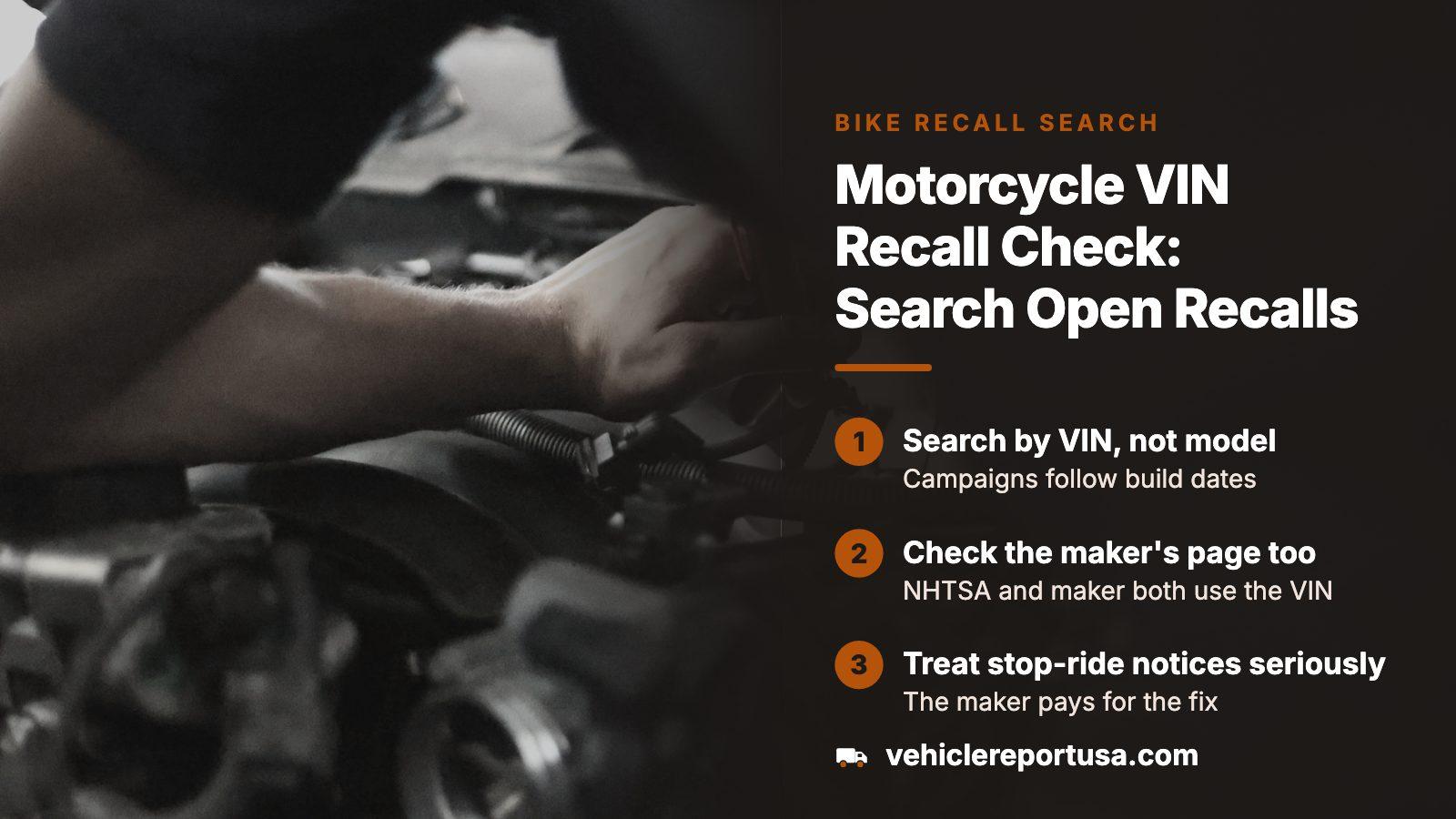
THE SHORT ANSWER
Copy the VIN from the frame, confirm it matches the title, and search by that number instead of by model name. NHTSA's records and the maker's own recall page both work from it. A hit names the failing part, the hazard and the dealer fix, which costs the owner nothing inside the 15-year window. Take a stop-riding notice at its word until the repair is done, and search again after any recall work.
- Search by
- VIN, because campaigns follow build dates
- Repair cost
- Maker pays; the duty ends at 15 calendar years from first sale
- Preview
- Free, shown before any payment
What comes back when you search a bike's number
Each hit is a campaign record that the maker filed with NHTSA. The record carries a park-it flag, and several Yamaha campaigns set it, telling owners to stay off the bike or ride only to the dealer. A useful hit tells you four things:
- The part at fault, in the maker's words, and the hazard it creates
- The model years and build dates that decide if your bike is in
- The remedy, which the dealer carries out at no cost to the owner
- Whether the maker says to stop riding meanwhile
Why the number beats the model name
A recall covers a slice of a model, not all of it. Makers draw the line with build dates, fitted accessories and sometimes where a bike was sold, so two bikes sharing a model and year can end up on opposite sides.
| Campaign | Maker | Which bikes it reaches |
|---|---|---|
| 14V794000 | Harley-Davidson | Dyna and Softail bikes of model year 2012, but only those built from August 22, 2011 to February 24, 2012 |
| 19V574000 | Harley-Davidson | Touring bikes, only where the Tour-Pak conversion kit is fitted |
| 26V146000 | Honda | CMX300, CMX500 and CL500 models from 2023 through 2025 |
| 26V500000 | Honda | Stretches the first one back to 2017 for the CMX500 and CMX300, and adds the 2025 SCL500 |
A 2020 CMX500 sat outside the first Honda campaign and inside its expansion. Only the VIN tells a lookup which side a given bike falls on.
Running the search at the bike itself
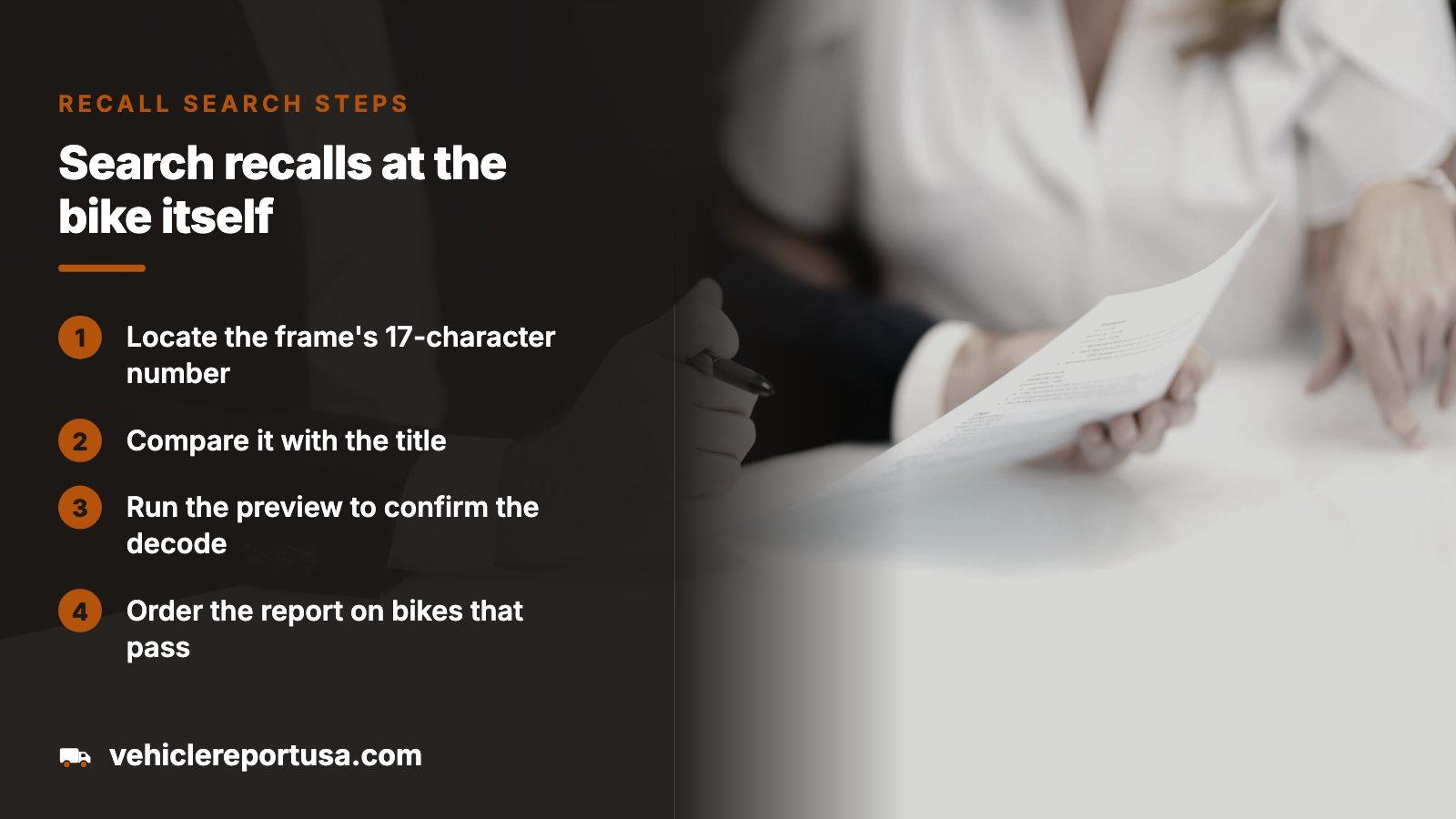
- Locate the frame's 17-character number. Federal rules put it on a part not built to come off short of repair, or on a plate fixed permanently to one, and Kawasaki sends owners to the manual for the spot on each machine. Photograph it and the title's number.
- Compare the two. Federal rules require digits, not letters, in the final four positions of a motorcycle VIN, and the tenth character is the year code: P for 2023, R for 2024, S for 2025, T for 2026. A letter there means a misread or a number that is not a true VIN.
- Run the free preview to confirm the decode, then search the number with NHTSA and the maker's own page. Mind each box's reach: Suzuki handles U.S. spec street bikes after January 13, 2000, and Kawasaki goes back to November 3, 2011 and takes 11 to 17 characters.
- Order the report on bikes that pass, so open recalls sit next to the title and damage records.
When a repaired bike turns up in a second recall
Yamaha's FJR1300 shows how a finished recall can lead to another. Campaign 20V813000 began January 20, 2021 and covered 2016 to 2020 FJR13A and FJR13AE bikes whose second gear could crack under load; dealers were to inspect, then reprogram the engine computer and replace axle assemblies as needed. Campaign 21V865000, filed in November 2021, says that programming may stop the engine accelerating as intended, and bikes already repaired must return.
From an NHTSA owner complaint
An owner of a 2018 FJR1300 told NHTSA in July 2021 that transmission recall work had been done on the bike. Afterward, the owner says, the engine computer limited revs to roughly 4,000 rpm in the lowest gears at slow speeds, and the owner met that ceiling while trying to move out of a dangerous rear-end situation. The complaint asks NHTSA and Yamaha to act. Yamaha's follow-up campaign on engine-computer programming for those bikes came about three months later.
Ask the seller for the dealer's work order on any completed recall, and search the VIN again instead of trusting an old printout.
Reading the hit: stop-riding notices and quieter ones
| What the record shows | Example | What to do with it |
|---|---|---|
| Park-it flag, or a notice to ride only to the dealer | Yamaha MT-09 campaign 22V130000: bad engine programming may blunt throttle response, kill the engine or hide a fault. Tenere 700 campaign 23V472000: wrong-length front caliper bolts | Treat the bike as unrideable until repaired; have the seller finish the work or arrange transport |
| A part that can fail with no stop order | Honda ADV160 scooter campaign 25V195000: an oil pump gear can fail and drive power is lost | Book the dealer repair at once and use the open item in the price talk |
| A compliance gap tied to an accessory | Harley campaign 19V574000: a luggage kit shipped without the replacement rear reflectors that federal lighting rules require | Look at the bike itself to see whether the kit is fitted |
| Eligibility by where the bike lived | Honda Gold Wing airbag campaign 17V031000: depends on where the bike was first sold or ever registered | Ask for the registration history, then search by VIN |
Searchable before the letter arrives
Owner letters trail the filing. NHTSA's record for Honda's 26V146000 says VINs became searchable on March 21, 2026 and lists owner letters as mailed June 15, 2026. For the expansion, 26V500000, the dates are August 4 and September 29. A buyer who runs the VIN can see a campaign weeks or months before the owner of record gets a notice.
From an NHTSA owner complaint
A 2017 Street Glide owner told NHTSA the bike fell over at a stop in August 2018 with the clutch engaged. About two months later a recall letter arrived describing a clutch fault the owner says matched. On November 15 the dealer that sold the bike confirmed it was covered but had no repair part and no date, and the maker's customer line said the same. The owner described the bike as in "unsafe condition to ride".
Covered and repairable are different states. Ask whether parts are on hand, and follow any no-ride advice meanwhile.
What the law gives you and where it stops
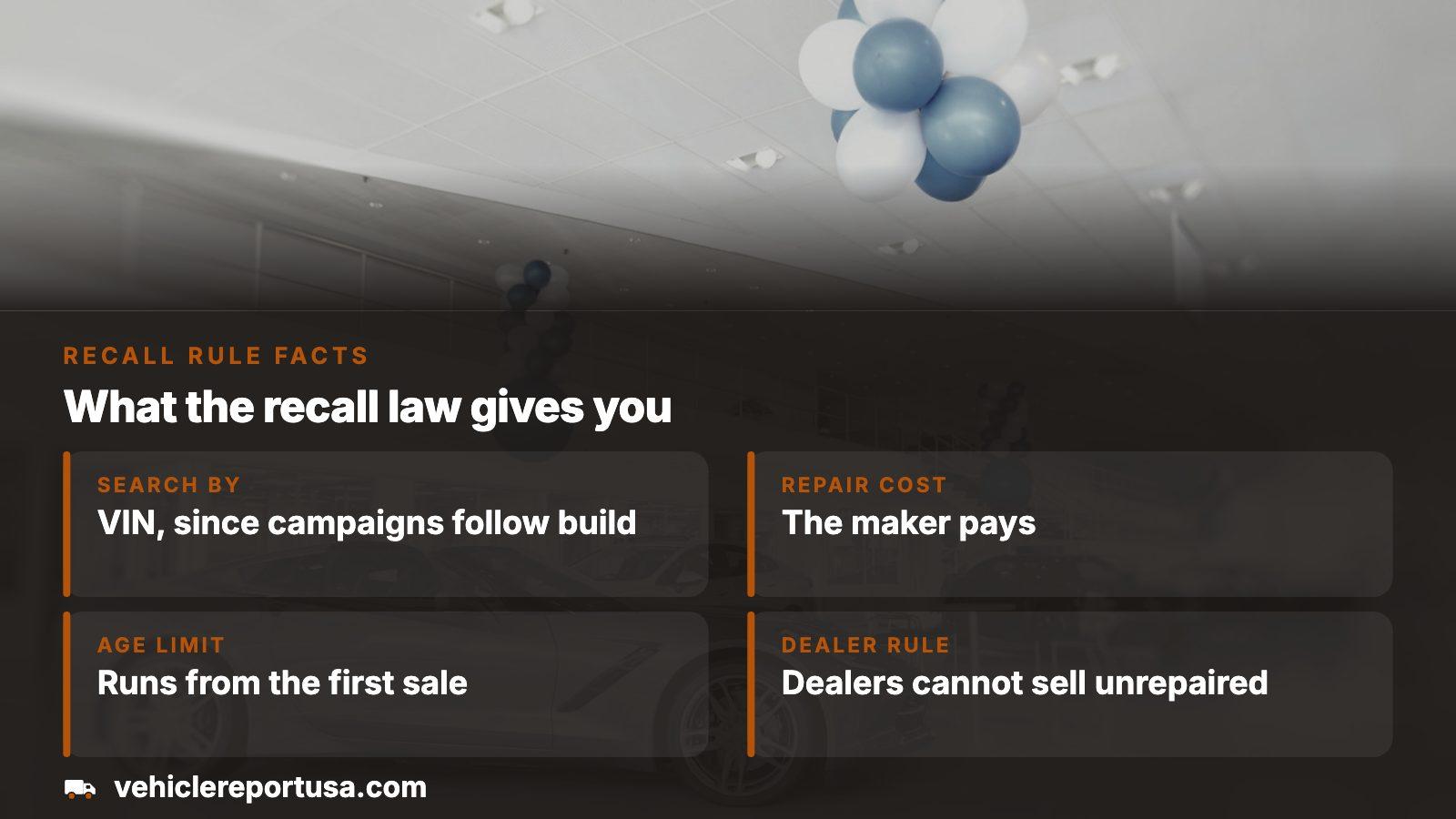
- Cost: the maker repairs, replaces or refunds less a depreciation allowance, without charge, once the bike is presented for the remedy.
- Age: when a bike's first sale lies further back than 15 calendar years from the notice or order, the no-charge duty falls away.
- Delay: no proper fix within 60 days of presentation counts, on its face, as evidence of an unreasonable wait.
- Dealers: the rule that stops a dealer selling recalled stock until it is fixed speaks of new vehicles only, so on a used bike checking falls to you.
A search with no hits is not proof of a clean bike. Each lookup has edges, as the Suzuki and Kawasaki pages show, and a campaign can be filed the week after you search.
Where the full report fits, and what it costs
A recall hit shows how the maker sees the bike and says nothing about how earlier owners treated it. A bike with an open recall may also carry a rebuilt brand, an odometer jump, a lien or a theft flag, and the VehicleReportUSA report searches those records on the same VIN.
The free preview confirms what the VIN decodes to, so run it on every candidate. Buying the report is one payment with no subscription, and anyone comparing several bikes can take 3, 5 or 10 reports together. The pricing page lists current amounts; the sample report shows how each section reads.
Where this information comes from
- NHTSA owner complaint 11426976 — owner experience, paraphrased
- NHTSA owner complaint 11161205 — owner experience, paraphrased
- NHTSA recalls API: Honda CMX500 and other motorcycle campaigns — Campaign numbers, covered models, remedies, park-it flags and the VIN-searchable dates quoted above; Yamaha and Harley-Davidson records come from the same API.
- eCFR: 49 CFR Part 565 — Federal VIN rule: 17 characters, where the number must sit, numerals in the last four on a motorcycle, and the year codes.
- US Code: 49 USC 30120 — No-charge remedy, the 15-year limit, the 60-day repair benchmark and the dealer rule for new vehicles.
- Kawasaki: owner center recalls — Shows the VIN or HIN box, its 11 to 17 character limit and the November 2011 start of its recall data.
- Suzuki Cycles: recalls — Shows the 17-character box, the January 2000 cutoff for U.S. spec street bikes and the phone route for off-road owners.
Sources and photos: Facts checked against the sources above in November 2026. Photos by Mustafa Sheikhmouss, Carrie Allen www.carrieallen.com and Richard R on Unsplash; diagrams by VehicleReportUSA.
Keep reading
- Motorcycle VIN Lookup: Check a Used Bike's History Before You PayDecode a bike's number first, then search it for recalls.
- Motorcycle VIN Year Check: Confirm the Model Year Before You BuyConfirm the model year from the tenth character, since campaigns are set by year.
- Suzuki Motorcycle VIN Check: Prefix, Plant, Recalls and PastOne maker worked through in detail, including how its recall lookup behaves.
- Sample reportSee how each record section reads before you order.
Frequently asked questions
Can I check a motorcycle for recalls with only the VIN?
Yes. The number is all a lookup needs, and it matters because campaigns follow build dates and fitted equipment, not only badge and year. Keep the title beside the bike so the frame number can be matched first.
Who pays for a motorcycle recall repair?
The maker pays. Federal law calls for repair, replacement or a refund less depreciation at no charge, unless the bike's first sale lies further back than 15 calendar years from the notice or order. On an older bike, phone the maker and ask what it will still do.
Can a seller sell a bike that has an open recall?
The federal sale bar covers new vehicles in dealer stock. On a used bike, assume nobody has checked for you. Run the VIN yourself, and ask for the dealer's work order if the seller says a recall was done.
The search shows no recall but a dealer says there is one. What now?
Ask the dealer for the campaign number. Makers use their own codes, such as 0173 at Harley-Davidson or KU8 at Honda, while NHTSA files the same campaign under a number like 18V734000. Search the VIN again and compare; a new filing can take days to appear.
Do recall searches cover scooters and off-road bikes?
Scooters appear in NHTSA's records beside motorcycles, as Honda's ADV160 campaign shows. Maker pages differ: Suzuki's box handles only U.S. spec street bikes and sends off-road owners to customer service, while Kawasaki's accepts a VIN or a hull number. Read the fine print before trusting a miss.
Now check the car itself
The guide explains what to look for. The report shows what this VIN has on record.