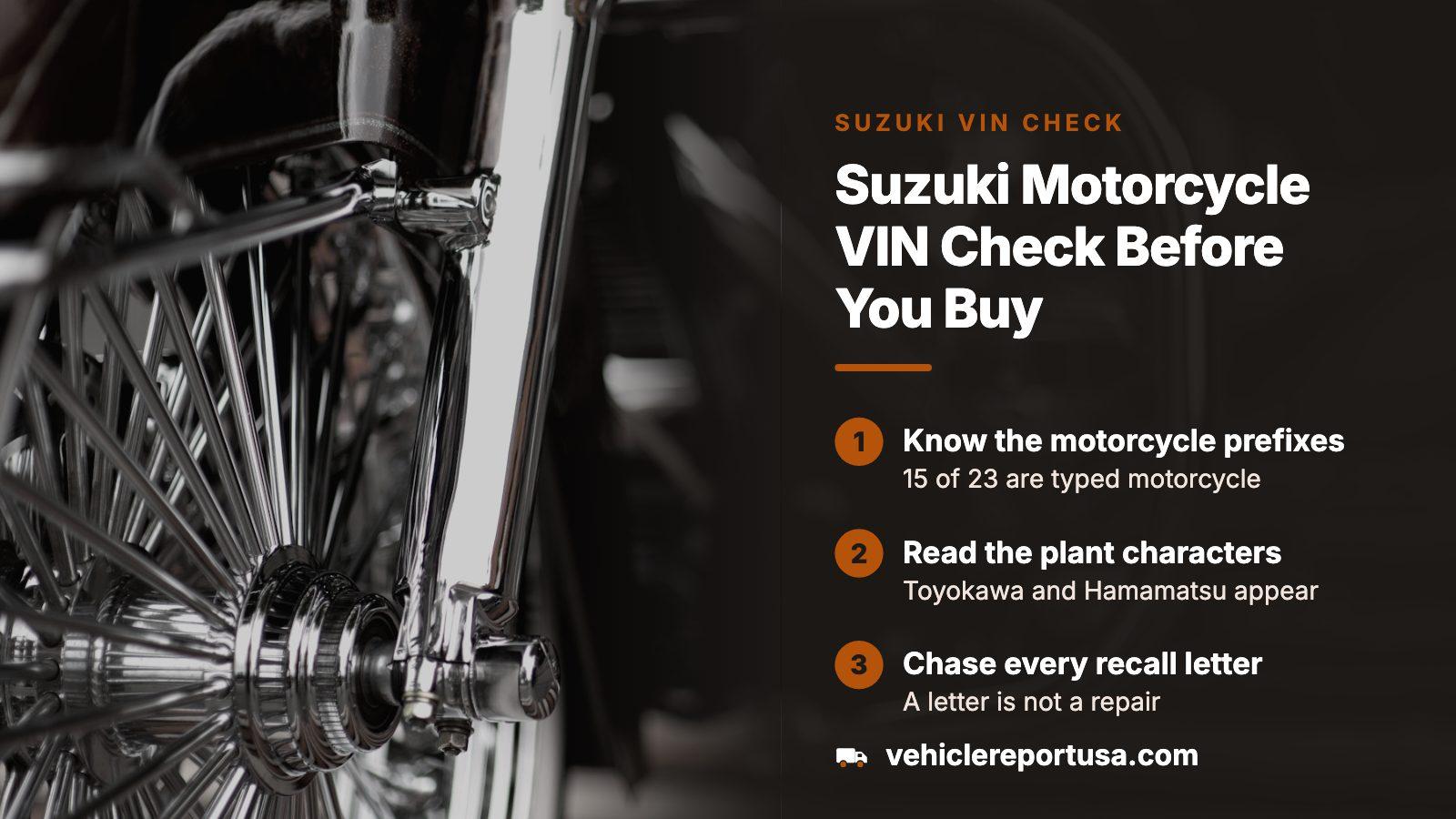
THE SHORT ANSWER
Copy the VIN off the frame and off the title, confirm the two agree, then run it. The preview is free and names the model, year and engine; the paid report goes further, into brand history, damage and auction entries, mileage history, liens, theft and unrepaired recalls. Check character ten against the advertised year and character eleven against the plant, and ask for the dealer's invoice behind any recall.
- Registry
- 15 of 23 Suzuki prefixes are typed motorcycle
- Plants in the samples
- Toyokawa and Hamamatsu, Japan
- Suzuki's own VIN search
- Street bikes only, recalls after January 13, 2000
- Preview
- Free, shown before any payment
Fifteen motorcycle prefixes, and what the first three characters leave out
NHTSA's registry holds 23 Suzuki prefixes. Fifteen are typed as motorcycles, led by JS1 under Suzuki Motor Corporation; the rest are filed for cars, trucks and multipurpose vehicles. The motorcycle entries point to Japan, Taiwan, Spain, China and the United States, so the opening three characters say who filed the number, not where the bike was built. Federal rules leave that to character eleven.
That gives online buyers a quick filter. If the photos show a bike but the number begins JS2, JS3 or JS4, the registry types that prefix as a car, multipurpose vehicle or truck. Either the seller copied the wrong number or the ad is off. Ask for a photo of the frame stamping beside the title.
What the federal decoder returns for popular Suzuki stubs
Each row is an 11-character stub copied from a Suzuki owner complaint and run through NHTSA's decoder. Characters four to eight encode the model line, engine type and power, and the rule lets the encoded horsepower sit up to 10 percent off the true figure, so read the output as a plausibility test, not a spec sheet.
| Stub | Decoded as | Engine | Plant |
|---|---|---|---|
| JS1GT78A8D2 | GSX-R1000, 2013 | 999 cc, 185.1 hp | Toyokawa, Aichi |
| JS1VP56A6D2 | V-Strom 650, 2013 | 645 cc, 67.7 hp | Toyokawa, Aichi |
| JS1DM11H4J2 | GSX-R1000, 2018 | 1000 cc, 185.3 hp | Toyokawa, Aichi |
| JS1GX72BXJ2 | Hayabusa, 2018 | 1340 cc, 194.4 hp | Toyokawa, Aichi |
| JS1EJ11D0N7 | Hayabusa, 2022 | 1340 cc, 185.1 hp | Hamamatsu, Shizuoka |
The Hayabusa rows show why the plant matters. Here character ten is D for 2013, J for 2018 and N for 2022, and character eleven is 2 at Toyokawa and 7 at Hamamatsu. The federal year table carries on with S for 2025 and T for 2026. A 2022 Hayabusa pointing to Toyokawa would break the pattern in these samples and needs an explanation.
Recall campaigns follow build windows, so the VIN decides
Suzuki campaigns name model years or a build window, and only the number shows whether a given bike sits inside one. A sample from NHTSA's files follows. Each remedy is a dealer repair, and most are free to the owner.
| Campaign | Bikes covered | Fault |
|---|---|---|
| 13V312000 | Hayabusa, 2013, built between January 22 and April 26 | Faulty ABS unit; anti-lock braking may stop working |
| 14V629000 | GSX-R750 for 2011 to 2014, GSX-R1000 for 2009 to 2014 | Missed upshift can damage the left chain adjuster, and the chain may come off |
| 16V878000 | DL650, model years 2012 through 2016, assembled August 30, 2011 to October 12, 2015 | Faulty stator can short, so the battery stops charging and the engine may stall |
| 24V769000 | Hayabusa, 2022 through 2024 | Rubber in the front master cylinder can swell and block the fluid port |
Other campaigns stack underneath. Number 13V449000 covers front master cylinders on GSX-R600, 750 and 1000 bikes; 15V852000 covers tappet and camshaft wear on the 650 models; and 18V694000 covers a twisted fuel pump O-ring on 2017 and 2018 machines.
A recall letter is not a repaired bike
A notice tells an owner a campaign exists. The repair happens only when a dealer does the work, and the invoice is the proof.
From an NHTSA owner complaint
An owner of a 2013 GSX-R1000 told NHTSA that the bike revved and flipped over while upshifting out of first at about 5 mph, and gave the failure mileage as 286. The crank cover, tail light and front rim were damaged, and the rider was unhurt. The complaint says a notice for campaign 14V629000, the chain adjuster recall, had arrived, and that the maker's answer was to visit a dealer.
If a report lists that campaign, ask for the invoice for the new adjuster. Then rerun the number close to payment day: 24V769000 expands and replaces an earlier campaign, 23V-088, and bikes fixed under the first still need the new remedy.
When the repair stays open because the part is missing
From an NHTSA owner complaint
The owner of a 2013 V-Strom 650 ABS told NHTSA that a notice arrived for campaign 16V878000, the stator recall, but the dealer could not do the repair because parts were out of stock. The owner says Suzuki could not say when they would arrive, and blamed a "parts distribution disconnect". The bike had not failed.
An open recall does not prove neglect; the last owner may have been waiting on a supplier. The fault still matters, since a failing stator can stall the engine. Ask the dealer whether parts are on the shelf, then price the wait into your offer or write the repair into the deal.
Title and damage records on a bike: what a blank means
Federal reporting is mandatory for common automobiles only. Some states send in motorcycles as well, and some exempt older machines from titling. The national title database holds about 87 percent of U.S. vehicles, with over half the states reporting in, and its salvage and total-loss file runs to roughly 20 million entries. A clean search can still hide a bike's history. A brand, once applied, stays in the record.
States also disagree on terms. One calls damage salvage where its neighbor does not, a flood brand is used in some states only, and an insurer's total loss does not always mean the bike was destroyed. Order the state's own title record and read it beside the report.
Red flags in a Suzuki report and the next move
| Finding | Next move |
|---|---|
| Decoded model or engine differs from the badges or the ad | Have the seller explain, and compare the frame number with the title |
| Year or plant character disagrees with the advertised bike | Ask for registration and purchase papers before discussing price |
| Salvage, flood or rebuilt brand, or an insurer total loss | Pay a mechanic to inspect the frame, steering head and forks, and price it as branded |
| Lien, impound or theft entry | Hold the deposit until the lender or police record is cleared in writing |
| Odometer readings that stall or fall | Ask for service receipts and match the dates |
A clean result means nothing was found, not that nothing happened. A private repair after a low-side leaves no record, so have a technician look at the forks and frame.
Running the check, and what it costs
- Copy the number from the frame and from the title and confirm all 17 characters match. Federal rules put it on a part meant to stay with the bike through repairs, or on a plate fixed to one.
- Enter it for the free preview and read the model, year, engine and plant against the advert.
- Run Suzuki's own recall search as well. It takes U.S.-spec street bike numbers for recalls after January 13, 2000, and off-road machines need a call to the maker.
- If the bike still fits, buy the report, then request the state title record and book an inspection.
The preview costs nothing. Buying a report is one payment per VIN, bundles of 3, 5 or 10 suit anyone weighing several bikes, and nothing renews. Current rates are on the pricing page.
Where this information comes from
- NHTSA vPIC: Suzuki manufacturer and VIN prefixes — The prefix count, vehicle types and countries; the same decoder produced the plant, engine and year samples.
- NHTSA recalls API: Suzuki DL650 campaigns — Campaign numbers, covered bikes, build windows and remedies; sibling lookups covered the GSX-R and Hayabusa campaigns.
- eCFR: 49 CFR Part 565 — Federal VIN rule: year letters, plant position, banned letters, the power tolerance and where the number sits.
- NMVTIS: consumer guidance — Coverage figures, reporting limits for motorcycles and the state differences that cause blank results.
- Suzuki Motorcycles: safety recalls — The maker's own VIN box, its scope and date limit, and the phone route for off-road vehicles.
- NHTSA owner complaint 10731250 — owner experience, paraphrased
- NHTSA owner complaint 10986329 — owner experience, paraphrased
Sources and photos: Facts checked against the sources above in November 2026. Photos by Steve Smith, Owen Michael Grech and Sander Jeurissen on Unsplash; diagrams by VehicleReportUSA.
Keep reading
- Motorcycle VIN Recall Check: Find Open Recalls on Any BikeHow a motorcycle recall search works and what to do about an open campaign.
- Motorcycle VIN Year Check: Confirm the Model Year Before You BuyReading character ten and its neighbors to confirm the year a bike was built.
- ATV VIN Lookup: Check a Quad's History by Frame VIN Before You BuyFor Suzuki quads and other off-road machines, which the maker's recall search does not take.
- Motorcycle VIN Lookup: Check a Used Bike's History Before You PayThe general walk-through for any bike: decode, title records and what a full report covers.
Frequently asked questions
Where is the VIN on a Suzuki motorcycle?
Suzuki's recall page does not say where it sits, so rely on the federal rule: a part not made to be removed, or a plate fixed permanently to one. Look over the frame, then compare with the title. A number found only on a bolt-on piece needs an explanation.
Does the check work on a Suzuki ATV or dirt bike?
Suzuki's own recall search accepts only U.S.-spec street motorcycle numbers, and its page tells owners of off-road vehicles to phone customer service. For a quad or dirt bike, use that phone route for recalls and read the ATV lookup guide before ordering anything.
Does a clean recall result mean a Suzuki is sound?
It means no campaign covers that number today. Campaigns are filed against windows, such as bikes assembled between August 30, 2011 and October 12, 2015 for the stator recall, so a bike just outside one is not covered. Rerun the VIN near purchase, because campaigns get replaced.
Why do two bikes of one model decode to different plants?
The plant sits in character eleven, and a model can change factories over the years. NHTSA's decoder placed a 2018 Hayabusa stub at Toyokawa and a 2022 stub at Hamamatsu. A different plant is not suspicious alone; a plant that contradicts the seller's story or the paperwork is.
Do I need all 17 characters, or will a partial number do?
Suzuki's recall box expects all 17. NHTSA's decoder accepts shorter numbers with an asterisk for each unknown character, which helps when a photo is blurry, but it flags the result as incomplete. For a purchase decision, read the full number off the frame.
Now check the car itself
The guide explains what to look for. The report shows what this VIN has on record.