THE SHORT ANSWER
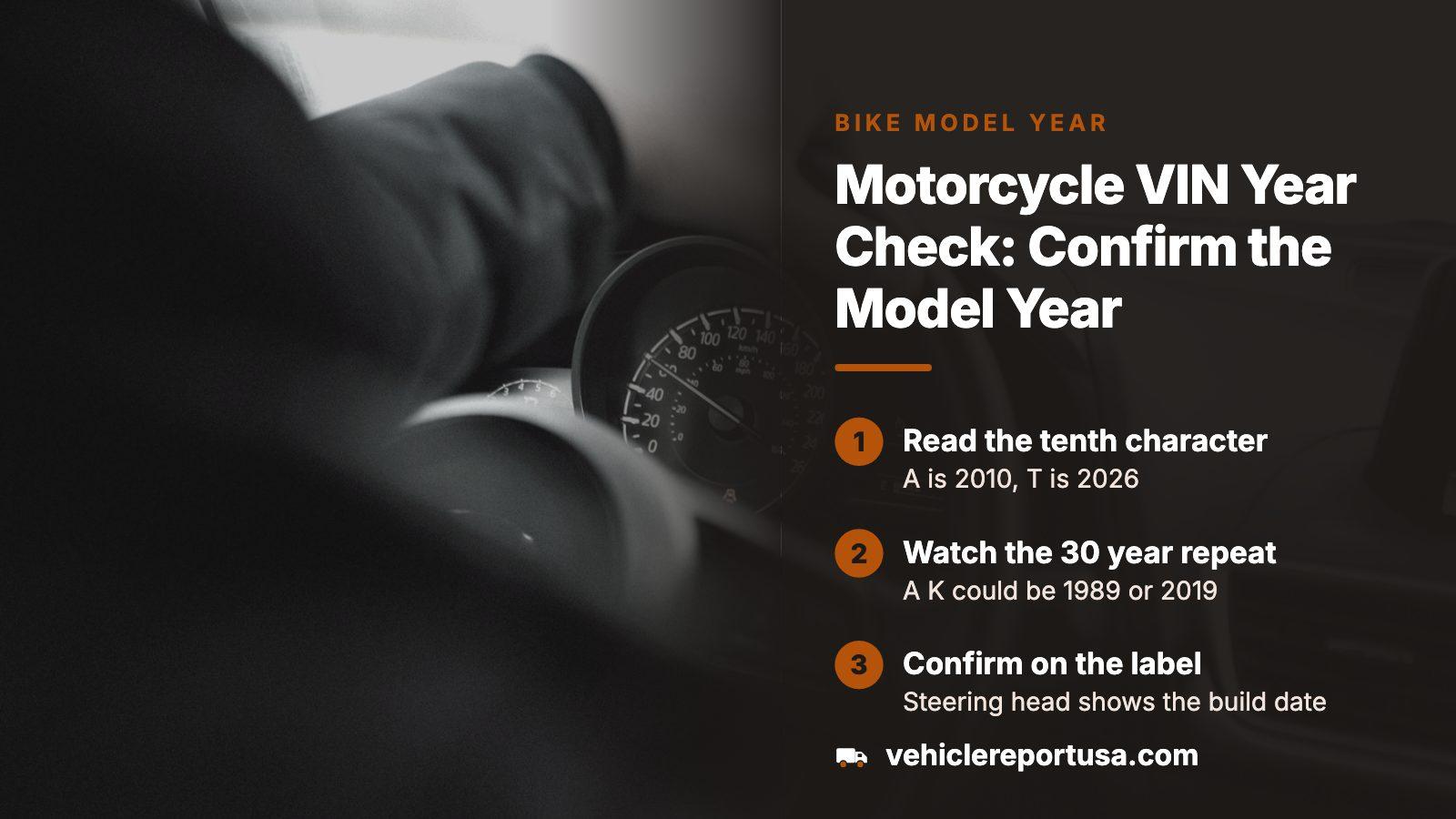
Read the tenth character of the frame VIN: A is 2010, F is 2015 and T is 2026, while a bike from 2001 to 2009 carries a single digit. Because the codes repeat every 30 years, a K could be 1989 or 2019, so confirm with the build date on the steering-head label and the title. The preview decodes year and model at no charge, and the paid report then shows the bike's history.
- Year code
- Tenth of 17 characters
- Code cycle
- Repeats every 30 years
- Build date
- Printed on the steering-head label
- Preview
- Free; report is one payment
The tenth character is the year, and the chart skips letters
A bike built to the federal format carries 17 characters, and I, O and Q never appear. Count to the tenth and you have the year code. Position nine is a check digit that exposes a misread number, and the last four characters of a motorcycle VIN must be digits, so a letter there means you are reading some other number.
From 2010 the codes run A, B, C, D, E, F, G and H for 2010 to 2017. The alphabet then skips I, so J is 2018, K is 2019, L is 2020, M is 2021 and N is 2022. P, R, S and T take 2023 to 2026. Bikes from 2001 to 2009 use the digits 1 to 9, and no year code ever uses U or Z.
One letter, two bikes thirty years apart
The chart starts over after 30 years, so one character fits two different machines.
| Tenth character | Older reading | Newer reading |
|---|---|---|
| A | 1980 | 2010 |
| F | 1985 | 2015 |
| K | 1989 | 2019 |
| T | 1996 | 2026 |
Cars get a tie-breaker, because the federal rule makes their seventh character a letter on newer models. The note that sets out that test names passenger cars plus lighter multipurpose vehicles and trucks. Motorcycles are not in it, so a bike's number offers no shortcut. Settle the question with the label, the title and what is physically on the machine. Left alone, NHTSA's decoder reads a K as 2019, so type the year from the advert and see whether the decode accepts it.
Model year is a label; the build date sits on the plate
Federal rules treat the model year as a label a manufacturer attaches to a design, regardless of the calendar year of assembly, so long as production stays under 24 months. A machine finished in one year can honestly wear the next year's code.
The maker's label records the real build month and year. On a motorcycle it is fixed to a permanent part close to where the steering post meets the handlebars. It has a line for the build date and none for the model year.
Build date and model year in a real recall
NHTSA's record for Triumph campaign 14V009000 covers certain Tiger Explorer and Trophy bikes of model years 2012 to 2014, built between November 17, 2011, and December 16, 2013. The production window opens in 2011, though the earliest model year it names is 2012.
So an advert saying 2011 over a VIN that reads 2012 may be innocent. A seller who cannot show a label or a title that agrees has more explaining to do.
Finding the frame number and the label
A car's VIN is readable through the windshield, but the rule that requires that lists cars, light trucks, multipurpose vehicles and low speed vehicles, not bikes. On a motorcycle the number is stamped or plated onto a part that is not meant to come off, so you have to look for it.
- Begin at the steering head, where the forks meet the frame, and turn the bars to one side for a clear view.
- Wipe the grime away and photograph the stamping and the label, with enough bodywork in frame to show where each sits.
- Copy the build month and year from the label and set it beside the year code.
- Compare stamping, label and title one character at a time. All three must give the same VIN.
What the decode says about the model
The first three characters name the maker. NHTSA's lookup returns Harley-Davidson for 1HD, Honda for JH2 and Triumph for SMT. Characters four to eight describe the bike, and for a motorcycle the rule wants five facts to be recoverable: who built it, what kind of bike it is, the model line, the engine and its net brake horsepower. The maker picks the characters and files the key with NHTSA.
Treat any horsepower in a decode as approximate, since the rule tolerates 10 percent either way. A blank field means NHTSA holds no data for it, not that the bike lacks the part.
NHTSA's decoder also takes a partial number, with * for each unreadable character and the ninth digit optional. That helps when rust hides part of a stamping, though the check digit can then confirm nothing.
Once the year fits, what the report adds
A matching year shows only what the bike was built as. VehicleReportUSA's report then searches records tied to that same VIN, and a handful of entries move a motorcycle's price.
| If the report shows | Do this |
|---|---|
| A salvage, rebuilt or flood brand | Pay a mechanic to check frame alignment before you talk price. |
| Damage or auction photos | Compare them with the bike in front of you, forks and neck first. |
| Odometer entries that stall or drop | Ask for dated service invoices that explain the gap. |
| A lien or an impound entry | Get the lender's written release before any money moves. |
| A theft or insurance loss record | Stop and ask for a written explanation. |
Running the check, and what it costs
- Enter the frame VIN in the form on this page, with no spaces.
- Read the preview, which is free. The decoded year and model should match the advert and the label.
- If they do and the bike is still a contender, buy the report. It is one payment, not a subscription, and sets of 3, 5 or 10 are there for anyone weighing a few bikes.
- Read the report against the title before you hand over a deposit.
Amounts for a single report and for each pack are on the pricing page.

Recalls follow the number, not the year
NHTSA offers a recall lookup at no cost, and it accepts a VIN. Enter the number rather than the model and year, because a campaign tied to build dates, like the Triumph one above, can miss a bike that looks as though it belongs.
From an NHTSA owner complaint
A 2012 Triumph Tiger 800 XC owner told NHTSA that the mounts on all four turn signals had failed, one while the bike sat parked and three on ordinary street and highway rides. Triumph had recalled certain 2012 Tiger 800 XC bikes by VIN, and the owner wrote that Triumph "did not include mine" although the model and year matched.
Two bikes of one model and year can land on opposite sides of a recall's line, which is why the lookup has to run on the complete VIN.
Other public checks, and the one no record replaces
- NICB's VIN check, also free, tells you if a vehicle has flood damage, sits on a theft list without being recovered, or has been declared salvage.
- NMVTIS reports from approved providers stay with five items: the current title, any brand a state applied, the odometer reading, and total-loss and salvage history. Some listed names sell only to dealers, so read the provider page first.
None of these replaces a look at the bike. The FTC advises an independent inspection before you buy, and a mechanic will spot a bent fork or a tired chain that no record mentions.
Where this information comes from
- eCFR: 49 CFR Part 565, VIN requirements — The year chart, the motorcycle row and the limits of the position-seven test.
- eCFR: 49 CFR 567.4, certification label — Where a motorcycle's label sits and what it states.
- NHTSA vPIC: VIN decoder — The public decoder, with its partial-VIN and model-year boxes.
- NHTSA recall record: campaign 14V009000 — A recall whose production window starts before its first model year.
- NHTSA owner complaint 10860826 — owner experience, paraphrased
- FTC: Used Cars — History reports, free lookups and the case for an inspection.
- NMVTIS: Understanding a vehicle history report — The five indicators an NMVTIS report is built around.
Sources and photos: Facts checked against the sources above in November 2026. Photos by Miles Loewen, Michal Biernat and Nathan Dumlao on Unsplash; diagrams by VehicleReportUSA.
Keep reading
- Motorcycle VIN Lookup: Check a Used Bike's History Before You PayThe full walk-through for decoding a bike and reading its history.
- Pre-1981 Motorcycle VIN Check: What It Can and Cannot ShowOlder frames fall outside the standard year chart.
- Motorcycle VIN Recall Check: Find Open Recalls on Any BikeOpen recalls follow the VIN, not the advert.
- PricingWhat one report or a pack costs, paid once.
Frequently asked questions
What if the tenth character and the advert's year disagree?
Ask whether the bike was finished late and sold as the next model year, and read the build month on the steering-head label. Type the advert's year into NHTSA's decoder: it still runs but flags the mismatch. A seller with no label or paperwork to explain the gap is a warning.
Can I check the year from a partly readable VIN?
Yes, if the tenth character is legible. NHTSA's decoder takes partial numbers, with * for each missing character. Without the check digit you lose protection against a misread, so confirm the year against the label and title.
Why does a 1989 bike decode as a 2019 model?
Year codes repeat every 30 years, and the decoder picks the newer year unless you supply one. Type 1989 and it decodes against that year. Bikes older than 1981 are different: NHTSA's decoder rejects a pre-1981 year, so use maker references instead.
What does a blank field in the decode mean?
It means NHTSA has no data for that item, since the decoder works from keys the makers file. It does not mean the bike lacks the feature. Check the bike itself, and rely on the report for records a decode never holds.
Is a motorcycle VIN year check free?
The preview carries no charge, and a report is bought once and does not renew. NHTSA's recall lookup and NICB's VIN check cost nothing, but they cover open recalls plus theft, salvage and flood flags, not the liens, title records and photos a full report searches.
Now check the car itself
The guide explains what to look for. The report shows what this VIN has on record.