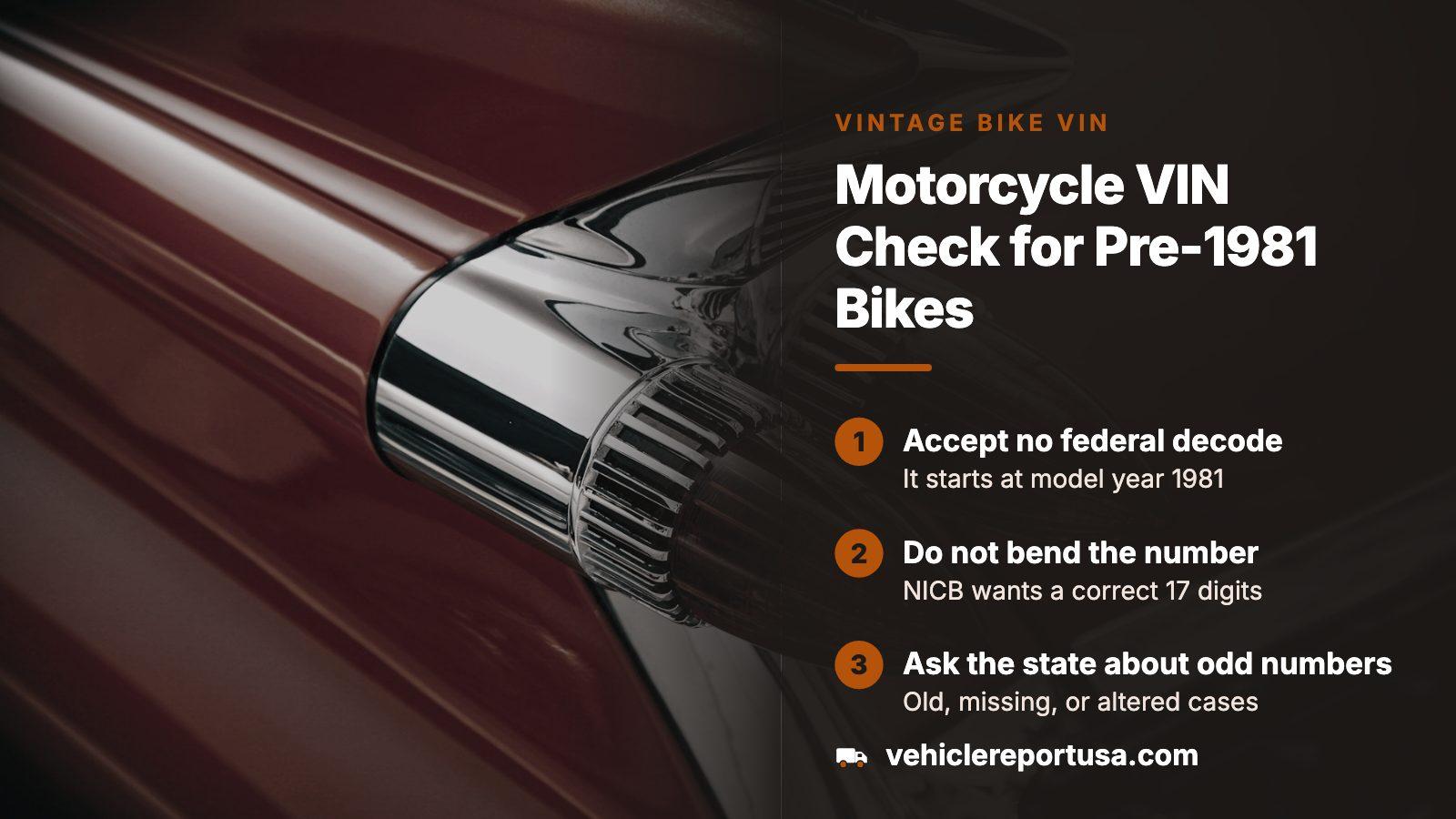
THE SHORT ANSWER
Yes, with limits. NHTSA's decoder covers only 1981 and newer, and NICB's lookup wants a correctly typed 17-digit VIN, so a 1970s frame number gets no free explanation. A paid history report searches the number for title, damage, lien and theft records, and it can only return what was filed against that exact number. Run the free preview first, treat a quiet result as thin evidence, and inspect the bike yourself.
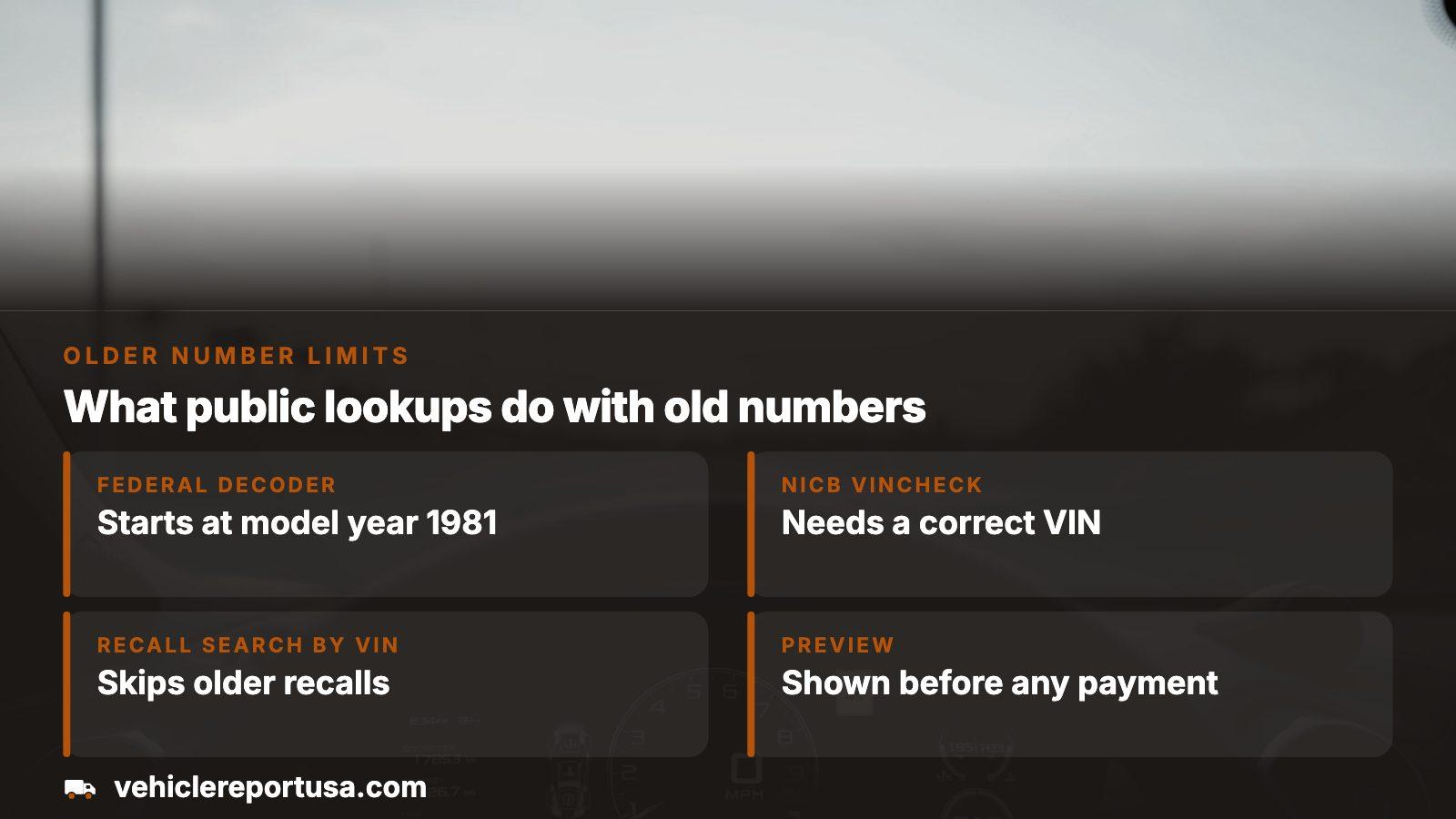
- Federal decoder
- Starts at model year 1981
- NICB VINCheck
- Needs a correct 17-digit VIN
- NHTSA recall search by VIN
- Skips recalls past the 15-year mark
- Preview
- Free, shown before any payment
Why a 1970s frame number gets no decode
Federal tools were built around the 17-character number that NHTSA's rules require. Its public decoder works from the 1981 model year onward, and the agency's own page says vehicles built before that standard are outside what the system can decode. Type in an earlier year and the tool refuses it. A seventies bike therefore carries a number that no federal website will turn into a model year, engine size or plant.
That does not make the stamping worthless. It is still the identifier on the title and on any insurer's file, and records filed under that exact string can be searched. What you lose is the free cross-check. For an older bike, the maker's parts book or a marque owners' club has to confirm the year and engine.
What each public lookup does with an older number
| Lookup | On a pre-1981 bike | Why |
|---|---|---|
| NHTSA vPIC decoder | No decode | Built for the 1981 model year onward; earlier years are rejected |
| NHTSA recall lookup by VIN | Usually blank | Recalls past the 15-year mark drop out, unless the maker extends them |
| NHTSA recall lookup by model year and model | Works | Lists recalls, investigations and complaints for the model, not for your machine |
| NICB VINCheck | Only with a correct 17-digit VIN | Reads theft and salvage records from participating insurers, and covers some motorcycles |
| NMVTIS | Patchy | Federal reporting is required for common automobiles only, though several states also report motorcycles |
The model search is the one federal route that reaches back into the seventies. NICB's theft screen is still worth running if the bike has a number it can read.
What a history check can still find on a vintage bike
A report searches the number for records, so the useful question is which records an old motorcycle is likely to have. A bike that sat with one owner for decades may have almost nothing on file. One that crossed state lines, went through an insurer or passed an auction block leaves a longer trail.
- A salvage, rebuilt or flood brand carried over from an earlier title.
- An insurer's total-loss entry, or a transfer to a salvage yard.
- A lien that was never released, or an impound entry.
- A theft record that nobody cleared.
- Odometer readings from title transfers, which on a bike this old may be few.
An empty result is common for survivors and does not clear the bike. The federal title system admits that some reporting entities send nothing, so a search can come back blank by mistake.
Running the check without bending the number
- Find the frame number and photograph it with part of the bike in shot. Makers of that era did not share one layout, so try the steering neck first, then the frame tubes, then any riveted plate.
- Copy the characters exactly as stamped, letters and dashes included, and compare them with the title.
- Enter the number as it appears. Never pad it to reach 17 characters.
- Read the free preview. What comes back tells you whether the full report is worth buying for this bike.
From an NHTSA owner complaint
An owner of a 1978 Honda CB750 filed a complaint with NHTSA in 2008 about an electrical fault. The online form refused a frame number shorter than 17 characters, so the owner tacked four extra characters on the end just to submit it, and said so in the narrative.
Take the warning from it: a padded number is no longer your bike's number, so whatever it returns describes something else or nothing.

Recalls on a bike from the seventies
NHTSA's VIN search drops recalls once they are older than 15 years, which empties it for almost any pre-1981 bike. The search by model year and model behaves differently: its records cover bikes from before 1981 too, for Honda, Yamaha, Harley-Davidson and Suzuki among others.
Its page for a 1978 Honda CB750 shows one recall, a fuse holder spring that can overheat. For a 1975 Harley-Davidson SXT125 it shows one about fatigue cracks in the rear frame tubing near the seat. A model search covers the whole model, so read each campaign for the bikes it actually named.
From an NHTSA owner complaint
An owner of a 1975 Harley-Davidson SXT125 told NHTSA in 1997 that the maker would not carry out the recall on that bike, because the motorcycle and the notice were "too old". The frame-tubing campaign is still in NHTSA's record today.
Do not count on a free repair for a recall that old. Treat the campaign as an inspection list and look at that part of the frame yourself, or pay a mechanic to.
How states treat a number that is old, missing or reassigned
Titling is where an old bike's number gets tested, and every state has its own routine. California's DMV lists the events that call for a verification: no DMV record of the bike, a number that DMV itself assigns, papers that differ from the number on record, and a motorcycle that has had its engine cases changed. Licensed private verifiers may not inspect a motorcycle with no California record, so that work falls to the other groups the handbook names: DMV employees, peace officers and auto club staff.
Other states will differ. Before you pay a seller, ask your own DMV what it needs for a bike of that age with no matching record, since a bike you cannot title is one you cannot register.
Red flags on the stamping and the paperwork
| If you see | What to do |
|---|---|
| A frame number that differs from the title by one character | Re-read both in daylight. If they still differ, ask for papers that explain it before talking price. |
| Characters that look bright, uneven or oddly spaced | Stampings can be redone. Look for filing or grinding nearby and ask why. |
| Engine cases that do not fit the seller's story | Swaps are common, but California, for one, treats a case change as a verification event. Ask for receipts. |
| A bill of sale and no title | Ask your DMV what it will accept before any money moves. |
Cost, and what to do when the answer is thin
The preview costs nothing. Buying a report is a one-time charge, nothing recurs, and bundles of 3, 5 or 10 exist for shoppers weighing several bikes. The pricing page shows what each costs. Add the free lookups: NICB caps VINCheck at five a day from one IP address, and it says plainly that it is no substitute for a full history.
- Match the frame number to the title, and the seller's name to the title.
- Ask the marque's owners' club how that year's numbers were laid out.
- Search recalls by model and read each campaign.
- Have a mechanic check the frame, neck and engine cases in person.
Where this information comes from
- NHTSA: vPIC VIN decoder — Where the decoder's 1981 starting point and its handling of earlier years were read.
- NHTSA: Check for recalls — Explains what a VIN search leaves out, including recalls past 15 years, and what a model search returns.
- NMVTIS: information for consumers — What the federal title system shows, which vehicles states must report, and why a search can miss history.
- NICB: VINCheck — The free theft and salvage screen, its 17-digit requirement and its daily search limit.
- California DMV: vehicle verifications — One state's list of when a motorcycle must be verified and who may do it.
- NHTSA owner complaint 10252643 — owner experience, paraphrased
- NHTSA owner complaint 816841 — owner experience, paraphrased
Sources and photos: Facts checked against the sources above in November 2026. Photos by Clem Onojeghuo, Alejandro Escamilla and Dennis Eusebio on Unsplash; diagrams by VehicleReportUSA.
Keep reading
- Motorcycle VIN Lookup: Check a Used Bike's History Before You PayThe general lookup for bikes from 1981 on, including how the frame number differs from the engine serial.
- Motorcycle VIN Recall Check: Find Open Recalls on Any BikeRecall searching for bikes in more depth than this page goes.
- Motorcycle VIN Year Check: Confirm the Model Year Before You BuyReading a model year from a number that does decode.
- Sample reportSee how a finished report lays out each section before you buy.
Frequently asked questions
Can I run a VIN check on a motorcycle made before 1981?
Yes, you can search the number for title, lien, damage and theft records, but federal decoders will not explain it. NHTSA's decoder starts at the 1981 model year, and NICB wants a correct 17-digit VIN. Start with the free preview and treat a quiet result as thin evidence, not a clean bill.
Why does a form reject my short frame number?
Many online forms expect the 17-character layout, and NICB can only match a VIN typed in full. Do not pad the number to fit, because you would be searching a different string. Photograph the stamping, check it against the title, and ask the seller for any papers that explain the format.
Does NHTSA show recalls for a 1970s motorcycle?
Yes, by model year and model. The VIN search drops recalls past the 15-year mark unless the maker extends them, but the model search lists recalls, investigations and complaints, including 1970s motorcycles. Read each campaign closely, since it covers the model and not only your machine.
Does a clean report prove an old bike was never stolen or wrecked?
No. NICB reads only participating insurers' records, and the federal title system warns that not every entity reports. Few records is normal for a bike whose owners never filed a claim. Inspect the frame and neck yourself, and request the title history straight from the state.
What if the number on the bike does not match the title?
Re-read both in daylight first, since misreads are common. If they still differ, ask for papers that explain it, such as a state-assigned number or a verification record. Without those you may be unable to title or register the bike, so ask your DMV what it will accept before paying.
Now check the car itself
The guide explains what to look for. The report shows what this VIN has on record.