THE SHORT ANSWER
Locate the stamped number on the frame and type it in for the preview. The report that follows covers title brands, liens, theft, damage and open recalls. Plenty of side-by-sides were never titled or insured, so a sparse result happens often. Back it up with the seller's papers, the maker's recall lookup and your own eyes on the frame.
- Federal label
- Recreational off-highway vehicle (ROV)
- Recalls found
- 44 ROV recalls in the CPSC database, 2012 to 2021
- Decoder quirk
- Polaris prefix 4XA is filed as a motorcycle
- Recall agency
- CPSC, not NHTSA
What a history check can say about a side-by-side
Buyers shopping a used Ranger, RZR, Pioneer or Teryx tend to treat the machine like a farm tool, and farm tools rarely leave a paper trail. A history check is only as good as the records filed against that number. Where a UTV was titled, financed through a lender, insured after a theft or put through a salvage auction, those events can surface. Where it was bought for cash and kept in a barn, the honest answer may be that little exists.
That is still useful. A clean, thin result tells you the number is not attached to a known theft or a brand. A result that shows a lien or an insurance loss tells you to stop and ask the seller hard questions before any money moves. Either way, you learn it before the trailer is hitched.
Preview first, report second
Typing in a VIN returns a no-cost preview. Paying is a separate step, taken once per report; see the pricing page for the options.
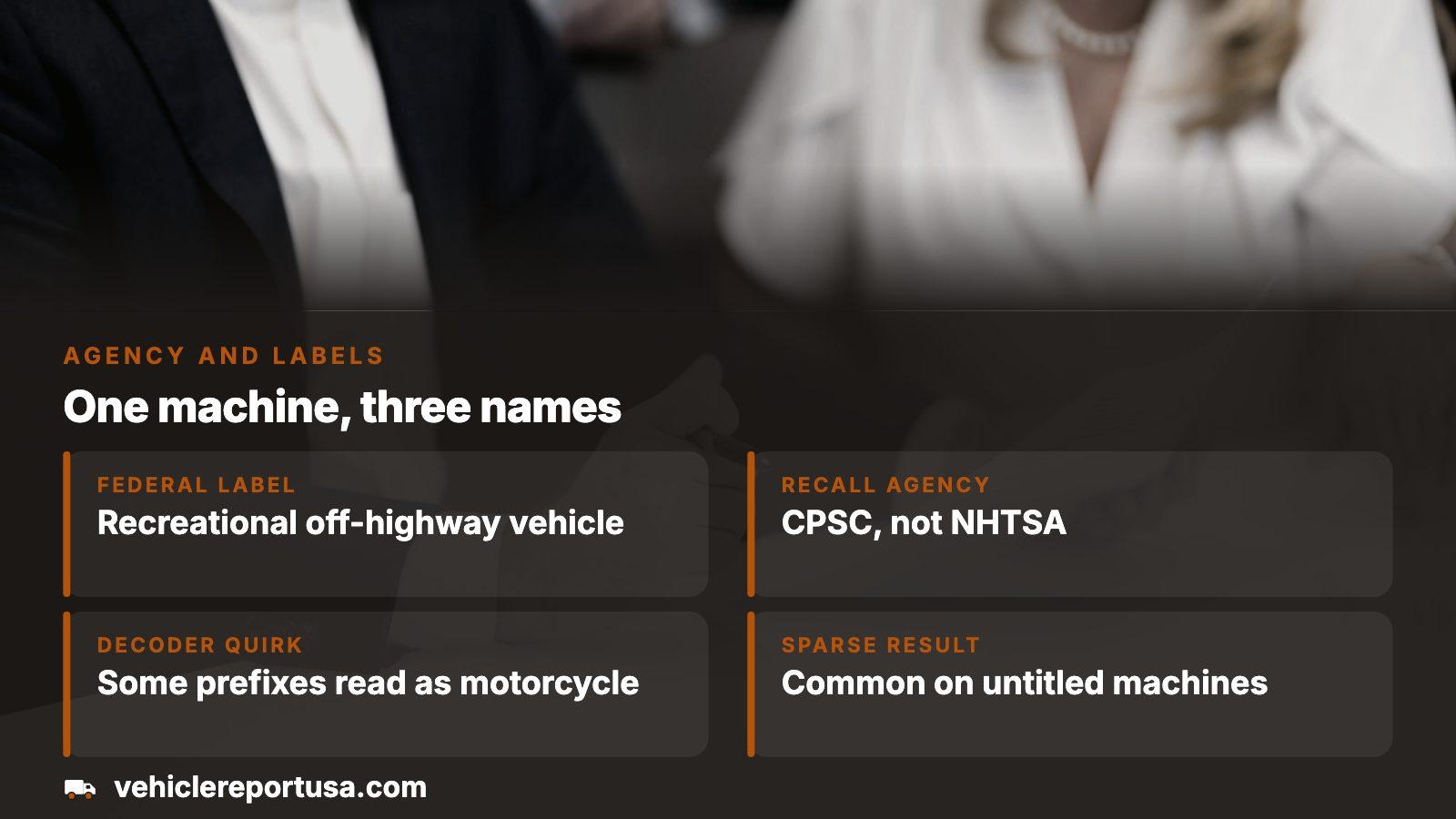
UTV, ROV, side-by-side: the same machine under three names
Federal safety staff call these machines recreational off-highway vehicles, or ROVs. The Consumer Product Safety Commission says an ROV runs on at least four tires and is meant for off-road recreation. Several features set it apart from a quad: a steering wheel where a quad has handlebars, bench or bucket seating, foot pedals for throttle and brake, a roll cage, seat restraints, and speeds beyond 30 mph.
Why this matters when you shop: a rule, label or recall written for quads may not reach the side-by-side next to it. If a seller says the machine is just a big ATV, correct the record in your own head and search it under the right heading. The quad-focused pages on this site, such as the ATV lookup page, are a separate topic.
Getting the number off the machine
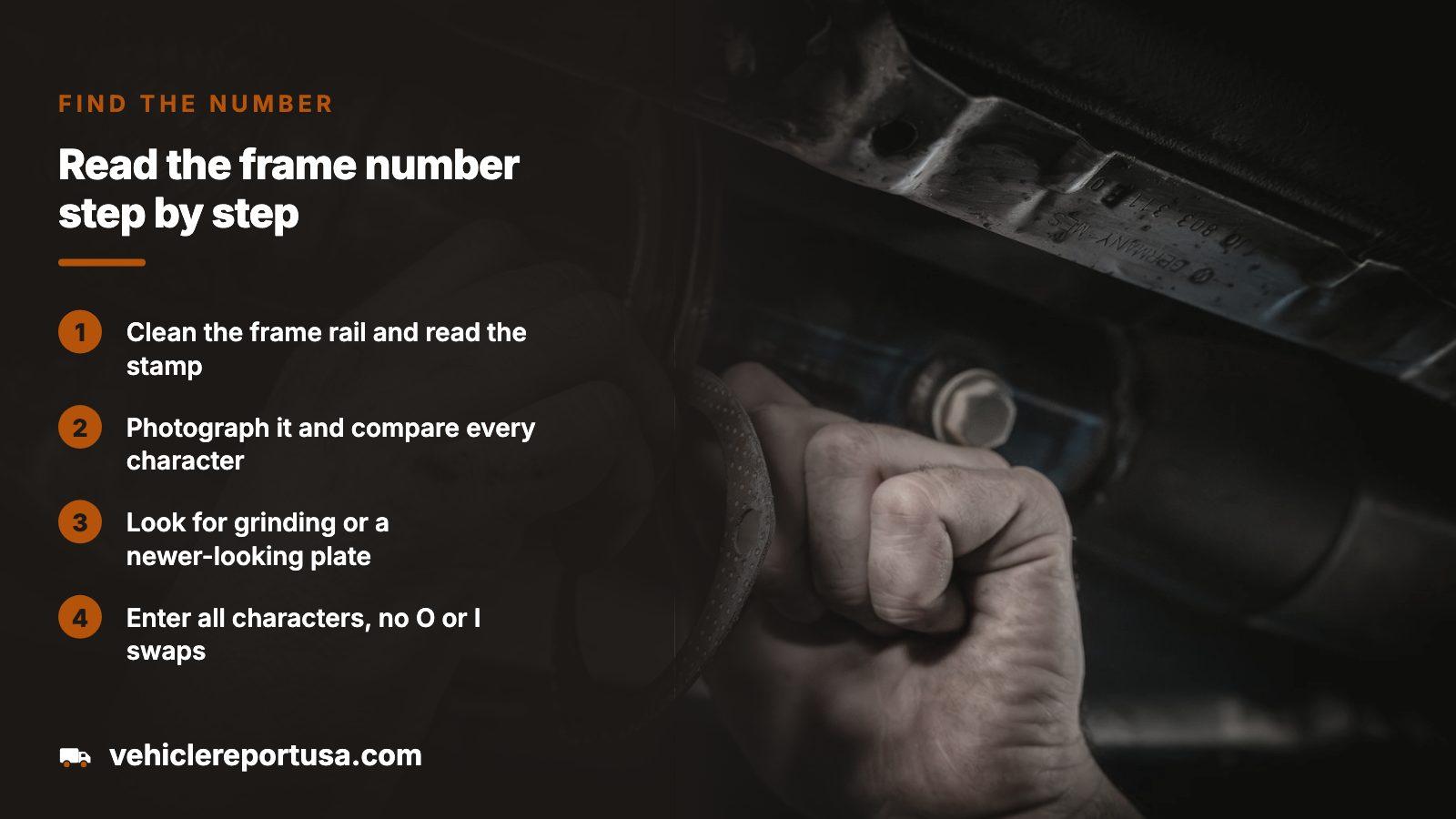
Most makers stamp or rivet the VIN to the main frame, often near a front wheel well or low on a side rail, and many add a sticker elsewhere. Mud hides it, so bring a rag and a flashlight. Copy it by photo and by hand, then compare it to the bill of sale, any title and the registration slip.
- Clean the frame rail and read the stamped number in raking light.
- Photograph it, then compare every character against the seller's paperwork.
- Look for grinding, a plate that looks newer than the metal around it, or uneven spacing.
- Enter all 17 characters, with no letter O or I swapped in for zero or one.
A number that cannot be read, or that does not match the papers, is a reason to walk away. It is not a puzzle to solve after you have paid.
Why a free decode can mislabel a UTV
NHTSA's public decoder was built around road vehicles, and powersports makers sit awkwardly in it. Its listing for the make Polaris carries three vehicle types: Motorcycle, Low Speed Vehicle and Off-Road Vehicle. The manufacturer prefix 4XA, assigned to Polaris Industries, is filed under Motorcycle. So a side-by-side may decode with a type that does not match what is in your driveway.
We also tried a made-up Polaris-style VIN through the decoder. It came back flagged for a failed check digit and with a note that detailed data was unavailable. Read that as a warning about decoders, not about your machine: a mismatched type or an empty spec table does not make the VIN fake. A typo in the ninth character, however, can.
| What you see | What it usually means |
|---|---|
| Type says motorcycle | The maker's prefix is filed that way; check the machine against its photos |
| Specs mostly empty | Decoder gaps for powersports, not proof of a problem |
| Check digit error | Re-read the number; a single wrong character causes this |
| No decode at all | Short or older frame number; use the paperwork and a person at the dealer |
Recalls: which agency holds them
Side-by-side recalls are logged by the CPSC, not NHTSA, so a car-style recall search can come back empty and tell you nothing. A search of the CPSC recall database for recreational off-highway vehicles returns 44 recalls dated 2012 through 2021, with 10 of them in 2017 alone. The notices cover a wide spread of faults.
- Polaris RZR, June 4, 2019: brakes can fail, about 1,200 vehicles, free dealer repair.
- Honda Pioneer 700 and 1000, December 3, 2020: electric power steering can lose control, about 118,600 vehicles.
- Kawasaki Teryx and Teryx4, September 4, 2019: joint assembly can cause steering loss, about 2,600 vehicles.
- Yamaha Wolverine RMAX4 1000, February 11, 2021: rear shock mounts can snap, roughly 820 vehicles, free repair at a dealer.
Every notice says to park the machine until the repair is finished, and every maker says it writes to registered owners. A second owner who never registered may have heard nothing. Request the repair paperwork from the seller, then call a dealer with the VIN to confirm.
Red flags that justify walking away
Use the result alongside what you can see and feel. CPSC staff reviewed 329 ROV incident reports covering January 2003 through September 2010, including 169 fatalities, and the commonest pattern was a sideways rollover that ejected the occupant. Bent cage tubes, mismatched paint on one side or a replaced seat belt deserve questions.
Signs to stop the sale
A lien showing on the report, a theft flag, a salvage or insurance-loss record the seller never mentioned, a frame number that fails to match the papers, or a seller who will not let you read the stamped VIN yourself.
None of these proves wrongdoing alone. Together they are enough to renegotiate or leave.
Price, and the jobs left for you
Start with the preview, which costs nothing and shows whether the number returns any records at all. Buying the full report is a one-off payment for a single machine, or a pack if you are weighing several. Nothing renews, so nothing needs cancelling. The pricing page holds the figures.
Beyond the report, three jobs are yours: ask your own motor vehicle agency how it treats off-road machines, run the maker's recall lookup with the VIN, and get the bill of sale in writing. The national title system exists to curb fraud and keep stolen vehicles from being resold, so a report drawing on it is a sensible first filter, not the final word.
Where this information comes from
- CPSC: Recreational off-highway vehicles — Definition of an ROV, how it differs from an ATV, and the incident report review.
- CPSC: Polaris RZR brake recall alert — Hazard, unit count and remedy for the 2019 RZR brake recall.
- CPSC: Honda Pioneer steering recall alert — Steering-loss hazard, unit count and the dealer inspection remedy.
- NHTSA: vPIC VIN decoder — The federal decoder and its vehicle types for powersports makers.
- NMVTIS: Vehicle history for consumers — What the national title system is for and how buyers can get a report.
Sources and photos: Facts checked against the sources above in November 2026. Photos by Johann Noby, Martin Fennema and Carrie Allen www.carrieallen.com on Unsplash; diagrams by VehicleReportUSA.
Keep reading
- Polaris RZR VIN Check: History Report Before You Buy a Used RZRThe most common UTV name, with model-specific points to check.
- ATV VIN Lookup: Check a Quad's History by Frame VIN Before You BuyThe straddle-seat side of powersports, which follows different rules.
- Where Is the VIN Number on an ATV? Frame Spots by BrandMore detail on reading a stamped frame number.
- Kawasaki Mule VIN Check: Look Up a Used Mule Before You BuyA work-focused side-by-side line, checked the same way.
Frequently asked questions
Do UTVs have a standard 17-character VIN?
Most newer ones carry a 17-character number, but the federal rule that sets that format was written for road vehicles. Older machines, imports and some small-maker units can have shorter frame numbers. A shorter number is not automatically a problem, though it often means a thinner history, so lean harder on the paperwork and the physical inspection.
Will a UTV VIN check show every owner?
Not reliably. Ownership appears only where a title, registration, lien or insurance event was recorded for that number. Many side-by-sides are sold privately and never retitled, so gaps are normal. Treat a short list of owners as the minimum known, and ask the seller who they bought it from and when.
Can I check a UTV for theft?
Yes, a history check searches theft records filed against the VIN, and insurers also run their own public screening tools. A clear result is meaningful but not a guarantee, because an unreported theft leaves no record. Compare the stamped number with the seller's documents and be wary of cash-only deals on a machine with no paperwork.
Are side-by-side recalls in the NHTSA database?
Usually not. They are filed with the Consumer Product Safety Commission, so a car-style recall search can return nothing even when a recall exists. Search the CPSC list by maker and model, then call a dealer with the VIN to confirm whether the repair was done on that specific machine.
Does a UTV need a title?
It depends on the state. Some states title off-road machines like cars, some register them without a title, and some rely on a bill of sale. Ask your state's motor vehicle agency before agreeing on a price, because a machine you cannot register or sell later is worth less.
Now check the car itself
The guide explains what to look for. The report shows what this VIN has on record.