THE SHORT ANSWER
Type the sled's VIN into the lookup and read the free preview. Expect the maker and model year to decode. Title brands, liens, damage and theft entries appear only if the sled was titled, insured or reported somewhere. Snowmobile recalls sit with the Consumer Product Safety Commission rather than in road-vehicle data, so search that list as well. The full report is one payment, and not even it can see a worn track or a tired engine.
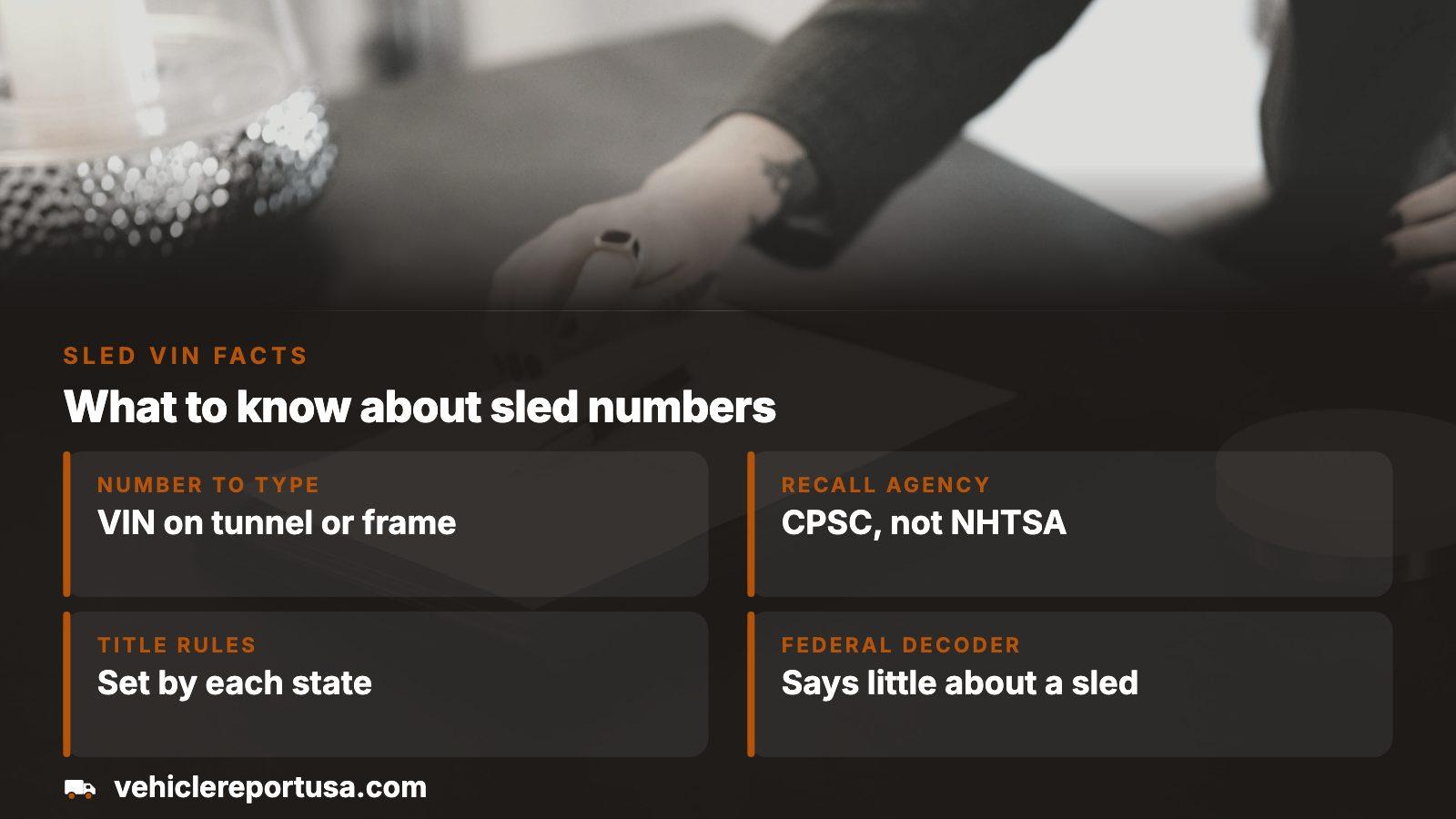
- Number to type
- The VIN on the tunnel or frame, never an engine serial
- Recall agency
- CPSC, which lists Snowmobiles as its own category
- Title rules
- Set by each state, and some issue none
- Preview
- Free, shown before any payment
What a snowmobile VIN search returns, record by record
The search checks the same record sources for a sled as for a pickup or a trailer. What differs is how often they hold anything. A sled can spend its whole life without ever meeting a title clerk, an adjuster or an auction block, and then the lookup has little to report.
| Record searched | What to expect on a sled |
|---|---|
| Branded title (salvage, rebuilt, flood) | Appears only where a state issued a title that could carry the brand |
| Insurer total-loss, damage and theft entries | Present if an insurer, shop, auction or police filing reported the sled |
| Liens | Debts filed against the number; none shows if none was filed |
| Mileage | Often absent, so judge wear on the machine itself |
| Recalls | Built on road-vehicle data, so sled recalls need a separate search |
| Owners, value and specs | Owner changes where recorded, a value estimate, build details |
A thin result is not a verdict on the sled. It shows how much of its history was ever written down.
Finding the VIN on a sled before you discuss price
Read the number off the machine yourself instead of trusting a listing or a text message. The federal product-safety agency's recent recall notices show that makers put it in different spots, and the spot can shift by model and year.
- Ski-Doo and Lynx: a decal under the seat, on the tunnel's right-hand side.
- Arctic Cat: a stamping on the tunnel, or a decal near the rear of its top surface.
- Polaris: on the right side of the frame, along with the model number.
Photograph the stamping and the decal, then compare both with the registration or title. Arctic Cat's 2024 Mountain 600 notice picks out the affected sleds by an R in the tenth position, so glance at that character against the year in the ad. Type the number exactly as printed. The insurer-crime screen below wants a correct 17-digit VIN, so an unusual serial may fail to match there, which proves nothing alone.
Why the federal decoder says so little about a sled
NHTSA's decoder, vPIC, is built from manufacturer submittals, and snowmobiles sit at the edge of what it covers. It files the Arctic Cat maker code 4UF and the Polaris codes SN1 and S21 under the type Off-Road Vehicle, and a search of its list of makes turns up no Ski-Doo entry, though BRP and Can-Am are listed.
A sparse preview is not a failed search
Blank engine or body fields can simply reflect what federal records hold for this class of machine. Buying the report does not fill them in. What it adds is the record searches: title, damage, liens, theft and insurance.
Titled, registered or neither: your state decides how much history exists
The national title database's own FAQ names cars, buses, trucks, motorcycles, RVs and tractors among the vehicles it covers, and snowmobiles are not in that list. Whatever title history a sled has lives with the state that issued it, and states disagree.
| State | What its agency says |
|---|---|
| North Dakota | A sled must be titled and licensed if ridden on land the owner does not control. The salvage law reaches sleds, so a badly damaged one carries a Previously Salvaged brand, but the damage-disclosure law leaves them out. |
| Connecticut | A snowmobile sits on the list of vehicles that need no title. |
Ask your own state's agency whether sleds are titled. Where none is issued, the VIN, the registration and a signed bill of sale are all you hold, and a search has less to find.
Sled recalls sit with a separate federal agency
The Consumer Product Safety Commission publishes snowmobile recalls from outside the road-vehicle side of the government, and its database has Snowmobiles as a category. A search of its recall data for the word snowmobile in a title returned 96 records at the time of writing. One covers about 600 Arctic Cat Mountain 600 sleds, a model that sold new for five figures, whose steering pin could work loose.
A road-vehicle recall search may not surface any of this. Search by maker and model, then ask a dealer to run the VIN. BRP says a dealer will screen a machine's VIN for open safety bulletins without charging for it, and Polaris keeps a recall page where an owner can look up a VIN.
Theft and insurer records: a free screen to run beside the report
The National Insurance Crime Bureau's VINCheck reports whether a member insurer has an unrecovered theft, a salvage declaration or flood damage on file for the VIN. Searches are capped at five per IP address in a 24-hour period, and the VIN must be a correct 17-digit one. Its stated reach is insured US vehicles and some motorcycles and watercraft; snowmobiles are absent from that wording.
Only participating insurers' records appear, and police files are not queried. The bureau warns that a clean result does not promise a clean past, so treat it as one input. If the numbers on the sled and the paperwork disagree, ask the local police to run the VIN before paying.
Red flags in the result and on the machine
- A salvage, rebuilt or Previously Salvaged brand the seller never mentioned.
- A lien against the VIN and no written release in the seller's hands.
- A theft entry or an insurer total-loss record tied to the number.
- A decal and a stamping that tell different stories, or neither matching the registration.
- Stamping that looks ground, re-struck or uneven, or a decal sitting over a scratched patch.
Sleds live outdoors and ride on trailers, so scuffs are normal. Altered characters are not. If the seller's papers cannot be squared with the number on the machine, walking away costs less than sorting it out later.
Running the search, and what it costs
- Enter the VIN exactly as it appears on the tunnel or frame, with no spaces.
- Read the free preview. It shows what the number decodes to before any payment.
- Check that the decoded maker and year match the ad. A mismatch is a reason to stop.
- If the sled stays on your list, buy the report: one payment, no subscription. Anyone shopping several sleds has the option of a larger bundle, in sizes of 3, 5 or 10.
Single-report and pack amounts are listed on the pricing page. Seeing the preview costs nothing; payment begins only at the report.
The order that catches most problems before money changes hands
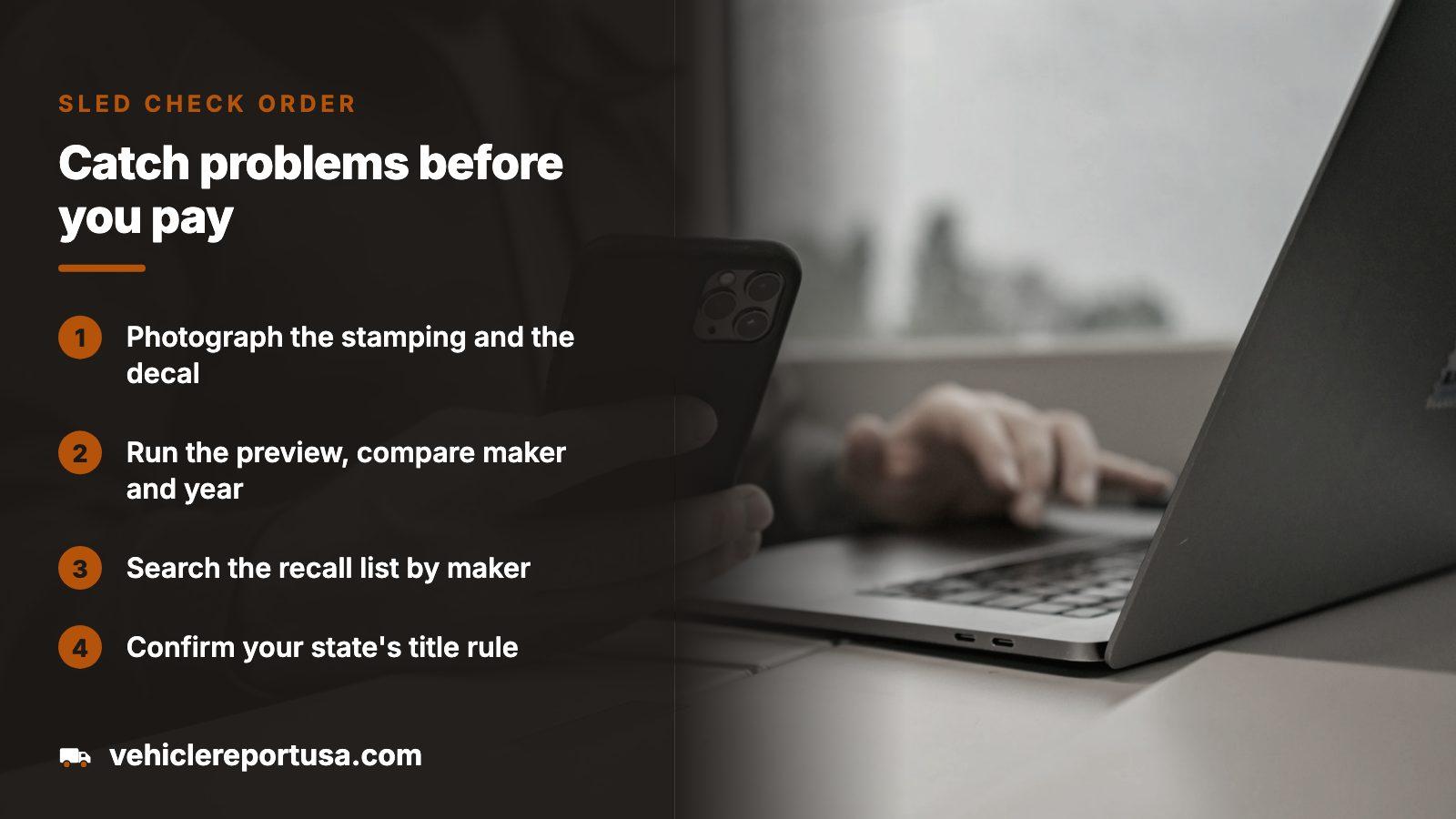
- Photograph the stamping and the decal, and ask to see the title or registration.
- Run the preview and compare the maker and year with the listing.
- Search the recall list by maker and model, then run the number through the insurer-crime screen.
- Confirm your state's title rule, and buy the report if the sled is still a candidate. The sample report shows each section first.
- Have a snowmobile shop look at the engine, track, skis and suspension.
A sled often changes hands with its trailer, and the trailer carries its own VIN, its own title rules and its own history.
Where this information comes from
- CPSC: recalls — The agency's recall database, with Snowmobiles as a category and weekly updates.
- CPSC: Arctic Cat Mountain 600 recall — A sled recall notice giving VIN locations, the tenth-character clue, unit count and price range.
- NHTSA: vPIC API — The federal decoder whose maker codes and make list explain the thin result on a sled.
- NMVTIS: frequently asked questions — The federal title database's list of covered vehicle types and what its reports hold.
- NICB: VINCheck — A theft and total-loss screen with its search limit, VIN length and coverage stated.
- North Dakota DOT: motor vehicle registration manual — One state's title, salvage-brand and damage-disclosure rules as they apply to snowmobiles.
- Connecticut DMV: vehicle title service — A state where a snowmobile is on the list of vehicles that need no title.
Sources and photos: Facts checked against the sources above in November 2026. Photos by Frederick Rosa, Anastasiia Nelen and Annika Wischnewsky on Unsplash; diagrams by VehicleReportUSA.
Keep reading
- ATV VIN Lookup: Check a Quad's History by Frame VIN Before You BuyQuads share the thin paper trail and the consumer-product recall path, with details of their own.
- Utility Trailer VIN Check: What the History Shows Before You BuyThe trailer under the sled has its own number, title rules and history.
- Sample reportA look at each record section before you spend anything on a full report.
- PricingWhat one report costs, and what the larger packs cost, paid once with no subscription.
Frequently asked questions
Does a VIN search work on a used snowmobile?
Yes. Read the VIN off the tunnel or frame, type it in, study the preview, and only then choose whether to buy the report. Whether title, lien, damage or theft entries come back depends on whether the sled was ever titled, insured or reported, so lean harder on the inspection.
Does a snowmobile need a title to be sold?
That depends on the state. North Dakota requires one for a sled ridden off the owner's own land, while Connecticut lists snowmobiles among vehicles that need no title. Ask your state agency, and where none is issued, get a signed bill of sale that includes the VIN.
Will a snowmobile VIN check show recalls?
Do not count on it. Sled recalls are handled by the Consumer Product Safety Commission, so search its list by maker and model, then ask a dealer to run the VIN. Notices for sleds often tell owners to stop riding until a dealer repairs the machine.
Does a clean result mean the sled is clean?
No. It means the records searched held nothing against that number. The insurer-crime screen sees only participating insurers and no police files, and the national title database does not name snowmobiles among its covered types. Pair any clean result with a close look at the machine.
Will a VIN check reveal whether a snowmobile was stolen?
It searches theft records tied to the number, and the insurer-crime screen adds a second look from participating insurers. Neither covers every theft, because a record exists only if someone filed a report. Altered characters on the machine call for a police check.
Now check the car itself
The guide explains what to look for. The report shows what this VIN has on record.