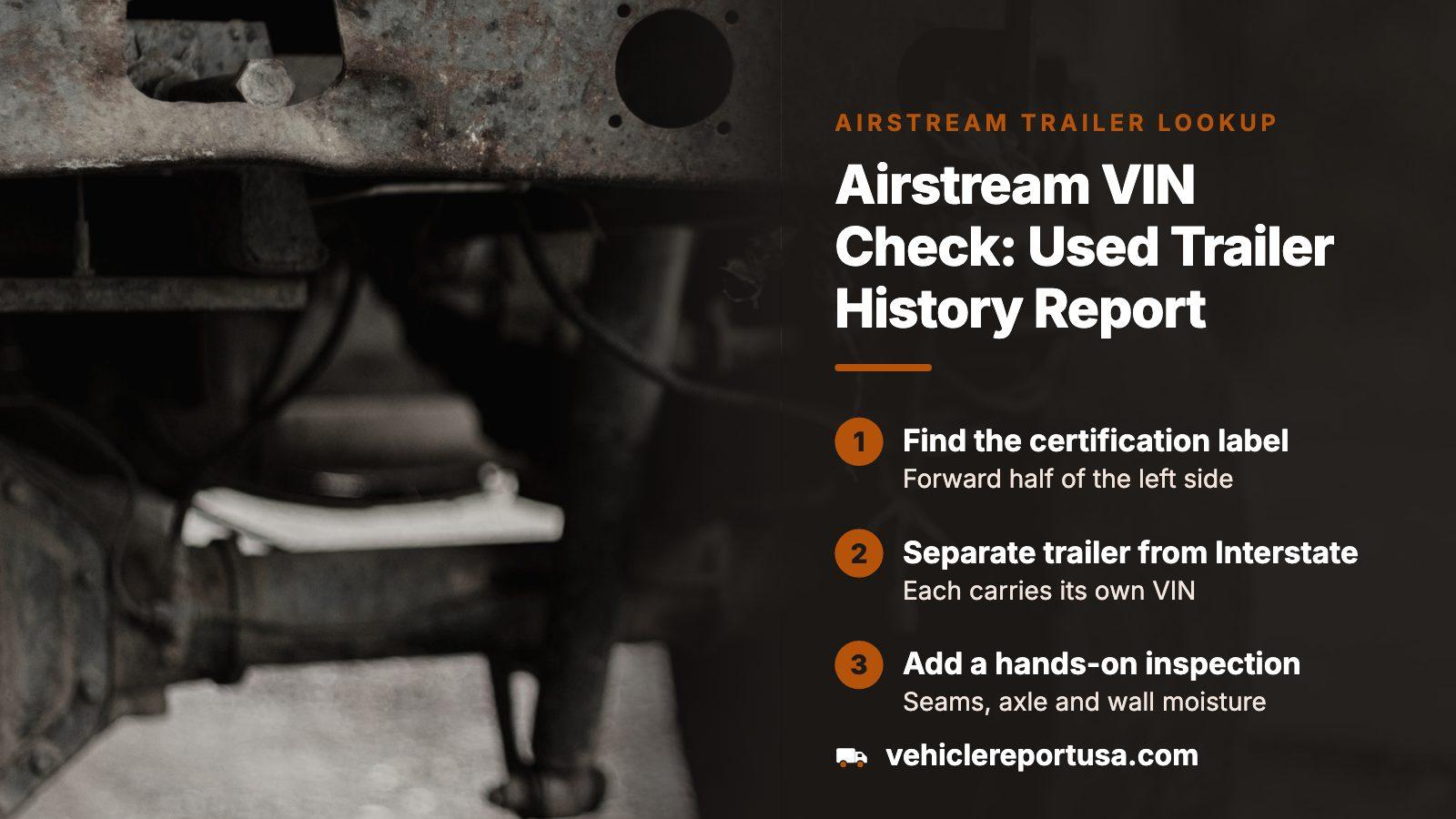
THE SHORT ANSWER
Read the VIN off the certification label on the trailer itself, then paste it into the lookup box. The preview is free. The paid report adds the title and damage history, lender claims, theft entries and unrepaired recalls. A used Airstream also needs a hands-on inspection, because a history report says nothing about worn seams, axle condition or water in the walls.
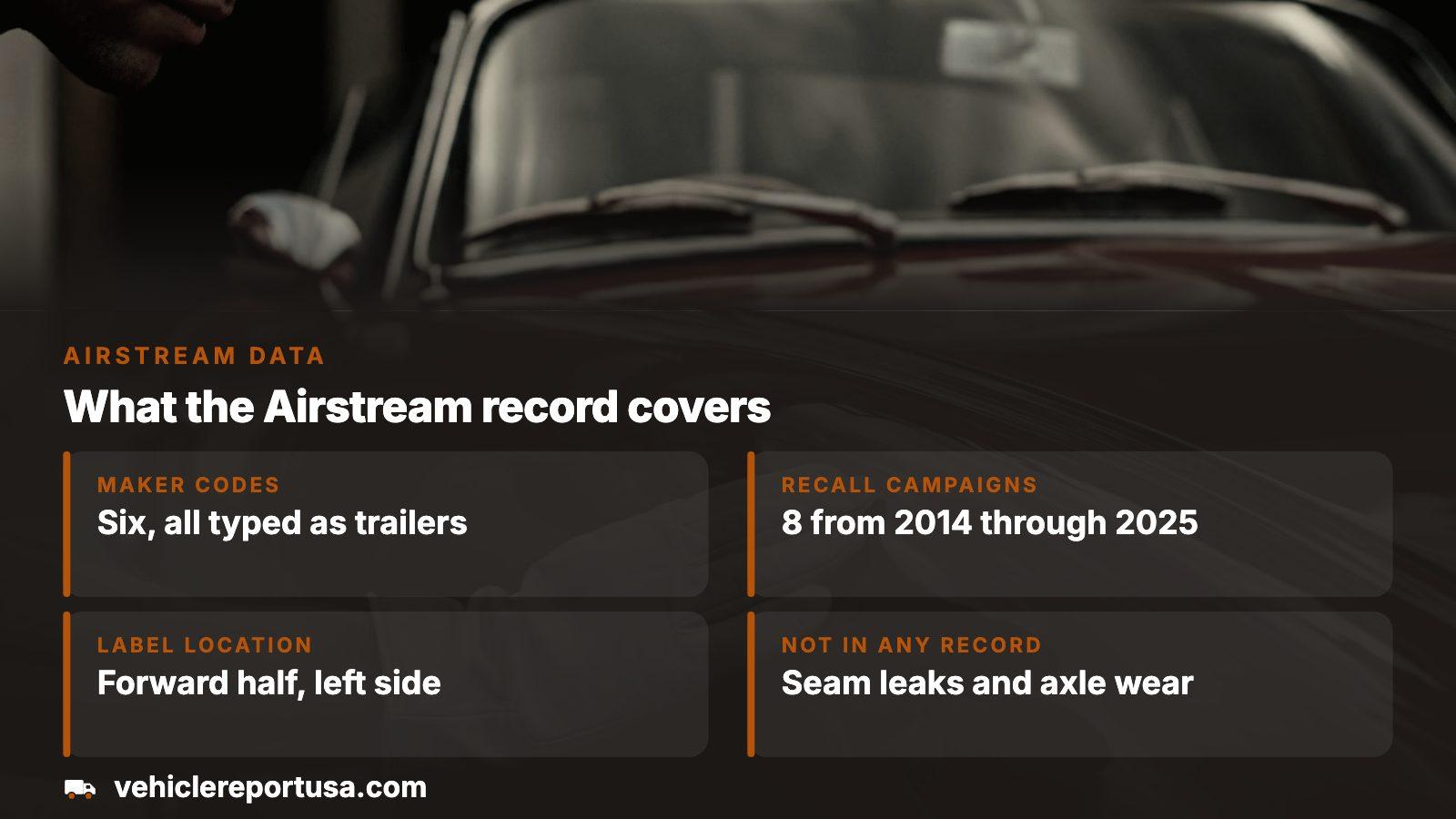
- Maker codes in vPIC
- Six Airstream identifiers, all typed as trailers
- Classic recall campaigns
- 8 distinct campaigns from 2014 through 2025
- Label location
- Forward half of the trailer's left side
- Not in any record
- Seam leaks, axle wear, interior water damage
What an Airstream VIN check can tell you
Airstreams hold their value, which is exactly why a buyer should want paper behind the shine. A used one can change hands several times, cross state lines, and pick up a repair history that never appears in a listing. The check pulls what reporting channels hold on that one number.
| Report entry | What it means for an Airstream |
|---|---|
| Title brands | Salvage, rebuilt or flood wording sharply cuts resale value and can affect insurance |
| Damage and accident records | Points you to the corner or panel that was repaired |
| Salvage and auction photos | Shows the trailer as it looked before any cosmetic repair |
| Liens and impounds | Confirms a lender has no claim on a unit the seller calls paid off |
| Theft and insurance entries | Flags a trailer reported stolen or written off |
| Odometer readings | Mostly relevant to Interstate coaches, which drive themselves |
| Open recalls | Lists safety campaigns that a dealer has not yet completed |
Trailer or Interstate: which number you are checking
Most people searching this have a towable in mind, a Classic, International, Flying Cloud, Globetrotter, Bambi or Basecamp. NHTSA's decoder lists the maker as Airstream Inc., with Thor Industries named as its parent company. It holds six manufacturer prefixes for Airstream, and every one of them is typed as a trailer.
The Interstate is different. It is a touring coach, so it drives and carries its own mileage, and recall notices for it refer to 19, 24 and 24X versions. Run the same check, but treat the odometer line as meaningful, since a low reading on a coach with a worn interior deserves a question. For a trailer, mileage is not tracked, so judge wear by looking at the unit.
Getting the VIN off the trailer, not off the ad
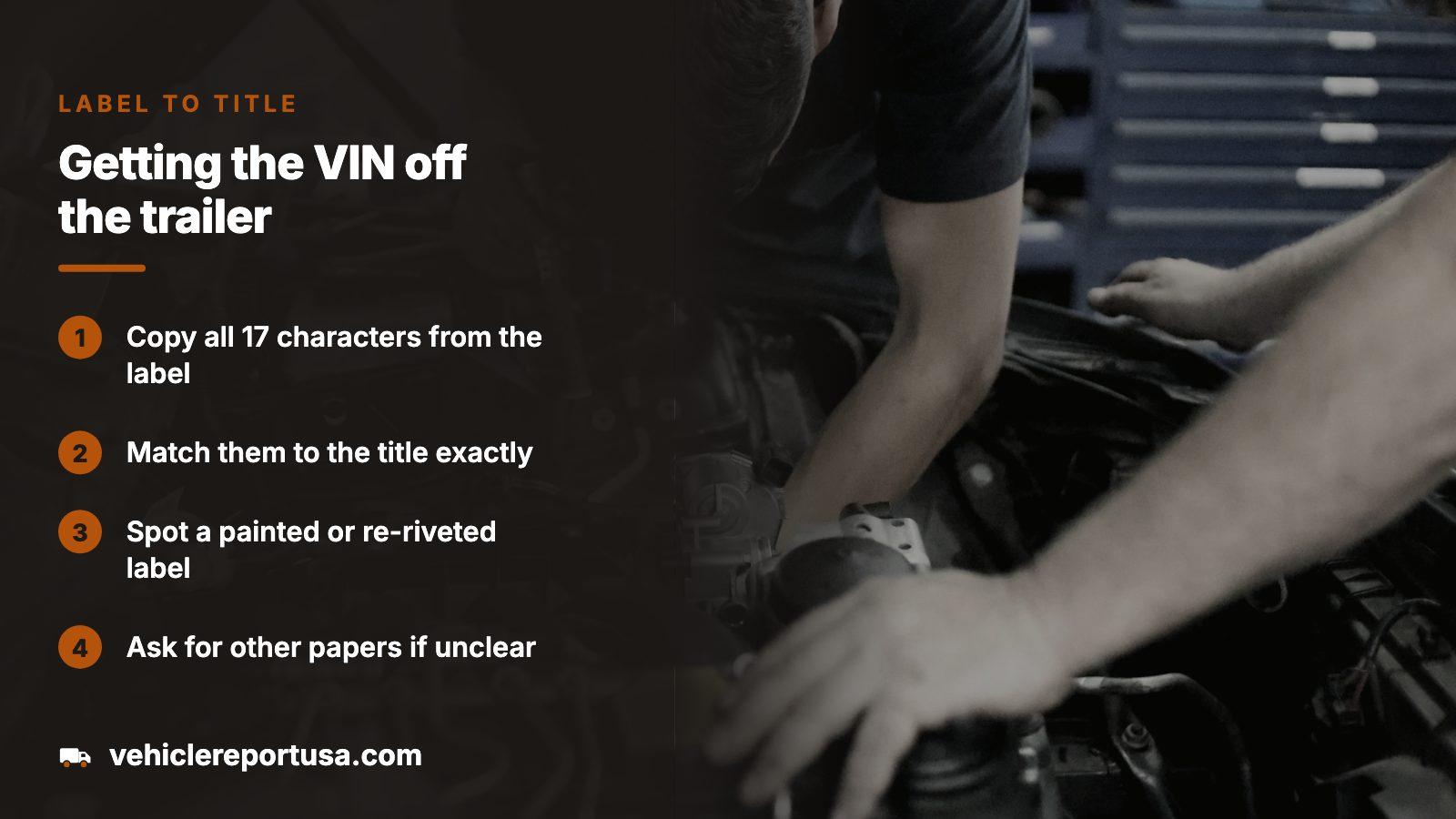
Under federal rules, the certification label on a trailer is mounted toward the front of the left side, where you can read it standing outside. That label carries the VIN, so start there and photograph it. Then compare it to the title and the registration.
- Copy all 17 characters from the label, not from a listing or a text message.
- Match them to the title, character for character.
- Look for a label that has been re-riveted, painted over or smudged beyond reading.
- Ask for the seller's other documents if any character is unclear.
A number that differs between label and paperwork is a stop sign. The federal consumer page on titles describes cloned vehicles, where a stolen unit is given a VIN lifted from another one of the same make and year. Paper that checks out in only one place proves little.
Recall history on Airstream travel trailers
NHTSA's recall data for the Classic shows 8 distinct campaigns between 2014 and 2025, all filed by Airstream and all repaired at no charge. By model year the count is one for 2014, 2015, 2016 and 2018, two for 2019 through 2022, one for 2023 and 2024, and two for 2025. Model year 2017 returned nothing.
| Campaign | Problem on certain trailers | Fix |
|---|---|---|
| 15V761000 | Propane regulator window could degrade and crack on 2016 units built in late 2015 | Dealer replaces regulator and hoses |
| 19V334000 | Spare tire carrier could touch the ground and separate on 2018 to 2020 trailers | Corrected carrier brackets |
| 19V753000 | Poorly welded ball coupler may not grip the tow ball on 2019 to 2020 units | Temporary adaptor, then a shim plate |
| 21V671000 | Two-stage propane regulator may fail and raise gas pressure on 2021 trailers | Inspect, replace as needed, leak-test |
| 22V348000 | Entry step may collapse when the fastener pulls through the washer on 2022 models | New washer plus thread locker |
| 25V143000 | Sofa footrest switch wiring may overheat on certain 2021 to 2025 Classics | Reverse relay installed |
The Interstate has its own list. For model year 2021 alone, NHTSA returns 6 campaigns, covering a radio harness, suspension bolts, weight labels and cooktops. A used coach should be run against all of them, not only the headline item.
What owners report after the sale
NHTSA keeps owner complaints for Airstreams too, and several describe problems no history report could have predicted. They are first-hand accounts, filed in the owners' own words.
From an NHTSA owner complaint
One owner of a 2015 Airstream International wrote that the door latch dropped off and kept them shut in for roughly sixty minutes at a remote campsite without phone signal. A butter knife was their only tool, and they eventually forced their way out. They noted that the emergency window is a last resort, and called the problem dangerous and easy to fix.
The lesson for a buyer is physical. Operate every latch, lock and window from both sides before you pay, because a spotless VIN record cannot vouch for hardware.
From an NHTSA owner complaint
A Basecamp owner reported that the side door window came off as a whole unit while driving at 70 mph and landed on the highway. They said the maker inspected it and was replacing it, and described it as a known problem on earlier Basecamps.
Ask whether any such repair was done, and get the paperwork.
Red flags in an Airstream's report
- A rebuilt, salvage or flood brand on a unit advertised as clean.
- Recent title transfers across several states in a short window.
- A lien still showing after the seller says the loan is gone.
- Open recalls on propane, wiring or hitch parts, which affect safety.
- Auction photos showing damage that the current paint hides.
- A VIN on the label that does not match the one in the report.
A single flag starts a conversation, while a cluster of them is grounds to leave. The national title database retains each brand that a state sends it, which means a brand dropped from a later title can still show up, but only where the originating state reports.
What no VIN check can see
Reporting is uneven. The national title database admits that a clean search result may be wrong until every reporting entity files its data. States also differ on thresholds, so one may brand a damaged unit and another may not. Trailers are not named on that page as a reporting focus.
Even a perfect record cannot show a slow leak, a soft subfloor, tired bearings or tires past their age. Pair the report with a moisture meter, a wheel-off look at the brakes and a test of every appliance. Run the recall search too, since a repaired item and an open one look alike on a listing.
Cost and what to do next
Type in the VIN and a preview appears before any money changes hands. The report behind it is bought once, not rented by the month, and shoppers weighing several trailers can pick a pack. See the pricing page for current options.
- Photograph the label and the title, then compare the numbers.
- Run the preview, then the report if you are serious.
- Resolve any open recall with an authorized dealer.
- Walk the trailer with the printout beside you.
- Negotiate on what you found, or walk away.
Where this information comes from
- NHTSA recalls API: Airstream Classic — campaign numbers, problems and remedies for the trailer line
- NHTSA recalls API: Airstream Interstate — the touring coach's separate campaign list
- NHTSA vPIC: Airstream manufacturer identifiers — maker prefixes and the parent company
- eCFR 49 CFR 567.4: certification label — where the label goes on a trailer
- NMVTIS: For Consumers — what a federal title report holds, and its gaps
- NHTSA owner complaint 11482324 — owner experience, paraphrased
- NHTSA owner complaint 11495595 — owner experience, paraphrased
Sources and photos: Facts checked against the sources above in November 2026. Photos by Zoshua Colah, Mustafa Sheikhmouss and Mohamed Gado on Unsplash; diagrams by VehicleReportUSA.
Keep reading
- Travel Trailer VIN Check: Run the History Before You Buy the CamperThe general check for towables, whatever the brand.
- RV VIN Recall Check: Chassis, Coach and Trailer Recalls Before You BuyHow to search recalls for an RV by VIN or by model.
- Where Is the VIN Number on a Trailer? Label, Frame and TongueMore on finding and reading a trailer's number.
- PricingReport and pack options, laid out before you commit.
Frequently asked questions
Does an Airstream VIN lookup work on older silver trailers?
It works best on units with a standard 17-character VIN. Trailers built before that format may carry shorter numbers and return little. If the lookup comes back thin, lean on the title, the registration and a close physical inspection rather than assuming the trailer has no history.
Can I check Airstream recalls without paying?
Yes. NHTSA publishes recall data you can search by make, model and year, and the maker handles repairs through its dealers at no cost. That answers one question only. It will not show title brands, liens, theft or damage records.
Is the Airstream VIN the same as the serial number?
On a modern trailer, the 17-character VIN on the certification label is the number to use for any lookup. If a seller quotes a shorter serial from a plate or a brochure, ask for the full VIN and match it to the title before you run anything.
Is the preview really free?
Yes, the first screen costs nothing and shows what the number matched. Moving on to the whole report is one purchase, and anyone weighing several trailers can pick a pack. Nothing renews.
Will the report show leaks or water damage?
Only when the damage produced paperwork, say a flood brand or a claim. Slow leaks around seams and windows rarely do, so bring a moisture meter and study the floor and walls yourself.
Now check the car itself
The guide explains what to look for. The report shows what this VIN has on record.