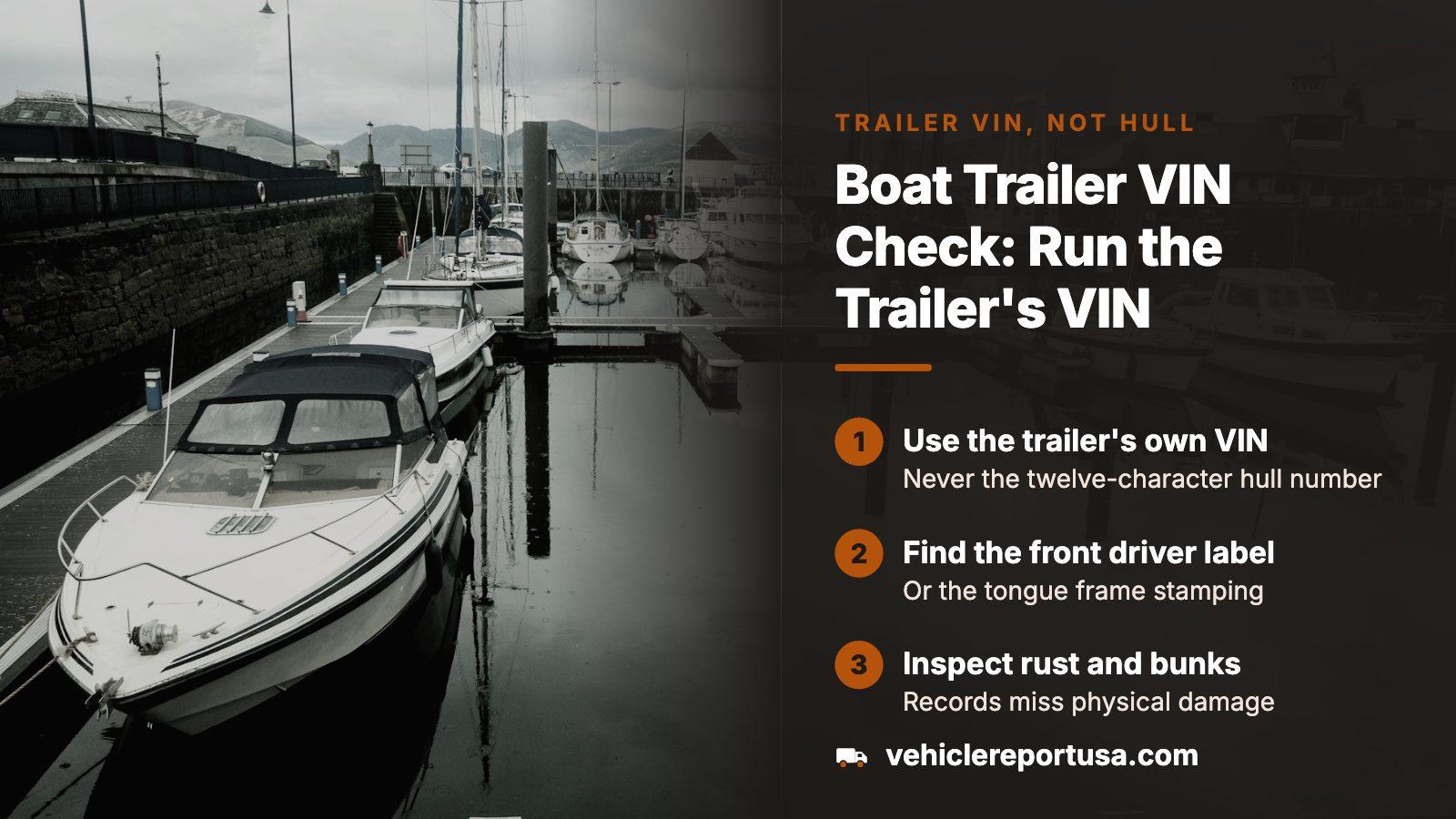
THE SHORT ANSWER
Read the VIN from the label near the front on the driver side of the trailer, or from the frame, never the twelve-character hull number on the boat. Type it in and look over the preview before spending anything. Order the full report only for a trailer you still want. Rust, bent frames and worn bunks still need your own eyes.
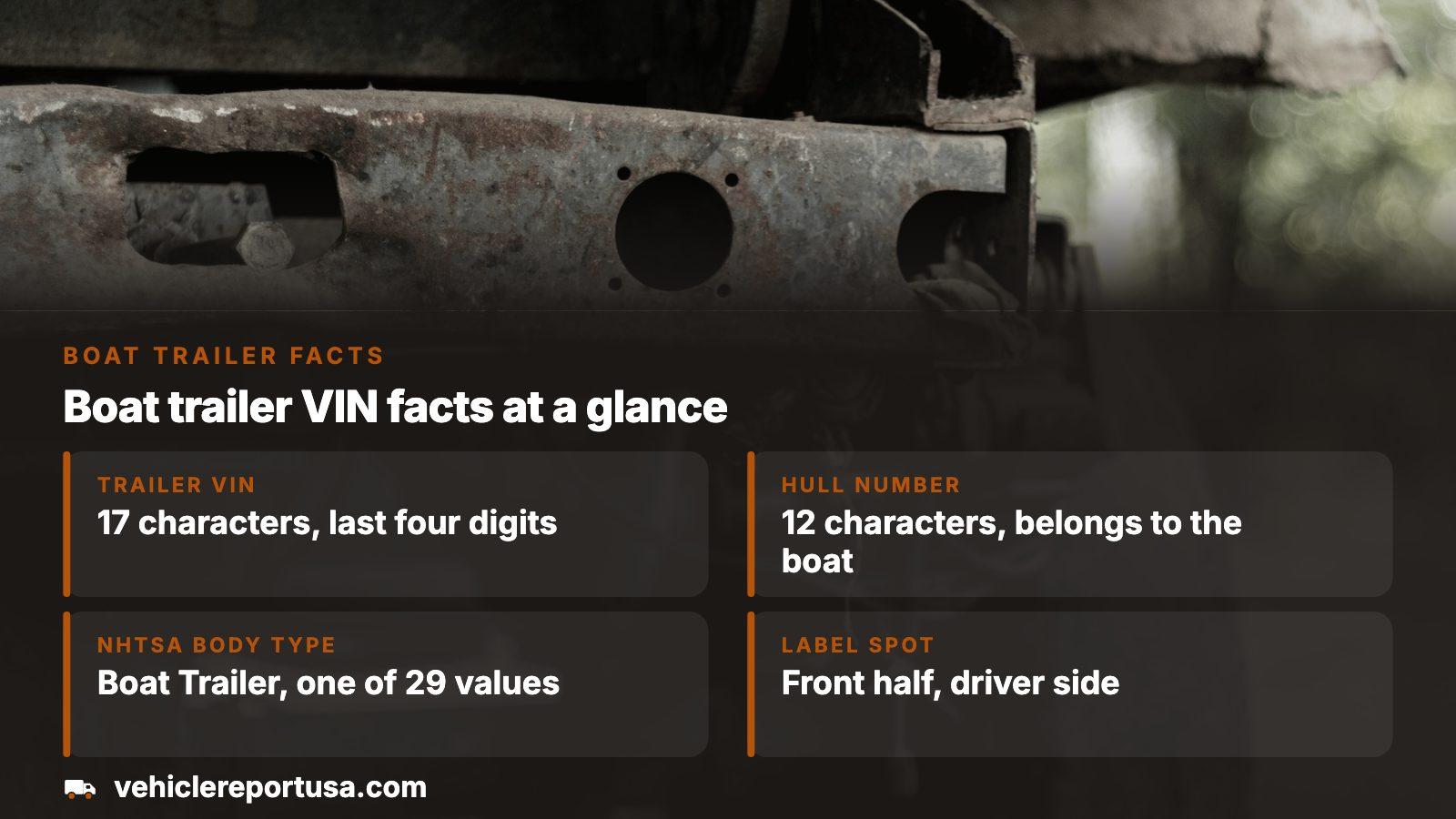
- Trailer VIN length
- 17 characters, last four digits
- Hull number length
- 12 characters, belongs to the boat
- NHTSA body type
- Boat Trailer is one of 29 values
- Label spot
- Front half, driver side
What a search under the trailer's VIN can turn up
Shoppers at a lakeside listing tend to inspect the boat for an hour and the trailer for a minute. Yet the trailer holds the weight at highway speed, and it has its own record, searchable by its VIN.
| Record | What it tells you about the trailer |
|---|---|
| Title brand | Salvage, junk or flood labels, where a state titled and reported the unit |
| Liens and impounds | A lender still owed money, or a past tow-and-hold |
| Theft | A report filed against this exact number |
| Damage and auction photos | Earlier losses and sales, with pictures where they exist |
| Open recalls | Safety campaigns on the make that were never repaired |
A trailer never titled, insured or auctioned may return little. A thin result still tells you something: ask the seller for paperwork.
Hull number or trailer VIN: which one to type
Federal rules give the boat its own identifier. A hull identification number has twelve characters with no spaces or hyphens: a maker code, a serial, the month and year of certification or build, and the model year. It is carved, molded or bonded into the boat, usually on the starboard side of the transom, with a duplicate hidden elsewhere inside.
Regulators class the trailer as a motor vehicle, which is why it has a 17-character VIN. Inside it, characters four to eight spell out what the builder filed about the trailer: its make, kind, body style, size and axle layout. The last four must be digits. Enter the longer number here. A twelve-character hull number will not decode as a trailer, and a search on it tells you nothing about the wheels underneath.
Where to read the number on a trailer with a boat on it
Federal rules put a trailer's certification label toward the front, driver side, where you can read it without moving a part. Makers rivet or bond it so a removal wrecks it. Spray, salt and sun fade it, so wipe it before deciding it is blank.
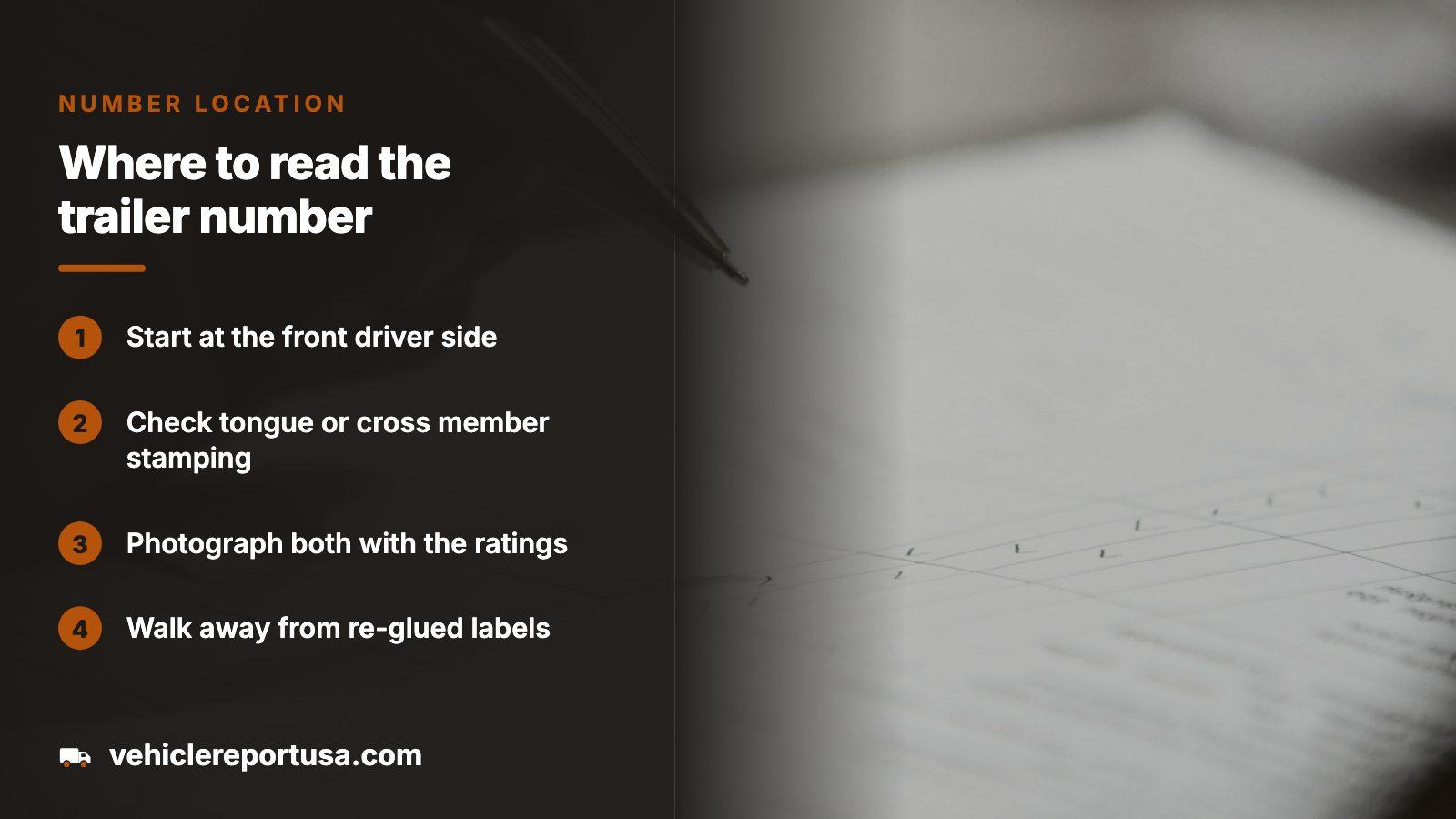
- Start at the front on the driver side, near the tongue or the winch stand.
- Check the frame stamping on the tongue or the front cross member if the label is gone.
- Photograph both, along with the rating figures printed beside the number.
- Compare the characters with the title or bill of sale before you type them.
- Walk away from a label that looks re-glued, painted over or mismatched with the paperwork.
Trailers often get a seller's name on the label rather than the builder's. That is legal when the seller takes legal responsibility, and the words Responsible Manufacturer or Resp Mfr show it.
What NHTSA's decoder says about a boat trailer
NHTSA's public decoder keeps a trailer body type field with 29 values, and Boat Trailer is one. Small regional builders appear in the maker list too, though a decode is only as complete as what the builder filed.
- Body type should read Boat Trailer, not utility or flatbed, for a trailer sold to carry a hull.
- Length and axle count should match what you see. One axle on a listing that promised two is a conversation to have with the seller.
- Model year comes from the tenth character, so a mismatch with the ad deserves a question.
NHTSA says decoded details are reported by the manufacturer, so questions about a mismatch go to the maker. A decode shows how the trailer was built; it does not show what happened to it afterward.
Recalls that were filed on boat trailers
Boat trailers do get recalled. Campaign 14V626000 covered certain 2014 and 2015 adjustable steel and aluminum trailers from EZ Loader built between late May and mid September 2014: the inner bar acting as the suspension spring could break, which could make the trailer hard to control or let a wheel come off. NHTSA lists 1,357 units, and dealers were to inspect and repair at no charge.
A second campaign, 14V049000, named 2013 and 2014 boat trailers with certain Carlisle CrossTrax wheels whose rim lips could crack and separate. NHTSA lists 50 units. Both are old, and a used trailer can outlive its owner's memory of a notice.
From an NHTSA owner complaint
An owner of a 2014 EZ Loader boat trailer told NHTSA that a suspension recall notice had arrived, yet the fix could not be done because parts were missing. The owner judged the wait unreasonable, though nothing had broken. Takeaway: ask whether the repair was ever done, and see the receipt.
Saltwater, flood brands and the damage no record holds
Water is the trailer's real enemy, and a database sees only part of it. The Justice Department's title system explains that a brand is a label states give vehicles such as junk, salvage or flood, and that states differ on which ones they apply. It also notes that salt water makes electrical systems more likely to fail. Its list of covered vehicle types names cars, trucks, motorcycles and motor homes, and trailers are not on it, so a clean title search on a trailer proves less than it does on a pickup.
From an NHTSA owner complaint
A South Florida owner of a 2022 Karavan trailer, bought with a personal watercraft, wrote that painted steel was the only choice offered. Within a few years, and not many ramp visits, the owner described big rust holes and a bent frame. Takeaway: a history search cannot see corrosion, so crawl under the trailer yourself.
- Flake rust on the frame, springs or axle, especially at weld seams.
- Wiring that hangs loose or looks recently patched.
- Tires with different brands or uneven wear, and rims that do not match the label's ratings.
- Bunks or rollers that are cracked, rotted or reset off center.
Title, bill of sale and the registration side
Rules for trailers change by state. Texas sorts trailers into factory-built and homemade, then by gross weight: 4,000 pounds or less versus more. A new trailer's proof is the maker's certificate of origin, which Texas calls its birth certificate. A newly assembled trailer must carry a VIN, and if it has none, a police inspection comes before the state forms.
California treats a trailer with a hull, such as a coach boat trailer, differently from a plain boat trailer, and allows it to be registered both as a vehicle and a vessel. Call or visit your state's titling office about the rig you are buying, since weight and type change the answer, and match the VIN on the paper to the steel.
Running it: preview, report and what to do after
Entering the number shows a preview at no charge. If you want the whole report, you pay once and nothing renews; bundles of 3, 5 or 10 suit a buyer comparing several rigs. Prices sit on the pricing page, so none are printed here.
- Photograph the label and frame stamping before you leave the seller's lot.
- Enter all 17 characters and read the preview.
- Ask for the title or bill of sale, and confirm your state's rules.
- Buy the report if the trailer is still in the running.
- Inspect the frame, coupler, hubs and wiring, then settle the price.
Where this information comes from
- eCFR: 33 CFR 181.25, hull identification number format — Shows that the boat's number runs twelve characters and has its own layout.
- eCFR: 49 CFR 567.4, certification label — Places a trailer's label on the forward half of the left side and covers who may be named on it.
- eCFR: 49 CFR 565.15, VIN content — Says what positions four to eight must tell a reader on a trailer and that the last four are digits.
- NHTSA: recall and complaint records for boat trailers — The two EZ Loader campaigns and their unit counts came from NHTSA's recall data.
- NHTSA owner complaint 10760731 — owner experience, paraphrased
- NHTSA owner complaint 11655487 — owner experience, paraphrased
- Justice Department: NMVTIS for consumers — Explains title brands, state differences and why salt water matters.
Sources and photos: Facts checked against the sources above in November 2026. Photos by A P, Masjid MABA and Zoshua Colah on Unsplash; diagrams by VehicleReportUSA.
Keep reading
- Where Is the VIN Number on a Trailer? Label, Frame and TongueA closer look at the tongue, rail and label when the number is hard to find.
- Trailer Recall Check: Find Open Safety Recalls by VINHow recalls attach to a make, model and year, and how to read one.
- Utility Trailer VIN Check: What the History Shows Before You BuyThe same search for open utility trailers, with an NHTSA decode example.
- Trailer VIN Lookup: Check a Used Trailer's History by VIN Before You PayWhat a lookup of any trailer number returns before you commit.
Frequently asked questions
Does a boat trailer have its own VIN?
Yes. A trailer sold to carry a boat is a motor vehicle under federal rules and gets a 17-character VIN, usually on a label at the front left. The boat has a separate twelve-character hull number, so keep the two straight when you copy digits from a listing.
Can I run the boat's hull number instead?
Not for this search. The hull number identifies the boat and has a different length and format, so it will not decode as a trailer. Use the trailer's VIN. The boat itself is not covered by the report.
What if the trailer has no VIN at all?
Treat that as a stop sign until paperwork explains it. Some homemade trailers never received a number, and states such as Texas require a police inspection before assigning one. Ask for proof of ownership first, then ask your state agency what the next step is.
Will the search show rust or a bent frame?
No. A history search reads records, and corrosion only enters a record if someone filed a loss. Crawl under the trailer, check welds, springs and wiring, and use the search to catch brands, liens, theft and recalls that your eyes cannot see.
How do I check a boat trailer for recalls?
Use the make, model and year NHTSA has on file, which may be generic, so a miss can mean a name mismatch. A VIN-based report checks open recalls for the exact unit. If a repair was done, ask the seller for the receipt.
Now check the car itself
The guide explains what to look for. The report shows what this VIN has on record.