THE SHORT ANSWER
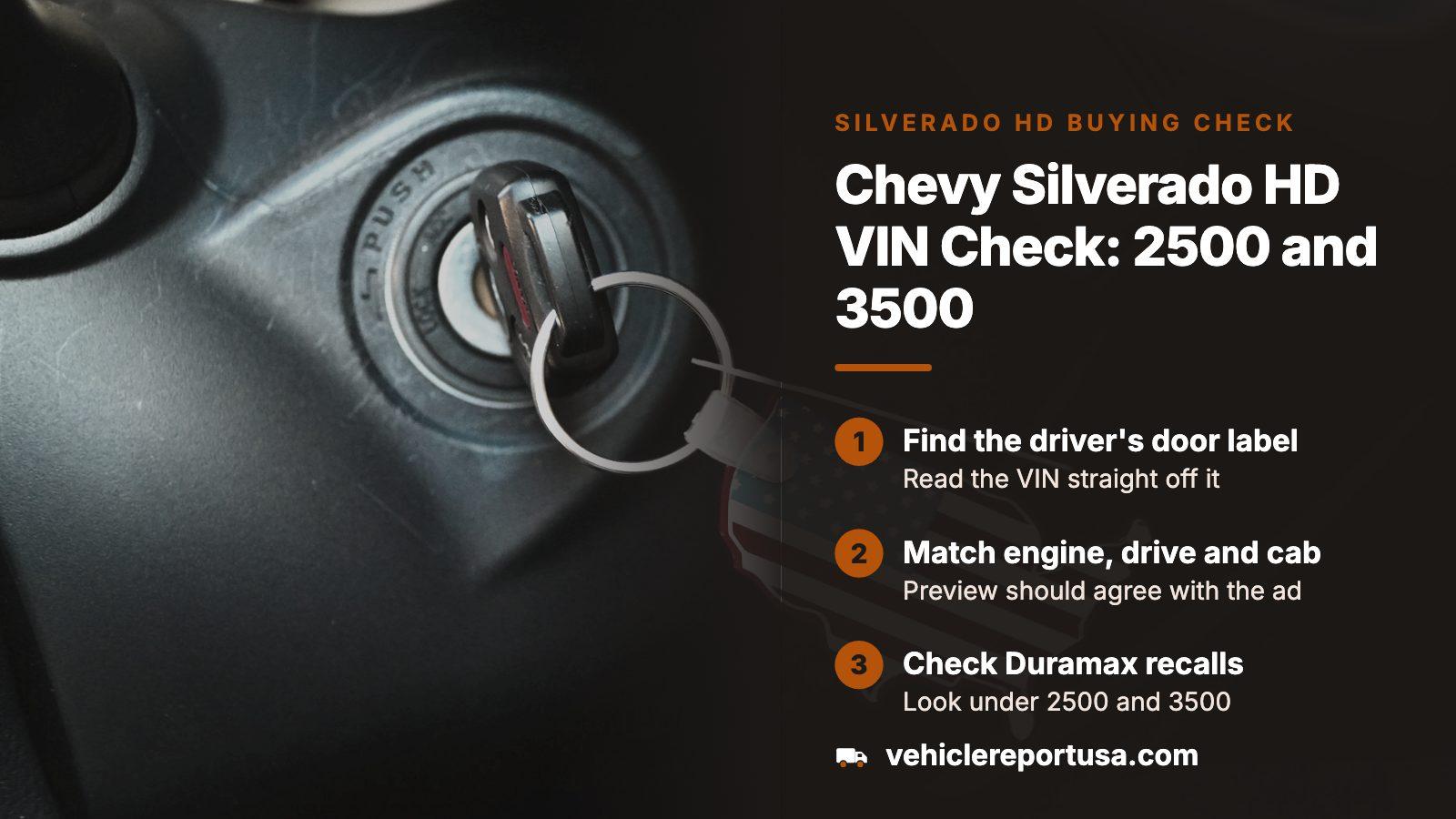
Find the label in the driver's door opening, read the VIN off it, and run the lookup. The free preview should agree with the ad on engine, drive and cab. The paid report is a single payment, no subscription, and adds brands, damage, odometer history, liens and theft entries. Check recalls separately: NHTSA lists several for 2017 to 2019 trucks.
- NHTSA filing names
- Silverado 2500 and Silverado 3500
- VIN label
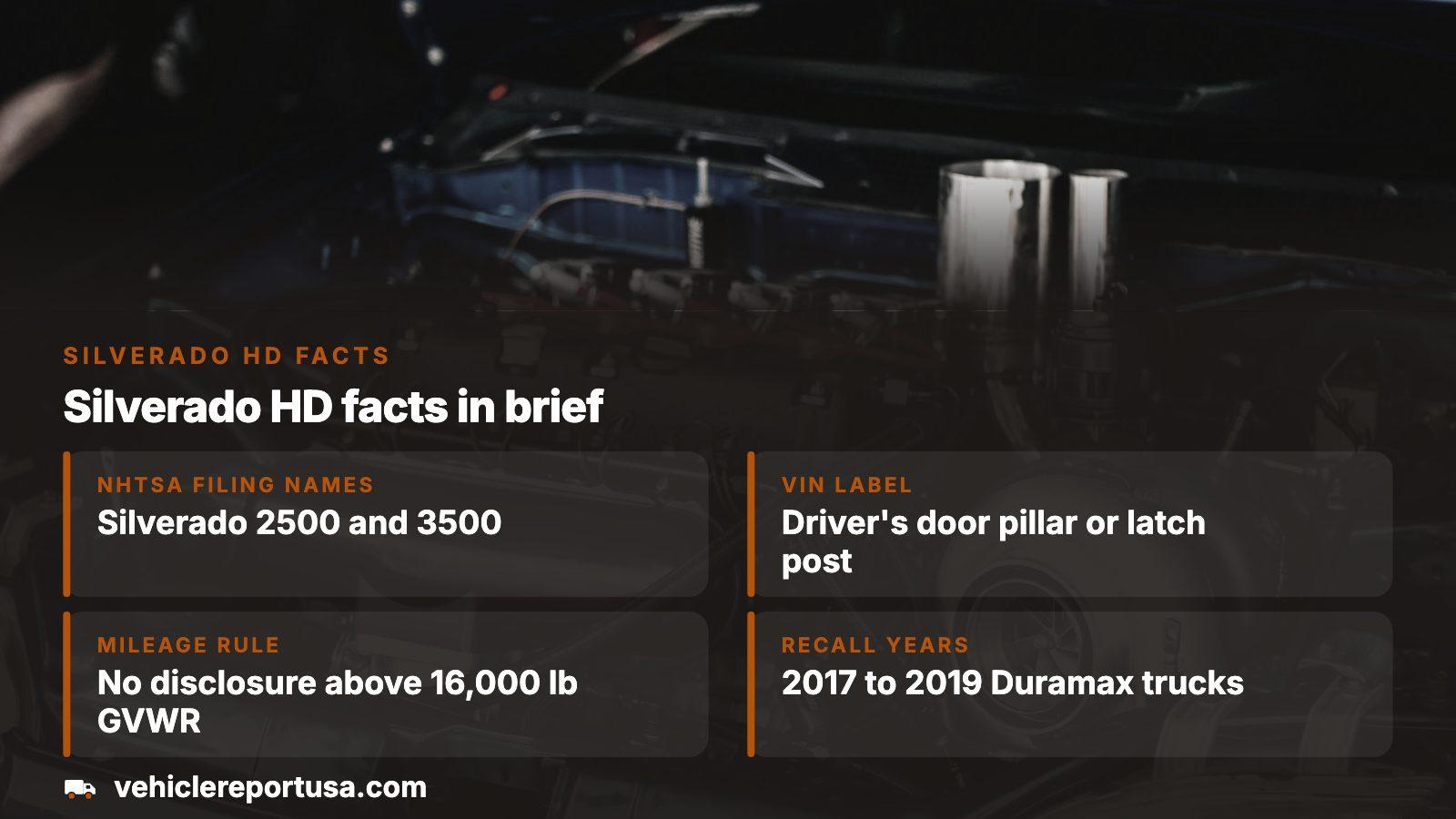
- Driver's door pillar or latch post
- Mileage rule
- No disclosure needed above 16,000 lb GVWR
- Preview
- Free, before any payment
Why a heavy-duty Chevy deserves a record, not just a test drive
A 2500 or 3500 spends its life doing things a half-ton rarely does: hauling a fifth wheel, carrying a slide-in camper, pushing a plow blade, idling at job sites. Those hours leave damage that a detailed cab and new tires cover up.
The listing can also blur which truck you are buying. The same Silverado name covers gas and Duramax diesel engines, single and dual rear wheels, and several cab styles. The VIN is the one identifier a seller cannot reword, and every record we describe below hangs off it.
What a Silverado HD lookup actually returns
The preview decodes the build. To see how much that can differ, we ran two invented 2021 strings through NHTSA's public decoder. Both came back as a Silverado 2500 built in Flint with four-wheel drive. One was a High Country with the 6.6 liter Duramax diesel in the 10,001 to 14,000 lb weight class. The other was a Work Truck with a 6.6 liter gasoline V8 in the 9,001 to 10,000 lb class.
| Section of the report | Why a Silverado HD owner cares |
|---|---|
| Title brands | Salvage, rebuilt or flood labels say what the frame and wiring have been through |
| Accident and damage entries | Trailer wrecks and rollovers raise frame and axle questions |
| Odometer readings | Dated readings show whether mileage climbed at a believable rate |
| Auction and salvage photos | Pictures of the truck as it sold, sometimes showing damage nobody mentioned |
| Liens and theft entries | Debt still owed on the truck, or a stolen-vehicle flag |
| Use type and owners | Private owner, fleet or rental use, and how many hands it passed through |
Getting the number off the truck
Federal rules require the maker to rivet or otherwise fix a certification label to the driver's side, by the hinge pillar or the door-latch post. On trucks where that spot is not practical, it moves to the left side of the dash. The VIN sits on that label beside the weight ratings, and it is built so it cannot be pulled off without damaging it.
- Read the number off the label by hand instead of copying it from the ad, then match it against the title.
- Photograph the weight ratings printed next to it. They matter for the mileage point later.
- On a cab-and-chassis truck finished by a body shop, such as a flatbed or utility body, the general label rule does not apply to multi-stage builds, so match the chassis number to the paperwork as well.
Preview first, report second
- Enter the VIN exactly as printed, with no spaces.
- Set the preview beside the ad. Engine, drive, cab and model year should all agree.
- Stop if something is off. A truck advertised as a diesel that decodes as gas is a price argument at minimum.
- Buy the report for the trucks that survive that first pass. It is a single payment per report, with packs for people comparing several trucks.

Recall campaigns on 2017 to 2019 Duramax trucks
NHTSA lists 7 campaigns for 2019 Silverado 2500 trucks, and 7 for the 3500. Two earlier ones concern the optional engine block heater on Duramax diesels from 2017 to 2019: 19V328000, which began in December 2019, and 21V496000, opened in January 2021. In both, the heater cord or its terminals can short, and NHTSA says that raises fire risk. Dealers replace the heater and reroute the cord at no charge.
Campaign 23V047000, from February 2023, targets trucks fitted with two fuel tanks. The rear one can crumple and stop the pump from feeding the front tank, so the engine quits while driving. Dealers inspect, swap parts where needed and add a vent hose, at no charge. Each campaign names only "certain" vehicles, so a full VIN lookup is the only way to know whether one specific truck is covered.
What owners wrote about the block heater and the fuel tank
From an NHTSA owner complaint
A 2017 Duramax owner described parking in the driveway with the block heater plugged in and being woken at 1 a.m. by a loud explosion. The truck and the garage were on fire, and the truck was a total loss. Months later the owner learned GM had recalled trucks of the same year for the heater cord.
From an NHTSA owner complaint
The owner of a 2019 Silverado 2500 wrote that a plugged tank vent collapsed the fuel tank and damaged the pump, and the truck stalled at highway speed in traffic. The dealer's mechanic reportedly said four other trucks with the same fault had already come in.
The takeaway for a buyer: both campaigns exist because of real failures, and several owners wrote that a dealer cut the cord off with no new part in stock. Get proof from the seller that the repair was completed, not merely begun.
Mileage fraud on private-sale HD trucks
From an NHTSA owner complaint
A 2018 Silverado 2500 buyer, in a private sale in 2025, handed over money for a truck reading 92,985 miles. At registration the title turned out to carry roughly 215,000.
From an NHTSA owner complaint
A second 2018 buyer, also a private sale, took the truck home at 75,200 miles. An emissions test then surfaced a record of 265,005 miles dated January 17, 2024.
Dated odometer readings in the report are what expose this. Keep in mind that the federal odometer rule, 49 CFR 580.17, lets a seller leave out the mileage statement on a vehicle rated above 16,000 pounds GVWR, and on a model year 2011 or newer once it is 20 years old. A one-ton with a gooseneck hitch can sit near that weight line, so read the door label and never count on a signed disclosure.
Reading the result: what stops a deal
- A salvage, rebuilt or flood brand that the seller never mentioned. NMVTIS treats brand, total loss and salvage history as warnings that a truck may be unsafe.
- Odometer entries that jump backward or stall for years, then climb.
- A lien, or an entry from a tow yard or impound.
- Auction photos showing damage that is gone from the truck in front of you.
- A use type that does not match the story, such as fleet service on a truck sold as a retired farm rig.
A clean report is good news, not a guarantee. Government title data is intentionally concise, so pair any report with an inspection by a shop that works on diesels.
Paying for it and what follows
You can read the preview without paying anything. When a truck earns the full report, you buy it outright, once, with no recurring charge. Amounts are on the pricing page, including the bundles that suit a shopper chasing several diesels at once.
After you run it, use NHTSA's recall search with the same VIN, ask for service records on any recall work, and have the frame, hitch area and rear axle inspected on a lift before you agree on a number.
Where this information comes from
- NHTSA recalls data: 2019 Chevrolet Silverado 2500 — campaign numbers, dates and remedies for the block heater and fuel tank recalls
- NHTSA owner complaint 11210667 — owner experience, paraphrased
- NHTSA owner complaint 11625716 — owner experience, paraphrased
- NHTSA owner complaint 11702712 — owner experience, paraphrased
- NHTSA owner complaint 11693812 — owner experience, paraphrased
- eCFR 49 CFR 580.17: odometer exemptions — the weight and age cutoffs for skipping the mileage statement
- NMVTIS: understanding a vehicle history report — what the federal title database covers and why brands matter
Sources and photos: Facts checked against the sources above in November 2026. Photos by Jake Kling, Jakub Żerdzicki and Willian Cittadin on Unsplash; diagrams by VehicleReportUSA.
Keep reading
- Ford Super Duty VIN Check: F-250, F-350 and F-450 History Before You BuyThe Ford side of the heavy-duty pickup shortlist.
- Ram Heavy Duty VIN Check: Reading a 2500 or 3500 Before PayingRun the same questions on a Ram 2500 or 3500.
- Truck Recall Check by VIN: Find Open Recalls Before You BuyHow to confirm open recalls on any truck by VIN.
- Truck VIN Lookup Specs: What the Decode Shows and Where It StopsConfirm cab, axle and engine by decoding the VIN.
Frequently asked questions
Does a Silverado 2500 HD VIN lookup work like one for a light-duty pickup?
The steps match, but the VIN decodes to different series, engines and weight classes, and NHTSA files the heavy-duty trucks under 2500 and 3500. Make sure the preview shows the diesel or gas engine, the drive and the rear wheel setup the seller advertised.
Can I try a Chevy Silverado HD VIN lookup without paying?
Yes, for the first step: the preview decodes the build so you can hold it against the listing. The full report, with title, damage, mileage and lien records, is a one-time purchase. NHTSA's recall search costs nothing to use either.
Will the check tell me if the block heater recall was done?
NHTSA's recall search lists unrepaired campaigns for a VIN, and a repaired one disappears from it. Still ask for the dealer's repair order, because some owners reported cords removed and never replaced.
What if the truck is over 16,000 pounds GVWR?
Then the seller does not have to give a written mileage statement under the federal rule, which makes dated odometer readings in a history report more useful. Read the weight rating on the door label to see where the truck falls.
Is a clean report enough to commit to a used Silverado HD?
No. An empty record only shows that nothing got reported, and plenty of damage never is. Add a lift inspection of the frame, steering and hitch area, a diesel scan on a Duramax, and proof any recall work was finished.
Now check the car itself
The guide explains what to look for. The report shows what this VIN has on record.