THE SHORT ANSWER
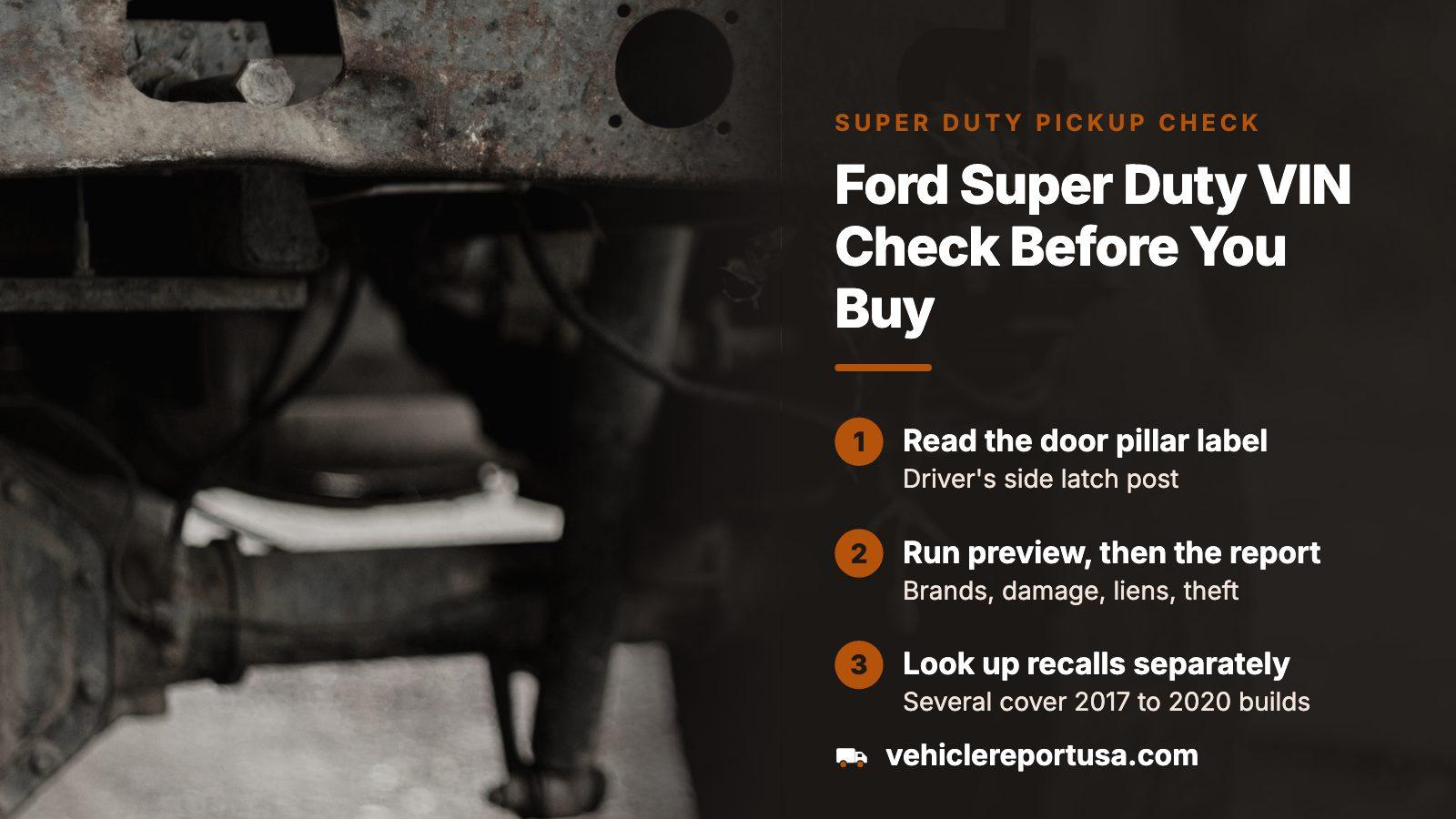
To look up a Ford Super Duty by VIN, read the number off the label on the driver's door pillar, enter it, and review the free preview. The full report is a one-off purchase that adds title brands, damage, odometer readings, liens and theft records. Run it for every truck on your list, then separately check open recalls, because several Super Duty campaigns cover 2017 through 2020 builds.
- Models covered
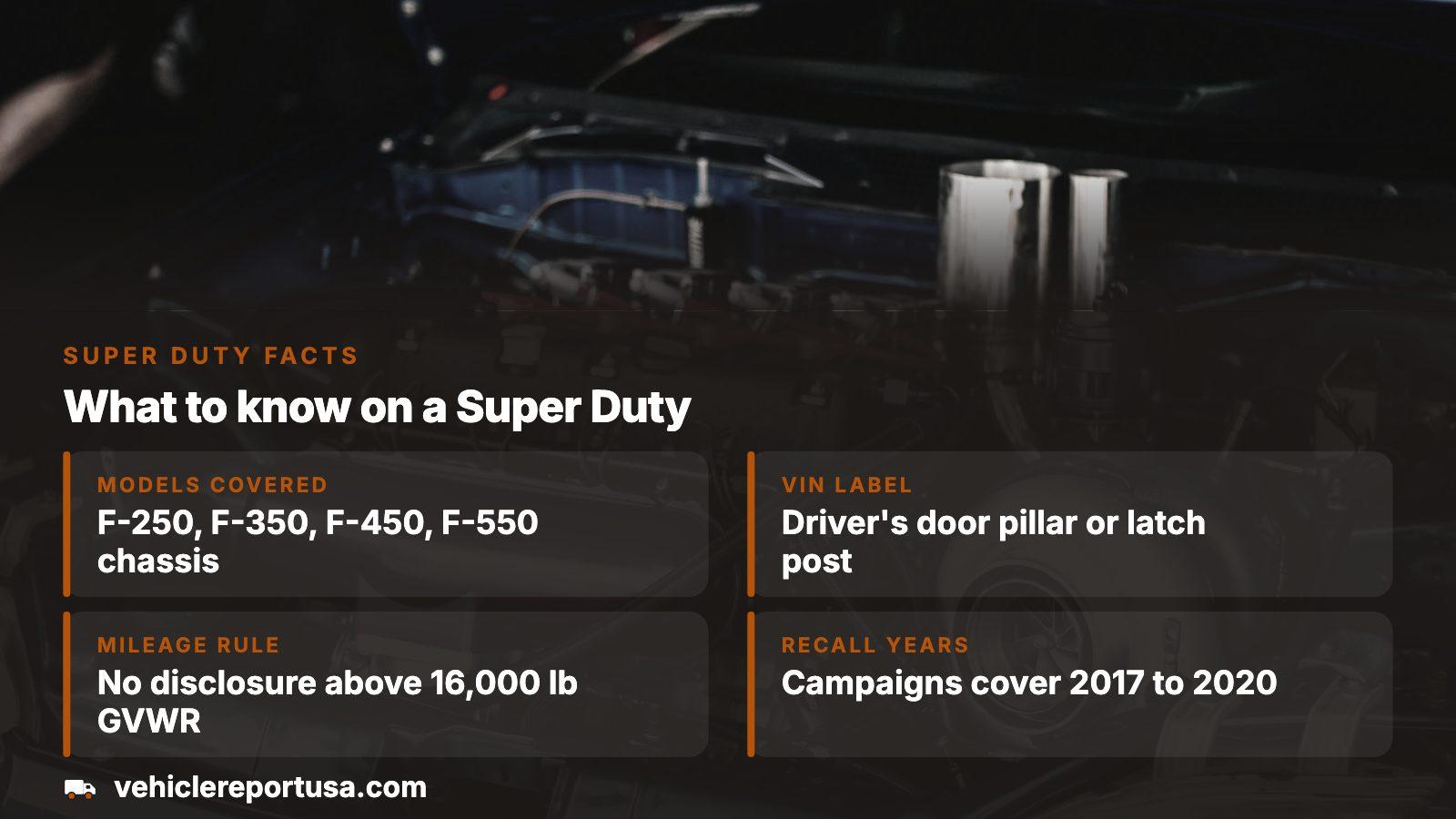
- F-250, F-350 and F-450 pickups, plus F-550 chassis
- VIN label
- Driver's door pillar or latch post
- Mileage rule
- No disclosure needed above 16,000 lb GVWR
- Preview
- Free, before any payment
Why a heavy-duty Ford deserves more than a glance at the listing
Most Super Duty trucks are not bought to commute. They pull gooseneck and fifth-wheel trailers, carry camper bodies, plow lots and spend years on job sites. That use leaves wear a clean cab and fresh tires can hide.
Ford sells the line as F-250, F-350 and F-450 pickups, with the F-350 available on single or dual rear wheels and with either a gas V8 or a turbo diesel. Each combination has its own towing and payload rating, which means a listing can describe the wrong truck without anyone lying: the history tied to the VIN settles which one you are actually looking at.
What the lookup tells you about a hard-used truck
The preview decodes the truck. The report then follows the same VIN through records that matter most on a work truck.
| Record | Why it matters on a Super Duty |
|---|---|
| Title brands | A salvage, rebuilt or flood label changes what the frame and wiring have been through, whatever the paint looks like |
| Accident and damage entries | Rollovers, jackknife hits and trailer wrecks leave frame and axle questions a visual walk-around misses |
| Odometer readings | A string of dated readings shows whether the mileage climbed at a believable pace |
| Auction and salvage photos | Pictures of the truck at sale, sometimes showing damage the seller never mentioned |
| Liens and impounds | Debt still owed against the truck, or time in a tow yard |
| Ownership and use type | Whether it served a private owner, a rental pool or a business |
Reading the VIN off the truck itself
Start in the driver's door opening. The maker's certification label is fixed there so it cannot be peeled off without wrecking it, and it carries the VIN beside the weight ratings. No label in the door opening? The regulation allows the left end of the dash as the fallback.
- Copy the VIN from the label yourself, then match it to the title and the registration.
- Photograph the weight ratings printed beside it; they matter for the mileage question further down.
- On a cab-and-chassis truck finished by a body builder, such as a flatbed or service body on an F-450 or F-550, the general label rule does not cover multi-stage vehicles, so match the chassis number to the paperwork too.
Running it: preview, then the report
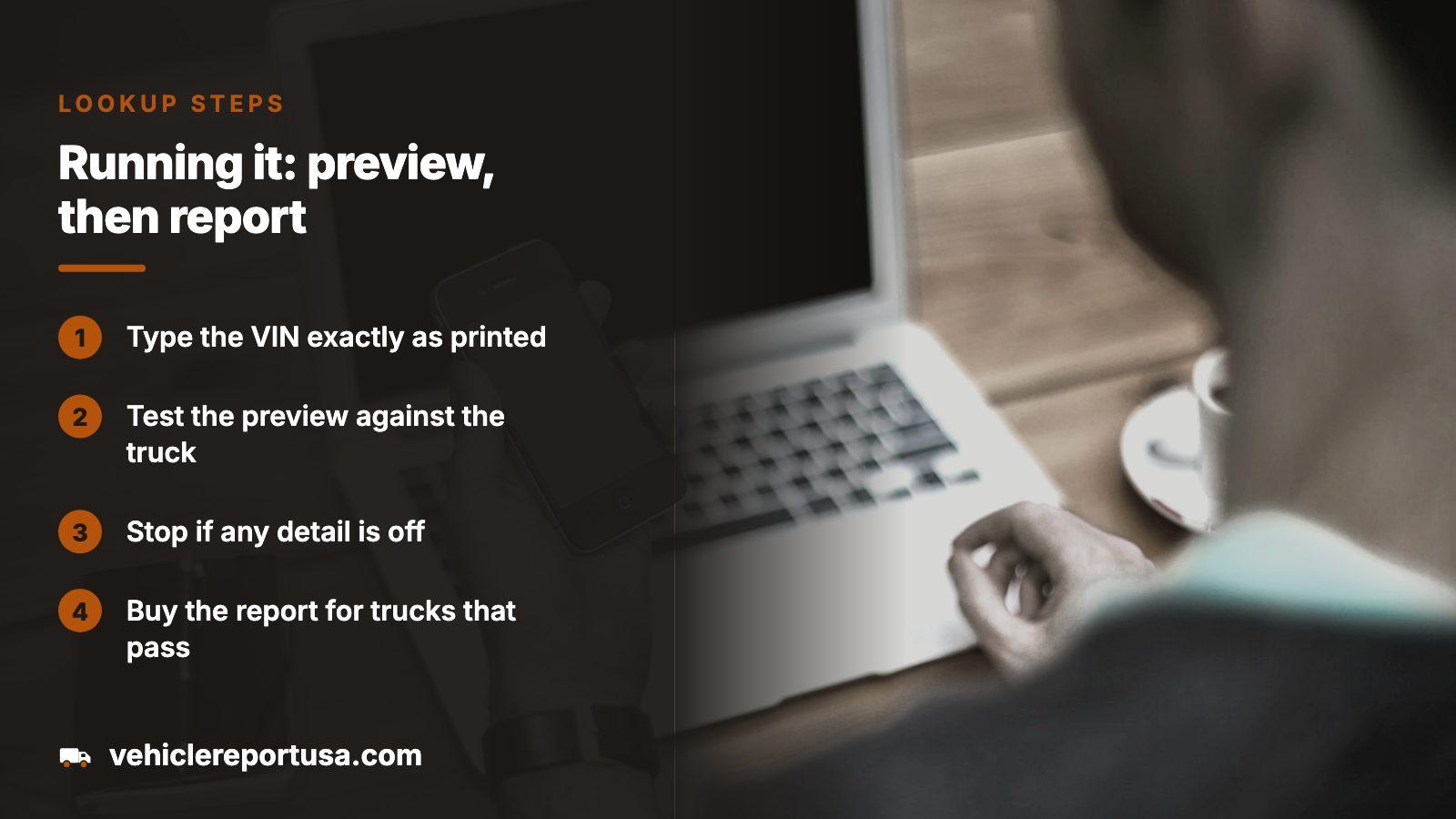
- Type the VIN into the lookup box exactly as printed, without spaces.
- Read the free preview and test it against the truck: cab style, bed length, drive and engine should all match what the ad claims.
- If a detail is off, stop. A truck sold as a diesel that decodes as a gas model is a pricing problem at best.
- Buy the report for trucks that pass that first look. It is one payment per report, with packs for people comparing several trucks.
Recalls that follow Super Duty builds from 2017 to 2020
The federal recall database lists a handful of campaigns across these models. A report can show whether an open one is still attached to your truck.
| Campaign | Trucks | Problem and fix |
|---|---|---|
| 17V331000 | 2017 F-250 to F-550 | Chrome handle cover accessory could let doors unlatch in a side impact; dealers remove the covers and refund the price |
| 18V894000 | 2017 to 2019 Super Duty | Corroded block heater cable can short and overheat; dealers disable the cable, then replace it |
| 19V633000 | 2019 and 2020 Super Duty | Manual seat recliner missing a pawl, so the seat back may be loose; dealers inspect and replace as needed |
| 19V688000 | 2019 F-250 and F-350 | Rear axle shaft on locking-differential trucks may fail early; dealers inspect and replace |
| 20V576000 | 2019 F-250 and F-350 4x4 | Front axle wheel end yoke may be mis-welded; dealers inspect and replace the axle if needed |
Counts by year are modest: 2 campaigns for a 2017 F-250 and 4 for a 2017 F-450, against 1 for a 2020 F-250. Recalls can arrive late, too: a 2015 F-250 picked up a rearview camera recall in 2025. Nothing came back under these model names for 2021 onward, so for a newer truck use the live recall lookup with the VIN.
When the F-550 or F-450 under the body has a second recall list
Many F-550 entries in the federal data were filed by the companies that built ambulances, fire apparatus and first-responder trucks on a Ford chassis, not by Ford. Their subjects were brake lights that could glow without the pedal pressed and back-up camera screens that could flip the image. Buying a retired service truck means asking who built the body and checking recalls against that builder too.
What owners report: the front-end shake
NHTSA holds 370 owner complaints for the 2011 F-250 alone, and steering and suspension is the largest group. Two recent ones show what to test for on an older Super Duty.
From an NHTSA owner complaint
Filed in January 2025 by the owner of a 2011 F-250: above 55 mph a single bump sets off a violent shake and the wheel no longer lines up with the tires. The dealer would not take the truck on trade until the steering box was addressed. No warning light came on.
From an NHTSA owner complaint
Someone else, with a stock, unlifted 2011 truck used on a farm, wrote that the shake first hit around 2020 and returned after the front end was rebuilt 3 times, most recently in 2024.
Complaints are one owner's account, not an agency finding. The takeaway: a history report will not show worn steering parts, so drive any used Super Duty over rough pavement at highway speed and pay a shop to go over the front end.
Why the odometer record can look thin on a heavy truck
Under federal odometer rules a seller may skip the mileage statement when the vehicle's gross weight rating tops 16,000 pounds. Pickups usually sit under that line, so their sellers owe a written disclosure, but a heavier F-550 chassis may not.
Age is a second exemption, and it varies with model year: older trucks can drop out of the requirement after a decade, newer ones after twenty years. Gaps in a very old truck's readings can be ordinary. On a late-model pickup they deserve a question, and the weight rating you photographed tells you which case you are in.
Cost, and your move after the result
Reading the preview is free. A report is a single payment that never renews, and the current rates for one report or a bundle are on the pricing page.
- A clean record: book a pre-purchase inspection that covers the front end, the axles and any trailer-hitch wear.
- A branded title or damage entry: ask for the repair paperwork, or walk away and price the truck as the brand demands.
- A lien: keep your money until the lender's release letter is in hand.
- An open recall: ask a Ford dealer to confirm the repair is done, since it is free to the owner.
Where this information comes from
- NHTSA recalls data: 2017 Ford F-250 — recall campaigns, dates and remedies for the Super Duty years named
- NHTSA recalls data: 2019 Ford F-350 — axle and seat campaigns for 2019 trucks
- NHTSA owner complaint 11637880 — owner experience, paraphrased
- NHTSA owner complaint 11618620 — owner experience, paraphrased
- eCFR 49 CFR 567.4: label placement rule — door-opening location and permanent attachment of the VIN label
- eCFR 49 CFR 580.17: odometer exemptions — the weight and age cutoffs for skipping the mileage statement
- Ford: Super Duty — model lineup, rear wheel options and engines
Sources and photos: Facts checked against the sources above in November 2026. Photos by Zoshua Colah, Alejandro Escamilla and Willian Cittadin on Unsplash; diagrams by VehicleReportUSA.
Keep reading
- Check a Truck VIN Number: Pickups, Box Trucks and Heavy-Duty RigsThe general version of this check for pickups, box trucks and heavy rigs.
- Ram Heavy Duty VIN Check: Reading a 2500 or 3500 Before PayingRun the same questions on the Ram side of the heavy-duty shortlist.
- Chevy Silverado HD VIN Check: 2500 and 3500 History Before You BuyThe Chevrolet side of the heavy-duty pickup shortlist.
- Truck VIN Lookup Specs: What the Decode Shows and Where It StopsConfirm cab, axle and engine by decoding the VIN.
Frequently asked questions
Can I try a Ford Super Duty VIN lookup without paying?
Yes for the first step: the preview decodes the truck so you can match cab, engine and drive to the listing. The full report, with title, damage, mileage and lien records, is bought once. Federal recall lookups cost nothing either.
Which Super Duty years have the most recalls?
In the federal data pulled for this page, the 2017 F-450 shows 4 campaigns and the 2017 F-550 shows 5, partly from body builders. A 2017 F-250 shows 2 and a 2020 F-250 shows 1. Counts shift as new recalls are filed, so verify by VIN.
Does the VIN tell me if it is a diesel or a gas truck?
The decoded preview lists the engine, and it should agree with the badge and the listing. Ford sells the line with a 7.3L gas V8 and a 6.7L Power Stroke diesel. If the VIN says one and the seller says the other, get the explanation in writing.
Why does an F-550 show little mileage history?
Federal rules excuse sellers from the odometer statement when the rated gross weight is above 16,000 pounds, so fewer readings may be on record. Thin mileage on a heavier chassis is not automatically a warning, but on an F-250 it deserves a question.
Do I run the VIN check ahead of the test drive?
Ahead of it. The preview takes minutes and can end a deal over a brand or a mismatch before you burn a trip. Drive only the trucks that survive, and take the report along to the pre-purchase inspection.
Now check the car itself
The guide explains what to look for. The report shows what this VIN has on record.