THE SHORT ANSWER
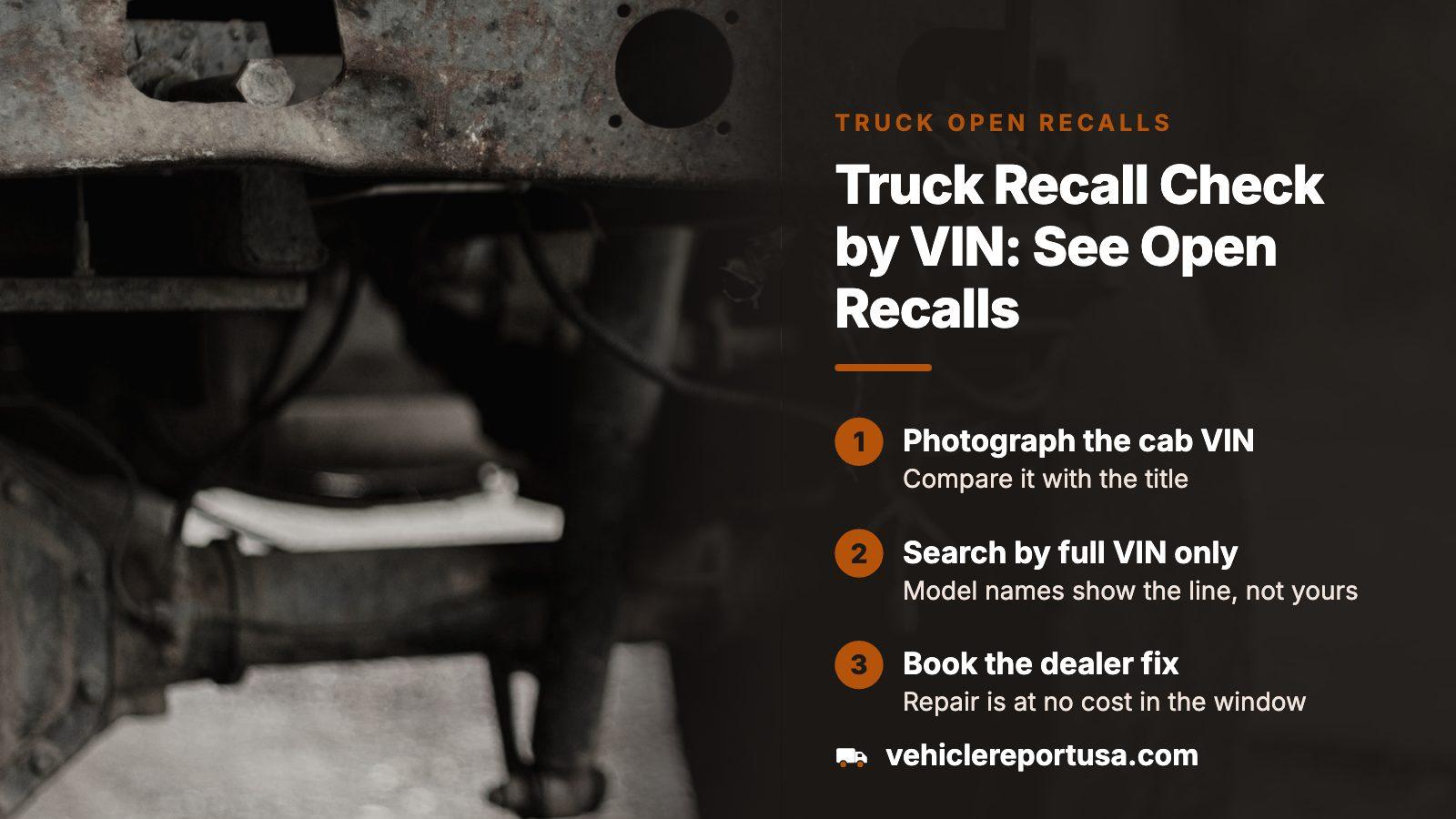
Photograph the VIN on the cab, compare it with the title, then paste it into NHTSA's recall page. A result of zero unrepaired recalls means nothing is open that the maker has reported against that VIN. Any hit lists the failing part, the hazard and a free dealer fix. A model-name search shows what exists for the line, not what applies to this truck.
- Search by
- The full VIN, not the model name
- Repair cost
- Free at a dealer for recalls inside the 15-year window
- Preview
- Free, shown before any payment
What a truck's recall result actually tells you
NHTSA's search has two modes. Type a year, make and model and you get the general picture for that model: campaigns, investigations and complaints. Type a VIN and you get a narrower, more useful answer: whether this one vehicle still needs a repair. For a buyer standing next to a used truck, only the second mode matters. A good result gives you:
- The campaign number, which you can quote to any dealer
- The failing component and what the maker says could happen if it fails
- The remedy, which is a repair, replacement, refund or, rarely, a buyback
- A note on whether the maker wants the truck parked until the work is done
A clean search prints a line reporting that no unrepaired recalls are attached to that VIN. Treat that as a good sign about open campaigns, and nothing more.
Why two trucks of one model year get different answers
Makers draw each campaign around a slice of production: a build window, an option such as a locking rear differential, or a drivetrain. NHTSA's records for the 2019 model year show how crowded one year can be. The F-150 returned 9 campaign records, the Silverado 1500 returned 10 and the F-250 returned 4.
| Campaign | Truck | What it reaches |
|---|---|---|
| 19V805000 | 2019-2020 F-150 | Loose fastener at the positive battery terminal, with stalling and fire risk |
| 19V688000 | 2019 F-250 and F-350 | Only trucks with the electronically locking rear differential |
| 20V576000 | 2019 F-250 and F-350 4x4 | Front axle yoke welded in the wrong place on some axles |
| 19V889000 | 2019 Silverado 1500 | Brake module software that can switch off stability control and ABS with no warning light |
| 20V650000 | 2019-2020 Silverado 1500 | Driveshaft joint that may not be welded properly |
Only a VIN tells a lookup which of those apply. A 4x4 with the locking differential can sit under both Ford axle campaigns while its two-wheel-drive neighbor sits under neither.
When the symptoms match but the VIN does not
The VIN rule cuts both ways. A truck can fail in the way a recall describes and still show nothing, because the maker's population stops where its data stops.
From an NHTSA owner complaint
A 2019 Silverado 1500 owner told NHTSA in November 2026 that the truck threw battery warnings, voltage swings and power dips, and that the alternator's positive cable connection had visibly overheated. The symptoms matched recall 19V888, yet the maker and NHTSA both said the VIN was outside it. A dealer quoted 1,345 dollars for the repair without inspecting the truck.
The lesson for a buyer is to read the recall text for a truck you are considering and ask the seller about any matching symptom, even when the VIN returns a clean result. A clean result is not a mechanical inspection.
Half-ton pickups, heavy-duty rigs and big trucks
The 2019 Ram 1500 query returned 30 records. A 2019 Freightliner Cascadia returned 29, mostly filed by Daimler Trucks North America, and the list is heavy on brake and steering hardware rather than comfort items.
- Several Cascadia campaigns concern loose brake caliper mounting bolts on air disc brakes.
- Campaign 18V913000 deals with under-tightened bolts at the steering and tie rod arms.
- Campaign 21V689000 covers a drag link that can separate and cause complete loss of steering control.
- Campaign 20V642000 pairs a software update with new clutches for unintended vehicle movement.
Fleet trucks often change hands with paperwork gaps, so match the cab's VIN to the title before searching. A swapped cab can return a record for a different chassis.
Running the check at the truck itself
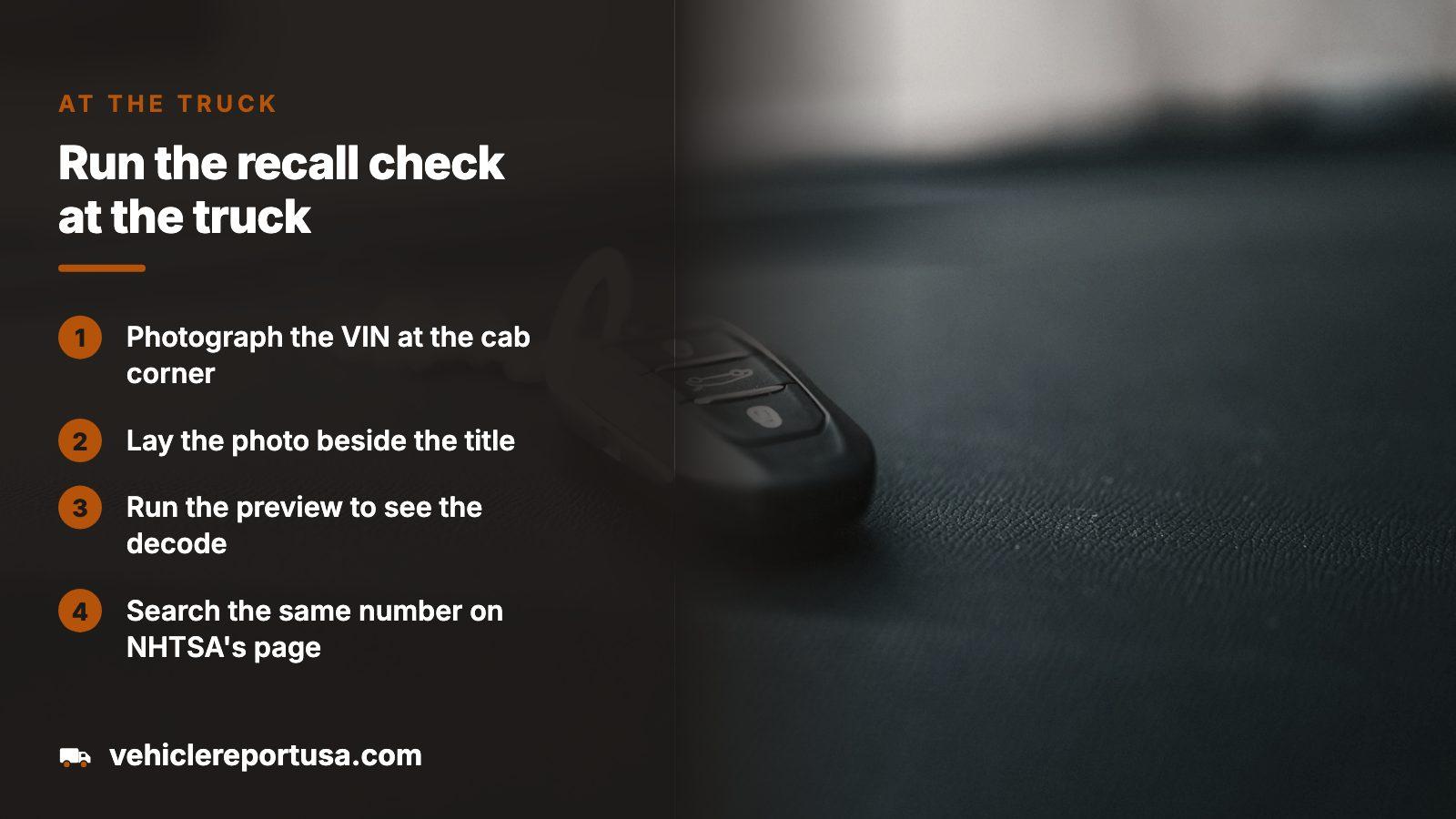
- Crouch at the driver's front corner of the cab, find the stamped plate on the dash top, and photograph it. The registration card repeats the number, and an insurance card may too.
- Lay the photo beside the title. One mismatched character means a misread, a retitled truck or a question to settle first.
- Run the free preview here to see whether the VIN decodes to the make, model and year in the seller's ad.
- Search the same number on NHTSA's page and on the maker's site if it has a lookup, because maker data can lead NHTSA's.
- Buy the report only for trucks that pass, so recall status sits next to the title and damage records.
What the federal search leaves out
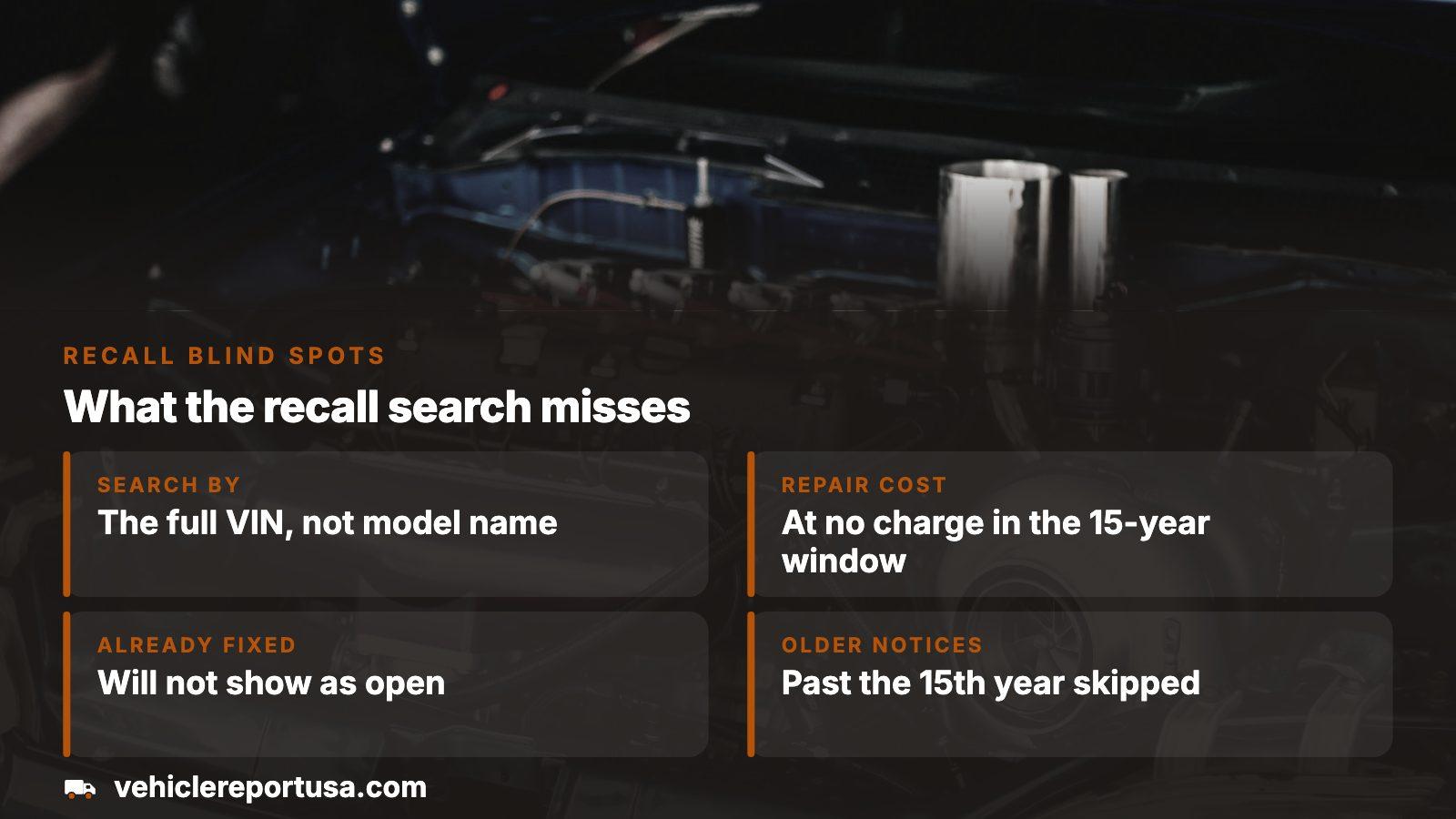
NHTSA lists the cases its VIN search skips, and each gap matters on a used truck:
- Work that was already done, which is why a clean result cannot show what was fixed
- Fresh announcements where the maker is still uploading affected VINs one batch at a time
- Notices past their 15th year, unless a maker keeps covering them
- Campaigns by small manufacturers, including some specialty builds
- Goodwill and service programs that never qualified as safety recalls
From an NHTSA owner complaint
An owner of a 2019 F-150 told NHTSA in September 2026 that the brake master cylinder seal leaked while towing with family aboard and that only a low fluid light appeared. A Ford recall covered the same part on other years but not this truck, and a dealer replaced the cylinder and booster.
For a truck over 15 years old, search anyway and call the maker, since coverage can run longer than the federal tool shows.
A fixed truck can be recalled a second time
Ford's block heater campaigns show it. Recall 18V894000 covered the engine block heater cable on 2015-2019 F-150s and 2017-2019 Super Duty pickups with that heater, because water could corrode the splice connector and raise fire risk. Dealers started by disabling the cable. Then 19V278000 followed, because trucks repaired under the first campaign might have had the connector damaged during the work. Owners got a second notice, and dealers disabled the heater again until replacement cords arrived. If a seller claims the recall is done, request the repair order and search the VIN again, since the first fix may not be the last.
If the VIN shows an open recall
Within 60 days of a recall decision going to NHTSA, the maker has to mail the registered owner, and the dealer repair costs nothing. A buyer can take that two ways. Ask the seller to have a franchised dealer complete it before the sale, or buy the truck knowing you will book the work yourself. Get the campaign number in writing either way. If the maker has told owners to stop driving the truck, do not take it on the highway, and have it hauled instead. NHTSA suggests registering the truck and rechecking every six months, and its free SaferCar app pushes an alert if a new campaign lands on a VIN you saved.
What the full report adds, and what it costs
A recall search lists the maker's debts to the owner. It is silent on how the truck was driven, crashed or sold. The report here sets recall status beside the title, any damage or salvage entries, mileage readings, lien notes and theft flags, which is where a rolled-back odometer or a branded title would surface. The preview costs you nothing. One payment buys a report, with nothing recurring, and the pricing page has the tiers. Use the preview and NHTSA first, then decide if the truck deserves a full report.
Where this information comes from
- NHTSA: Check for Recalls — What the VIN search shows and omits, the 15-year limit, owner notice timing and free repairs.
- NHTSA: 2019 Ford F-150 — Campaign records for the F-150, including the block heater and battery cable recalls.
- NHTSA: 2019 Chevrolet Silverado 1500 — Brake module, driveshaft and battery cable campaigns for the Silverado.
- NHTSA: 2019 Ford F-250 — Axle shaft and front axle yoke campaigns on Super Duty trucks.
- NHTSA: 2019 Freightliner Cascadia — Brake, steering and clutch campaigns on a heavy tractor.
- NHTSA owner complaint 11775196 — owner experience, paraphrased
- NHTSA owner complaint 11764640 — owner experience, paraphrased
Sources and photos: Facts checked against the sources above in November 2026. Photos by Zoshua Colah, Bence Balla-Schottner and Willian Cittadin on Unsplash; diagrams by VehicleReportUSA.
Keep reading
- Check a Truck VIN Number: Pickups, Box Trucks and Heavy-Duty RigsThe wider truck check, covering title, odometer and damage records beyond recalls.
- Ford Super Duty VIN Check: F-250, F-350 and F-450 History Before You BuyModel-specific notes for F-250 and larger Ford pickups, where axle campaigns concentrate.
- Semi Truck VIN Check: Run a History on a Used Class 8 TractorWhat to verify on a tractor before buying, from the cab number to brake records.
- RV VIN Recall Check: Chassis, Coach and Trailer Recalls Before You BuyThe same recall question for motorhomes, where chassis and body makers file separately.
Frequently asked questions
How do I do a truck recall check by VIN?
Copy the VIN from the truck, check it with the title, and enter it on NHTSA's recall page. The result lists unrepaired recalls tied to that vehicle or reports none. Repeat the search on the maker's site, since its data can run ahead of the federal record.
Does a clean result mean the truck has never been recalled?
No. Finished repairs drop out of the search, so a truck with a long campaign history can still return zero. Brand-new campaigns can also be missing while the maker uploads its VIN list. Ask for service records if you want to know what was fixed.
Can a dealer refuse a recall repair because of high mileage?
Mileage is not a limit in the federal rules. NHTSA's page ties free coverage to the 15-year window and the maker's own terms. If a dealer turns you away, quote the campaign number, call the maker's customer line, and keep a record of who said what.
Do heavy-duty trucks and semis show up in the same search?
Mostly yes, since big makers such as Daimler Trucks North America file with NHTSA, and a 2019 Cascadia returned 29 campaign records. Small or specialty builders are excluded from the VIN search, so call the builder for those.
What does the VehicleReportUSA preview cost?
The preview costs nothing and shows the make, model and year the VIN decodes to. A full report adds recall status beside title, damage and odometer records, and is bought once. NHTSA's search is a separate government tool with no charge.
Now check the car itself
The guide explains what to look for. The report shows what this VIN has on record.