THE SHORT ANSWER
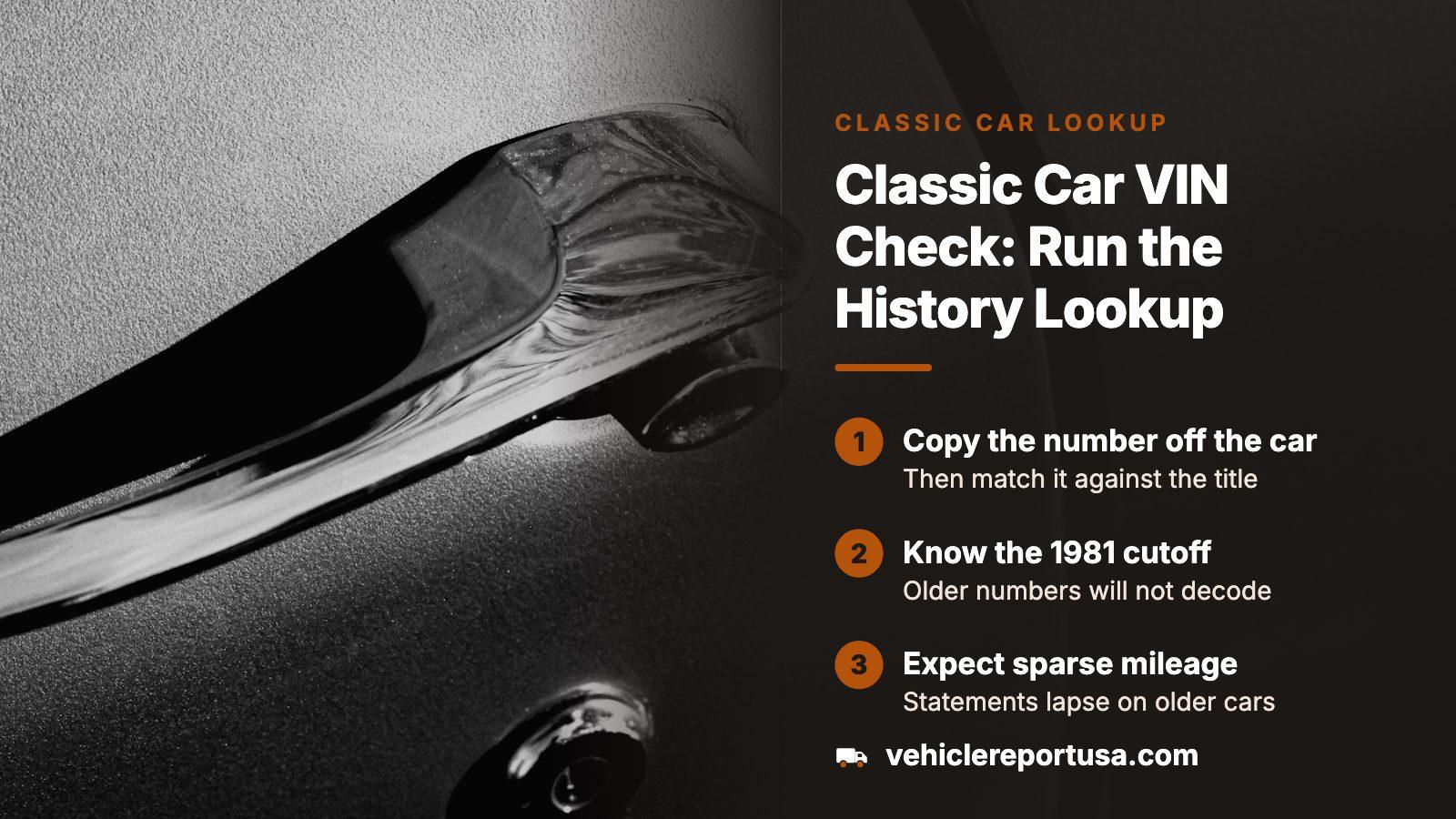
To check a classic car by VIN, copy the number from the car itself, match it against the title, then enter it. A 17-character VIN, standard from about 1981, returns a history lookup covering title brands, damage, odometer readings, theft and recalls. A shorter pre-1981 number will not decode, because NHTSA's own decoder rejects those years. Check those cars against the plate, the title and a marque specialist instead.
- Decoder cutoff
- NHTSA rejects model years before 1981
- Mileage statement
- Not required after 10 or 20 years, by model year
- Preview
- Free, before any payment
Which classic VINs a history lookup can read
The dividing line is the standard 17-character format. When NHTSA's decoder was handed an 11-character number with a 1967 model year, it answered with a pre-1981 error and returned nothing. California's verification form draws a nearby line: on 1980 and newer vehicles the model year is read from the tenth character, whereas earlier ones are dated using a reference manual. The tools sit a year apart, so test a 1980 car by hand.
| Built | Number format | What a lookup can do |
|---|---|---|
| 1981 and later | 17 characters | Decodes the vehicle and pulls title, damage and mileage records |
| Before 1981 | Earlier formats outside the standard | Decoder refuses it, so history rests on the car and its paperwork |
California's worksheet has boxes for automobiles, street motorcycles, trailer coaches and commercial vehicles, so a vintage pickup or camper meets the same line as a coupe.
Finding the number on an older vehicle
Read the VIN off the vehicle, never a listing. A verifier's worksheet from California lists where to look: through the windshield, the driver-side body, the passenger-side body, the engine bay, the door post, the steering column or the firewall. Some numbers ride on riveted or glued plates, and others are stamped into the body or frame.
- Photograph the number where it sits, then again close up.
- Write down every character yourself and compare it with the title, one position at a time.
- Judge the plate's condition: the same worksheet has boxes for illegible, damaged, altered and missing numbers.
- On a 1970 or newer car, find the federal certification label as well, because the form checks that it agrees with the VIN.
An odd location is normal on an old car. A plate that has been touched, or a label that disagrees with the title, is not.
What a lookup shows for a classic, and what it leaves out
The federal title database, NMVTIS, is short on purpose. Its data flows in from state title offices, auto recyclers, salvage lots and insurers, and each report rests on five indicators.
| Record | Why it matters on an older car |
|---|---|
| Title brand | Salvage, junk and flood labels from any state stay on file, however good the paint looks now |
| Odometer reading | A recorded figure to hold against the dash, often sparse on an older car |
| Total loss and salvage history | A record of severe damage; a stolen car recovered intact can still carry a total-loss label |
| Theft | Included in some cases only |
| Repairs and recalls | Absent from the federal data, so look them up separately |
A paid report from this site adds the accident, auction photo and lien sections that the title database does not carry.
Why the mileage record is thin on a classic
Federal rules stop asking for a mileage statement as a vehicle ages: for model years through 2010 the cutoff is 10 years measured from when that model year began, and for 2011 and later it is 20. Two other groups never need one, namely anything rated above 16,000 pounds and any vehicle with no engine of its own, which covers trailers. A gap in the odometer rows of a classic pickup or a camper trailer can therefore be perfectly legal.
From an NHTSA owner complaint
A buyer who bought a 1994 Ford Thunderbird from an individual seller on eBay told NHTSA he suspected odometer fraud. The car showed 91,000 miles at purchase. A history report he ordered afterward listed 118,090 miles at a Tennessee DMV visit in 1999 and 125,035 on a service record in April 2000. He said the car then gave him trouble because of its high mileage.
Run the report before paying, line up each earlier reading with the dash, and ask the seller to explain any drop.
Recalls on older cars: the records exist, the status often does not
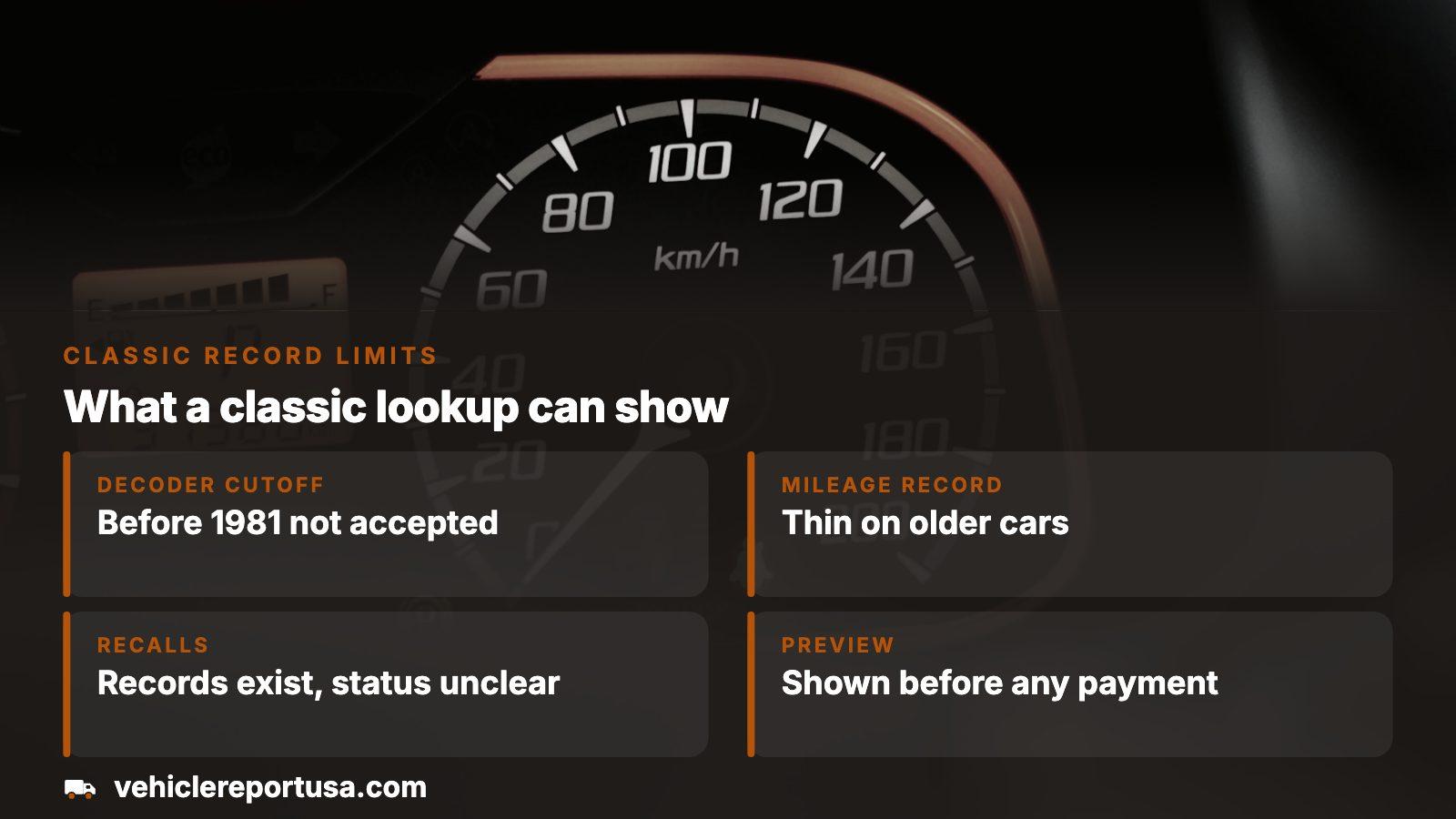
NHTSA's recall data reaches back to the 1960s. A query for the 1967 Ford Mustang returns five records: two from 1966 on steering gear and tire clearance, two from 1967 on steering wheel spokes and a retaining nut, and one from 2019 covering replacement wheel spindles sold for 1960s Mustangs. That last one matters to anyone buying a restored car, since a replacement part can carry its own recall.
From an NHTSA owner complaint
A buyer of a used 1987 Chevrolet Corvette told NHTSA the seat belts were not working properly and an old belt recall had never been performed. Chevrolet said it could not tell from the VIN, given the car's age, whether the work was ever done, and said replacing the belts would be at the buyer's cost. The buyer added that the first owner never received the notice.
Treat an older car's recall status as unknown until the seller shows paperwork proving the work, and ask a marque specialist which campaigns apply to that model year.
Red flags when the paperwork and the car disagree
In California, verifiers inspect the car in person and match its number to the ownership paper. If the two differ, the owner signs a sworn statement that they were unaware of the mismatch. Numbers marked altered, damaged or missing get flagged for referral to the California Highway Patrol instead of processing.
- A number on the car that differs from the title, even by one character.
- A plate or label that looks altered, or a number nobody can read.
- A certification label that disagrees with the VIN.
- A title brand, or a salvage or total-loss entry, the seller left out of the conversation.
- An odometer reading well below the earlier readings in the record.
None of these proves fraud. Each one is a reason to stop admiring the paint and start asking for documents.
Running the lookup, and what it costs
- Enter the number exactly as you read it from the vehicle, with no spaces.
- Start with the preview at no cost; it reports if the number is accepted and what it decodes to.
- On a 1981 or later model, compare that decode with the badges, engine and body in front of you.
- Buy the report only for the vehicles still on your list.
If a pre-1981 number is refused, that follows from its age and not from anything wrong with the car. Each report is a single purchase with no subscription behind it, and buyers comparing several vehicles can take 3, 5 or 10 in a pack. The pricing page lists current rates.

What a lookup cannot settle, and the next step
Reporting gaps can hide history. The federal title data is not the full state record, brand rules differ from state to state, and some states exempt vehicles above a certain age from titling altogether, which leaves older cars with thin or missing records. A clean result is a good sign and nothing more.
- Have a marque specialist or a trusted mechanic inspect the car in person.
- Ask the DMV in the state where you will register it how an older car is titled there.
- Keep the paid report for the car that survives your own inspection.
Where this information comes from
- NHTSA vPIC: VIN decoder API — how the federal decoder treats numbers shorter than 17 characters and pre-1981 years
- NHTSA recalls by vehicle: 1967 Ford Mustang — the old campaigns and the recent parts recall counted on this page
- eCFR: 49 CFR 580.17, odometer disclosure exemptions — the age and weight thresholds after which a seller need not state mileage
- Bureau of Justice Assistance: NMVTIS for consumers — what the federal title database holds, and where its coverage has gaps
- California DMV: REG 31, verification of vehicle — what a trained verifier records when physically inspecting an older vehicle
- NHTSA owner complaint 10132882 — owner experience, paraphrased
- NHTSA owner complaint 10266694 — owner experience, paraphrased
Sources and photos: Facts checked against the sources above in November 2026. Photos by Linus Belanger, Jakub Żerdzicki and muhammad dennisa on Unsplash; diagrams by VehicleReportUSA.
Keep reading
- Classic Car VIN Tag Replacement: What Is Legal and What a Buyer Should CheckIf the plate on the car looks replaced, read this before you pay.
- Pre-1981 Motorcycle VIN Check: What It Can and Cannot ShowThe same pre-1981 split, worked through for vintage bikes.
- Check a Truck VIN Number: Pickups, Box Trucks and Heavy-Duty RigsCheck a classic pickup or work truck with the heavier-vehicle rules in mind.
- Sample reportSee a finished report before you decide to buy one.
Frequently asked questions
Can I run a VIN check on a classic car with a short VIN?
You can try, but expect a pre-1981 number to be refused. NHTSA's decoder returns an error for model years before 1981, which says nothing about the car's history. For those cars, compare the plate with the title and have a marque specialist confirm the identity.
How do I look up classic car VIN numbers to find the model year?
On a 1980 or newer vehicle, the tenth position carries a letter or digit standing for the model year, which is how California's verifiers date a car. Older numbers have no such position, so the verifier takes the year from an NATB/NICB reference manual. Use the same books, or ask a marque club.
Will a classic car history report show the mileage?
It shows only readings that someone recorded. Sellers of older vehicles may legally skip the mileage statement, and heavy trucks and trailers never need one, so rows can be missing. Compare what appears with the dash and any service records, and press the seller on a reading that drops.
Is there a free classic car VIN check?
Partly. NHTSA's recall lookup costs nothing, and the National Insurance Crime Bureau runs a free VIN search covering flood damage, unrecovered theft and salvage declarations. Here too, the preview carries no fee. Accident records and auction photos sit in the paid report, billed once.
What if the VIN stamped on the car differs from the VIN printed on the title?
Stop before any money moves. In California, a trained verifier inspects the car in person and the owner signs a sworn statement that they were unaware of the mismatch. Other states differ, so ask that state's DMV and get the seller's fix in writing.
Now check the car itself
The guide explains what to look for. The report shows what this VIN has on record.