
THE SHORT ANSWER
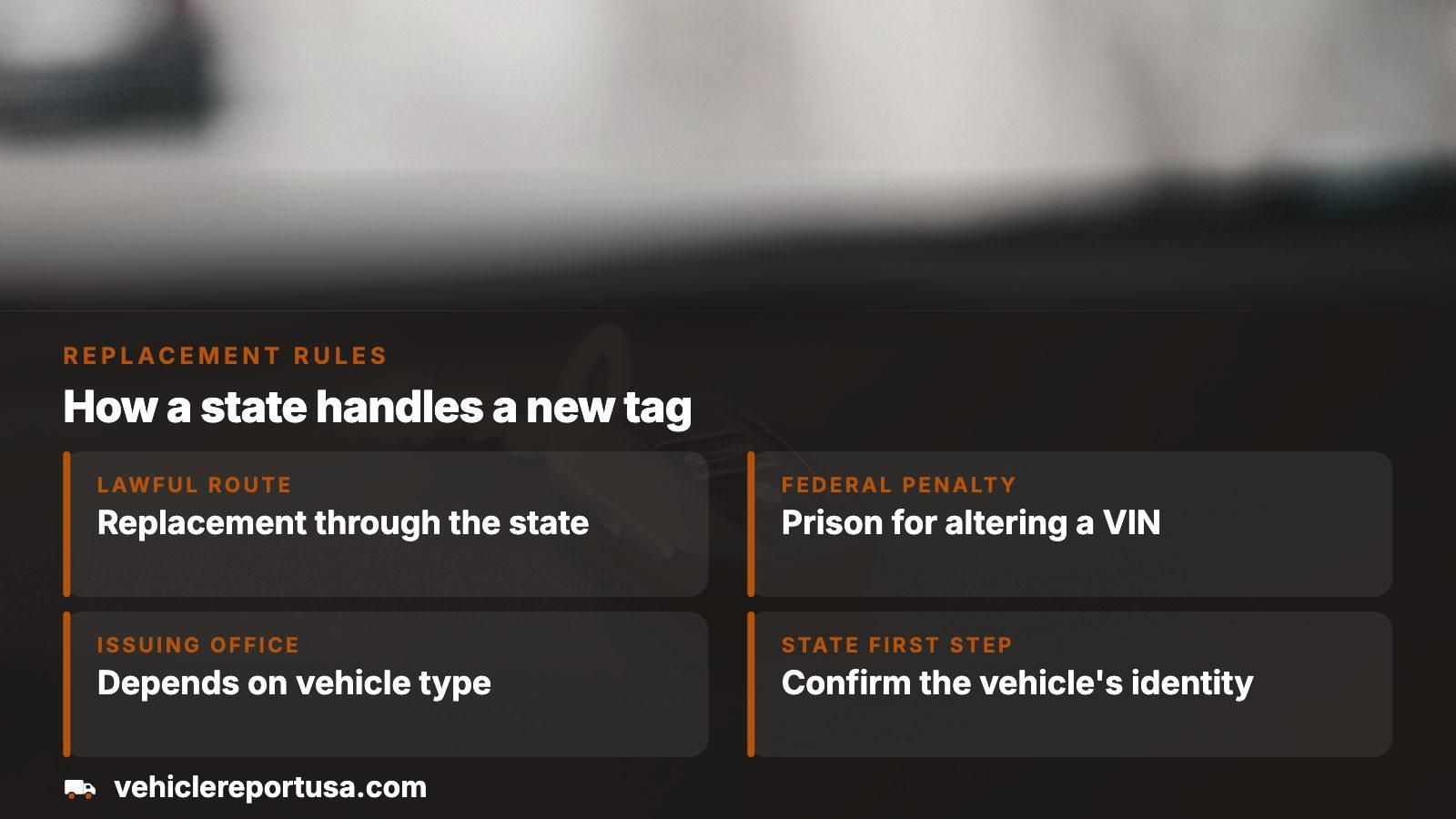
Replacing a classic car's VIN tag is lawful only when state law is followed. Federal law bars removing, tampering with or altering an identification number, with an exception for restoring or replacing one as the state directs, and a vehicle with a changed number can be seized. A buyer should ask for the state's paperwork, compare the tag with the title and the other labels on the vehicle, and run the number before paying.
- Federal penalty
- Up to 5 years in prison for altering a VIN
- Lawful route
- Replacement through the state, never a self-fitted plate
- Preview
- Free, before any payment
Why a replacement tag has to come through the state
A VIN tag is not a part you order and rivet on. Federal law punishes knowingly removing, obliterating, tampering with or altering a vehicle's identification number, with a fine, up to 5 years in prison, or both. A short list of people sits outside the ban: someone who restores or replaces a number as state law directs, and someone repairing the vehicle when the change is reasonably necessary. Both exceptions vanish if that person knows the vehicle is stolen.
| Federal law | What it says | What it means for a buyer |
|---|---|---|
| 18 U.S.C. 511 | Bars altering or removing an identification number unless a listed exception applies | Whoever changed the tag needs a lawful reason, and state paperwork is the usual proof |
| 18 U.S.C. 512 | A vehicle or part with a changed number can be seized and forfeited, except where the replacement conforms to state law | A tag with no state record behind it is a legal risk that travels with the car |
Which office issues the plate for a trailer, bike or truck
The office that hands out a state-assigned plate depends on the state and the vehicle type. California's registration manual shows how finely that splits: its DMV assigns and attaches plates for light trailers, trailer coaches and new motorcycles at original registration, while requests for passenger vehicles, commercial motor vehicles and motorcycles that are not new go to the California Highway Patrol.
| Vehicle in California | Who assigns the VIN plate |
|---|---|
| Trailer under 6,000 pounds unladen | DMV |
| Trailer coach | DMV |
| New motorcycle | DMV |
| Motorcycle that is not new | Highway Patrol |
| Passenger vehicle or commercial motor vehicle | Highway Patrol |
| Commercial trailer of 6,000 pounds or more unladen | Highway Patrol |
That is one state's arrangement. Another may route the request elsewhere, so call the agency that will title the vehicle and describe the make, the year and what happened to the old plate.
What the state does before it hands out a number
California does not issue a number on request. Its manual says a physical verification is always required when DMV assigns a VIN. DMV staff, peace officers, auto club employees and DMV-licensed verifiers can do one, though licensed verifiers face limits on salvage rebuilds, specially constructed vehicles and motorcycles with no California record. The Highway Patrol steps in when:
- the vehicle's identity cannot be confirmed, or its public and alternate VINs disagree;
- either VIN shows signs of alteration or tampering;
- the federal label is gone or unreadable and no second number can be found.
A lawful replacement therefore leaves an inspection record. Ask to see the state's paperwork, not just a story about it.
A tag that came off for bodywork is not automatically a red flag
Plenty of restored vehicles lose their tag for a while. Federal law carves out removal that is reasonably necessary for a repair, so a tag unscrewed for paint is not a crime in itself. The trouble starts when it returns damaged, or returns as a different plate with no explanation.
Ask for the shop's invoice or work order that mentions the tag, and inspect the tag and its rivets for gouges and scratches. A repair story counts only when the paperwork agrees with it.
Checks to make on the vehicle itself
The NICB inspection guide was written for insurance staff and police checking cars from the modern 17-character era, so locations shift on an older body. The logic carries over: every place the vehicle carries its number should tell the same story.
- The plate and its fasteners: scratches or damage on the tag or its rivets.
- The metal around it: fresh scars, excess glue or loose trim, signs that something was pulled out to reach the tag.
- Other labels: a scratched, loose or replaced door-area label, or an emissions label under the hood scraped over its model year.
- The firewall and any body plate: leftover rivet holes, cleaner or differently shaded paint, new welds or glue.
- The papers: white-out, strike-overs, bleached paper, or a VIN that differs between documents.
Photograph each spot in daylight with the title beside you. None of this proves tampering alone, and NICB says its checklist cannot promise to catch every altered number.
Tests the number itself can fail
For a 17-character number, a few checks need only the title and a decoder.
| Test | What a genuine number does |
|---|---|
| Length | Fills all 17 positions |
| Letters | Never uses I, O or Q |
| Ninth character | A numeral or the letter X, the check digit, calculated from all the other positions |
| Tenth character | Matches the model year on the title |
| Uniqueness | Never repeats across the 60 years that start with the 1980 model year |
These tests fit only the modern format. The federal year chart starts at 1980, so a 17-character tag on a car built before then needs an explanation, such as a number the state assigned. An older, shorter number cannot be run through these checks, and the classic car VIN check page covers how those vehicles are verified instead.
What a history report can and cannot say about a swapped tag
A history report follows a number, not the metal it is stamped on. Pull one and you see title brands, salvage and total-loss entries, theft records and odometer readings filed against that VIN. If a plate was lifted from another vehicle, the clean record belongs to that other vehicle. That is why the FTC calls a report no substitute for an independent inspection.
Run both numbers
Look up the number stamped on the vehicle and the number printed on the title as two separate checks. The preview is free and shows what each decodes to. If the make, year or body style disagrees with what is in front of you, the tag or the paperwork is wrong, and that gets settled before money moves.
NICB also offers a VIN lookup covering flood damage, theft without recovery and salvage declarations, and it is worth a pass too. A full report from VehicleReportUSA is bought once, with no recurring charge; current rates sit on the pricing page.
Questions to put to the seller before paying
- Who removed or replaced the tag, when, and for what reason?
- Is there a verification or assignment record from the state, and will the agency confirm it?
- Does the title carry exactly the number on the tag, character for character?
- Are there photos or shop invoices from before and after the restoration?
- Can the sale wait until a state inspector or an independent mechanic has looked at the vehicle?
Straight answers backed by paper are the good outcome. A seller who cannot say who handled the tag, or bristles at the question, has given you a reason to walk.

Where this information comes from
- U.S. Code: 18 U.S.C. 511, altering or removing motor vehicle identification numbers — the crime, the penalty and the exceptions for repair and for replacement under state law
- U.S. Code: 18 U.S.C. 512, forfeiture of certain motor vehicles and parts — when a vehicle with a changed number can be seized, and the exception for state-conforming replacements
- eCFR: 49 CFR part 565, vehicle identification number requirements — the 17-character format, the check digit, the letters left out and the year chart that starts at 1980
- California DMV: VIN plate assignments, manual section 1.160 — which vehicles DMV plates itself and which go to the Highway Patrol
- California DMV: vehicle verifications, manual section 1.165 — when a physical verification is required and who may perform one
- NICB: Vehicle Identification Inspection Guide — the plate, label, firewall and paperwork checks used to spot an altered number
- FTC: Used cars — why a history report does not replace an inspection, and what NICB's lookup covers
Sources and photos: Facts checked against the sources above in November 2026. Photos by Carrie Allen www.carrieallen.com, Anastasiia Nelen and Bence Balla-Schottner on Unsplash; diagrams by VehicleReportUSA.
Keep reading
- Classic Car VIN Check: History Lookups for Older Cars, Pickups and TrailersThe lookup itself, and how a pre-1980 number is verified when a decoder refuses it.
- Pre-1981 Motorcycle VIN Check: What It Can and Cannot ShowThe same older-number problem, worked through for vintage bikes.
- Trailer VIN Lookup: Check a Used Trailer's History by VIN Before You PayTrailers carry federal VINs too, and tags get swapped on them.
- Sample reportSee a finished report before you decide to buy one.
Frequently asked questions
Can I legally replace the VIN tag on my classic car?
Only by the route your state sets. Federal law exempts a number restored or replaced as state law directs, so the first call goes to the titling agency, not a parts catalog. California, for one, requires an inspection first. Keep whatever paperwork the state issues.
What happens if I buy a vehicle whose VIN plate was altered?
Under federal law the vehicle can be seized and forfeited unless the replacement conformed to state law or another exception applies. Whoever knowingly altered the number risks up to 5 years in prison. Get the state's paperwork before paying, because afterward the burden is yours.
Where is the VIN tag on a classic car?
On vehicles built to the current federal rule, the number sits inside the cabin, readable through the glass beside the driver's side windshield pillar, and on some makes repeats on a body plate under the hood. Older vehicles predate that rule and vary by maker, so read the number off the metal and match it to the title.
Will a VIN history report show that a tag was replaced?
Not directly. A report lists records filed against a number, such as title brands, salvage or total-loss entries, theft and odometer readings. It cannot see the plate on the vehicle, so a mismatch appears only when you compare the report with the car. The preview is worth running on both the tag number and the title number.
Can a restoration shop remove my VIN tag to paint the car?
Federal law exempts a change reasonably necessary for a repair, so temporary removal is not automatically a crime. Have the shop note it on the invoice and return the tag undamaged. No exemption covers an altered number or a stolen vehicle, and your state may add its own rules.
Now check the car itself
The guide explains what to look for. The report shows what this VIN has on record.