THE SHORT ANSWER
Read the number off the plate on the front left of the trailer, check it against the frame, then enter it in the preview. A paid report adds brands, liens, theft, loss and auction entries, and open recalls. It says nothing about hoist condition, welds or tires, so you still need to inspect those yourself.
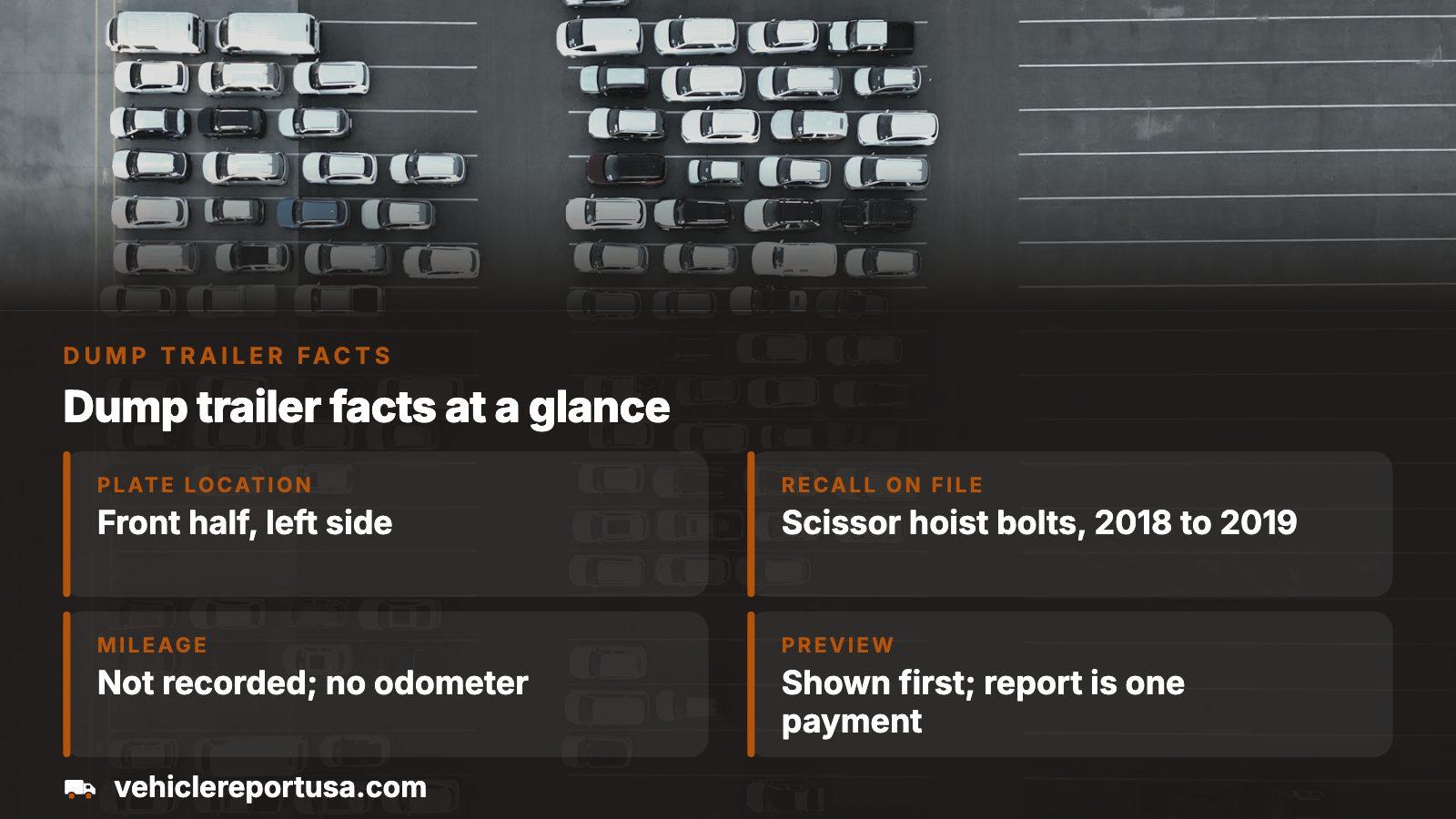
- Plate location
- Front half, left side of the trailer
- Recall on file
- Load Trail dump trailers, 2018-2019, scissor hoist bolts
- Mileage
- Not recorded; trailers have no odometer
- Preview
- Free; the full report is a single payment
What a search turns up on a dump trailer
Dump trailers lead hard lives. They haul gravel, demolition debris, hot asphalt and wet dirt, and many change hands when a contractor upgrades. A VIN search cannot see that wear. It can show whether the unit has a paper trail that fits the seller's story.
| What you want to know | What the search can show |
|---|---|
| Ever declared salvage or junk? | Title brands and insurer total-loss calls, where a state or insurer reported them |
| Does a lender hold a claim? | Liens and impound holds filed under the number |
| Reported stolen? | A theft entry for this VIN |
| Wrecked or flooded? | Loss and auction entries, plus photos when any exist |
| Any safety fix still open? | Unresolved recalls tied to the unit |
| How hard did it work? | Nothing. No odometer or hour meter feeds the record. |
Trailers leave thinner records than cars. An entry appears only when something got reported: a title issued, a loan taken, a claim paid, a theft filed. A quiet result is weaker proof here than on a pickup.
Reading the VIN off the trailer
By federal rule the maker rivets or otherwise fixes a plate to the trailer so that taking it off ruins it. On a trailer it belongs on the left, in the forward half, readable from outside. Expect the build date, weight ratings, the VIN and the vehicle type, in a fixed order that includes a rating for every axle.
Photograph the plate, then locate the number stamped in the frame close to the tongue and match the two against each other. A plate that looks newer than the paint, drilled-out rivets, or a stamping ground smooth are all reasons to stop. Federal rules also make the final four VIN characters on a trailer digits, a quick test for a mistyped or doctored number.
NHTSA's decoder lists Dump Trailer as one of its trailer body types, but it reports only what the maker filed. If it returns an error or a body type that does not match what you are looking at, treat that as a question for the seller.
The hoist recall and what it teaches
Recalls on dump trailers are uncommon, which makes the one on file worth reading. NHTSA campaign 19V279000 covers certain 2018 and 2019 Load Trail tandem axle and triple axle dump trailers fitted with the scissor hoist option. Under heavy loads, the bolts joining the hydraulic cylinder to the hoist can break, letting the box fall back onto the frame fast enough to injure someone.
The maker's fix was bracing plus stronger bolts, fitted by dealers at no charge. NHTSA lists 355 trailers as potentially affected, a small share of production, and a trailer is covered only if its make, model and year match what the maker filed.
Search the exact make, model and year
When I searched NHTSA for several other dump trailer makers, nothing came back. That does not prove those trailers are clear. Recalls are filed under the exact names the maker used, so a loose search can miss a real one. A VIN-based search removes the guessing.
What an owner reported about a dump trailer's tires
Not every problem lives in a database. Owners file their own complaints with NHTSA, and one concerns a 2018 Load Trail tandem axle dump trailer.
From an NHTSA owner complaint
This owner bought a set of new trailer tires, had a local shop mount them, and then lost all four one after another, somewhere between roughly 100 and 2000 miles. Each time the tread peeled off in one piece and yanked the trailer sideways. Pressures had been checked before every failure. The owner suspected recaps sold as new and kept two of the failed tires for inspection.
Takeaway for a buyer: a clean history says nothing about rubber, bearings, brakes or lights. Read the date codes and sidewalls on every tire, ask who sold them, and budget for replacements if the set is old or mismatched.
Running the check in five steps
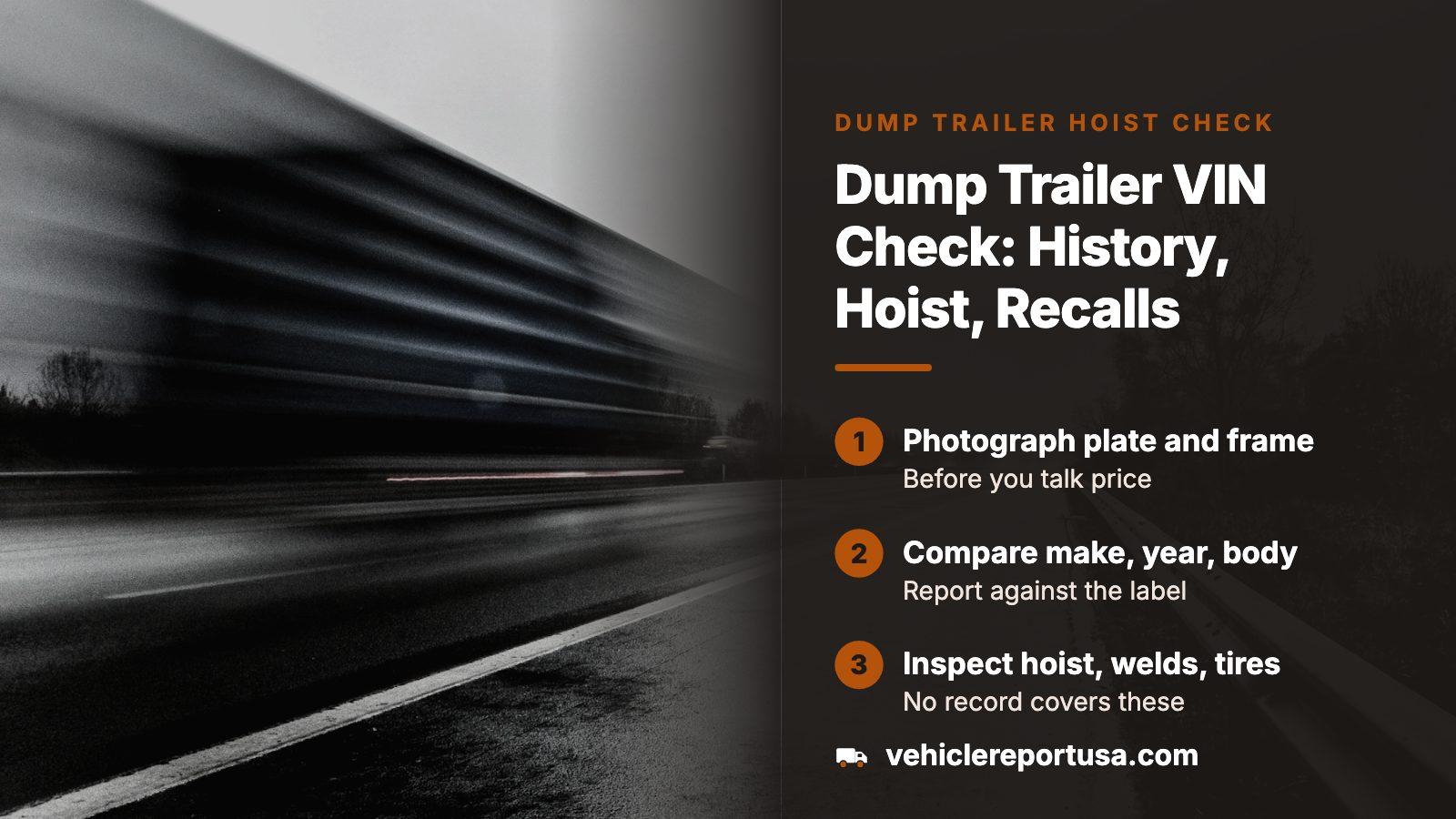
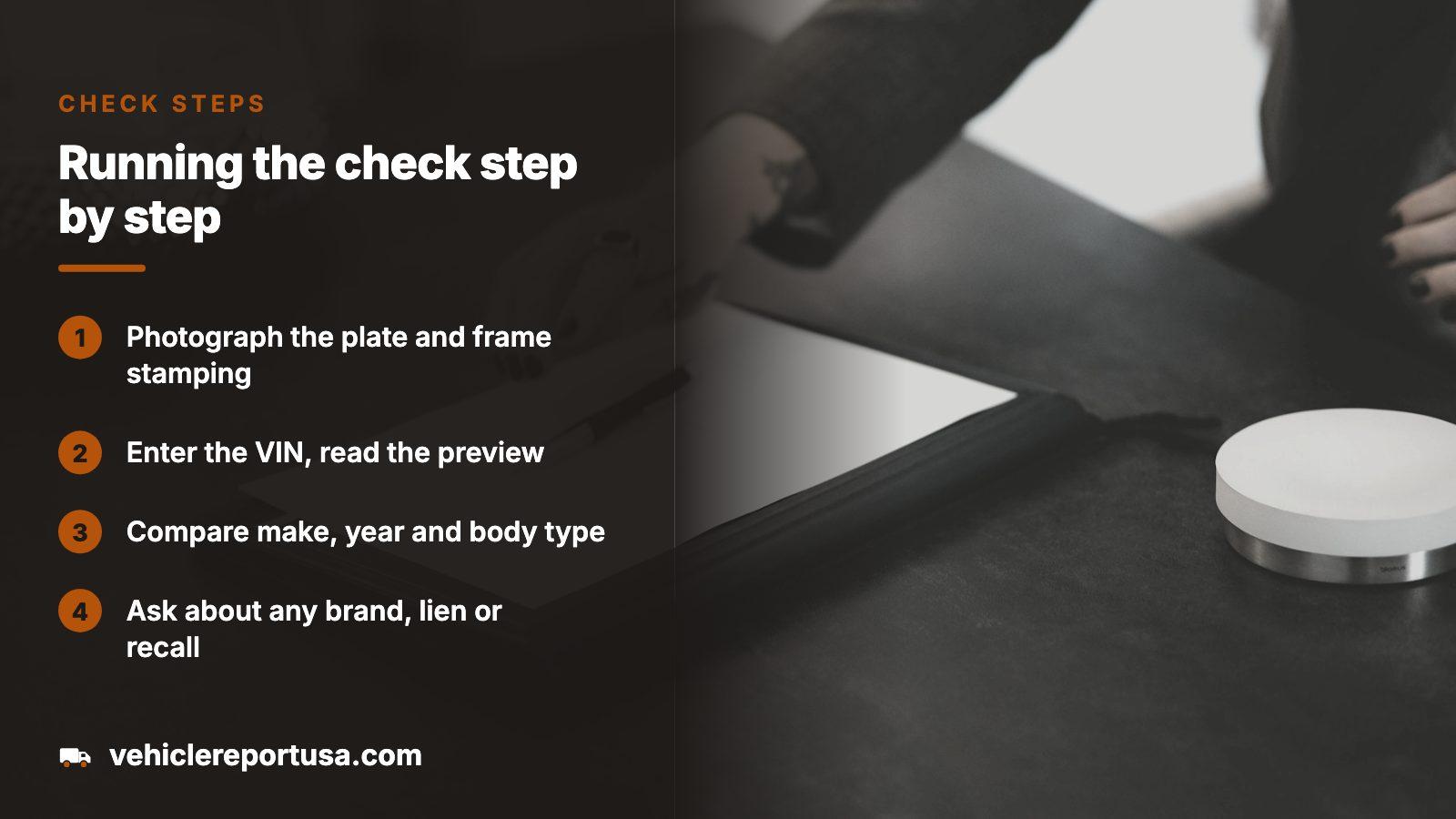
- Photograph the certification plate and the frame stamping before you discuss price.
- Enter the VIN in the VehicleReportUSA preview and read what comes back at no charge.
- Compare the make, year and body type in the result with the label and the listing.
- If the trailer is still in the running, buy a report and read each section against what the seller told you.
- Ask about any brand, lien, claim or recall that turns up, and keep the answer in writing.
Do all this ahead of a deposit. A salvage brand or an unreleased lien is cheap to learn about early and costly to learn about once the trailer is parked at your place.
Red flags in the results
- A salvage, junk or flood brand nobody mentioned, or one the seller calls cosmetic.
- A lien that the title in the seller's hand does not show.
- A theft entry, or a total-loss decision on a trailer that later reappeared.
- A make, year or body type in the report that disagrees with the label.
- A title from another state than the seller lives in, with no explanation.
States set their own brand rules. A damaged trailer might be branded salvage in one state and escape the label in the next, though the federal title system keeps a brand once a state has applied it. The Justice Department also cautions that reporting gaps can produce a false clear result, and its list of covered vehicle types does not name trailers. A thin report should raise questions, not settle them.
Paperwork that should match the search
Trailer titling depends on the state and the weight. Texas shows how much it can matter: a manufactured trailer rated above 4,000 pounds gross must carry a title, a new one comes with a manufacturer's certificate of origin, and a used one that heavy needs a certificate of title, applied for on Form 130-U. Texas also sends trailers over 7,500 pounds gross for an annual safety inspection, and plenty of dump trailers sit above that line.
Your state will have its own thresholds and forms, so confirm them with your motor vehicle agency. In every state the pattern is the same: the name on the title, the VIN on the paper and the VIN on the trailer should agree, and any lender should have released its claim.
Budget and the hands-on inspection
The preview is where to begin, and it carries no charge. A full report is one payment, with a pack for anyone sizing up several trailers in an afternoon. No renewal follows; rates live on the pricing page.
Then book a hands-on look at the hoist, hydraulic lines, frame, axles and tires, and have the seller raise and lower the box with a load in it. If the report shows a brand, a lien or a theft entry, get it cleared in writing or walk away.
Where this information comes from
- NHTSA recall campaign 19V279000 — hoist bolt defect, affected years, remedy and unit count
- NHTSA owner complaint 11520598 — owner experience, paraphrased
- NHTSA vPIC VIN decoder — what the decoder covers and why its data comes from the maker
- eCFR: certification label rule, 49 CFR 567.4 — plate contents and how it must be fixed to the vehicle
- Justice Department NMVTIS consumer page — what brands mean, how states differ and where reporting falls short
- Texas DMV: Trailers — one state's title weights, form and inspection rule
Sources and photos: Facts checked against the sources above in November 2026. Photos by Ümit Yıldırım, Annika Wischnewsky and Iain on Unsplash; diagrams by VehicleReportUSA.
Keep reading
- Utility Trailer VIN Check: What the History Shows Before You BuyThe same search for open utility trailers, which have a different recall record.
- Trailer Recall Check: Find Open Safety Recalls by VINShows how to look up recalls by make, model and year.
- Where Is the VIN Number on a Trailer? Label, Frame and TongueWalks through the plate and the frame stamping in more detail.
- What If a Trailer Has No VIN Number? A Buyer's ChecklistCovers a trailer whose number is gone, ground off or never assigned.
Frequently asked questions
Does every dump trailer have a VIN?
A trailer built by a maker carries one on its plate and in a frame stamping. A homemade or assembled trailer may have none until a state assigns a number. A trailer with no number is a serious reason to pause before paying.
Will a VIN search show how many loads a dump trailer has hauled?
No. Trailers carry no odometer and no hour meter, so the record holds no usage figure. Judge wear by looking at the hoist, the box floor, the hinges, the axles and the tires, and by asking for maintenance receipts.
Will the search show the hoist recall?
It checks open recalls tied to the unit. The recall on file for dump trailers covers certain Load Trail units from 2018 and 2019 with the scissor hoist option. Confirm the match yourself on NHTSA's site and with the maker.
Are there liens on trailers?
Yes, when a lender financed the trailer and a state recorded the claim. Searching the VIN before you leave a deposit is how you find out. If a lien appears, ask the seller for a written release before any money moves.
Do I pay anything to see the preview?
No. The preview is free. A full report is a separate payment, made once, either for one report or a pack. See the pricing page for rates. No subscription follows.
Now check the car itself
The guide explains what to look for. The report shows what this VIN has on record.