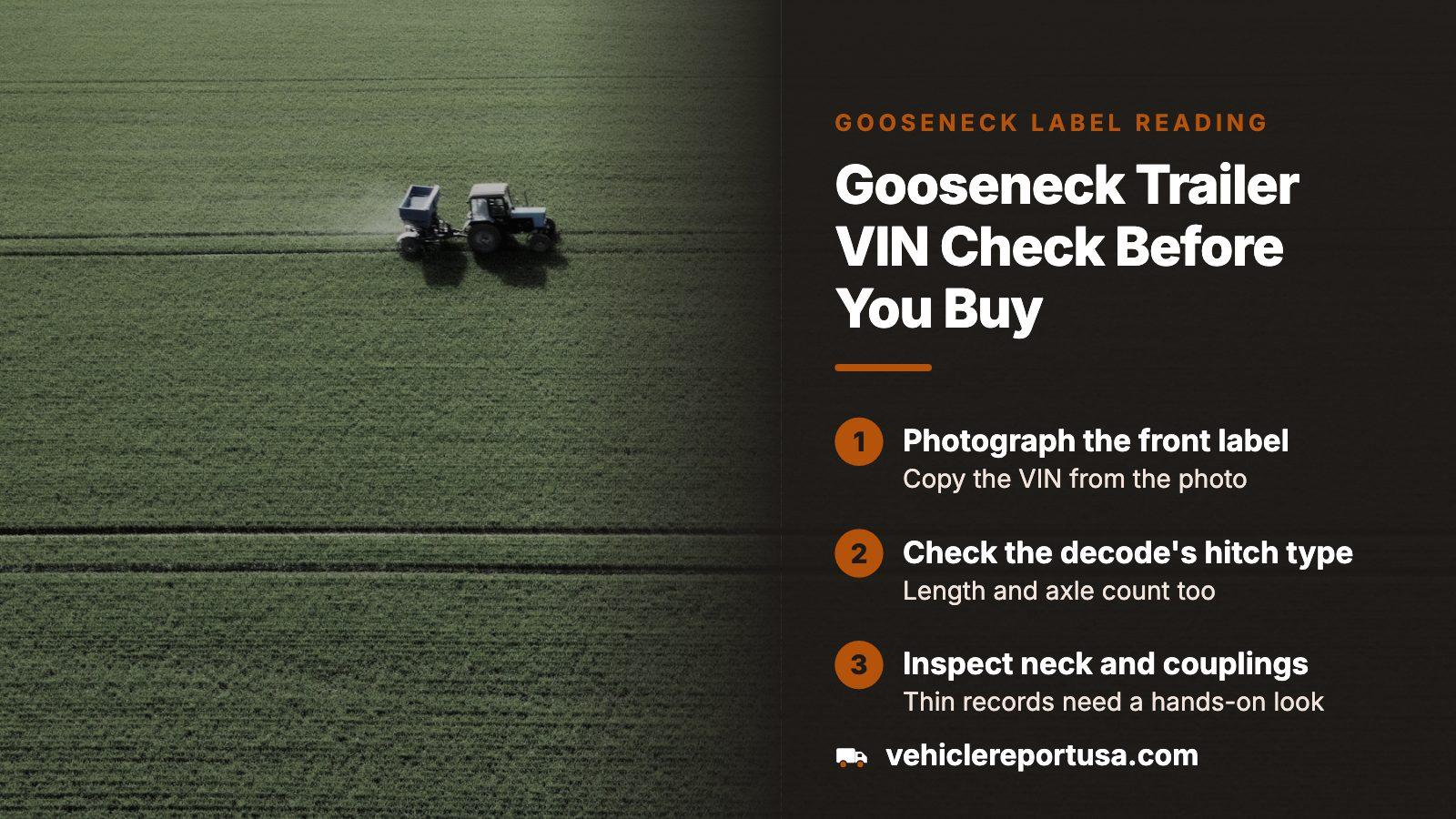
THE SHORT ANSWER
Photograph the builder's label near the front of the driver's side, copy the VIN from the photo, and run it. The preview decodes the number first. The one-time report then looks for title brands, damage and salvage entries, liens, theft records and open recalls. Gooseneck trailers leave thinner paper trails than pickups, so a short result still needs a hands-on inspection.
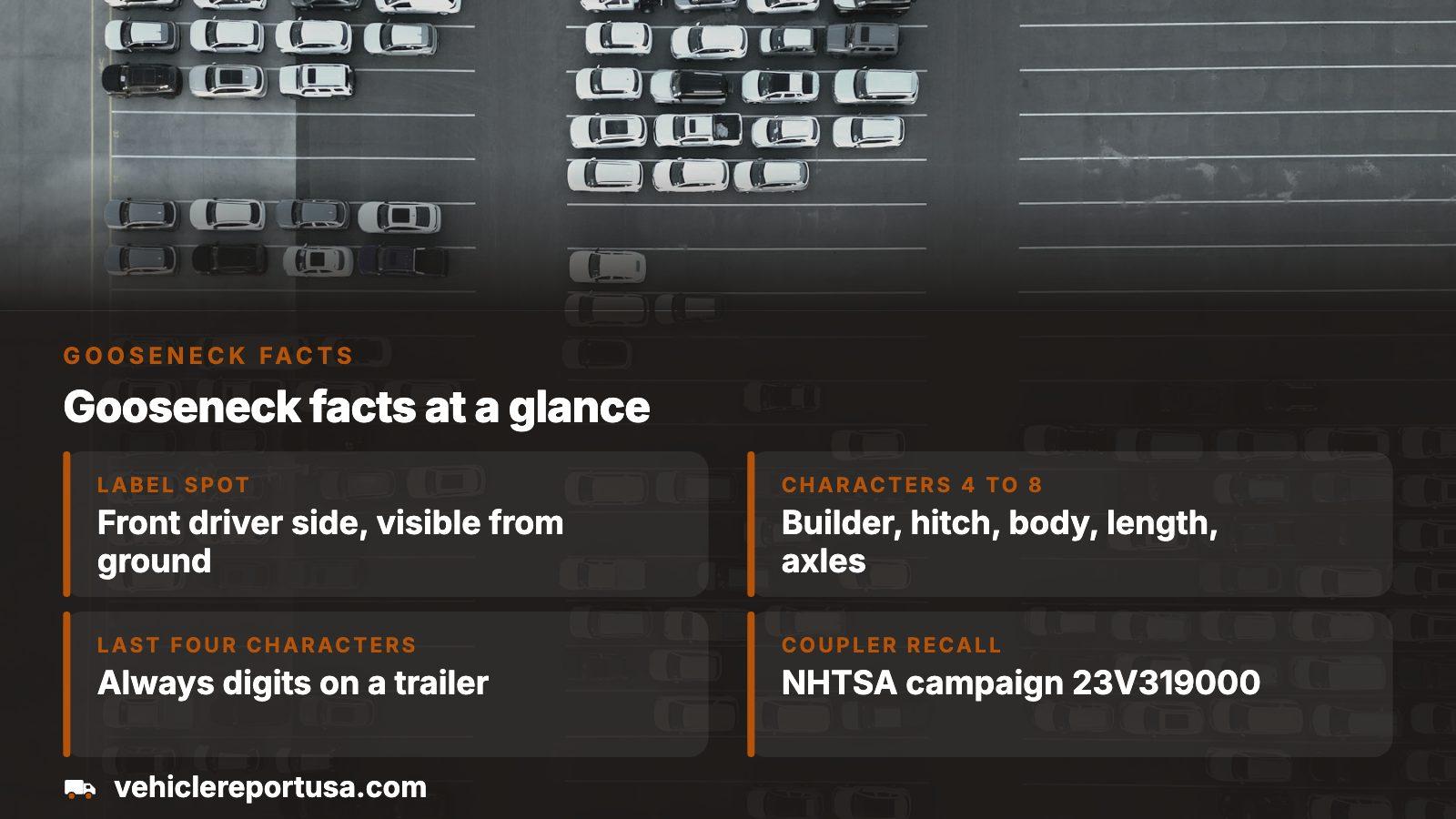
- Label spot
- Front part of the driver's side, visible from the ground
- Characters 4 to 8
- Builder, hitch style, body, length, axle layout
- Last four characters
- Always digits on a trailer
- Coupler recall on file
- NHTSA campaign 23V319000
What a search adds to a trailer you are about to buy
A gooseneck rig is usually bought to haul something heavy: equipment, hay, livestock, a skid steer. The trailer may have lived a hard life before you saw it, and the seller's photos will not show a bent frame rail. The VIN is the one identifier that follows the trailer through sales, so the search starts there.
- Title brands like salvage or flood, which stay attached to the number once a state applies one.
- Damage and salvage entries, including auction photos when a lot was listed.
- Liens, so a lender cannot claim the trailer after you pay the seller.
- Theft entries, which matter because an expensive trailer is easy to hitch up and tow away.
- Open recalls, including hitch hardware.
Where a gooseneck sits among hitch types
NHTSA's decoder keeps a list of nine ways a trailer can connect to its tow vehicle. Gooseneck is one entry, and fifth wheel is a separate one, next to ball hitch, bumper pull, pintle hook and kingpin. That separation helps you, because the decoded type should match the trailer sitting in the yard. When the listing and the decode disagree, the seller owes you an explanation.
The federal definition of a semitrailer is about weight carried by the tow vehicle, and it never uses the word gooseneck. Do not expect a decode to settle what your state calls the trailer. For paperwork, the state's own wording rules.
Finding the VIN on a gooseneck and copying it correctly
The federal rule for trailers places the certification label toward the front of the driver's side, in a spot you can read from the ground. It must be riveted or otherwise attached so that prying it off wrecks it. On a gooseneck that puts it around the neck, often near a storage box, so look there first.
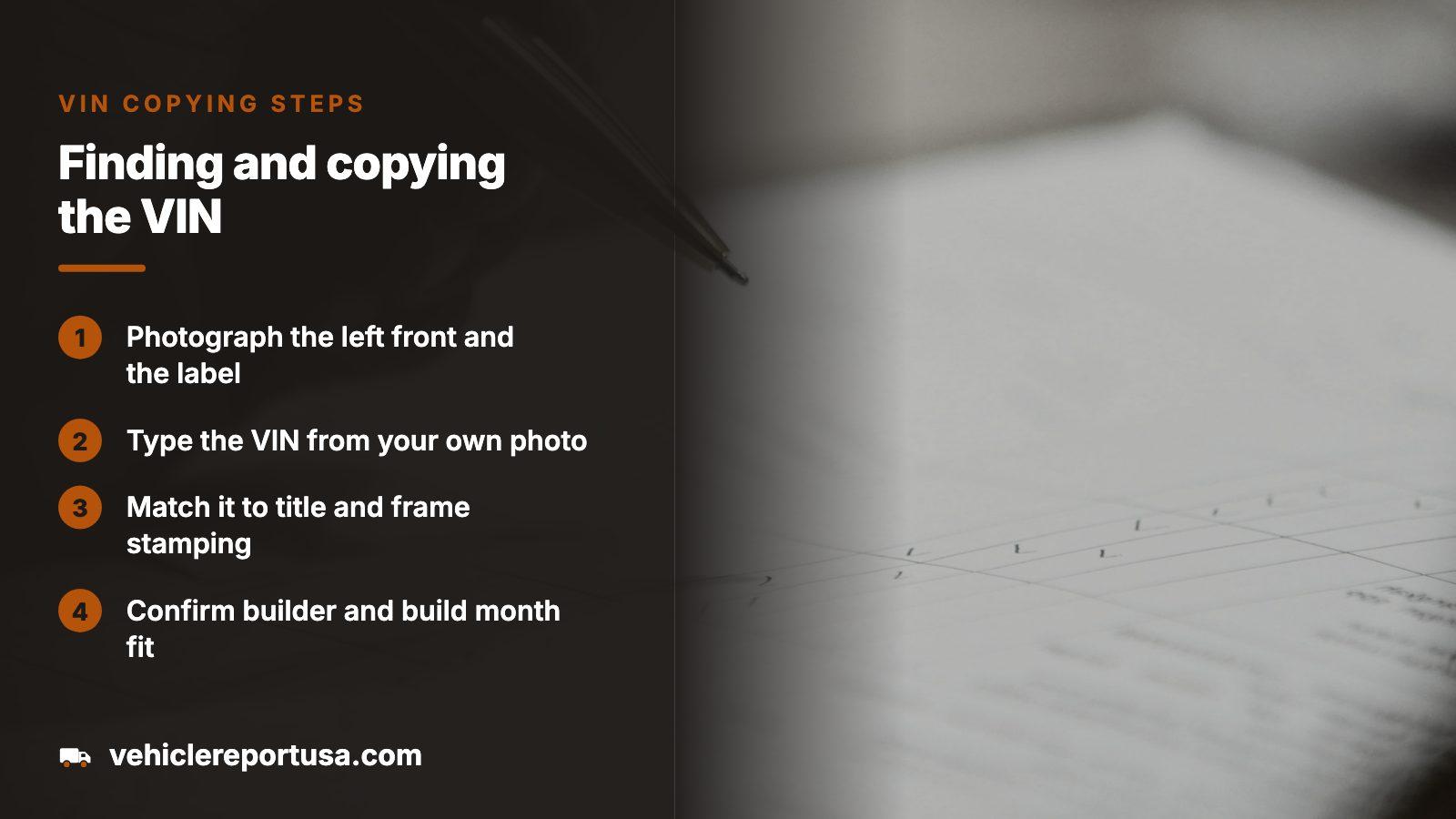
- Take a wide photo of the left front, then a close one of the label.
- Type the VIN from your photo, never from a text message the seller sent.
- Match it with the title and with any number stamped into the front frame.
- Confirm the builder and build month on the label fit the ad.
Texas tells owners to check the tongue for the builder's name, which separates a factory trailer from a homebuilt one. If the label is gone or looks replaced, ask the seller before you ask any database.
What the decode says before you pay
The positions between the maker code and the check digit are not random on a trailer. The federal VIN rule requires them to spell out the make, the kind of trailer, the body, the length and how the axles are arranged. Position 9 is a check digit built to expose copying errors, and the final four characters must be digits.
| Decoded field | Example from a public decode |
|---|---|
| Maker | PJ Trailers Manufacturing, from the opening three characters |
| Hitch connection | Gooseneck |
| Body | Flat deck, listed as a platform style |
| Length field | 39 |
| Axle count | 2 |
| Build location | Sumner, Texas |
That row set came from NHTSA's decoder fed a partial number taken from a 2023 owner complaint. The decoder warned that the input was incomplete and that the year it guessed could be off, so it is an illustration, not a model of a full report. Enter the whole VIN and the model year when you have them.
The coupler recall and what an owner reported
Gooseneck hardware is a safety item, and NHTSA campaign 23V319000 shows why. PJ Trailers recalled certain 2022 to 2024 models that came with a Demco EZ Latch coupler on the gooseneck. Its mounting bolts could work loose and let the coupler pull away from the inner tube. NHTSA warns that a separated coupler raises the chance of the trailer coming off the truck in a crash. Dealers replace the couplers at no charge, and owner letters went out on June 15, 2023.
From an NHTSA owner complaint
A business owner with a 2023 PJ trailer reported that routine inspection found loose gooseneck coupler bolts. The owner snugged them up and kept using the trailer, but a later check found a bolt had broken. A dealer said the couplers needed replacing, and the owner linked the failure to the recall. The complaint puts the failure at about 30,000 miles and says the trailer was not repaired.
Tightening loose bolts did not end the problem here. Before you buy a trailer built in that window, ask for proof that the coupler was replaced, not just snugged.
Why a gooseneck report can come back thin
The Justice Department's NMVTIS description of covered vehicles runs through cars, buses, trucks, motorcycles, RVs and tractors. Trailers do not appear in it. The same page warns that commercial vehicles may be missing where another state agency keeps their records. Insurers must report salvage and total losses only for the newest five model years, which leaves older wrecks possibly unfiled.
NMVTIS adds that an empty answer most likely means no state has reported anything for that number. For a trailer, read that as an unknown, not a clean record. Pair the search with an inspection of welds, the neck and the axles, and with the paperwork in your hand.
Red flags worth walking away over
- A label that peels off cleanly, looks newer than the paint, or has been painted over.
- A VIN whose check digit fails, which usually means a typo but can mean an invented number.
- A decode that contradicts the ad on hitch type, length or axle count.
- A salvage, junk or flood brand the seller never mentioned.
- A lien on the record when the seller says the trailer is paid off.
- A build date inside a recall window with nothing to show the repair was done.
- A seller who wants cash fast and will not let you inspect the neck or couplings.
Title paperwork to ask for
Rules differ by state, so treat Texas as one example. Its DMV says a manufactured trailer with a gross weight over 4,000 pounds must be titled. A used one in that class needs a certificate of title, and a new one needs the manufacturer's certificate of origin. Texas also says a factory-built trailer with missing paperwork cannot simply be registered as a homebuilt one.
Whatever your state, the VIN on the title, the label and the frame should agree. Your state motor vehicle agency can tell you how it handles trailers that carry no number.
Running the check and what it costs
Enter the VIN on this site and the preview decodes it at no charge. If the decode fits the trailer, you can buy a report as a single payment, with no subscription. Pricing, including packs for anyone comparing several trailers, sits on the pricing page.
Then inspect the trailer with the report open on your phone: compare the neck, the couplings and the frame against any damage entry, and ask the seller about every gap.
Where this information comes from
- eCFR 49 CFR 567.4: certification label — where the trailer label goes and how it is fixed
- eCFR 49 CFR 565.15: VIN content — what characters 4 to 8, the check digit and the last four must hold
- NHTSA vPIC decoder — source of the connection types and the example decode
- NHTSA owner complaint 11564548 — owner experience, paraphrased
- NMVTIS frequently asked questions — which vehicle types it covers and why a result can be empty
- Texas DMV: trailers — one state's titling rules for manufactured trailers
Sources and photos: Facts checked against the sources above in November 2026. Photos by Ilia, Masjid MABA and Iain on Unsplash; diagrams by VehicleReportUSA.
Keep reading
- Where Is the VIN Number on a Trailer? Label, Frame and TongueMore on locating the label and frame stamping.
- Trailer VIN Lookup: Check a Used Trailer's History by VIN Before You PayThe general version for any trailer type.
- Horse Trailer VIN Check: Read the Number, Label and Records Before You BuyAnother hauler that often rides on a gooseneck frame.
- PricingSee how a single report and the packs are priced.
Frequently asked questions
Can you run a VIN check on a gooseneck trailer?
Yes, when the trailer carries a standard 17-character VIN. The preview decodes it before you pay, and the report searches whatever records exist. Trailers generate fewer records than cars, so a short result is a reason to inspect harder.
Where is the VIN on a gooseneck trailer?
Look for the certification label near the front on the driver's side. Then check the front frame and neck area for stamping. If neither shows a number, the trailer may be homebuilt or altered, and your state agency decides how it gets one.
Does the VIN tell me the length and axle count?
For a trailer built to the federal rule, characters 4 to 8 must encode the builder's filed data on trailer kind, body, length and axles. A decoder can show those, but confirm the numbers by measuring and counting.
Will a recall search cover my gooseneck coupler?
NHTSA recalls are filed by make, model and year, and one covered Demco EZ Latch couplers on certain PJ trailers. A report lists open recalls for the VIN it finds. For a different coupler brand, ask the builder directly.
Is the report free?
Just the preview carries no charge. A full report is a single payment rather than a plan, and you will find amounts on the pricing page. Buy it after the decode matches the trailer in front of you.
Now check the car itself
The guide explains what to look for. The report shows what this VIN has on record.