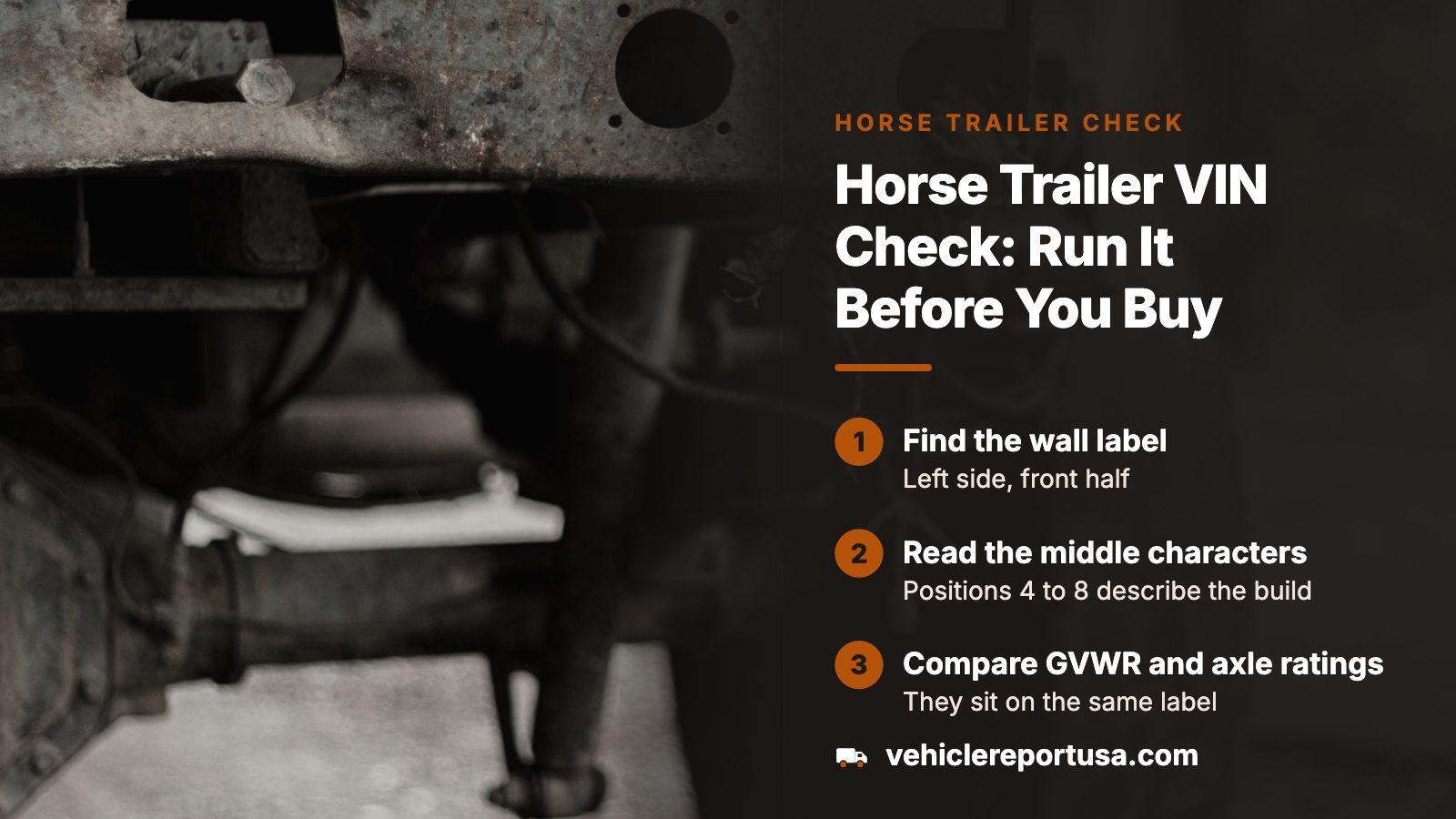
THE SHORT ANSWER
Find the VIN on the certification label, on the left-hand wall in the front half of the trailer, and match it to the title. The free preview decodes the number. The one-time report then searches title brands, damage and salvage records, liens, theft entries and open recalls. Trailers leave thinner records than pickups, so a short result is not a clean bill.
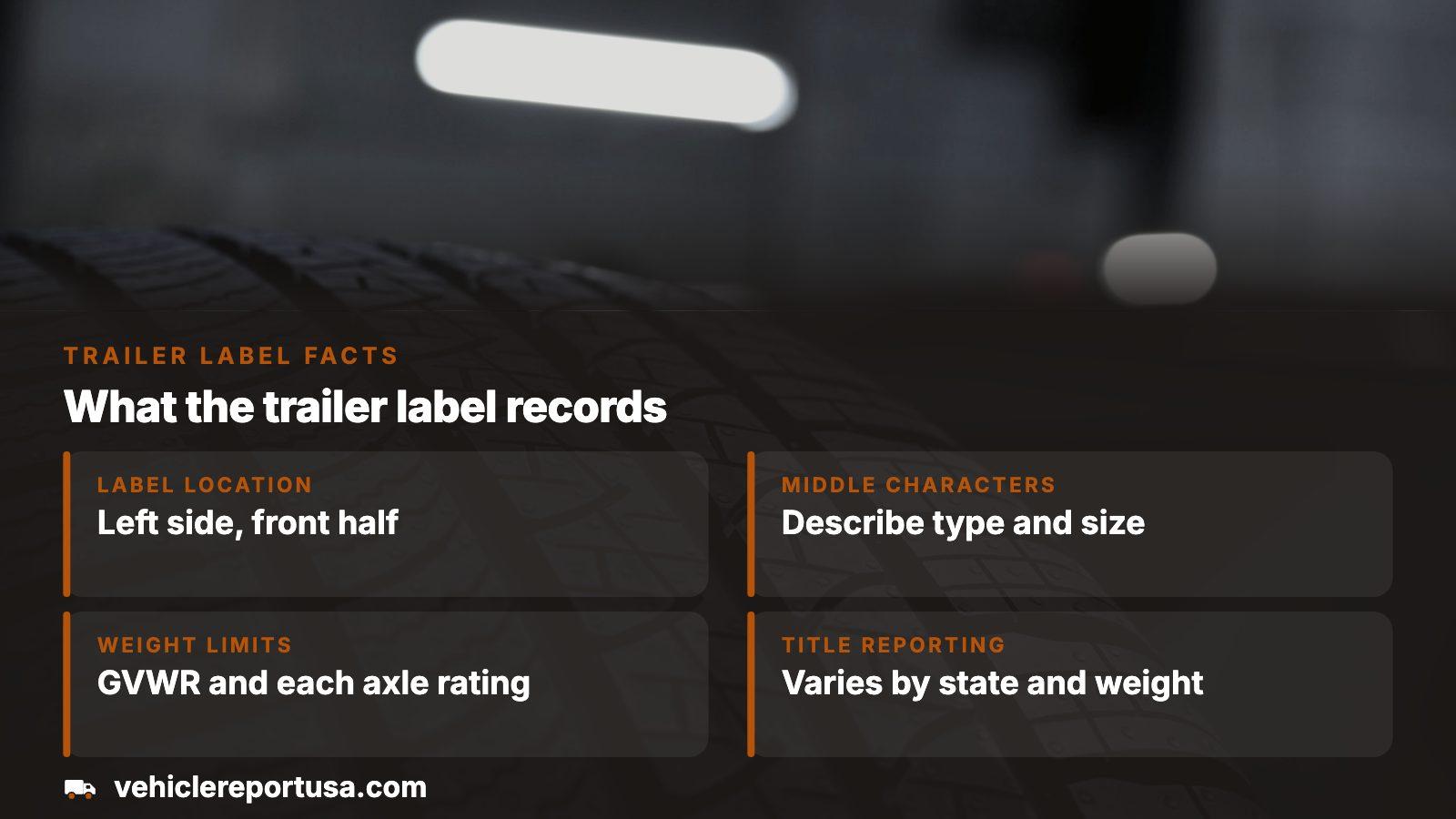
- Label location
- Left side, front half, readable from outside
- Middle characters
- Positions 4 to 8 describe type, body, length and axles
- Weight limits
- GVWR and a rating for each axle sit on the same label
- Title reporting
- Federally required for common automobiles only
What a history search covers on a horse trailer
A horse trailer has no odometer and no engine, so much of a car report goes quiet. The paperwork and damage side remains, and that is where used trailers hide trouble.
| Record | What it tells a horse trailer buyer |
|---|---|
| Title brand | A salvage or rebuilt status that follows the VIN into every later sale |
| Damage and auction photos | Whether the box, frame or axles have already been through a wreck |
| Lien | A lender's claim that can outlive a handshake sale |
| Theft entry | Whether the trailer was ever reported stolen |
| Open recall | A known fault in the axles, hitch or label that nobody repaired |
Federal title reporting is mandatory for common automobiles only, though some states add other vehicle types. A trailer may show fewer entries than a pickup, and a short report means few records exist, not that the past was spotless.
Finding the number on a bumper-pull, gooseneck or fifth-wheel box
By federal rule the certification label sits on the trailer's left-hand wall, in the front half, readable from the ground. Also look at the front of the frame, the tongue or the gooseneck, in case the builder stamped the number there. The label is supposed to be fixed so firmly that removing it wrecks it.
- Photograph the label from a step back, then up close.
- Transcribe the number from your photo, never from a message the seller sent.
- Compare them with the title and any frame stamping, then decode the number and confirm the builder and year match the ad.
A label that peels away clean, or looks newer than the paint around it, calls for a direct question: who replaced it, and why?
What else the label says: weight, date and builder
The label also names the builder, gives the month and year of manufacture, and states a gross vehicle weight rating plus a rating for each axle. Those limits cover the loaded trailer, so tack, hay, water and the animals all count against them. Subtract the empty weight to see what you can put aboard.
Labels can be wrong. Bison Coach recalled certain Bison horse trailers from the 2016 to 2018 model years because the axle rating on the label was incorrect, which could lead an owner to overload the trailer. The remedy was a corrected label at no charge.
Decoding the number: what the middle five characters must say
On a trailer, positions 4 to 8 must say which make it is, what kind of trailer, the body style, how long it is and how its axles are arranged. On a truck the same characters cover engine and brakes, so a decoder tuned for pickups fumbles a trailer. Position 9 is a check digit that one mistyped character usually breaks, so it also tests your copying.
NHTSA's public vPIC register names the builder from the first three characters. These horse trailer builders each came back as trailer makers:
| Builder | First three characters |
|---|---|
| Featherlite | 4FG |
| Sundowner | 13S |
| Exiss Sooner | 4LA |
| Cimarron | 5PA |
| 4-Star | 4FK |
| Trails West | 49S |
One builder can use several codes: the register lists two for Merhow and three each for Lakota and Logan Coach. One of Merhow's is a six-character maker code with a 9 in third place, so characters 12 to 14 finish naming the company. An unexpected code is a reason to look again, not an accusation. The register has no separate horse entry, only a live animal trailer body type, so a decode may say trailer without saying horse.
Recalls, build dates and what owners report
Recalls attach to build windows, and the date on the label places a trailer inside one. In campaign 15V753000, Trails West recalled certain 2015 and 2016 trailers, the Classic II among them, built from February 18 to August 25, 2015 on 3,500-pound torsion axles. A weld on the torsion arm might fail and let the wheel assembly separate; dealers replace suspect axles at no cost.
From an NHTSA owner complaint
In July 2015 an owner reported that a Trails West Classic II, about three months old, lost its right front axle on the highway. The wheel assembly crossed the road with a horse aboard and five people in the tow vehicle. A representative of the builder advised hauling it 25 miles for repair; asked whether that was safe, the reply was "WELL, IT SHOULD BE."
The complaint does not say why the axle broke, and nothing on file puts that trailer inside the recall. The takeaway is narrower: a new trailer can still carry a defect, and a recall search covers only the exact number entered.
Red flags in the result and in the driveway
- A salvage or rebuilt brand on the title record.
- Auction photos showing bent frame members, a damaged axle or a collapsed floor.
- A lien the seller never mentioned.
- A label that disagrees with the title, the frame or the number in the ad.
- A build date inside a recall window, with no proof of repair.
- A seller who rushes you or will not let you look the trailer over.
A total-loss entry needs care. An unrecovered theft can be written off as a total loss after 30 days, and that note stays on the record even if the trailer later reappears unharmed.
Title paperwork changes with the state and the weight
Whether a trailer carries a title depends on the state and the weight. In Texas, a manufactured trailer over 4,000 pounds gross must be titled, while a used one at or under that weight can be proved with a bill of sale plus the registration receipt, or the title where one was issued. A new trailer arrives with a Manufacturer Certificate of Origin.
Texas also distinguishes numbers it assigns, because a trailer never had a permanent one or police cannot work out the original, from numbers it reassigns when the original is known but was removed, altered or obliterated. A reassigned number is no defect, yet the seller should be able to explain why. Look up your own state's rule before you buy.
What no VIN search will see
A history report is paperwork. It cannot see a soft floor under the mats, a cracked weld, worn bearings, aged tires or a latch that no longer seats, and a trailer carrying live weight over rough roads needs all of those sound. Pay an independent mechanic or trailer shop to look it over.
- The floor, from above and from underneath.
- Welds at the axle mounts and around the hitch.
- Brakes, the breakaway system, and the age and wear of the tires.
- Doors, ramps, latches and every light with a tow vehicle connected.
Cost, then the order to work in
Seeing the preview costs nothing, and it decodes the number first. The report itself is bought once, with nothing recurring; if several trailers are on your list, packs of 3, 5 and 10 exist, and the pricing page lists them.
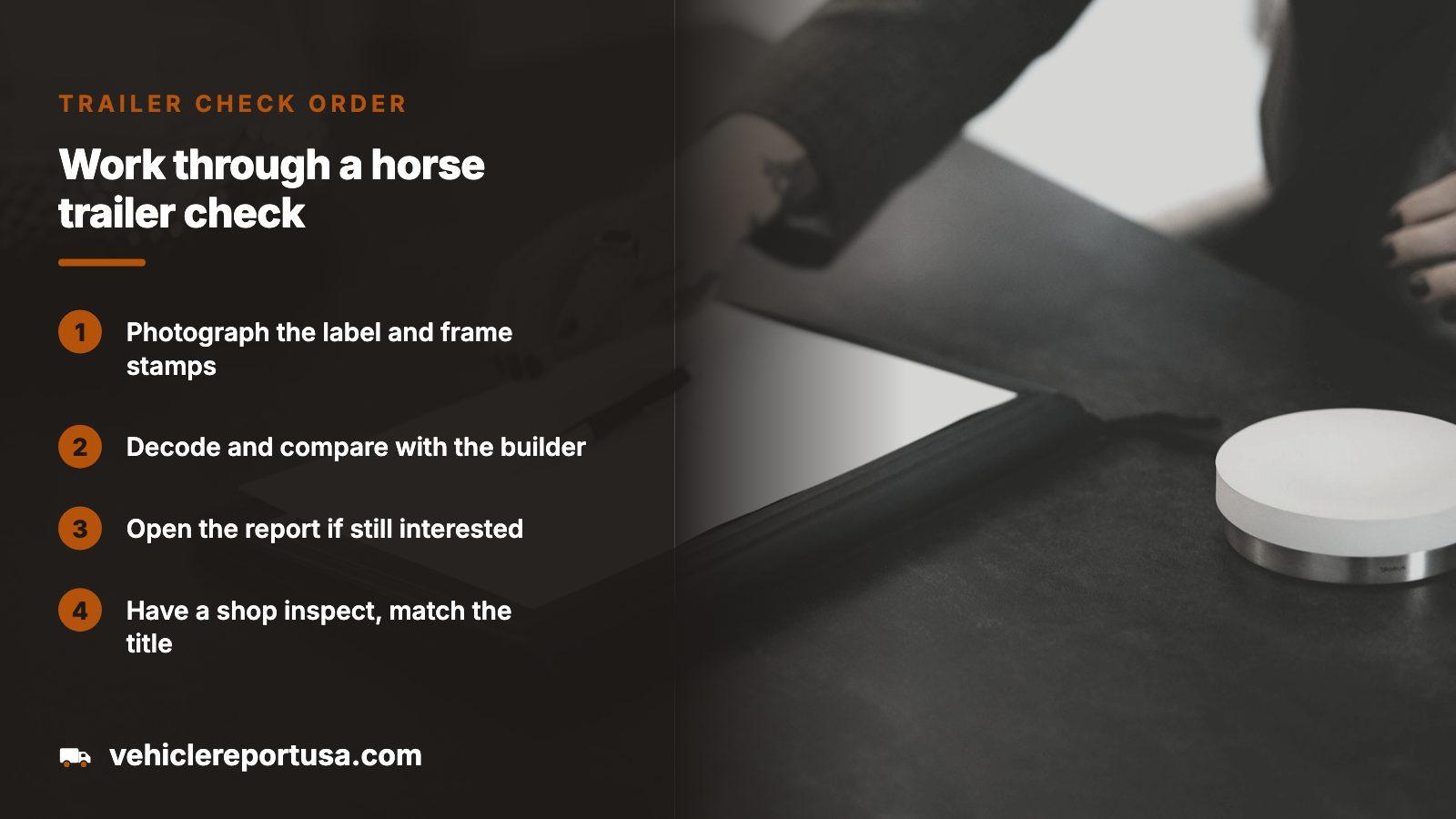
- Photograph the label and any frame stamping.
- Decode the number and compare builder and year with the ad.
- Open the report if the trailer is still in the running, then search recalls for the VIN and owner complaints for the model.
- Have a shop inspect it and match the title to the label before money moves.
Where this information comes from
- eCFR: 49 CFR 567.4, certification label — Where a trailer's label goes, how it is fixed, and which ratings and details it lists.
- eCFR: 49 CFR 565.15, VIN content — What positions 1 to 3, 4 to 8, 9 and 12 to 14 must carry on a trailer.
- NHTSA: vPIC VIN decoder and builder register — Builder codes, trailer body types and the several codes some builders hold.
- NHTSA recall 17V325000, Bison horse trailers — The wrong axle rating printed on certain labels, and the corrected label offered.
- NHTSA owner complaint 10734999 — owner experience, paraphrased
- U.S. Department of Justice: NMVTIS consumer information — What federal title data covers, which vehicles must be reported, and why gaps occur.
- Texas DMV: trailers — One state's weight thresholds, ownership papers and number assignment for trailers.
Sources and photos: Facts checked against the sources above in November 2026. Photos by Zoshua Colah, Annika Wischnewsky and Pablo Alvarez on Unsplash; diagrams by VehicleReportUSA.
Keep reading
- Trailer VIN Lookup: Check a Used Trailer's History by VIN Before You PayThe general trailer lookup, for homemade units and other types of trailer.
- Travel Trailer VIN Check: Run the History Before You Buy the CamperCamper-style trailers raise questions a plain stock box does not.
- Check a Truck VIN Number: Pickups, Box Trucks and Heavy-Duty RigsThe truck that pulls the trailer deserves its own history check.
- PricingCompare one report with a pack if you are looking at several trailers.
Frequently asked questions
Where is the VIN on a horse trailer?
Check the certification label on the left side toward the front, then the front of the frame, the tongue or the gooseneck for stamping. If there is no number anywhere, do not guess: a homemade or stripped trailer needs a state process, which in Texas begins with an officer's inspection.
Can you run a VIN check on a horse trailer?
Yes, when the trailer has a standard VIN. The preview decodes the number before you pay, and the report searches whatever records exist for it. Trailers generate fewer records than cars, so read a thin result alongside an in-person inspection.
Does the check show the trailer's weight rating?
Take the ratings from the label itself, where the builder prints the gross rating and one for each axle. The Bison recall shows a label can be wrong, so compare it with the maker's own paperwork when the numbers look odd.
What if the seller has no title for the trailer?
That depends on the state and the weight. In Texas a used trailer at or under 4,000 pounds can be documented without a title when none was ever issued, but heavier ones need one. Learn your state's route before paying.
How much does a horse trailer VIN check cost?
The preview costs nothing. The report is bought once rather than by subscription, and packs come in 3, 5 and 10 for anyone comparing trailers. Amounts live on the pricing page.
Now check the car itself
The guide explains what to look for. The report shows what this VIN has on record.