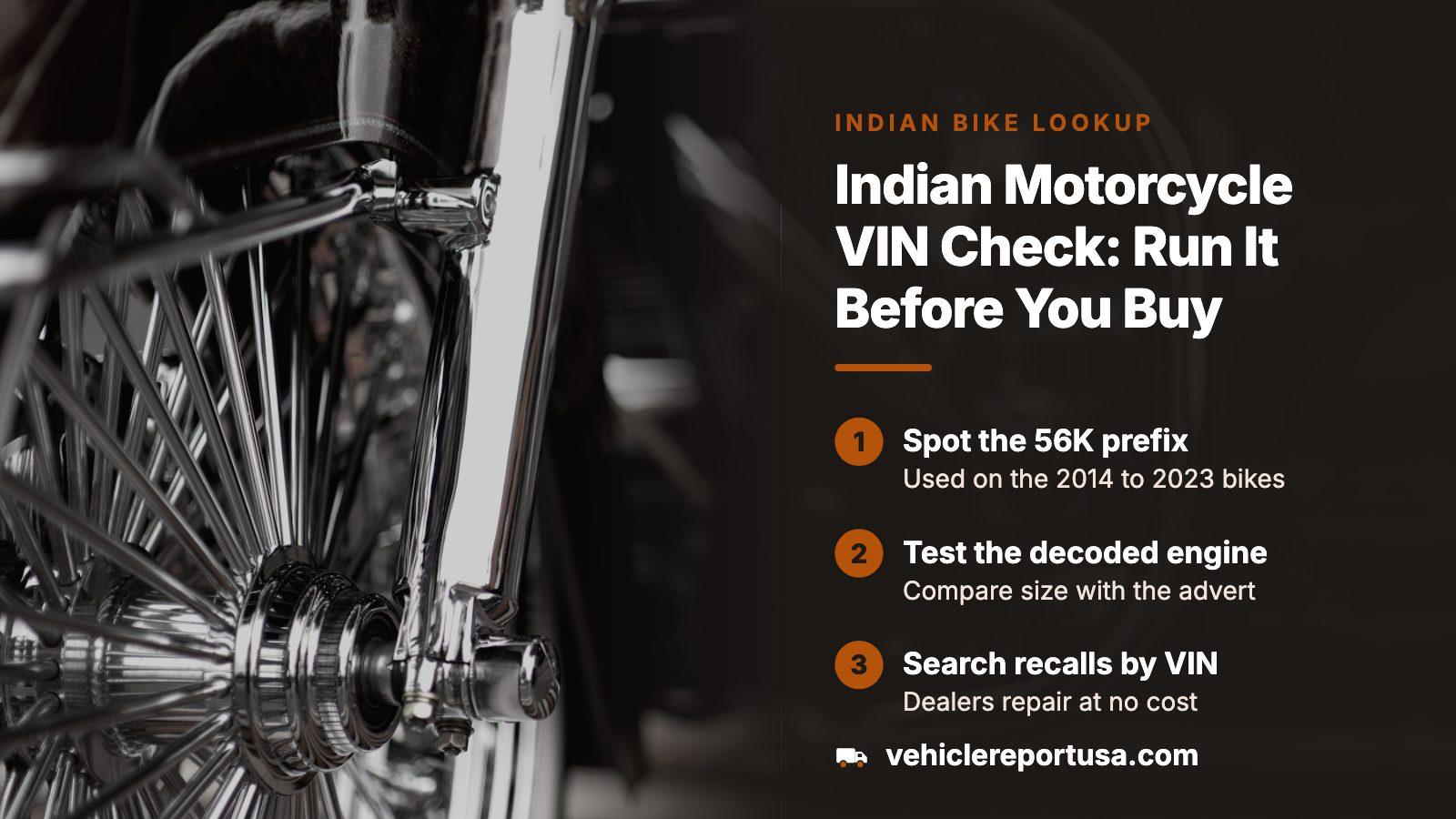
THE SHORT ANSWER
Copy the VIN from the bike and from the title, confirm they match, then run it. The free preview decodes the Indian's model, year and engine size. The paid report goes further: brands on the title, accident and salvage entries, odometer history, liens, stolen-vehicle flags and any open recall. Compare the tenth character with the advertised year, and ask for dealer paperwork on any recall that shows as unrepaired.
- Prefix
- 56K on 2014 to 2023 bikes in NHTSA files
- Year letter
- Tenth character, E for 2014 up to P for 2023
- Recalls
- Search by VIN; dealers repair at no cost
- Preview
- Free, shown before any payment
Reading an Indian VIN before you spend anything
NHTSA lists 56K as an Indian Motorcycle LLC prefix, with 5YA and 5CD also filed under Indian Motorcycle Company. VINs shown on owner complaints for Chief, Scout and Challenger family bikes from 2014 to 2023 all begin 56K, and NHTSA's decoder returned Spirit Lake, Iowa as the plant for every stub tried. Position ten holds the model year letter, which should fit the year in the advert.
| Model year | Tenth character |
|---|---|
| 2023 | P |
| 2022 | N |
| 2021 | M |
| 2020 | L |
| 2019 | K |
| 2018 | J |
| 2017 | H |
| 2016 | G |
| 2015 | F |
| 2014 | E |
The characters I, O, Q, U, Z and 0 never serve as year letters, per NHTSA's decoder. One bike filed as a 2022 model carries M, the 2021 letter. Treat a one-year gap as something to raise with the seller; a larger gap needs a written explanation.
Checking the decoded engine against the advert
Under 49 CFR 565.15, positions four to eight of a motorcycle VIN must describe its make, type, line, engine and net brake horsepower. The encoded power may be up to 10 percent off the true figure, so it is a sanity check, not a measurement. NHTSA's decoder gave consistent engine data within each family:
| Family | Engine size decoded | Power decoded |
|---|---|---|
| Chief Vintage, Chieftain, Springfield | 111 cubic inches | 92 hp |
| Scout, Scout Bobber | 69 cubic inches | 100 hp |
| Challenger, Pursuit | about 108 cubic inches | 122 hp |
If the advert claims a bigger engine than the decode shows, or the decode names a different family from the badges, stop and ask. A letter in the last four characters is also a warning: federal rule reserves them for digits on a motorcycle.
What the history search adds to the decode
A decode shows the bike as built. The report searches records filed against the VIN, and for an Indian these move an offer:
- Salvage, flood or rebuilt brands, and insurer total-loss entries
- Damage records and auction listings, with photos
- Mileage entries from different dates, to test a low reading
- Liens and impound entries that would follow the bike to you
- Theft flags
- Recalls still open for that VIN
NMVTIS, the federal title database, covers motorcycles. It draws on state titling offices, insurers and recyclers, and each state brands by its own standards, so a bike one state would brand may go unbranded in another.
The recalls an Indian buyer is likely to meet
Open recalls matter on an Indian because campaigns have been frequent. NHTSA's lookup returned four campaigns for a 2018 Chieftain and four for a 2016 one, only two shared. A sample:
| NHTSA campaign | Bikes covered | Problem |
|---|---|---|
| 15V721000 | 2015 to 2016 Chief Classic, Vintage, Chieftain, Roadmaster | Rear brake power can drop or disappear |
| 18V228000 | 2018 Chief, Chieftain, Springfield, Roadmaster | Corroded right-hand switch can start the bike unintentionally |
| 19V776000 | 2014 to 2019 Chief, Chieftain, Roadmaster, Springfield | Gear indicator can say neutral while in gear |
| 18V416000 | 2017 to 2018 Scout, Scout Sixty, Scout Bobber | Trapped air in the ABS circuit |
| 24V069000 | 2019 to 2022 Challenger, FTR and Pursuit trims | Brake lights can glow without braking |
Why the recall search has to start from the VIN
Campaigns often reach only bikes built within set date windows, so searching by model name can list recalls that skipped your bike and omit ones that hit it. Numbers also get replaced: a 2022 lighting campaign says it supersedes campaign 19V-339, so a number from a forum may be out of date. Dealers perform open recalls at no cost to the present owner.
From an NHTSA owner complaint
A buyer of a used 2014 Chief Vintage told NHTSA in December 2017 that the dealer sold the bike with a recall undone. It would not start, and another Indian shop did the recall work two days after the sale. The complaint says the selling dealer noted that notices go to the previous owner, admitted it never looked the recall up, and offered nothing extra.
A mailed notice may reach only the previous owner, so run the VIN yourself before you buy.
Running the check with the bike in front of you
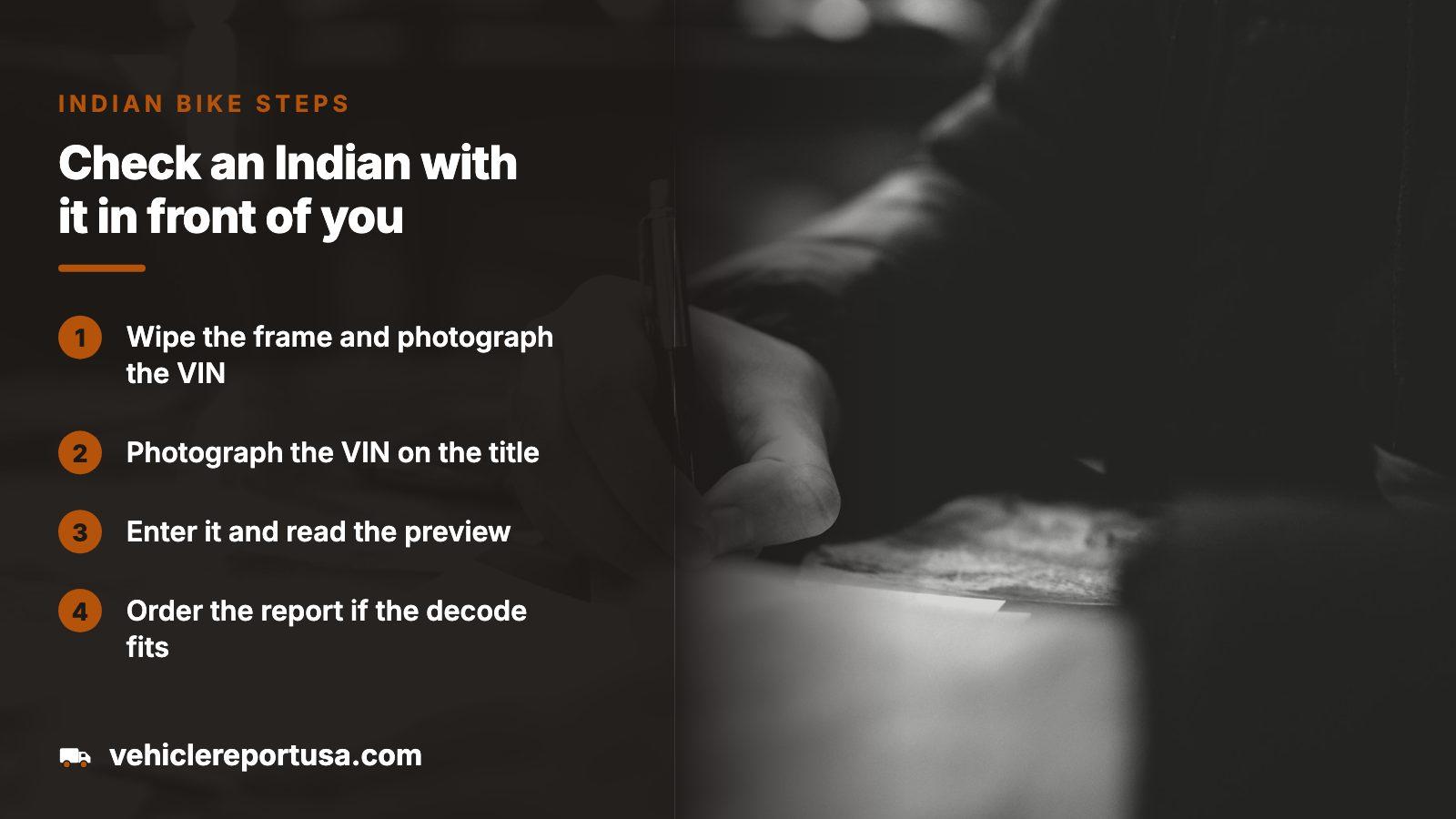
- Wipe the frame and photograph the VIN. Federal rule puts it on a part not designed to come off short of repair, or on a permanently fixed plate, so a loose or mismatched piece needs explaining.
- Photograph the VIN on the title beside it. Every character must agree.
- Enter it in the preview and read the model, year and engine size returned. The tenth character should match the table above.
- If the decode fits the advert, order the report: one payment, no subscription.
- Read the findings against the seller's account and ask about each flag.
Red flags in an Indian report, and the next move for each
| The report shows | Your next move |
|---|---|
| A salvage, flood or rebuilt brand | Have a mechanic check frame and steering head alignment before talking price. |
| Mileage entries that drop or stand still | Request service records and line up the dates. Walk if the seller cannot explain. |
| An open recall with no repair on file | Book the dealer repair, or make it a condition of sale. |
| A lien or impound entry | Get a written lender release before money moves. |
| A theft record or insurer total loss | Ask for a written explanation. A recovered bike can keep the label. |
| A decode that differs from the advert | Make the seller explain before you pay. |
From an NHTSA owner complaint
An owner of a 2015 Roadmaster told NHTSA in December 2024 about campaign 19V776000, the gear-position switch recall. A dealer carried it out, but the owner says only the sensor was swapped, the remaining steps were skipped and the old symptoms returned. A second Indian dealer judged the recall incomplete, the maker would not pay to finish it, and the owner paid for the repair.
A closed recall proves paperwork, not a cure. Ask for the work order and test the symptom the recall describes.
What a clean report still leaves to you
NMVTIS calls its report deliberately short and warns that patchy state reporting can yield a false negative. A bike that was dropped, repaired privately or never insured leaves no record. States hold fuller title files than NMVTIS does, so request the state record on a bike you are serious about. A clean result narrows the risk, but it never removes it. Then have a qualified mechanic inspect the frame, forks and electrics, ride it, and bring the report's findings to the price talk.
What the check costs
The preview is free, and worth running on every Indian you consider: it confirms the decoded model, year and engine before you commit to anything. Save the full report for the bikes still on your list, ideally before you travel to see one. You pay once per report and nothing recurs; packs of three, five and ten exist for people comparing several bikes. The pricing page has current amounts, and the sample report shows how each section of the report reads.
Where this information comes from
- NHTSA vPIC: Indian Motorcycle VIN prefixes and decoder — Lists 56K, 5YA and 5CD as Indian prefixes; the same decoder supplied the plant, engine size and power examples.
- NHTSA recalls API: Indian motorcycles by model and year — Source for the campaign numbers, covered models and the no-cost dealer repairs.
- eCFR: 49 CFR Part 565 — Federal VIN rule: motorcycle descriptor positions, the 10 percent power tolerance and where the number must sit.
- NMVTIS: consumer guidance — What the federal title database shows, and the limits it warns about.
- NMVTIS: frequently asked questions — Confirms that motorcycles are among the covered vehicles and that brands carry dates.
- NHTSA owner complaint 11055803 — owner experience, paraphrased
- NHTSA owner complaint 11630705 — owner experience, paraphrased
Sources and photos: Facts checked against the sources above in November 2026. Photos by Steve Smith, Owen Michael Grech and Sander Jeurissen on Unsplash; diagrams by VehicleReportUSA.
Keep reading
- Motorcycle VIN Recall Check: Find Open Recalls on Any BikeHow recall campaigns are searched for a motorcycle and what to do about an open one.
- Motorcycle VIN Year Check: Confirm the Model Year Before You BuyReading the tenth character and the rest of a bike's number to confirm its model year.
- Motorcycle VIN Lookup: Check a Used Bike's History Before You PayThe general walk-through for any bike: frame number, title and what a full report covers.
- Sample reportSee how each record section looks before you buy a report.
Frequently asked questions
Can I run an Indian VIN check before driving out to see the bike?
Yes. Request close-up shots of the frame stamping and the title, then read the preview. If the model, year or engine size differs from the advert, you found out at no cost. Order the report only if the bike passes that first look.
Does the report show open recalls on an Indian?
Yes, it lists recalls still open for that VIN. The dealer repair costs the current owner nothing, so an open item is a booking to make and a point for the price talk. Ask for the work order once it is done.
Will it show whether the bike has crashed?
Only when the crash left a record: an insurer total loss, a salvage or auction listing, a damage entry or a title brand. A rider who dropped the bike and fixed it privately leaves nothing to find, so have a mechanic inspect the frame, forks and steering head.
The preview shows a different trim than the advert. What now?
Ask the seller to explain. Trims such as Limited, Dark Horse and Elite matter to value, and decoders infer trim from the descriptor characters. NHTSA's decoder named a different trim for the same Chieftain with 8 characters than with 11, so retype all 17 and compare them with the title.
Is an Indian with an old recall still worth buying?
Often, if the repair is done and documented. Most campaigns replace or update one part at a dealer. The risk is a repair marked complete that never cured the fault, so ride the bike, test the symptom the recall describes and keep the paperwork.
Now check the car itself
The guide explains what to look for. The report shows what this VIN has on record.