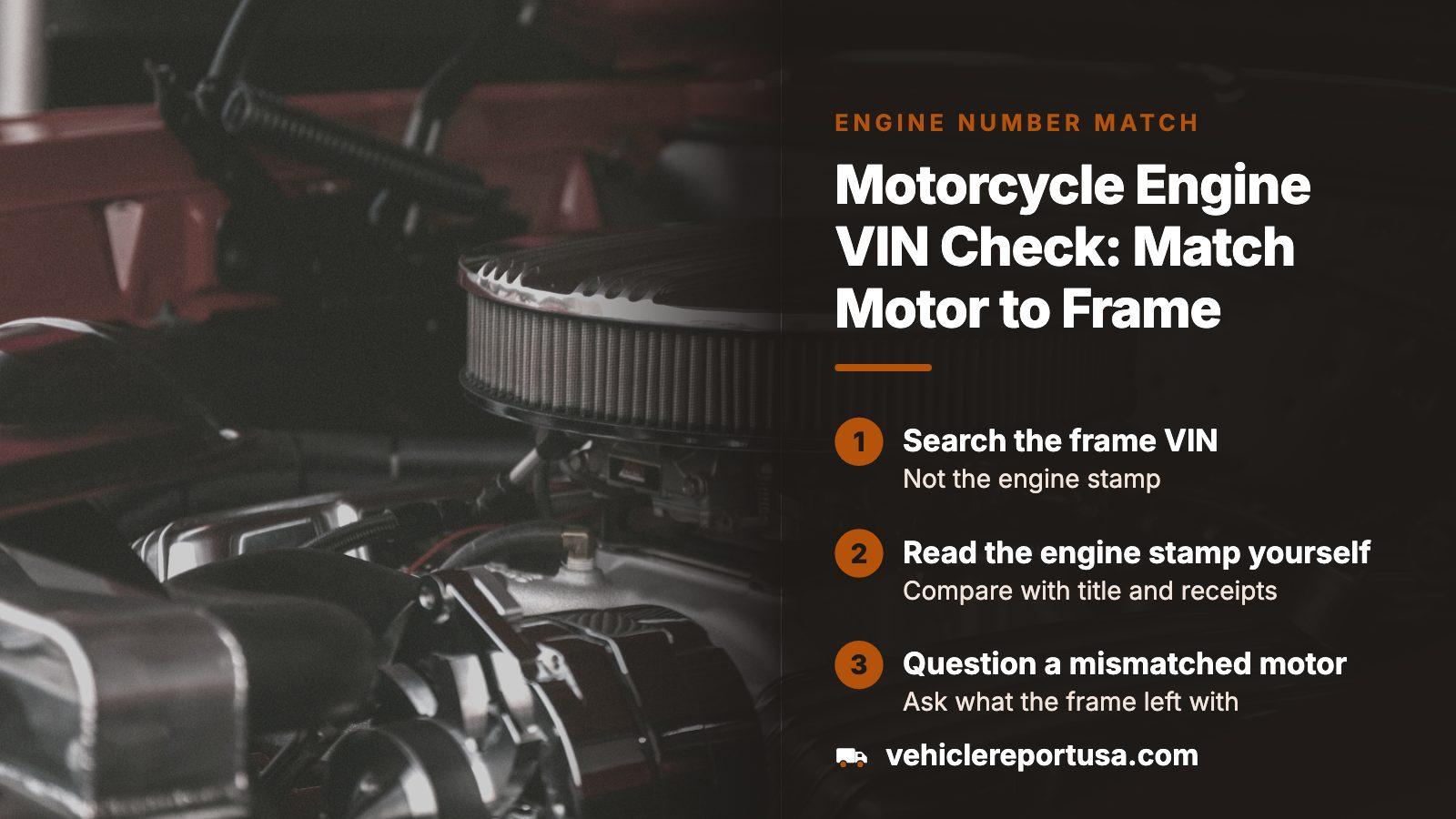
THE SHORT ANSWER
Enter the frame VIN, not the number stamped on the engine. The decode and the report describe what the factory built and what has been recorded against the frame. Then read the engine stamp yourself and compare it with the title, the seller's receipts and, where the maker offers one, its own record. A motorcycle motor VIN check on an electric bike follows the same plan: frame number in, motor serial compared.
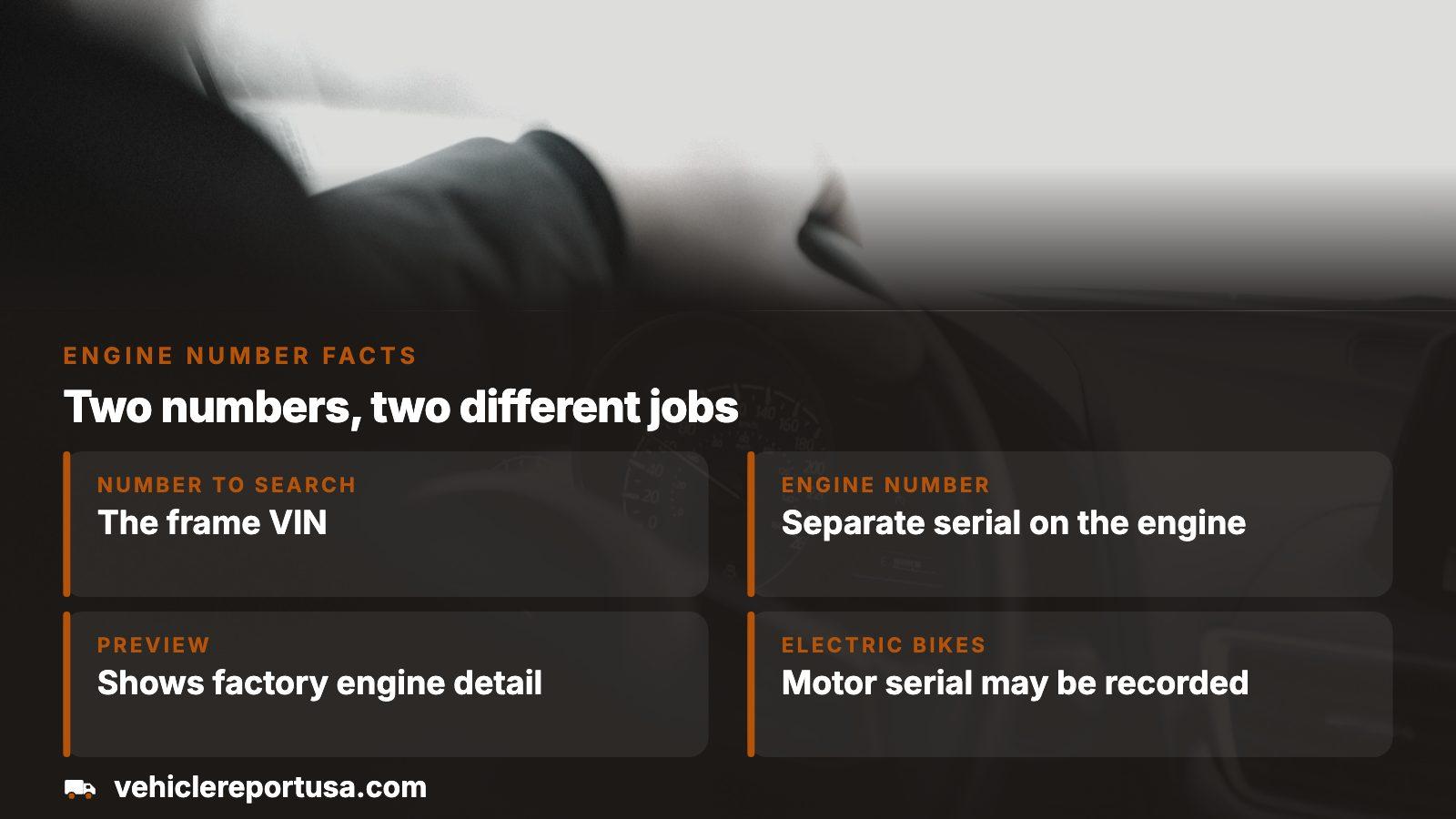
- Number to search
- The frame VIN, never the engine serial
- Engine number
- A separate serial stamped on the engine cases
- Preview
- Free, and shows the factory engine details
- Electric bikes
- In California the motor serial counts as the engine number
What an engine VIN check actually searches
The lookup tools a buyer can reach all start from the frame VIN. NICB's theft and salvage search needs a correct 17-digit VIN and may find nothing if one character is wrong. NHTSA's decoder takes a VIN, and so does the maker lookup run by Indian. None of them offers a box for an engine serial.
The VIN does say something about the engine. Under 49 CFR 565.15, the federal rule for motorcycle VINs, characters four to eight cover make, type, line, engine type and a horsepower figure within 10 percent of the real rating. That describes an engine family, not the unit bolted into the frame. NHTSA's system keeps fields for displacement, cylinder count and engine model, so a decode shows what the factory fitted. Whether the engine on the bike matches is the stamp's job.
Two numbers on one bike, each with its own job
| Question | Frame VIN | Engine number |
|---|---|---|
| What it identifies | The whole machine | One engine, as a part |
| Where it is stamped | At the steering head, on the side the maker chose | On the crankcases, at a spot that depends on the model |
| Works in a history report | Yes | No |
| Works in a theft or salvage search | Yes | No |
| Can change during the bike's life | Not in normal use | Yes, if the engine or its cases are replaced |
Since the numbers are filed separately, a clean history on the frame cannot tell you whether the engine inside is the original. Read both stamps.
Asking the maker which engine the frame left with
Some makers will show you. Indian's VIN search returns the engine serial with the model, year and factory configuration, for bikes from model year 2006 on. Its help pages put the stamp under the balance shaft cover on the right side of Chief, Chieftain and Challenger engines, and low on the left side of Scout and FTR engines, near the sidestand.
The same pages carry a caveat. If a rider cannot read the VIN, support staff can try to identify the bike from an engine number, but not once the engine has been replaced. For other brands, ask a dealer whether the factory file for your VIN lists an engine number.
Running the check in a sensible order
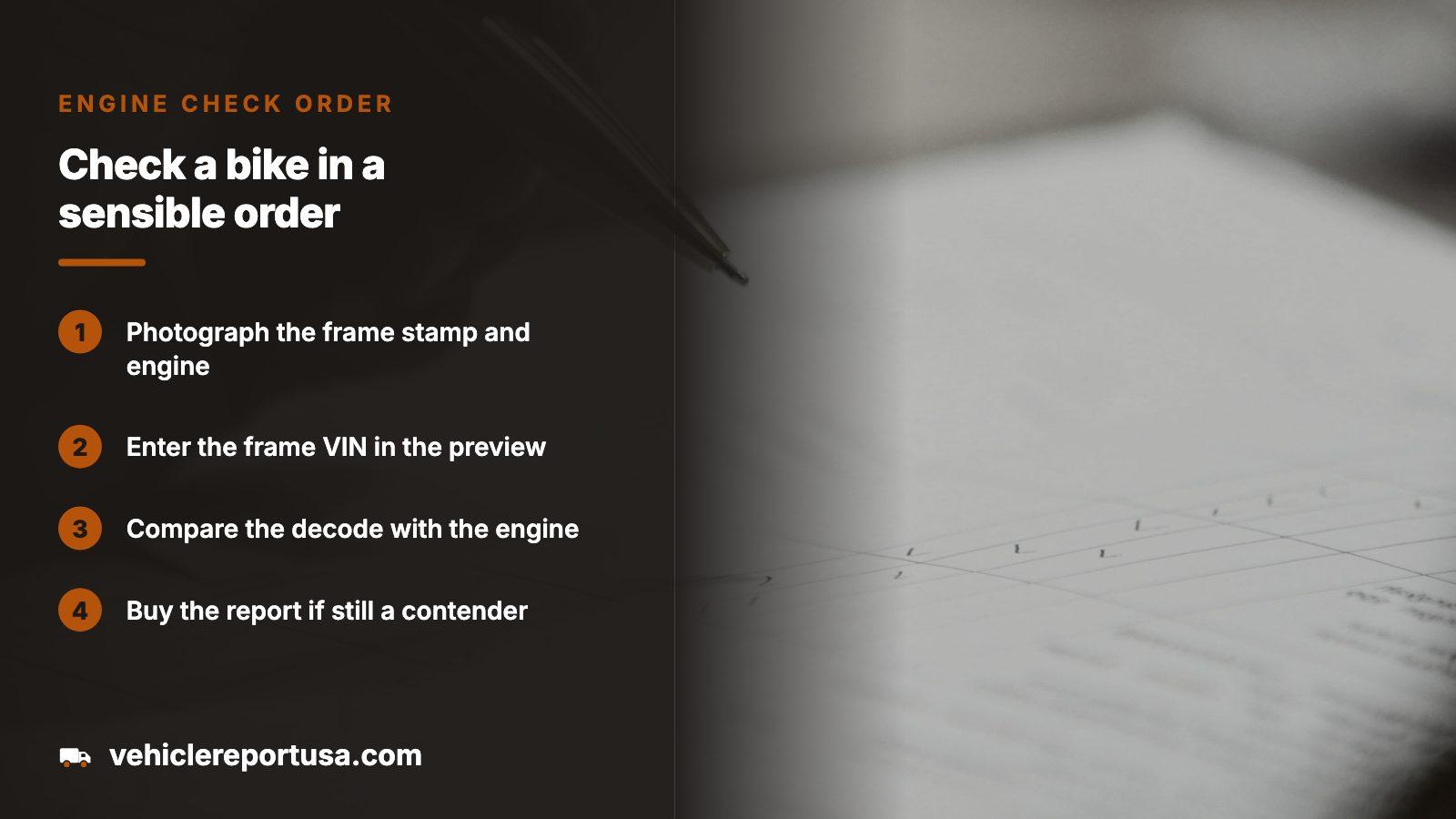
- Photograph the frame stamp and the engine stamp. A flashlight and a rag help, since the cases collect oil and grit.
- Enter the frame VIN into the preview and read the decoded engine type and displacement.
- Compare the decode with the engine on the bike. A displacement that disagrees means the engine was changed or the advert is wrong.
- If the bike is still a contender, buy a report and read it against the title. Ask the seller for receipts covering any engine work.
- Before a deposit changes hands, ask a dealer for that brand to check the engine number against its records.
Buying means paying once. The pricing page sets out what a lone report and the larger packs cost, and nothing renews. The sample report shows each section first.
What a mismatched engine can mean, and what to ask for
| What you find | What it may mean | Ask for |
|---|---|---|
| Engine number matches the maker's record | The engine is the original | Nothing more here; move on to title and history |
| A different number, with receipts | A repair or rebuild, common on a ridden bike | The invoice, the shop's name and any record the state required |
| A different number, no paperwork | A salvage engine or a parts-built bike | A written account; no payment until stamps and title agree |
| Displacement differs from the decode | A larger or smaller engine, or a wrong listing | The reason, and whether the title and insurer know |
| Damage or salvage record, plus a changed engine | The engine may have been replaced after a crash | Repair photos and a frame alignment check |
A stamp that is unreadable or looks ground down is a different matter. Treat it as a stop sign until an official verification explains it.
Why the engine stamp can matter after the sale
From an NHTSA owner complaint
The owner of a 2004 Ducati MTS 1000 wrote in 2008 that valve guides were failing on bikes of that era, with about 12,000 miles on his. He said the maker kept a list of "potentially effected engine numbers" and refused to do the repair because he was not the first owner, though the bike was always serviced by Ducati. The filing gives no outcome.
Take that as one owner's unverified account. The practical lesson: if a maker ties a repair to engine numbers, a dealer will look up the stamp on the cases. Record it before you buy and ask whether it appears on any campaign list.
What the frame history shows that an engine stamp cannot
Matching stamps prove little alone. NICB warns that some sellers build a bike from aftermarket parts, sell it as a genuine brand-name machine and apply a false VIN, since false numbers are easy to obtain. Its used-bike advice includes these warning signs:
- A title or registration marked as an assembled vehicle, or an advert that says all custom.
- A title history listing several manufacturers' statements of origin for major parts.
- Big components the seller claims were picked up at a swap meet.
The paid report adds what stamps cannot: title brands, damage and salvage entries with photos, odometer readings, liens and theft records filed against the frame VIN. NICB's own search makes a useful first screen, though it reads only participating insurers' files and NICB warns that a clean answer is no substitute for a full history.
How a state handles an engine change: California as one example
Rules differ by state, so ask your DMV before buying a bike with a swapped engine. California's registration manual calls for a verification in these cases:
- Recording an engine change, or a change of motorcycle engine cases.
- Changing an engine number to a VIN.
- Assigning a new VIN.
- Registration papers that show a different VIN from the one DMV has on file.
The manual also says an electric motorcycle's motor serial is used as its engine number, which is how a motor VIN question on an electric bike resolves. Ask the seller for any verification paperwork, and ask your DMV what it wants before titling a bike with a changed engine.
Paying for the report, and the step after
A free preview comes first: type in the frame VIN and read the decoded engine type and displacement against the bike in front of you. The full report is a single purchase with no subscription.
Buy it once the stamp, the decode and the title tell the same story, or when they do not and you want to know why. Take the report, your photos and the engine receipts to the viewing. If the numbers still disagree, hire a mechanic who can read stamps before paying a deposit.
Where this information comes from
- eCFR: 49 CFR Part 565, VIN requirements — Section 565.15 lists what characters four to eight must describe on a motorcycle VIN.
- NHTSA vPIC: VIN decoder API — Shows that decoding starts from a VIN and carries engine data fields.
- California DMV: vehicle verifications — The state's rules on verifying engine changes, engine numbers and VIN assignment.
- NICB: VINCheck — Free theft and salvage screen, its VIN requirement, daily limit and stated limits.
- NICB: motorcycle and boat theft — Cloned bikes, false VINs and warning signs on a used motorcycle.
- Indian Motorcycle: VIN and information label locations — A maker's account of where the engine number sits and when it no longer applies.
- NHTSA owner complaint 10229802 — owner experience, paraphrased
Sources and photos: Facts checked against the sources above in November 2026. Photos by Victor Hughes, Masjid MABA and Miles Loewen on Unsplash; diagrams by VehicleReportUSA.
Keep reading
- Motorcycle VIN Lookup: Check a Used Bike's History Before You PayThe frame VIN lookup this check depends on, step by step.
- Where Is the Motorcycle VIN Located? Frame, Label and Title MatchFinding the frame number when the neck stamp is dirty or hidden.
- Pre-1981 Motorcycle VIN Check: What It Can and Cannot ShowOlder bikes, where the federal decoder refuses the year and stamps matter more.
- PricingWhat one report or a pack costs, paid once.
Frequently asked questions
Can I run a motorcycle VIN check with only the engine number?
No. History reports, NICB's theft and salvage search and NHTSA's decoder all work from the frame VIN, so a bare engine serial returns nothing useful. Read the frame number off the neck or the title instead. If it is unreadable, a dealer or the maker's support desk may help, unless the engine was replaced.
Does a motorcycle have an engine VIN?
A motorcycle has one VIN, and it belongs to the frame. The engine has a separate serial that people sometimes call an engine VIN. California's manual shows where the two touch: it treats converting an engine number to a VIN as something that needs a verification.
What if the engine number on the bike differs from the seller's paperwork?
Read both again in daylight, because a 6 and an 8 or a 0 and a D are easy to confuse. If they still differ, ask for the invoice for the engine work and any record your state required. Without paperwork or an explanation, walk away or demand a verification.
Will the report show that an engine was replaced?
The report is filed by frame VIN, so it does not list an engine number against the bike. It can show records that often go with a swap, such as salvage entries, damage and brands, and the factory specs let you compare displacement. A garage swap that never reached an insurer leaves no trace.
Does a matching engine number prove the bike is genuine?
No. NICB describes cloned bikes built from aftermarket parts and carrying false VINs, so matching stamps only show that the numbers agree with each other. Pair the stamp check with a theft and salvage search on the frame VIN, a look at the title history, and an expert inspection before you pay.
Now check the car itself
The guide explains what to look for. The report shows what this VIN has on record.