THE SHORT ANSWER
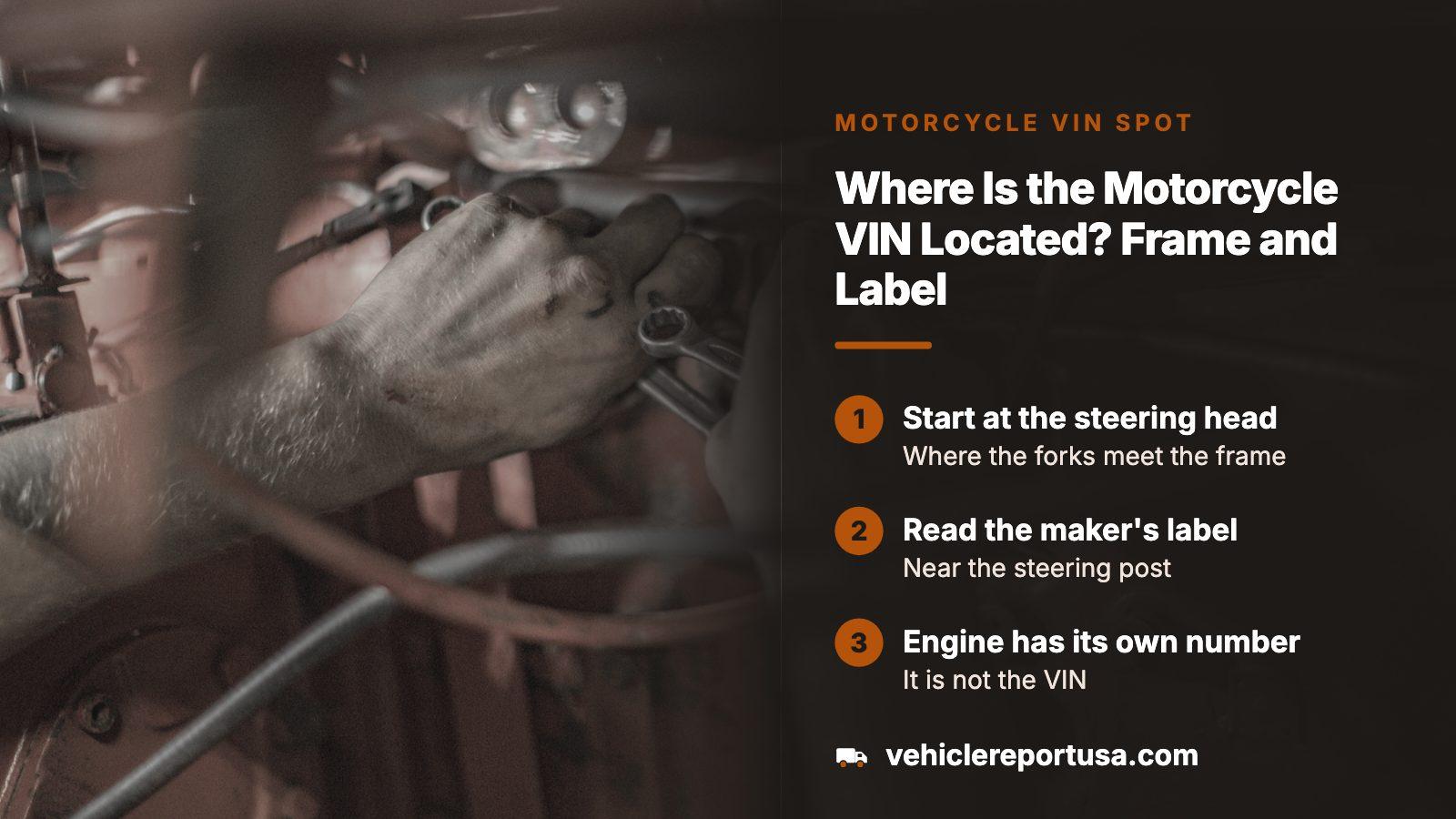
Begin at the steering head, where the forks join the frame. The certification label must sit on a permanent part close to where the steering post meets the handlebars, and the VIN itself must be stamped or plated on a part of the bike that is not designed to come off. The engine carries a separate number. Match frame, label and title, then run the VIN for a free preview.
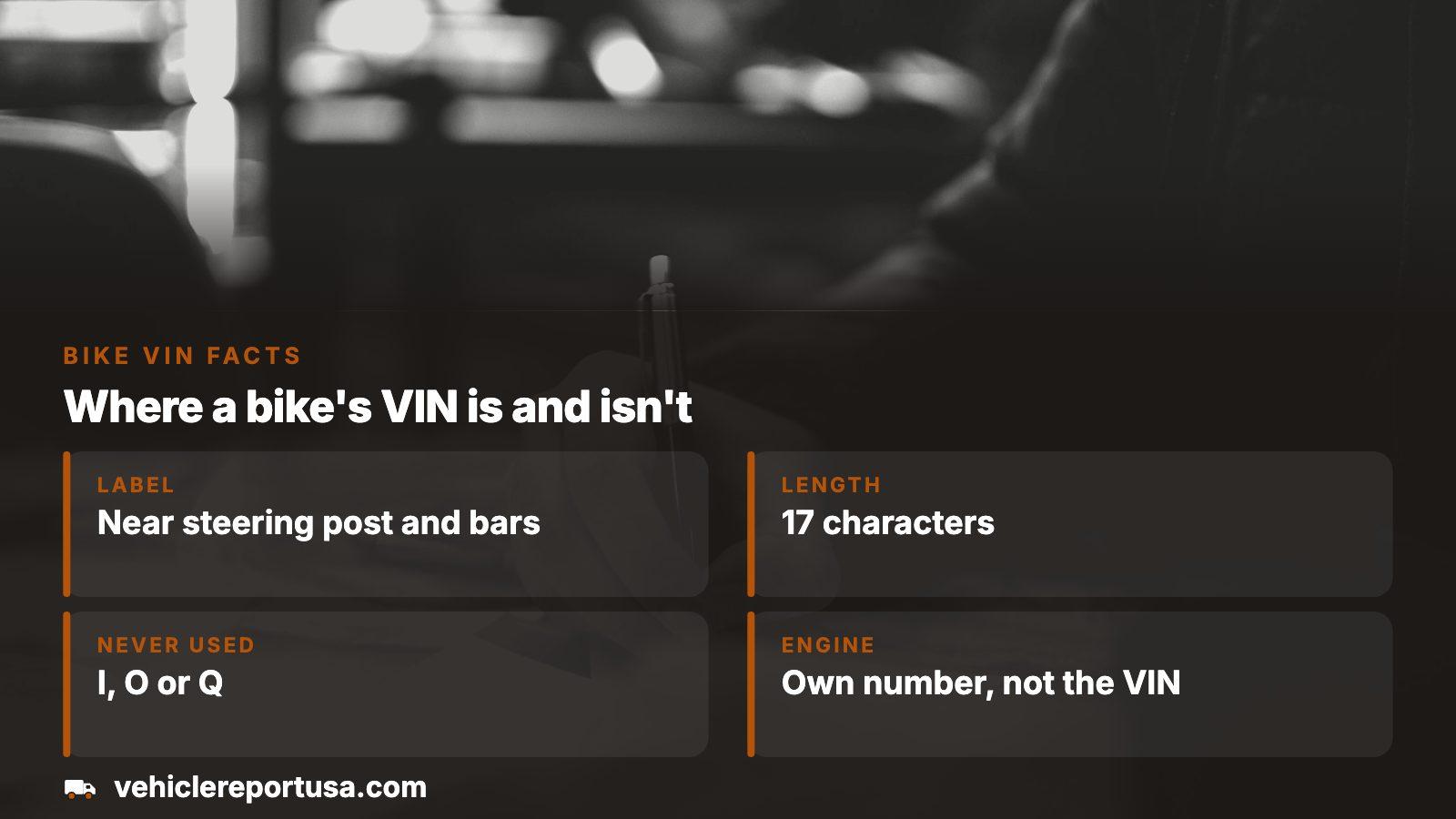
- Label
- Near the steering post and handlebars
- Length
- 17 characters, never I, O or Q
- Engine
- Has its own number, not the VIN
- Preview
- Free; the report is one payment
Two places to look: the maker's label and the stamped frame number
Federal rules give a motorcycle's VIN two homes. The first is the certification label, which makers must fix to a permanent part of the bike as near as practical to where the steering post meets the handlebars, readable without moving anything except the steering. The second is the stamped number, which the rule wants clear and permanent, on a part of the bike that stays put unless it is being repaired, or on a plate bonded to such a part.
The rule names a kind of part, not a precise spot, so the exact place is the maker's choice. Check the steering head first, then work along the rest of the frame, and look in the owner's manual or ask a dealer for the model's usual position.
Cars have an added rule that lets someone outside read the number through the windshield. Motorcycles are not named in it, so a seller's photo is no stand-in for your own look.
What the steering-head label tells you that the stamping does not
The label is more than a second copy of the number. Printed in block capitals, it carries:
- The full corporate name of whoever assembled the bike.
- The month and year the work finished at the main assembly point. That is a build date, and it can differ from the model year in the advert.
- Weight ratings, a statement that the bike meets federal safety standards, and the vehicle type.
The rules call for a rivet or an equally permanent fixing, so taking the label off should wreck it. One that peels away clean, shows glue, or sits on a part visibly younger than the frame around it deserves a question. So does a label whose VIN differs from the stamping by a single character.
The engine has its own number, and it is not the VIN
A motorcycle carries a frame VIN and an engine number, and they answer different questions. The frame number names the machine. The engine number names one power unit, which can be changed while the bike goes on living. California's inspectors record both on every motorcycle verification, and for an electric bike they use the serial number on the motor in place of an engine number.
Why a changed engine needs a paper trail
In California, recording an engine change or a change of engine cases always calls for a physical verification, and a licensed verifier may not handle a bike with an engine change at all. Other states set their own rules. Ask the seller what changed and when, ask for receipts, and ask your state's motor vehicle office what retitling would take.
Reading the number without misreading it
- Wipe the stamping, then hold a flashlight nearly flat against the metal so each character casts a shadow. Shallow characters clog with grime and paint.
- Photograph the stamping and the label with enough of the bike in frame to show where each one sits.
- Copy the number one character at a time. Those three letters do not occur in VINs, so a lookalike is a 1, a 0 or another letter.
- Count to 17. Position nine is a check digit, a single number or the letter X, put there so a wrong transcription shows up.
- Type it into NHTSA's decoder. A wrong ninth character or a banned letter comes back with an error code instead of a clean decode.
The decoder also takes a shortened number and returns what it can, flagged as incomplete, so a stamping half hidden by rust is not a dead end. A blank in the result means NHTSA has no data, not that the bike lacks the feature.

When the frame, the label and the title disagree
Disagreement between the numbers is the biggest catch a hands-on look can make. The Justice Department's NMVTIS page describes cloning. Thieves fit a VIN taken from another vehicle of matching make, model and year onto a stolen one, so the stolen machine and its false papers both show a genuine number, and buyers, title offices and police cannot spot the theft by reading the paperwork. Reading the metal against the title is the first test.
California's DMV shows what an agency does when a bike fails that test. Other states differ.
| What the inspector finds | What California does |
|---|---|
| The label is missing or unreadable | DMV staff must track down some other readable VIN. |
| The frame number differs from the title or record | A physical verification, then a title correction. A large change needs proof it is not another vehicle's number, or a bond. |
| Characters look altered or tampered with | The Highway Patrol verifies the bike, and verifiers report evidence of tampering to investigators. |
| An older bike is registered by engine number only | The Highway Patrol assigns a frame number before registration. |
Older and off-road bikes break the usual pattern
Frames built before the 17-character standard may carry a shorter number, and NHTSA's decoder starts at model year 1981. California asks for a full 17-character number that passes the check digit from model year 1983, and some off-road-only models fail that check and can be registered there only as off-highway vehicles. A short number on such a bike is not proof of a problem; it just means the decoder says little and the paperwork matters more. A separate guide here covers frames built before 1981.
Can you look up a motorcycle VIN number?
Yes. Several lookups accept a motorcycle VIN, and each one answers a narrow question.
- NHTSA's decoder returns the make, model, model year and engine details the maker filed. It is built for 1981 and newer vehicles.
- NHTSA runs a no-charge recall lookup that takes a VIN and returns open safety recalls.
- NICB's VINCheck flags flood damage, a theft report with no recovery, and salvage declarations.
- NMVTIS reports from approved providers cover the current title, state brands, a recent odometer figure, and insurer total-loss or salvage rulings. Reporting is mandatory for ordinary automobiles only, though some states also report motorcycles, so a quiet result for a bike proves little.
A decode says what the bike was built as. None of these says what happened to it afterwards.
Running a check once you have the number
- Enter the VIN you read from the frame, not the one printed in the advert.
- Read the free preview, which shows what the number decodes to.
- If the bike is still a contender, buy one report. It is one payment with no renewal, report packs of 3, 5 or 10 exist, and the pricing page lists the amounts.
- Check the title brand, theft and lien entries and any salvage or auction photos first, then set the odometer history beside what the seller told you.
A report searches records tied to that VIN. It cannot tell you whether the stamping on the frame has been altered, which is why the physical look comes first. The FTC's advice is to pair any history report with an independent inspection that looks for hidden damage.
Where this information comes from
- eCFR: 49 CFR 567.4, certification label — Where a motorcycle's label goes, how it is fixed and what it states.
- eCFR: 49 CFR Part 565, VIN requirements — Where the VIN itself must appear, the characters allowed and the check digit.
- NHTSA vPIC: VIN decoder — What the decoder covers, its 1981 starting point and the error codes it returns.
- California DMV: vehicle verifications — One state's rules on engine changes, missing labels and licensed verifiers.
- California DMV: VIN plate assignments — When the Highway Patrol steps in on altered numbers and older bikes.
- NMVTIS: information for consumers — What a search covers, how cloning works and why a clean result can mislead.
- FTC: Used Cars — Free recall and theft lookups, history reports and the case for an inspection.
Sources and photos: Facts checked against the sources above in November 2026. Photos by Nina Mercado, Michal Biernat and Owen Michael Grech on Unsplash; diagrams by VehicleReportUSA.
Keep reading
- Motorcycle VIN Lookup: Check a Used Bike's History Before You PayThe full walk-through for decoding a bike and reading its history.
- Motorcycle Engine VIN Check: Match the Engine to the Frame NumberWhat to do with the engine number once you have found it.
- Pre-1981 Motorcycle VIN Check: What It Can and Cannot ShowOlder frames carry numbers a modern decoder cannot read.
- Motorcycle VIN Recall Check: Find Open Recalls on Any BikeOpen recalls are found by VIN, so the number has to be right.
Frequently asked questions
Is the VIN on a motorcycle always stamped on the frame?
Not necessarily. The federal rule allows the number on a part that is not built to be removed, or on a plate fixed to such a part. Look for a stamped number and for the certification label, since the maker picks the spot.
What if the VIN label on my motorcycle is missing?
Look for a stamped frame number and read the title. Federal rules require a label near the steering post, so a missing one needs explaining. California has DMV staff hunt for another VIN, and the Highway Patrol steps in if none turns up.
Is a motorcycle's engine number the same as its VIN?
No. The VIN identifies the whole machine, while the engine number belongs to the engine alone. California verifications record both. If the engine was replaced, the paperwork may no longer match, so ask the seller for receipts and any title documents that mention the change.
Can you look up a motorcycle VIN number for free?
In part. NHTSA's decoder, NHTSA's recall lookup and NICB's VINCheck charge nothing, though each covers one slice: the maker's filing, open recalls, or flood, theft and salvage flags. A free preview of the VIN comes before any purchase, and the full report is one payment.
Why does my motorcycle's VIN have fewer than 17 characters?
A bike built before the 17-character standard may carry a shorter number. NHTSA's decoder starts at 1981 model years, and California requires the full format from 1983. Copy the number exactly as stamped, compare it with the title, and treat the paperwork as the main record.
Now check the car itself
The guide explains what to look for. The report shows what this VIN has on record.