THE SHORT ANSWER
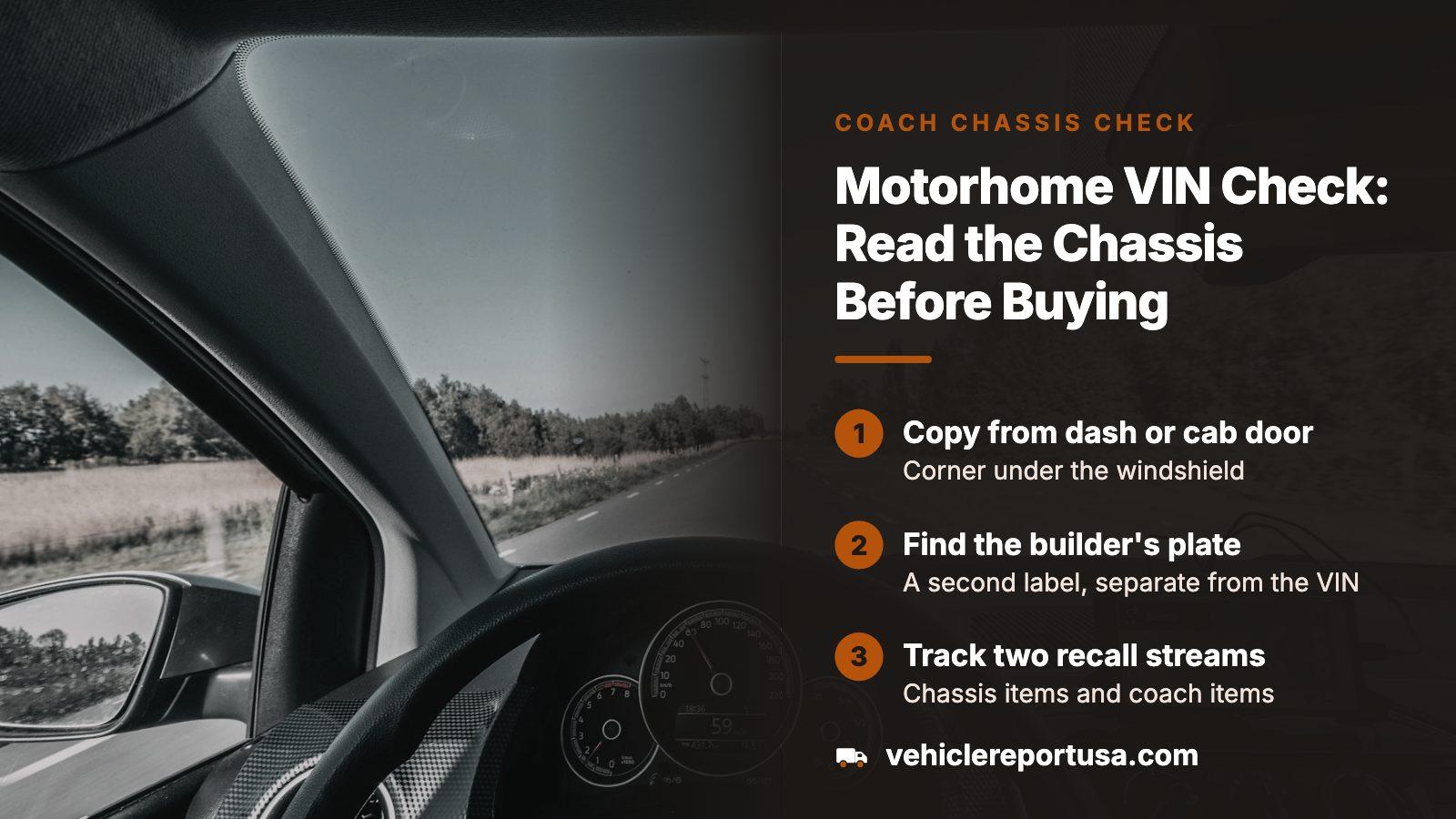
Copy the VIN from the dash corner under the windshield or off the sticker at the cab door, search it, and read the preview before you pay. On a coach that number was issued for the chassis, so the history describes the vehicle you drive, not the living quarters. Confirm the coach builder's own plate separately, and check recalls under both makers.
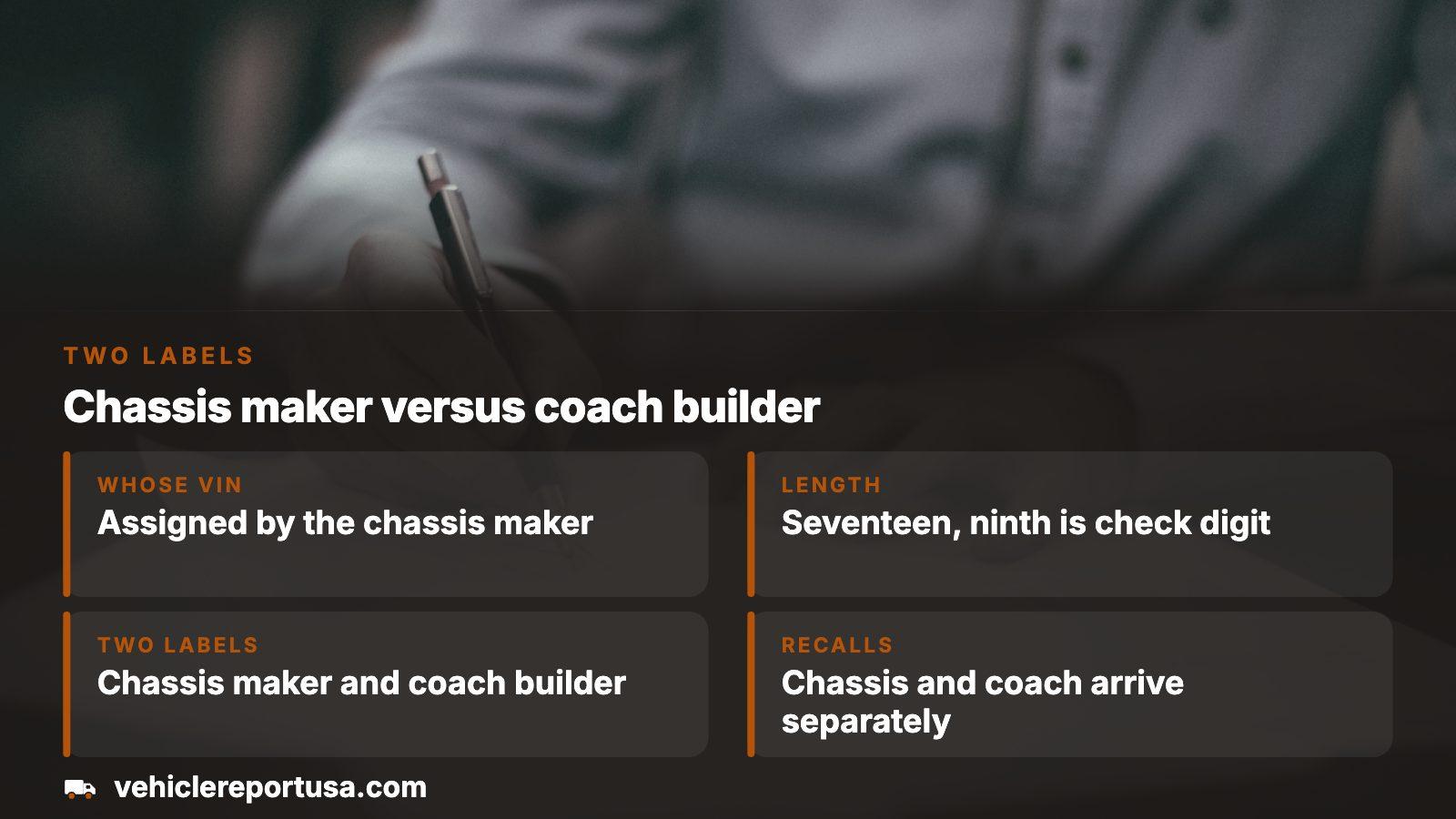
- Whose VIN
- The chassis maker assigns it, not the coach builder
- Length
- Seventeen characters, and the ninth is a check digit
- Two labels
- One from the chassis maker, one from the coach builder
- Recalls
- Chassis items and coach items arrive as separate campaigns
The VIN belongs to the chassis, so the check follows the chassis
Most motorhomes are finished in two steps. One company builds the frame, engine, axles and cab, and a second company builds the living space on top. Federal rules put the VIN assignment in the first company's hands: when a vehicle is built in more than one stage, the chassis maker issues the number, and a later alterer must carry on with the original number.
That is why a decode of a coach badged with an RV brand can come back naming a truck or van manufacturer. Nothing is wrong with the search. The title, the insurance policy and the state registration all hang on the chassis VIN, so the history you buy describes the part that gets titled, wrecked, stolen or sold at auction.
What a motorhome history can turn up
A coach is expensive, and its history can hide the same trouble a pickup's can. Free preview first; the paid report is where the entries become readable.
- Branded titles (salvage, rebuilt, flood) that can ride along when a coach crosses into another state.
- Damage and salvage entries, including auction listings with photos, which matter after a highway collision or a fire.
- Odometer readings over time, useful because a diesel pusher can show a very different story than its cab suggests.
- Lien and impound records, so the seller can actually hand you a clean title.
- Theft entries and insurance claim records.
- Open recalls attached to the chassis VIN.
What the report does not do is describe the cabinetry, the roof, the slide-outs or the appliances. A leaking roof leaves no title record. Treat the history as one half of the vetting and put a technician who services coaches on the other half.
Finding and copying the number without a typo
Walk to the cab and look at the lowest corner of the glass on the driver's side; the chassis number can normally be read from outside. A second copy is on a label by the driver's door latch. Copy it from the vehicle itself, never from an advertisement, and hold it up against the paperwork the seller hands over.
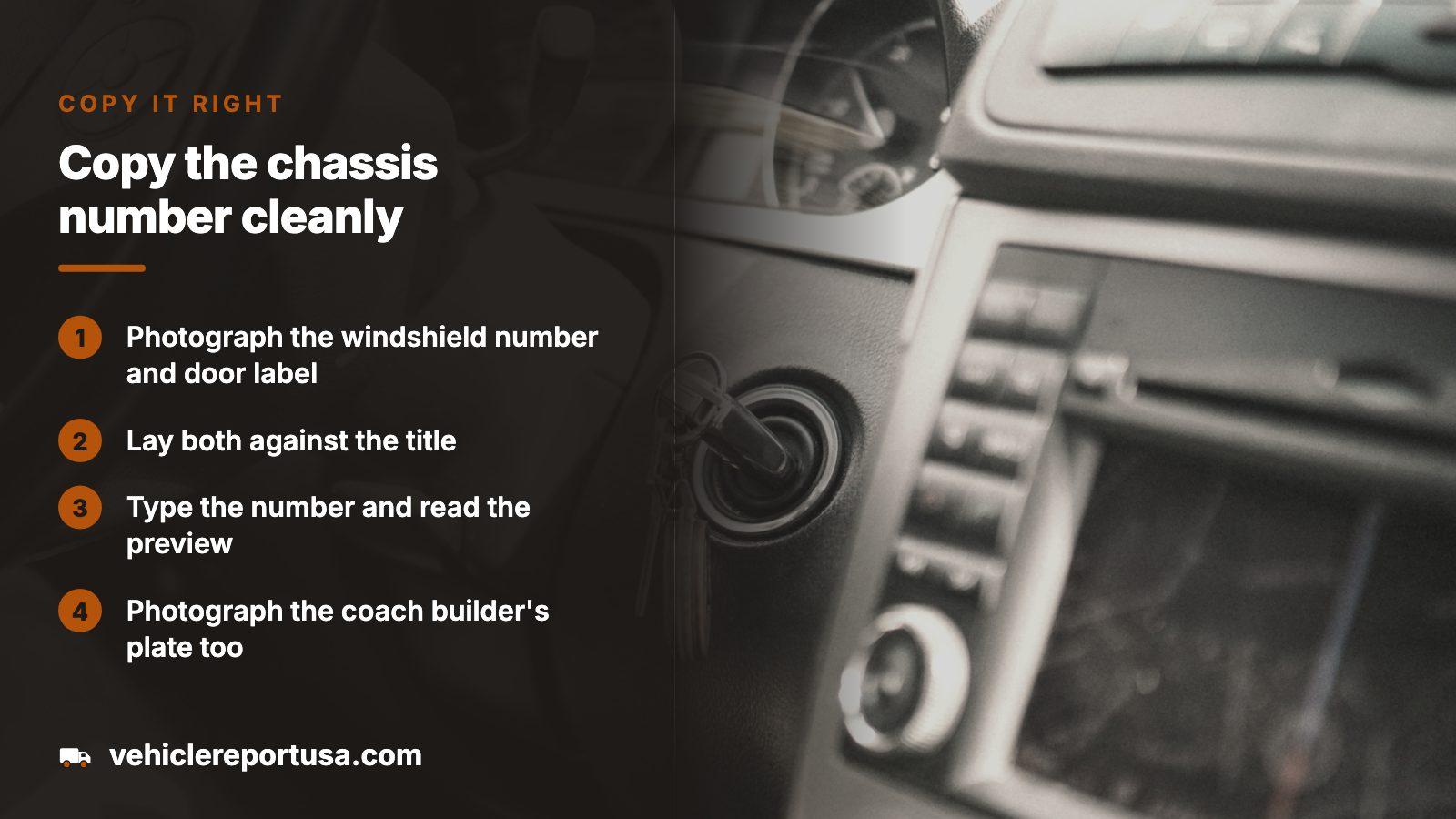
- Photograph the windshield number and the door label.
- Lay both against the title. If they disagree, the sale waits until the seller documents the reason.
- Type the number in and read the preview before any payment.
- Photograph the coach builder's separate plate too, since it holds the coach's own serial and weight ratings.
Federal labelling rules show why you need both plates. The chassis maker's label gives its name, a build date, axle and gross weight ratings and the VIN. The coach builder's label then states its own name, when it finished the job, and ratings for the completed vehicle.
Two makers, two recall streams
Recall work on a coach can come from either company. NHTSA's record for the 2020 Winnebago Navion lists six campaigns. One reroutes a propane line that can rub a tire, one fixes an awning that may roll out in transit, and one concerns air bag wiring that can snag in the seat mechanism. Those are coach-level items, sitting beside chassis-level ones such as hood latches and turn signals on other models from the same builder.
| Where the problem sits | Typical example | Who files the recall |
|---|---|---|
| Frame, engine, cab, brakes | Hood latch or turn signal campaign | Usually the chassis maker or the coach builder, depending on who supplied the part |
| Living quarters and body | Awning, door assembly, propane line | The coach builder |
| Wiring crossing both | Seat wiring that affects air bags | Whichever maker installed it |
A VIN search shows open recalls tied to the chassis number. For the coach side, search NHTSA by the builder's make, model and year too, and request the repair invoices from the seller.
When the chassis maker and the coach builder point at each other
Split manufacturing creates a real ownership problem when something fails. The records show it can leave a buyer with no one to pay for the fix.
From an NHTSA owner complaint
An owner of a 2020 Winnebago Navion told NHTSA that after the A/C was switched on with the engine running, an electrical fire smell followed within a minute. The dealer for the chassis said the coach wiring caused it, the insurer's adjuster agreed and denied the claim, and the coach builder's service center said the chassis wiring melted. Nobody accepted responsibility.
The lesson for a buyer: a fire or electrical claim in the history is worth a hard look, because disputes of that kind can stall repairs for months. If the preview hints at insurance or damage records, read them in full before you negotiate.
Red flags worth walking away from
- A VIN on the windshield that differs from the one on the door label or the title.
- A brand on the title that the seller never brought up, or several state changes in a short stretch.
- A loan the seller calls settled but cannot prove.
- An odometer reading that drops between records.
- Open recalls the seller waves off as minor, particularly anything involving propane, wiring or air bags.
- Repairs described by the seller but missing from any record.
A single flag can sometimes be explained away. A pile of them rarely can. If a coach has a clean preview but the seller is vague about where it has been stored or serviced, that vagueness is information as well.
Cost, and the steps once you have read the history
Nothing is charged for the preview. A report is bought once, never as a subscription, and the pricing page sets out single reports and bundles for shoppers weighing several coaches. Price a report against the coach, not against the lot's asking price: the history is cheap next to a mistake on a motorhome.
After the report, take three steps. Check recalls under the builder's own make as well as the chassis. Ask for service and repair records. Then book an independent inspection for the roof, slide-outs, tanks and tires, because none of those leave a trace in a title database.
Where this information comes from
- eCFR 49 CFR 565.13: VIN general requirements — who assigns the VIN on multi-stage vehicles, its length and the check digit
- eCFR 49 CFR 567.5: multi-stage manufacturer labels — what the chassis maker's and coach builder's labels must state
- NHTSA recalls API: 2020 Winnebago Navion — recall campaigns used as the example
- NMVTIS: vehiclehistory.gov — federal title information system behind brand and theft checks
- NHTSA owner complaint 11604269 — owner experience, paraphrased
Sources and photos: Facts checked against the sources above in November 2026. Photos by Sander Jeurissen, tim and Scott Graham on Unsplash; diagrams by VehicleReportUSA.
Keep reading
- RV VIN Lookup: History Check for Motorhomes, Trailers and Fifth WheelsA closer look at decoding the number on any RV.
- RV VIN Recall Check: Chassis, Coach and Trailer Recalls Before You BuyHow to find open recalls from both the chassis maker and the coach builder.
- RV Title Check: Read the Title History Before You Pay for a RigTitle brands and what they mean for a coach.
- Winnebago VIN Check: Chassis Number, Recalls and History Before You BuyBrand-specific notes if the coach you are looking at is a Winnebago.
Frequently asked questions
Does a motorhome have more than one VIN?
Usually one VIN, issued by the chassis maker. The coach builder adds its own serial number on a separate plate. Use the VIN for history searches and the plate to confirm the coach's build details and weight ratings against the seller's story.
Where is the VIN on a motorhome?
Start at the glass corner on the driver's side, then find the sticker beside the cab door. Each should agree with the other and with the title. If they differ, or one looks tampered with, hold off buying until you have answers.
Why does my RV VIN decode show a truck brand?
Because the VIN names whoever built the chassis. The RV company bought that chassis and built the coach on it. The decode is accurate for the chassis, and says nothing about the floor plan or interior.
Will a history report reveal a leaking roof?
No. A history report covers records: titles, damage entries, liens, theft and recalls. Water intrusion in a coach is a physical condition, so you need an inspection by a technician who works on RVs to find it.
Is the preview enough to buy on?
It works as a screen: free, and it indicates whether any records are filed under the number. Before money changes hands with a seller, read the whole report and make sure the title matches the chassis.
Now check the car itself
The guide explains what to look for. The report shows what this VIN has on record.