THE SHORT ANSWER
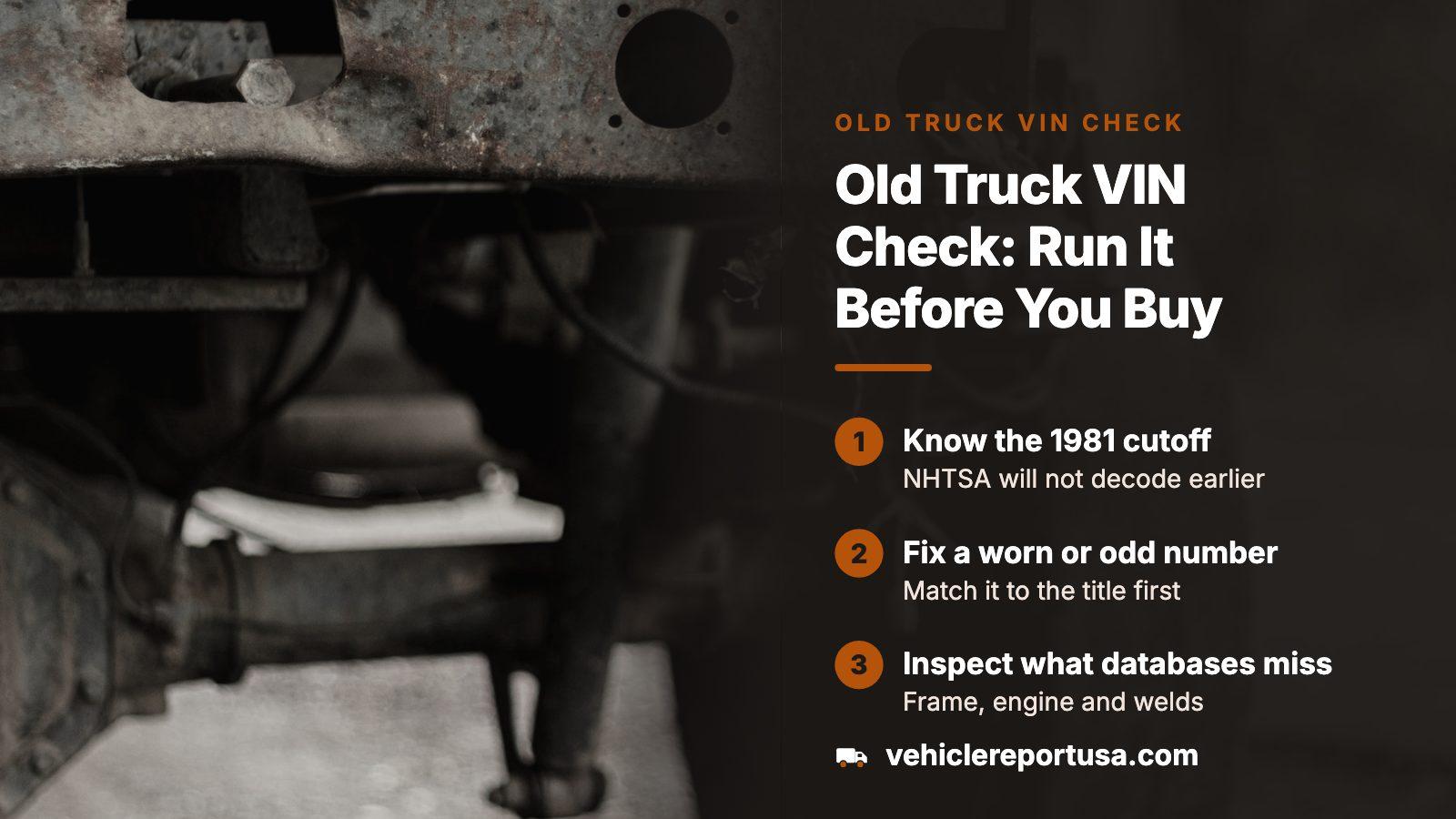
To check an old truck by VIN, read the number off the truck, match it to the title, then enter it. A 17-character VIN decodes, and the paid report adds title brands, damage, theft and recall records. NHTSA's decoder refuses anything earlier than model year 1981, so a truck that old rests on paperwork and inspection. Expect a thin mileage trail: sellers owe no mileage statement on a truck of model year 2010 or older.
- Decoder cutoff
- NHTSA refuses model years before 1981
- Mileage statement
- Not owed on model year 2010 or older
- Recall lookup
- Open recalls by VIN from NHTSA, at no charge
- Preview
- Free before any payment
Which old trucks a VIN check can read
Age decides how much a lookup can do, and the dividing year is 1981. Hand NHTSA's decoder any earlier model year and it returns an invalid-year error. In a test, a made-up 13-character number came back empty, with an Incomplete VIN notice instead of a make, model or year.
| Truck built | Number on it | What a lookup can do |
|---|---|---|
| Before model year 1981 | Often short of 17 characters | No decode and no database history. The plate, the title and an inspection carry the weight. |
| Model year 1981 and later | 17 characters | Decodes to make, model, year, body and engine, and a history report can follow. |
Made-up numbers shaped like a 1987 Chevrolet pickup and a 1990 Ford pickup both decoded to a make, model, year and engine. NHTSA's model lists show the same cliff: 310 Ford rows for 1981, none for 1975.
What to do with a short, worn or mismatched number
The decoder reports on its own data, not on the truck, and NHTSA says manufacturers supply that data and sends questions back to them. A short number is therefore a job for that marque's specialists.
- Read the number from the truck itself, not from the advertisement or the title.
- Check each position against the title.
- If it has 17 characters, decode it and set the make, engine and body against what you see.
- If it is short, scraped or different from the paperwork, ask your state's titling office how it treats that truck.
States differ. The federal title database warns that some states do not title vehicles past a certain age, so a very old truck may have no title entry to find. Ask early.
What the title record shows on an old truck, and where it goes quiet
The federal title database, NMVTIS, is concise on purpose: five key indicators fed by state titling offices, recyclers, salvage yards and insurers. Those sources do not describe vehicle condition the same way.
| Record | Old-truck wrinkle |
|---|---|
| Title brands | Standards differ by state, and a brand can be washed away when a truck is retitled where earlier states are not consulted. |
| Salvage and junk-yard entries | Not every state or company reports, so a gap can read as clean when it is not. |
| Total-loss findings | A truck not found within 30 days can be labeled total loss, and the label stays if it later turns up intact. |
| Accidents, auction photos, liens | These sit beyond the federal record, which is where this site's paid report adds detail. |
Read a blank as unknown, not as clean.
Why the mileage trail is thin
Odometer history mostly comes from the statement a seller signs at transfer, and federal rules stop asking for it as a truck ages. Any truck of model year 2010 or older is past the 10-year mark already. Newer models follow after 20 years, and anything rated above 16,000 pounds is excused outright. Where a seller does sign, the form must flag a reading the seller knows has passed the odometer's mechanical limit.
From an NHTSA owner complaint
A buyer who answered an online ad for a 1998 Toyota Tacoma told NHTSA the private seller refused a test drive and, when the buyer's husband pressed to check the VIN, produced an out-of-date title. The dash read about 166,000 miles, yet a history report on the VIN, read after the cash changed hands, gave about 278,000 as the last reading. The buyer also reports a broken transmission.
The earlier reading sat in the record all along. Pull it before you pay, and set every reading beside the dash.
Recalls on an old truck: old campaigns, uncertain status
Search NHTSA's recall data by make, model and year and it reaches well back. A 1975 Chevrolet C20 lists a 1977 campaign on front control-arm ball joints, and a 1979 C20 lists brake-hose and brake-switch recalls from that year. Spelling can hide them: a 1990 Ford query typed F-150 returned nothing, while F150 returned five records.
The free-repair obligation carries a time limit tied to the truck's first sale: it lapses if the notice or order arrives over 15 calendar years after that sale. A recall issued sooner ought to be repaired at no cost, however old the truck is now.
From an NHTSA owner complaint
The owner of a 1997 Ford F-150 told NHTSA that three rounds of parts had not cured a rough-running engine and a dead cruise control. The owner names a certain spark-plug brand along with a recall an earlier owner never had done, and says that repair can no longer be had.
Whether that holds depends on the dates, but the lesson stands: look up open recalls by VIN before buying, since a skipped repair passes to the next owner.
What no database sees: frames, engines and wear
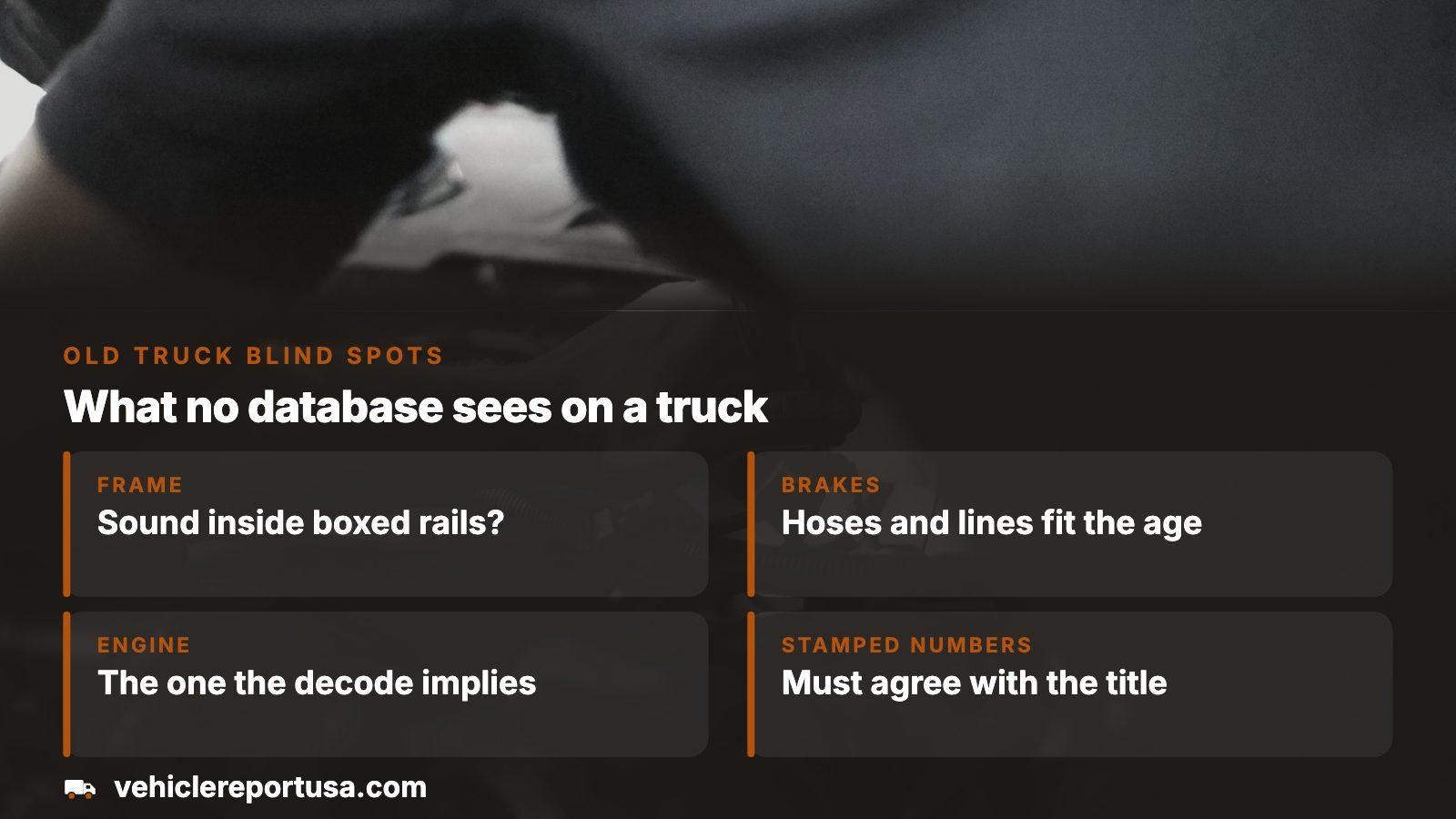
A history lookup follows paperwork. The FTC cautions that mechanical faults rarely show up in a history report, and that no report replaces an independent inspection. On a truck that has worked for decades, that gap is the main risk.
- Is the frame sound where it cannot be seen, including inside boxed rails?
- Do the brake hoses, lines and rear brakes fit the truck's age?
- Is the engine the one the decode implies, and is any swap documented?
- Do stamped numbers on the frame agree with the title?
Hire an independent mechanic and request a written repair quote that names the VIN. The FTC says that figure helps with negotiating the price.
Red flags worth a direct question
- A number on the truck that differs from the title, even by one character.
- A seller who will not allow a test drive, or whose title looks out of date.
- Dash mileage well below an earlier reading anywhere in the record.
- A title brand, salvage entry or total-loss finding nobody mentioned.
- A recall the seller says was handled but cannot document.
- A label or plate that looks scraped, repainted or swapped.
Each of these can have a harmless explanation. Ask for it in writing before money moves.
Running the check and what it costs
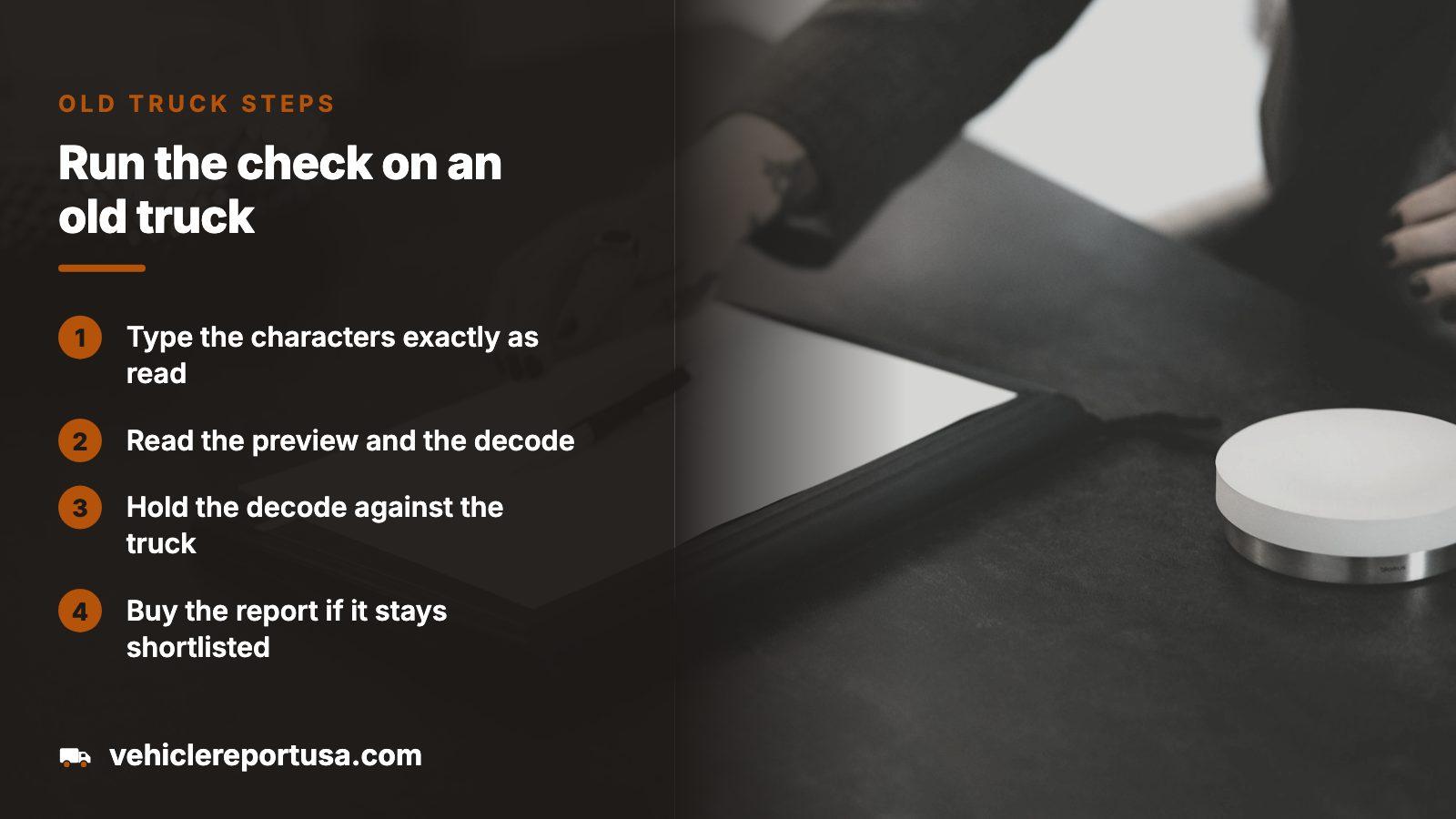
- Type the 17 characters exactly as read from the truck, with no spaces.
- Read the preview, which costs nothing. It confirms whether the number is accepted and what it decodes to.
- Hold the decode against the truck: model, cab, engine, drive.
- Buy the report only for trucks still on your list. Payment happens once and nothing renews. Comparing several trucks? Multi-report packs come as 3, 5 or 10.
The pricing page lists current rates. If the preview cannot read a number, skip the purchase and work from the paperwork and an inspection.
Where this information comes from
- eCFR: 49 CFR part 580, odometer disclosure (sections 580.5 and 580.17) — who must state mileage, the age and weight exemptions, and the mechanical-limit statement
- NHTSA vPIC: VIN decoder — the pre-1981 error, partial VINs, and data supplied by manufacturers
- Bureau of Justice Assistance: NMVTIS for consumers — what the federal title database holds and where its gaps are
- FTC: Used cars — free recall listings, paid title-record reports and why an inspection still matters
- 49 U.S.C. 30120: remedies for defects and noncompliance — the 15-calendar-year limit on free recall repairs
- NHTSA owner complaint 11399558 — owner experience, paraphrased
- NHTSA owner complaint 10618410 — owner experience, paraphrased
Sources and photos: Facts checked against the sources above in November 2026. Photos by Zoshua Colah, Annika Wischnewsky and Mustafa Sheikhmouss on Unsplash; diagrams by VehicleReportUSA.
Keep reading
- Check a Truck VIN Number: Pickups, Box Trucks and Heavy-Duty RigsThe general truck check, with label location and weight-class rules for heavier rigs.
- Classic Car VIN Tag Replacement: What Is Legal and What a Buyer Should CheckWhat a replaced or missing VIN plate means on an older vehicle.
- Truck VIN Lookup Specs: What the Decode Shows and Where It StopsRead cab, engine and weight class from a 17-character truck VIN.
- Sample reportSee a finished report before deciding whether to buy one.
Frequently asked questions
Can I run a VIN check on a truck built before 1981?
Databases will not help. NHTSA's decoder refuses those model years, and a short number returns an error instead of a decode. What works is physical: the number on the truck, the number on the title, and a mechanic who knows the make. Recall data searched by make, model and year can still show campaigns from that era.
How many characters is the VIN on an older truck?
A truck in the modern format carries 17. Numbers from before that format can run shorter. A made-up 13-character number came back from NHTSA's decoder as Incomplete VIN, with a note that the manufacturer was not registered for U.S. roads. That message describes the database, not the truck.
Why does an old truck's report show no mileage?
A seller need not state mileage on anything rated above 16,000 pounds, or on a model year 2010 or older truck once a decade has run from the start of that model year. With no statement at sale, odometer rows may never have been created, so a blank is not proof of rollback.
Can I check an old truck's VIN without paying?
In part. NHTSA runs a no-cost open-recall search by VIN, and its decoder reads model years from 1981 on. Title-record reports are different: the FTC says the provider's fee applies. This site's preview costs nothing and shows what the VIN decodes to, while the full report is paid for once, with nothing to cancel later.
What if the number on the truck does not match the title?
Hold off paying until someone explains it. A one-character slip can come from copying old paperwork, but a mismatch can also point to a swapped part or a replaced plate. Ask the seller for the paper trail, then ask your state titling office how it resolves a mismatch.
Now check the car itself
The guide explains what to look for. The report shows what this VIN has on record.