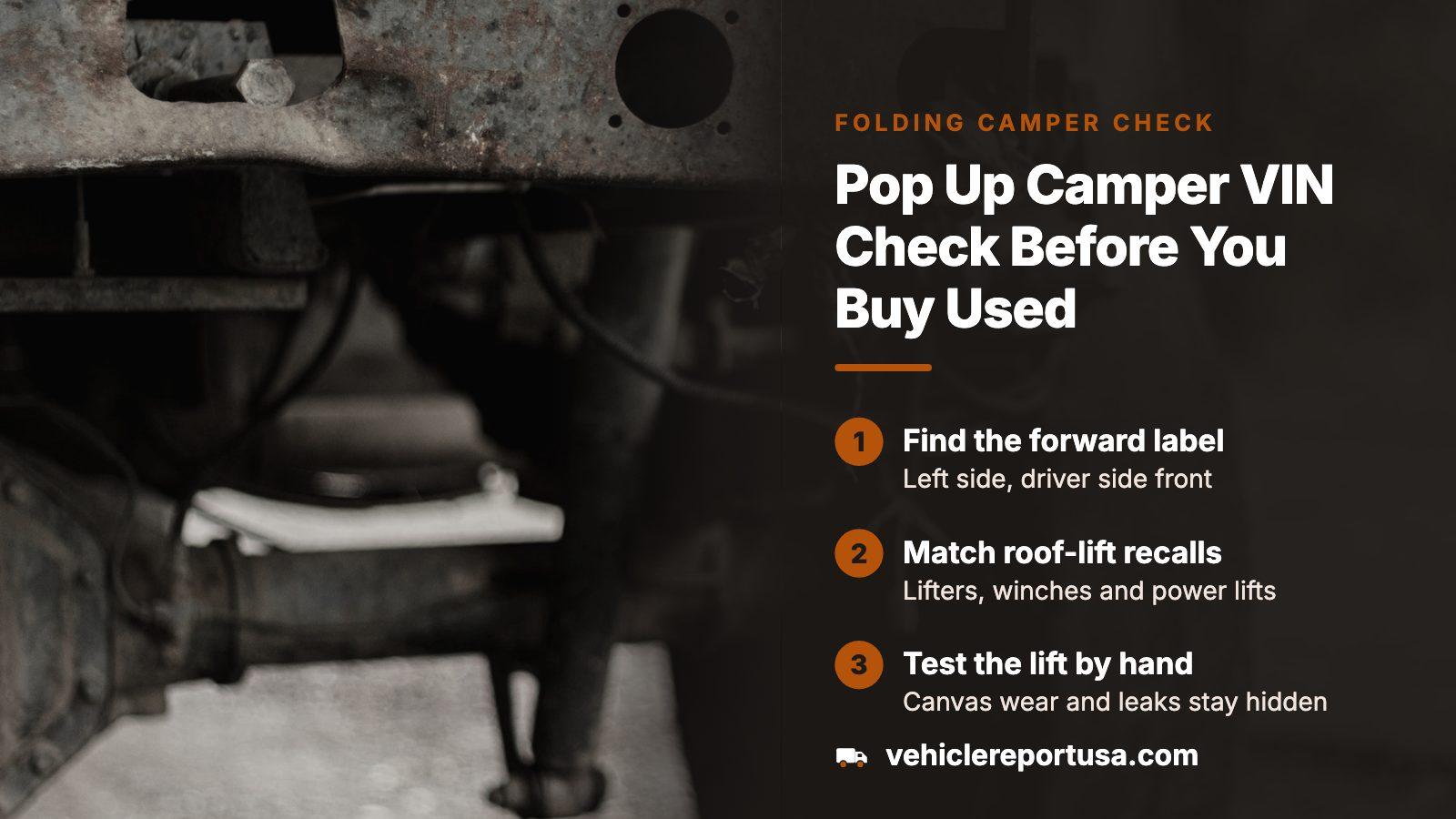
THE SHORT ANSWER
Read the 17-character VIN from the trailer's certification label near the front of the driver side, then search it. Preview first at no cost, then one payment for the report: title brands, salvage or damage entries, liens, theft and recalls. Folding trailers have had roof-lift recalls from several makers, so check the recall status, then test the lift and inspect the fabric and frame yourself.
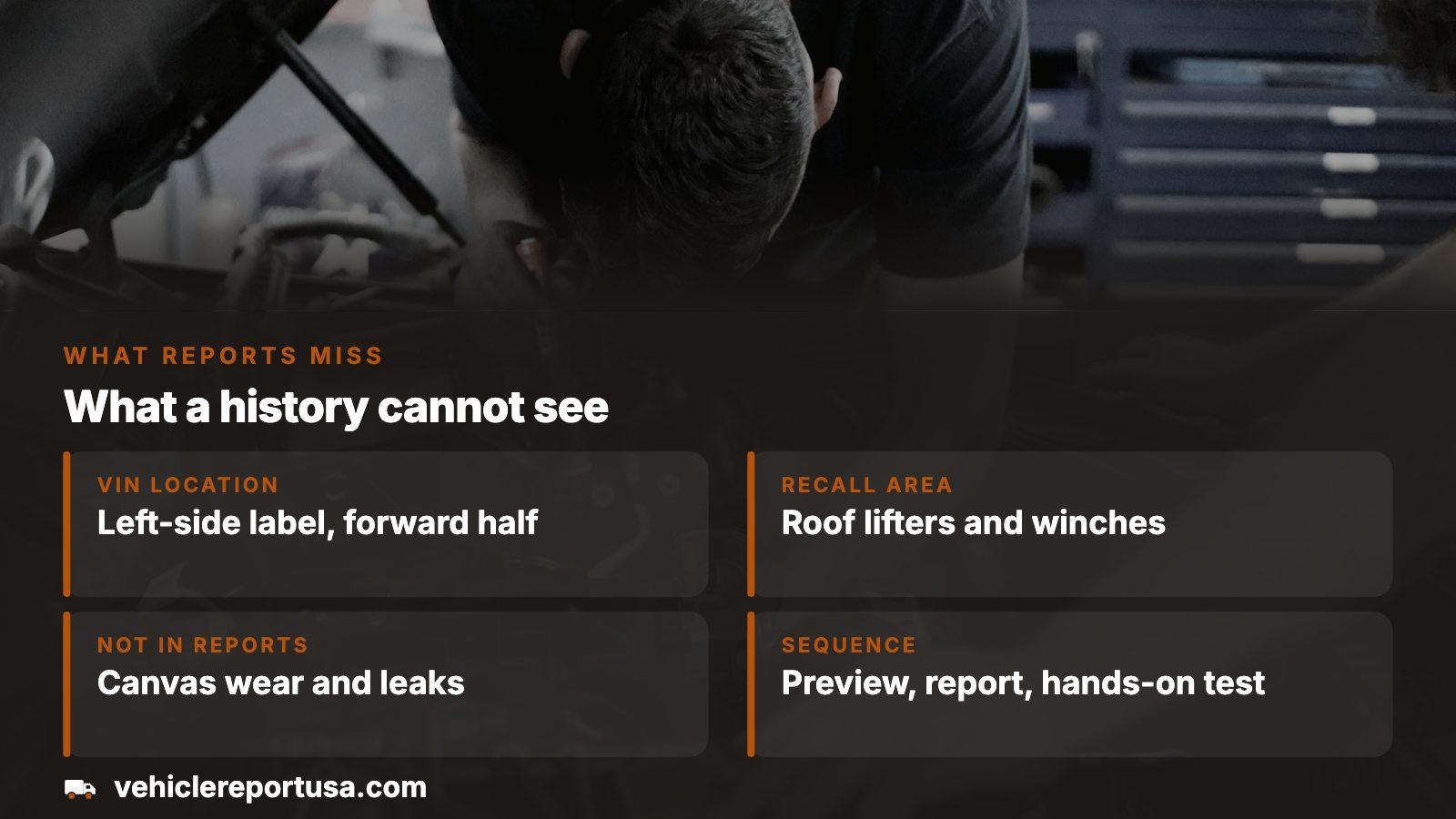
- Where the VIN is
- On the left-side certification label, forward half
- Known recall area
- Roof lifters, winches and power roof lifts
- Not in any report
- Canvas wear, leaks, lift condition
- Best sequence
- Preview, report, then a hands-on test
What a VIN search covers on a folding trailer
A pop-up is a trailer first and a tent second, and the VIN belongs to the trailer. In a trailer's number the middle characters describe make, trailer type, body, length and axle layout, so a decode should call it a camping trailer of modest length, not a boat trailer or motorhome. If it does not, the number was copied wrong or the label belongs to something else.
The history side is where the money question gets answered. A preview tells you whether records exist, and the report lays out title brands, damage or salvage entries, lien records, theft entries and any open recall. On a camper that sat in a yard for ten years, those records are often thin, and thin is a result in itself.
- Title brands such as salvage or flood, kept even if a later state left them off the paper title
- Insurer total-loss and salvage-yard entries
- A lien that could stop the title from moving to you
- Theft entries tied to the number
- Recalls that have not been repaired
Finding the number on a folding camper
Start at the driver side, toward the front. Federal rules call for a certification label fixed there so firmly it would be damaged coming off, and it carries the builder, build month and year, weight ratings and the VIN. On a pop-up it may sit low on the box or behind a latch, so run a flashlight along the edge before deciding it is gone.
Photograph the label straight on, then compare it with the number the seller texted you and the number on the title or registration. Three matching copies are what you want. One that differs by a character is either a typing slip or a warning.
Use all 17 characters
On a short number, NHTSA's decoder reports an incomplete VIN and cautions that the model year could be off. Partial numbers copied from an ad will not give a clean result.
Recalls that are specific to pop-ups
Folding trailers carry a mechanism that ordinary travel trailers lack: a roof that goes up and down on a lifter, winch or motor. NHTSA's records show that mechanism has been recalled more than once, and each case ends with a heavy roof moving when it should not.
| Campaign | Maker and units | Problem | Fix |
|---|---|---|---|
| 13V558000 | Jayco, 2011 Jay Series pop-ups | A roof-lifter failure can let the roof slam shut | Dealer adds a metal stop, no charge |
| 13V559000 | Starcraft, 2013 RT and Comet pop-ups built August 2010 to August 2012 | Same lifter failure | Same metal stop, no charge |
| 18V292000 | Jayco, certain 2011 and 2013 BB, BC and BD models | Misusing the manual override can damage a power roof lift | Warning label with instructions, no charge |
| 07V514000 | Folding trailers with a Carefree P55000 winch, listed under Forest River Flagstaff and Rockwood | Wrong material in winch cable shafts; the top could free-fall | New cable shafts, no charge |
These are examples from the public recall database, not a full list. Other makers and years exist, and a model-year range often covers only part of the units built, so the VIN search is what settles your trailer.
What an unfixed lift recall looks like to an owner
From an NHTSA owner complaint
The buyer of a brand-new 2008 Flagstaff pop-up from Forest River wrote that the electric lift quit on night one and stayed unreliable. In June 2011 the roof started coming down overnight with three grandchildren asleep beside him; the emergency braces were in place, so they climbed out the emergency exit. He learned of a winch recall only in December 2011, and said neither dealer nor maker had brought it up. Repairs ran past 500 dollars, plus lodging.
The lesson is narrow and practical. A recall can sit open for years when the original buyer never receives the letter, and a second owner is even less likely to. Searching the VIN before purchase finds an open campaign while you can still ask the seller to get it done, or walk away.
What a history report cannot see on a pop-up
Be clear about the limits. The federal title database is the weak spot: its consumer page names common automobiles as the required reporters and never mentions campers, so a clean answer may simply mean nothing was reported. Damage thresholds vary by state, and a few states skip titling for older vehicles, so a very old pop-up may have no title trail at all.
The things that ruin pop-up ownership are physical. Canvas that has mildewed, seams that leak, bed ends that sag, a lift that groans, wiring that was patched, a frame that has been bent by a hard curb. None of that produces a record. Justice Department guidance puts a history report next to an independent inspection, and a folding camper suits that advice better than most vehicles.
- Raise and lower the roof twice, and listen for a motor straining or cables rubbing
- Look at every canvas seam and corner in daylight, and smell the interior
- Check the frame, axle and tires for rust or damage
- Ask for the original paperwork, including any recall repair receipts
From label to inspection: the order I would follow
- Photograph the certification label and confirm the VIN matches the title or registration.
- Enter the VIN into the VehicleReportUSA search and read the preview, which costs nothing.
- If the preview shows records, decide on the report: a single purchase, no subscription.
- Go through the brands, damage entries, liens, theft hits and open recalls.
- Also search NHTSA recalls by brand and series name, since pop-up campaigns are filed under the series.
- Inspect the camper with the roof up before you hand over money.
Bring the report to the inspection. A lien must be cleared before the title can move, and damage nobody mentioned should change the price or end the talk.

When the camper has no title or no readable number
Older and homebuilt pop-ups raise a separate problem. States treat campers unevenly: Idaho, for one, only started titling truck campers in 2009 and left earlier units optional, and its FAQ sorts other states into three groups: titling them, merely registering them, or doing neither. A camper from one of those states can arrive with no title at all.
A missing or painted-over number is worse than a missing title. Do not buy a trailer whose VIN you cannot read and match to paperwork, because nothing can be searched and nothing proves the seller owns it. Ask your state titling office what it requires for an untitled trailer before you pay anything, and expect a VIN inspection at minimum.
Cost, and the sensible next move
The preview is yours to read without paying. If you go on, the report is billed one time per camper, and a bundle exists for shoppers lining up several. See /pricing for amounts; no plan renews behind your back.
Search the number before the drive out to see the camper. If records appear in the preview, buy the report and set it beside what the seller told you. Match the VIN, recall status and title first, then spend the afternoon testing the lift and crawling around the canvas. A pop-up that passes both the paperwork and the hands-on check is worth buying.
Where this information comes from
- NHTSA owner complaint 10438103 — owner experience, paraphrased
- NHTSA recall 13V558: Jayco pop-up roof lifter — Roof-lifter failure and the metal-stop remedy on 2011 Jay Series pop-ups.
- NHTSA recall 18V292: Jayco power roof lift — Manual-override misuse and the warning-label remedy.
- NHTSA recalls page — What a VIN recall search does and does not show.
- Bureau of Justice Assistance: NMVTIS consumer page — Coverage limits, false negatives and the advice to inspect.
- eCFR: 49 CFR 567.4, certification label — Where a trailer's label goes and what it lists.
- Idaho Transportation Department: truck campers FAQs — An example of how states differ on titling campers.
Sources and photos: Facts checked against the sources above in November 2026. Photos by Zoshua Colah, Jakub Żerdzicki and Mustafa Sheikhmouss on Unsplash; diagrams by VehicleReportUSA.
Keep reading
- Camper VIN Check: What the Report Covers on RVs, Trailers and Truck CampersThe wider check for campers, camper vans and truck campers.
- Travel Trailer VIN Check: Run the History Before You Buy the CamperA rigid trailer, with its own decode and recall pattern.
- Where Is the VIN Number on a Trailer? Label, Frame and TongueMore on locating the label and what to do when it is gone.
- Trailer Recall Check: Find Open Safety Recalls by VINHow to cover recalls from the trailer builder and its parts makers.
Frequently asked questions
Do pop-up campers have a VIN?
Yes. A folding camper built for sale is a trailer with a 17-character VIN on its certification label. Homebuilt or very old units may lack one, and with no number nothing can be searched.
Will a VIN search show a roof lift recall?
It can show whether a recall for that trailer is still open. It cannot tell you whether the lift works today, so also search by brand and series, and operate the lift yourself.
Does the report show canvas or leak damage?
No. Records come from titles, insurers, salvage yards and similar sources, and wear is not in them. Inspect the fabric, seams and floor in daylight, and ask the seller about storage.
Is the preview really free?
Yes. Reading the preview costs nothing. The report itself is a one-time charge, alone or bundled, and nothing recurs.
What if the seller has no title?
Ask your state titling office what it requires for an untitled trailer before paying. Some states do not title campers at all, but a VIN you cannot read, or no proof of ownership, is reason to walk away.
Now check the car itself
The guide explains what to look for. The report shows what this VIN has on record.