THE SHORT ANSWER
Enter the camper's 17-character VIN and read the preview before paying. A travel trailer or fifth wheel has one VIN for the whole unit, while a camper van or Class C is searched on its chassis VIN. The full report adds title brands, damage and salvage records, liens, theft entries and open recalls. A slide-in truck camper may have no VIN, since states disagree on titling one.
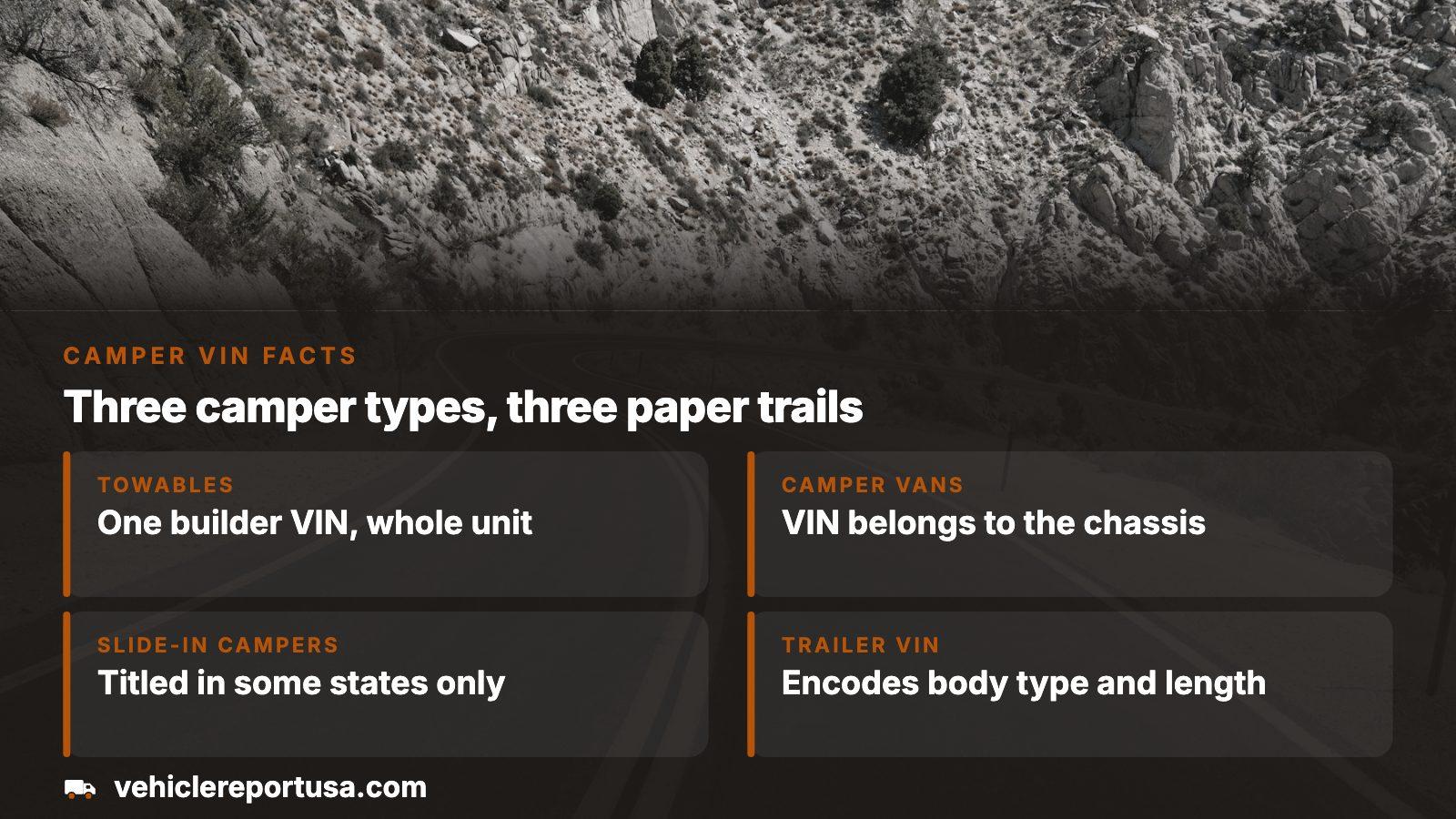
- Towables
- One VIN from the builder covers the whole unit
- Camper vans
- The VIN belongs to the chassis underneath
- Slide-in campers
- Titled in some states, left untitled in others
- Trailer VIN
- Encodes body type, length and axle layout
Three kinds of camper, three different paper trails
A lookup reads each camper type differently. A towable gets one VIN from its builder. A camper van or Class C inherits the VIN of the van or cutaway chassis it was built on. A slide-in unit rides in a pickup bed and may never have been issued a VIN.
| Camper type | Where the number comes from | What a VIN search reaches |
|---|---|---|
| Travel trailer, fifth wheel, popup | The builder, one VIN per unit | Title, damage, liens, theft and recalls on the trailer |
| Camper van, Class B or C | The chassis maker; a converter finishes it | Chassis title, odometer, damage, liens and recalls |
| Slide-in truck camper | A builder serial, a state number or nothing | Little by VIN, so run the pickup instead |
The truck or van that carries or tows the camper has its own VIN and its own history. Check it separately.
Slide-in truck campers: what to do when there is no VIN to run
States split on whether a slide-in camper is a vehicle or cargo. Idaho started titling them in 2009, and a unit bought since then must be titled when it measures six feet or more, has a floor, walls and a roof, and carries a built-in stove, toilet or similar fitting. Oregon titles a camper only when it was built to a recognized RV construction standard, and someone has to certify that. Ask what your state needs before the camper can go in your name.
- The builder's statement of origin, if the seller kept it
- Bills of sale that trace every owner
- A hands-on VIN inspection, which Idaho requires for campers arriving from out of state or lacking a title
- The seller's signed title where one exists, and proof that no lender holds it
With no number, nothing can be searched for liens or theft, so the paper chain and the truck's own report carry the weight.
Matching the label on the camper to the VIN you typed
A search box only proves the number exists. On a trailer, the certification label belongs on the left side, up front, where someone standing outside can read it, and it must be fixed so it cannot come off intact. It lists the builder, the build month and year, the weight ratings, the VIN and the vehicle type.
- Photograph the label and copy the VIN from it, not from the listing.
- Count 17 characters, and treat any I, O or Q as a copying error, because VINs leave those three letters out.
- Read a failed check on the ninth character as a likely misread: it is a check digit built to catch typing errors.
- Compare the decode with the unit. The middle characters of a trailer VIN describe type, body, length and axle layout.
- Match the number to the title, character by character.
A decode showing one axle on a two-axle camper deserves an explanation before you go further.
What the history report pulls up on a camper
The federal title database behind many history reports counts recreational vehicles and motor homes among its vehicles, though states that keep commercial vehicles in a separate system may leave some out.
| Record | What it means for a camper |
|---|---|
| Title brands | Salvage, flood or rebuilt status stays tied to the VIN through sales and moves |
| Accident and damage | Collision history on the frame or chassis, with auction pictures when they are on file |
| Odometer readings | Real mileage on a van or Class C; a trailer has nothing to track |
| Liens and impounds | A lender's claim can block a transfer; an impound shows a past tow |
| Theft and insurance | Whether the VIN was reported stolen or claimed on |
| Open recalls | Campaigns on the chassis or trailer that nobody repaired |
| Use type | Rental or fleet service behind a family-rig story |
Red flags that should slow a camper purchase
- A salvage, flood or rebuilt brand the listing never mentioned
- Auction photos showing roof, front-cap or frame damage
- A lien, or a title held by a lender who is not in the conversation
- A VIN that differs by a single character between frame, label and paperwork
- A theft entry, or mileage that falls or stalls on a van-based camper
From an NHTSA owner complaint
An owner of a 2019 Lance trailer told NHTSA that the side door fit badly and let in air, water and fumes. Months later the owner found that the label on the door showed a different serial number than the trailer itself, and the door came from another Lance model. In July 2020 the dealer confirmed it had replaced the original for poor fit, and had said nothing of it at the sale.
Read the serial on every label you can reach, and ask the seller in writing what has been replaced.
Recalls come from the chassis maker, the builder and the appliance company
A VIN search finds campaigns tied to that vehicle, yet many camper recalls are not. NHTSA lists a gas-leak recall on certain three-burner stoves under the appliance maker, with no model year. The builder can run its own campaign too, such as the 2018 and 2019 Lance 855S trailers where a 12-volt wire could touch the hot refrigerator burner box.
From an NHTSA owner complaint
An owner of a 2019 Lance camper told NHTSA the stove smelled of gas after use. A recall notice for the stove had arrived, but the repair part was not available, and the owner felt the maker had let more than a reasonable time pass.
Search the chassis or trailer by VIN, phone the builder with the unit's serial, and ask the seller for recall paperwork on each appliance, including whether repair parts exist.
What no VIN search can tell you
A history report follows titles, claims, auction lots and sales. A tired roof seal, a soft floor or a failing water heater leaves nothing in any of them. The report screens the camper, and a person who knows RVs judges it, testing the gas, water and 12-volt systems along with the running gear.
Treat a clean report as a reason to keep going, not as a verdict. It says no brand, claim, lien or theft entry has reached the records tied to that VIN. It says nothing about work done outside the records, such as a roof resealed by an owner or a door swapped between units. Receipts and service records fill that gap.
Running the check and what it costs
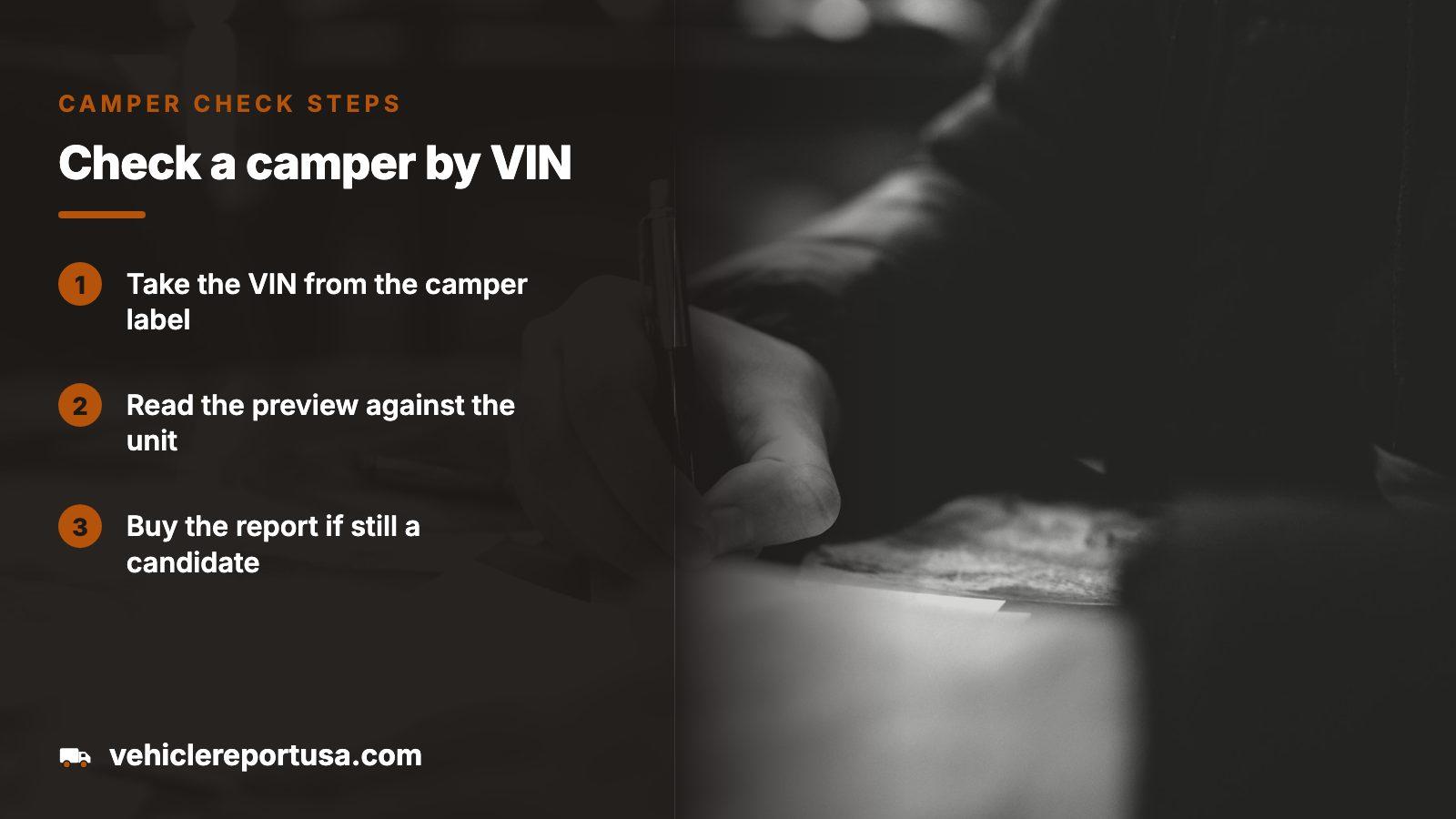
- Take the VIN from the camper's own label and enter all 17 characters.
- Read the preview and compare the decode with the camper's type, length, axles and year.
- If the unit is still a candidate, buy the full report.
Begin with the preview, which has no charge. The full report costs one payment and never bills again. Shoppers weighing a handful of campers can buy reports three, five or ten at a time. The pricing page lists rates, and the sample report page lays out each section. When the result is in, settle any brand or lien in writing, call the builder about recalls, and book the inspection.
Where this information comes from
- NHTSA owner complaint 11343705 — owner experience, paraphrased
- NHTSA owner complaint 11423815 — owner experience, paraphrased
- Bureau of Justice Assistance: NMVTIS FAQs — Lists recreational vehicles and motor homes among the vehicle types in the federal title system, with a caveat for commercial vehicles.
- eCFR: 49 CFR part 565, VIN requirements — Sets the 17-character format, the check digit and what the descriptive characters say about a trailer.
- eCFR: 49 CFR 567.4, certification label — Says where a trailer's certification label goes and what it has to list.
- Idaho Transportation Department: truck campers FAQs — Shows how one state decides which truck campers need a title and what an untitled unit must provide.
- Oregon DMV: title and registration handbook, chapter L — Shows a second approach, titling a camper only when it was built to a recognized standard and certified as such.
Sources and photos: Facts checked against the sources above in November 2026. Photos by Alexander Lunyov, Owen Michael Grech and Will Truettner on Unsplash; diagrams by VehicleReportUSA.
Keep reading
- Travel Trailer VIN Check: Run the History Before You Buy the CamperTowables get one VIN from the builder, and this page goes deeper on trailers and fifth wheels.
- RV VIN Lookup: History Check for Motorhomes, Trailers and Fifth WheelsWhy a motorhome decode names a truck maker, and how the chassis and coach split works.
- What If a Trailer Has No VIN Number? A Buyer's ChecklistWhat to do when the unit in front of you carries no number at all.
- RV VIN Recall Check: Chassis, Coach and Trailer Recalls Before You BuyHow to cover recalls from the chassis maker, the builder and the appliance companies.
Frequently asked questions
Can I run a VIN check on a camper that has no VIN?
Not by number. Ask the seller for the statement of origin, a chain of bills of sale and the titling steps your state requires. Run the pickup's VIN as well, since the truck has its own title, damage and lien history.
Does an RV camper VIN check work on a camper van?
Yes, on the chassis VIN, which belongs to the van or cutaway maker. The result covers title, odometer, damage, liens and chassis recalls. The conversion and living space sit outside it, so ask the converter about its own recalls.
Will a VIN search on a camper show water damage?
Only when water led to a claim, a brand or an auction sale. Slow leaks and soft floors create no title or insurance entry, so pay an RV-aware inspector to judge the roof, floor and plumbing.
Do I need to check the tow vehicle as well?
Yes. A pickup or SUV has its own VIN and its own record of brands, damage and liens. A clean camper says nothing about the truck pulling it. Treat them as two purchases and run both numbers.
The camper passed an inspection. Is the report still worth it?
Yes, because the two look at different things. An inspector sees the roof, tanks and wiring. The report shows a salvage brand, a lien, a theft entry or auction photos that the inspector could not see.
Now check the car itself
The guide explains what to look for. The report shows what this VIN has on record.