THE SHORT ANSWER
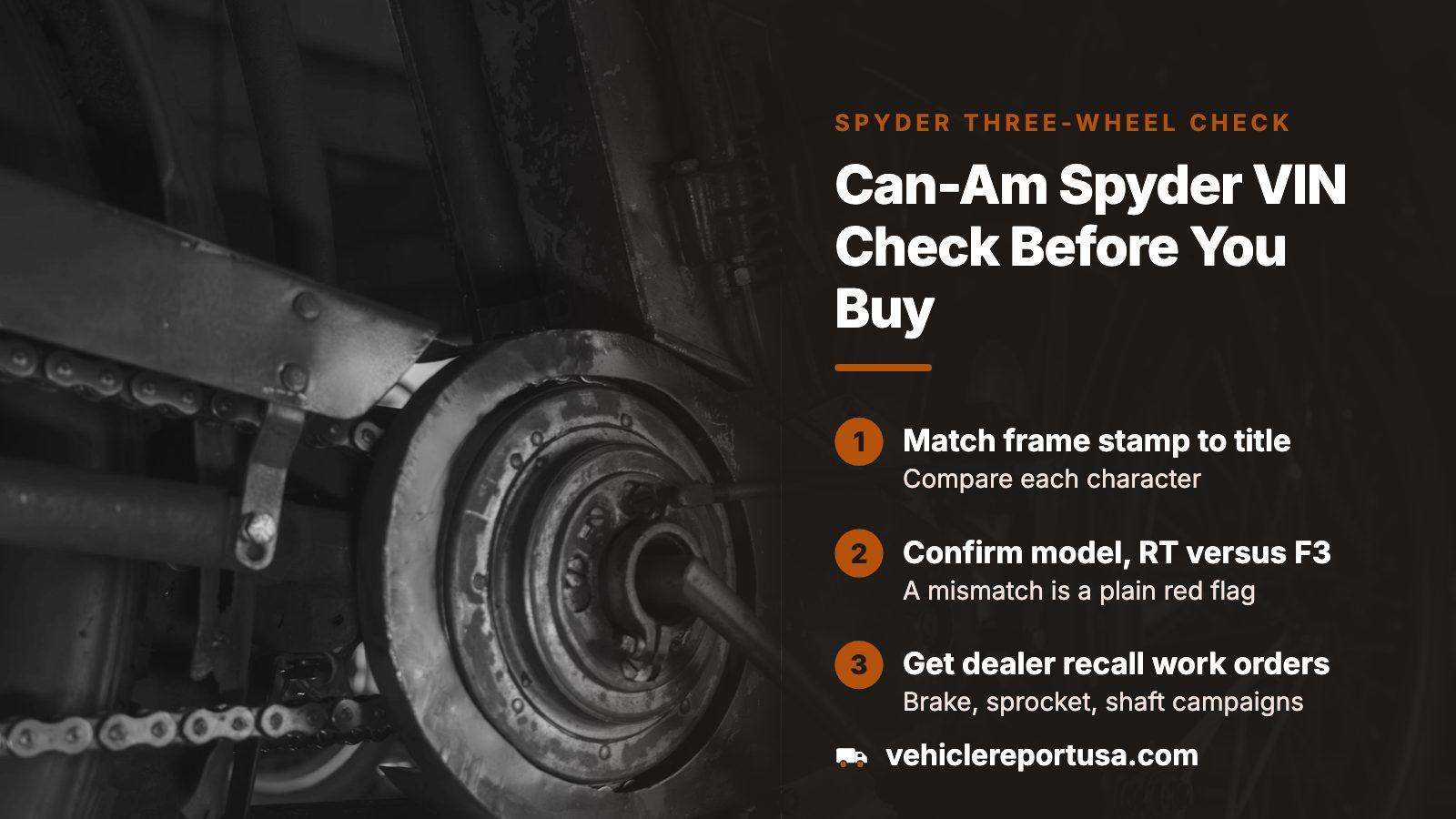
Copy the VIN from the frame and from the title, make sure they match, then run it. The preview, which costs nothing, names the model and year. Paying for the report adds brands on the title, crash and salvage entries, odometer history, liens, theft flags and unrepaired campaigns. On a Spyder, always confirm that the brake, sprocket and output shaft campaigns for that year were completed by a dealer.
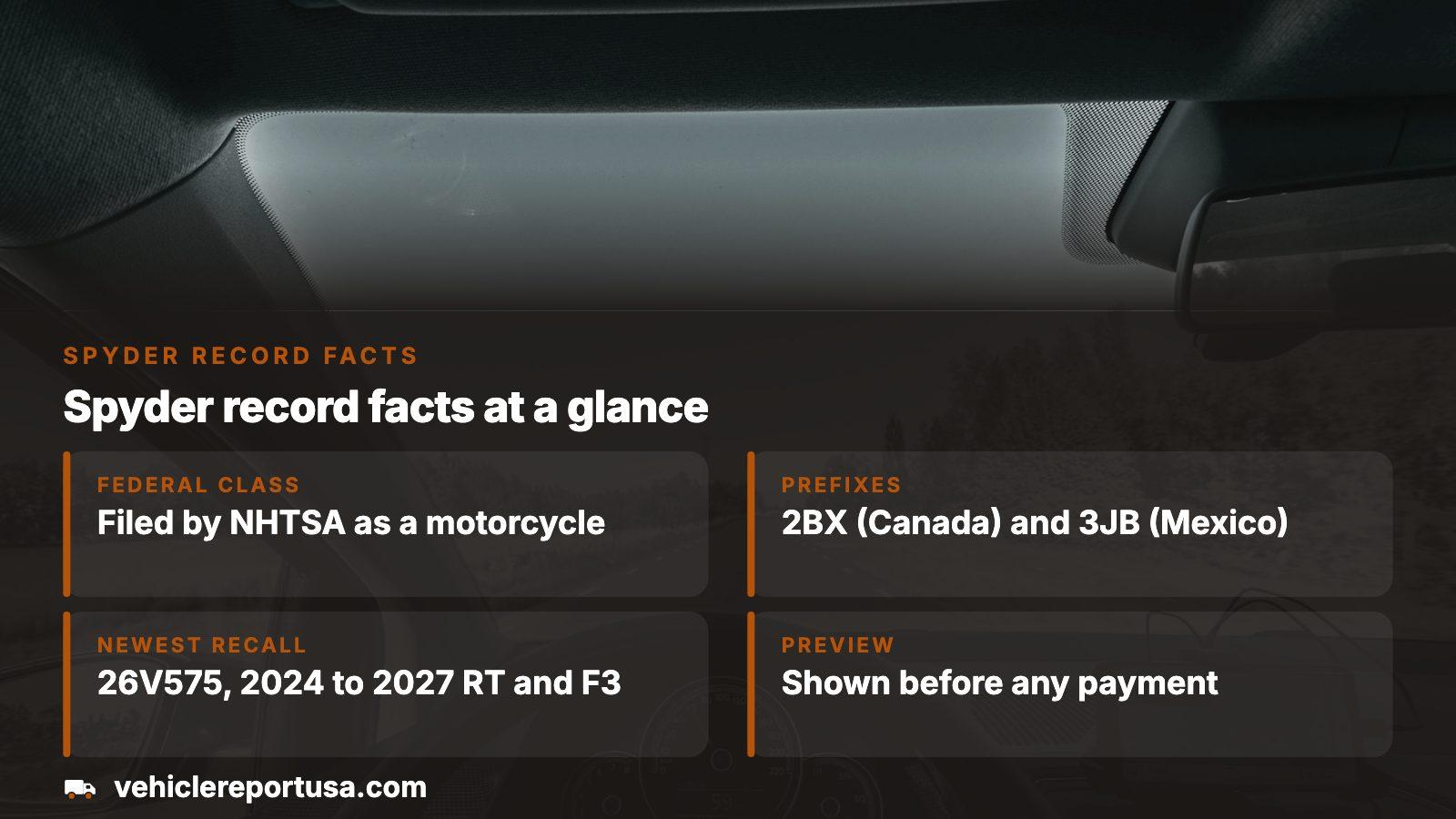
- Federal class
- Filed by NHTSA as a motorcycle
- Prefixes
- 2BX (Canada) and 3JB (Mexico)
- Newest recall
- 26V575, instrument cluster, 2024 to 2027 RT and F3
- Preview
- Free, shown before any payment
Why a three-wheeler gets a motorcycle check
The Spyder has two wheels up front, a reverse gear and a seat that feels closer to a jet ski than a Harley. None of that changes its paperwork. NHTSA's recall records call each of these machines a motorcycle, and its decoder lists the Spyder prefix under the vehicle type Motorcycle. So the number is searched the way any bike's would be, through federal recall data and through the title records states report.
VehicleReportUSA is built for motorcycles, trucks, RVs and trailers, which is why a Spyder buyer lands in the right place. A plain car report reads the same 17 characters, but the questions that matter on a trike, such as steering, sprockets and brake hardware, are the ones the recall history answers.
What the report can find on a used Spyder
Spyders are often sold by a second or third owner, sometimes after a long storage winter. A paper trail from that stretch is thin, so the report is the quickest way to see what a seller may not mention.
- A brand on the title (salvage, rebuilt, flood), which moves both the resale value and a lender's willingness to finance.
- Crash and total-loss entries, plus auction listings with pictures when the machine passed through one.
- Mileage recorded at inspections, sales and registrations, so a low-mile boast can be set against dated readings.
- A lien or impound entry that could pass to the next owner along with the keys.
- A theft report, and any recall still open on that one VIN.
Records depend on what states and insurers report, and motorcycle reporting is patchier than car reporting. A clean result lowers risk. It does not replace a ride and an inspection.
Recalls by Spyder generation
The rows below were pulled from NHTSA's recall lookup, model name by model name and year by year. Every remedy is described there as free of charge, so a bike with an open campaign is a repair you should not pay for.
| Model years | Campaign | What NHTSA recorded |
|---|---|---|
| 2008 to 2010 GS | 09V162 | Steering needed more force than expected to start a turn; 9,932 machines |
| 2008 to 2012 GS, RS, RT | 12V582 | Fuel cap might not seal on the filler neck |
| 2013 RT and ST | 13V386 | Brake master cylinder inlet could melt and leak fluid |
| 2013 RT | 15V095 | Very high engine compartment temperatures when idling in warm weather |
| 2015 to 2019 F3 and RT | 22V352 | Defective front sprocket could wear early and cut drive power |
| 2017 to 2019 F3 and RT | 24V728 | Output shaft could fatigue and break, losing drive power |
| 2020 RT | 20V186 | Brake support could break in a hard stop, a total loss of braking |
| 2020 to 2023 RT | 23V175 | Brake lights could stay lit without pedal pressure |
| 2022 and 2023 F3, F3-S | 23V053, 23V856 | Mirror lens could detach from its housing |
| 2024 to 2027 RT and F3 | 26V575 | Touchscreen cluster could reset, freeze or go blank |
Reading a Spyder VIN
NHTSA's decoder ties the three-letter prefix 2BX to Bombardier Recreational Products in Canada, and 3JB to BRP Mexico. A 2020 Spyder RT in NHTSA's complaint files carries 2BX at the front with the letter L in the tenth position, which is the model-year slot. Beyond the prefix, the decoder returns the model name, and that name matters because each trim sits under its own entry at NHTSA: GS, RS, RT, ST and the two F3 variants.
- Photograph the frame stamp, then the number on the registration or title, and compare the two one character at a time.
- See whether the opening letters belong to a BRP three-wheeler, and whether the tenth character agrees with the year advertised.
- Decode it and set the model name beside the seller's description; an RT passed off as an F3 is a plain mismatch.
- Look up the recalls for that year and model, then ask for a dealer work order covering each repair.
Where the stamp sits on a Spyder is covered on the page for finding a motorcycle's number, and the same logic applies: it belongs to the frame, not to a panel.

The recall nobody told the buyer about
From an NHTSA owner complaint
The owner of a 2013 Spyder RT told NHTSA in May 2014 that the bike had just been bought. Only afterward did the owner learn it was part of the brake master cylinder campaign, 13V386, and BRP said the repair had never been done. Nothing had failed yet. The complaint reads as a buyer finding out a safety job was still open after the sale.
That is the case a VIN search is built for. The campaign concerned a melting brake component and leaking fluid, and the seller's word that the bike was fine would not have turned it up. Run the number before the test ride. A campaign still open is grounds to ask for a dealer repair ahead of payment, or for a lower price.
Sprockets and shafts on the 2015 to 2019 bikes
The two campaigns that matter most on a mid-life F3 or RT are the front sprocket one from 2022 and the output shaft one from 2024. Both end in the same way: a loss of drive power. NHTSA's lookup returns both for the 2018 and 2019 model years, so a single VIN on those bikes can show two open items.
From an NHTSA owner complaint
An owner of a 2018 Spyder F3 wrote that a notice arrived for the output shaft campaign, 24V728, but parts for the repair had not reached dealers. The owner felt BRP had taken longer than was reasonable, though nothing had broken. A buyer in that spot inherits a wait, not a repair.
The takeaway: an open campaign on a used bike can mean waiting on parts for months. Ask whether the seller was notified, and whether the work order exists or is only promised.
Warning signs in the results
- A salvage or rebuilt brand on a machine advertised as accident-free.
- Mileage that falls from one dated entry to the next.
- An open campaign the seller calls done, with no dealer paperwork.
- A lien that the title does not show, or a title issued in a state far from the seller's home.
- A model year or model name in the decode that differs from the ad.
A lone warning sign calls for questions. Stack up several and walking away is the sensible move, above all on a machine with a braking or steering record.
Cost, and the order of steps
Nothing is charged for the preview, which only decodes the number. The report itself is one payment per machine. Packs of 3, 5 or 10 exist for shoppers weighing several bikes, and nothing renews. Rates sit on the pricing page.
In practice, get the VIN from the frame and the paperwork, run the preview, and read the report against the table above. NHTSA also runs its own free recall lookup, and it is worth doing in parallel. If everything lines up, test the brakes and the shifting on a ride, then ask for the service history.
Where this information comes from
- NHTSA: recall lookup by VIN — The free federal search that returns the campaigns listed in the table.
- NHTSA vPIC: BRP prefixes 2BX and 3JB — Prefix owners, country and the Motorcycle vehicle type.
- NHTSA: 2013 Can-Am Spyder RT — Recalls and owner complaints for the 2013 RT, including 13V386 and 15V095.
- VehicleHistory.gov: NMVTIS — What the federal title system is for and where its reports come from.
- NHTSA owner complaint 10592382 — owner experience, paraphrased
- NHTSA owner complaint 11655876 — owner experience, paraphrased
Sources and photos: Facts checked against the sources above in November 2026. Photos by Haberdoedas, Dimitri Karastelev and Sander Jeurissen on Unsplash; diagrams by VehicleReportUSA.
Keep reading
- Motorcycle VIN Recall Check: Find Open Recalls on Any BikeHow a motorcycle recall search works and what an open campaign means for a buyer.
- Where Is the Motorcycle VIN Located? Frame, Label and Title MatchFinding the stamped number on the frame so it can be matched with the title.
- Motorcycle VIN Year Check: Confirm the Model Year Before You BuyUsing the tenth character to confirm the model year before trusting the ad.
- Motorcycle VIN Lookup: Check a Used Bike's History Before You PayThe general walk-through for any make: decode, title records and a full report.
Frequently asked questions
Is a Can-Am Spyder a motorcycle for VIN purposes?
Yes. NHTSA describes Spyder models as motorcycles in its recall records, and its decoder lists the Spyder prefix under the Motorcycle vehicle type. State licensing rules vary, but the VIN is searched the way any motorcycle's would be.
Which Can-Am Spyder years have the most recalls?
Older Spyders accumulated campaigns across the 2008 to 2013 years, and the 2018 and 2019 F3 and RT show both the sprocket and output shaft campaigns. The newest is 26V575, covering 2024 to 2027 RT and F3 models with a touchscreen cluster.
Can I check Spyder recalls for free?
You can use NHTSA's own recall search at no charge, and it lists open campaigns by VIN. The preview here costs nothing as well, though title brands, crash entries, mileage readings and liens are in the report, a single payment.
Does a Spyder VIN start with 2BX?
Often. NHTSA ties 2BX to BRP in Canada, and 3JB to BRP Mexico. A 2020 RT in its complaint files starts with 2BX. If the prefix is neither of those, compare the title and the frame stamp before going further.
What if the seller says the recall was done?
Ask for the dealer work order showing the campaign number and date, then compare it with the VIN search. Recall repairs are free to owners, so a seller who cannot produce paperwork may simply not have had it done.
Now check the car itself
The guide explains what to look for. The report shows what this VIN has on record.