THE SHORT ANSWER
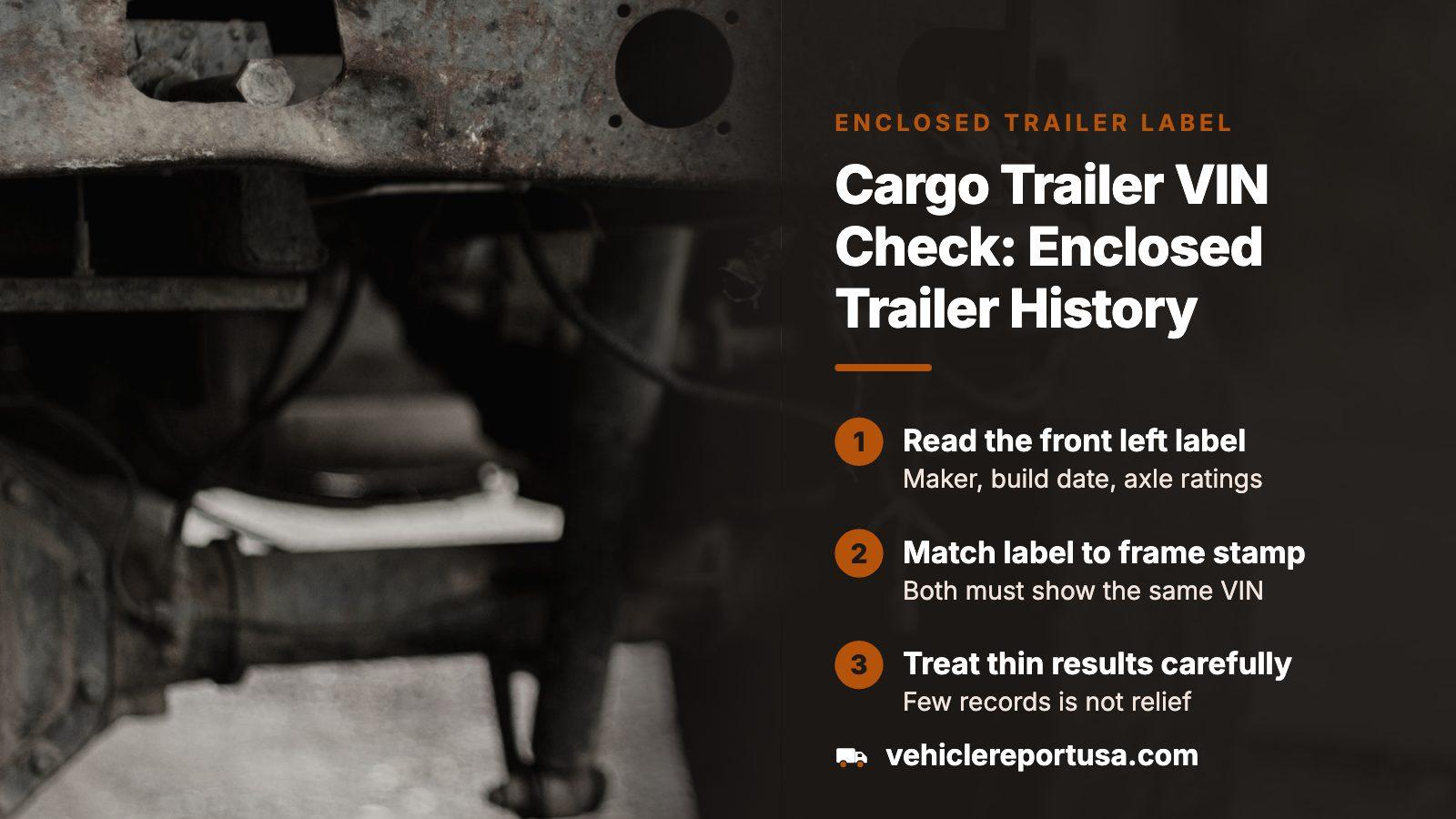
Find the certification label near the front of the trailer's left side, confirm its VIN against the stamping on the frame, and put the number into the free preview. If the trailer still interests you, a paid report searches brands, liens, theft, damage and open recalls. Enclosed trailers often leave few records, so a short result calls for a close inspection, not relief.
- Where the label sits
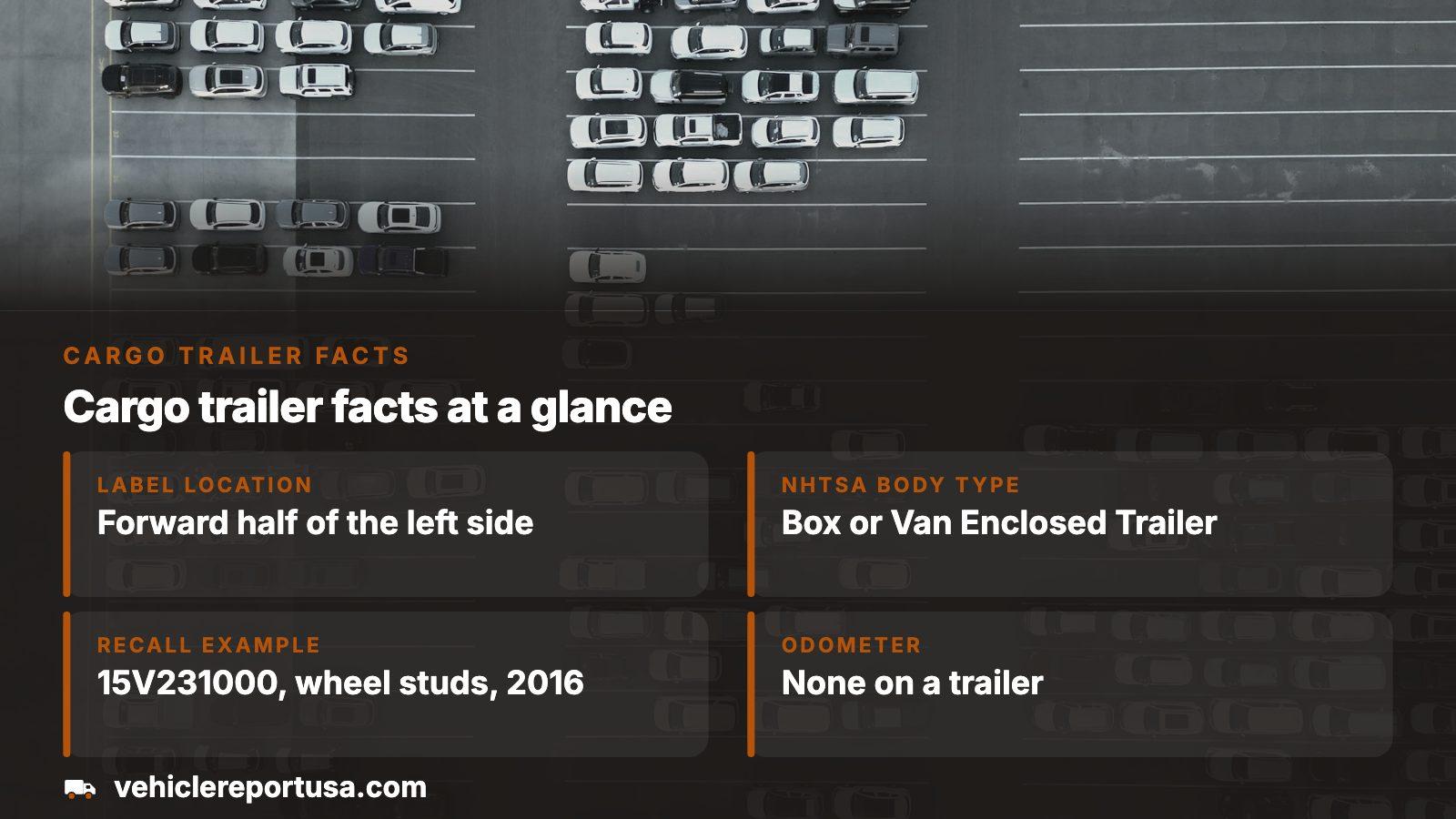
- Forward half of the left side
- NHTSA body type
- Box or Van Enclosed Trailer
- Recall example
- 15V231000, wheel studs, 2016 models
- Odometer
- None on a trailer
What a search can tell you about an enclosed trailer
A cargo trailer carries someone's livelihood: tools, show gear, a race bike, a mobile shop. Its paper trail is thin. A record exists only if the unit was titled, financed, insured, auctioned, reported stolen or recalled, and each event is filed under the VIN.
| Your question | What turns up |
|---|---|
| Was it ever branded? | A salvage, junk or flood label, where a state titled the trailer and passed it along |
| Does a lender still own part of it? | Liens and past impound holds |
| Was it stolen? | A theft report filed against this number |
| Was it wrecked or flooded? | Loss and auction entries, with pictures when they exist |
| Is a safety fix waiting? | Open recalls on the unit |
| How many miles? | Nothing. A trailer has no odometer. |
No charge applies to the first look. Going further means one payment for a single report, and nothing recurs.
Reading the label on the front left
Walk to the tongue and look back along the driver's side. Under federal rules a trailer's certification label sits toward the front on that side, legible from the ground, and it must be fixed so firmly that pulling it off wrecks it. On an enclosed box that usually means a plate or sticker on the nose or the first panel behind the A-frame.
- The maker's name, introduced by the words Mfd By or Manufactured By.
- The month and year the unit was completed.
- A loaded-weight rating, then one rating per axle, front to rear.
- The VIN, plus the vehicle type.
Photograph the label with the phone held flat so every character is sharp, then find the number stamped into the frame near the tongue and compare. A label that looks newer than the trailer, or one that is missing, raises questions before any talk of price.
Why a short result is normal for a trailer
The Justice Department runs the national title database behind many history reports. Its FAQ names the vehicle types it holds: cars, buses, trucks, motorcycles, motor homes, tractors and recreational vehicles. Trailers are absent from that list, and units a state registers through a separate commercial office may not appear either.
The same agency says the database is meant to be short, and that reporting gaps can give a false negative, for example no salvage history when some exists. A thin result tells you how few records there are, not that the past was clean. Two other places give more: the state's own title record and the seller's paperwork.
Insurer total loss on a stolen trailer
When a stolen trailer is not found within 30 days, an insurer may write it off as a total loss. If it surfaces undamaged later, the label stays on the record. A loss entry can therefore be a paperwork event, not damage. Ask the seller for the story behind it.
Recalls that have hit enclosed trailers
NHTSA's decoder has a body-type value called Box or Van Enclosed Trailer, and that is where most cargo haulers belong. Recalls in this space tend to come from makers that sell many brands under one roof.
Campaign 15V231000, received in April 2015, covered certain 2016 trailers built during March 2015. Among the many names were the Cargo Mate Blazer, Eliminator and Qualifier plus several Continental Cargo lines. The studs fastening wheels to hubs could snap, letting a wheel separate on the road. Dealers swap affected hubs at no charge.
A second campaign, 17V756000, spanned a long list of trailers and motorhomes and concerned fire extinguishers that might fail. Kidde supplies a free replacement. Each campaign reaches only certain builds, so searching the VIN shows whether this unit is covered and whether the repair happened.
What owners report when an enclosed trailer goes wrong
NHTSA keeps owner complaints on trailers. Two of them show the kind of trouble that a history search will not reveal, because a defect that was never reported leaves no VIN-linked record.
From an NHTSA owner complaint
A 2018 Continental Cargo owner wrote in July 2018 that the trailer was less than 7 weeks old when its axle broke while carrying a single small UTV. The tires blew and the rig nearly crashed. A shop told the owner the axle failed far below its rated load, which pointed to poor construction.
From an NHTSA owner complaint
A buyer who picked up a new Haulmark trailer in Texas and set off for Kansas stopped at a gas station in Oklahoma. The driver's side leaf spring fasteners were only finger tight, and the owner concluded they were never torqued at the factory. Repairs at a truck stop got the trailer home safely.
For a used purchase, crawl under it. Look at axle hubs, spring hangers and fasteners on a trailer of any age.
Running it, one step at a time
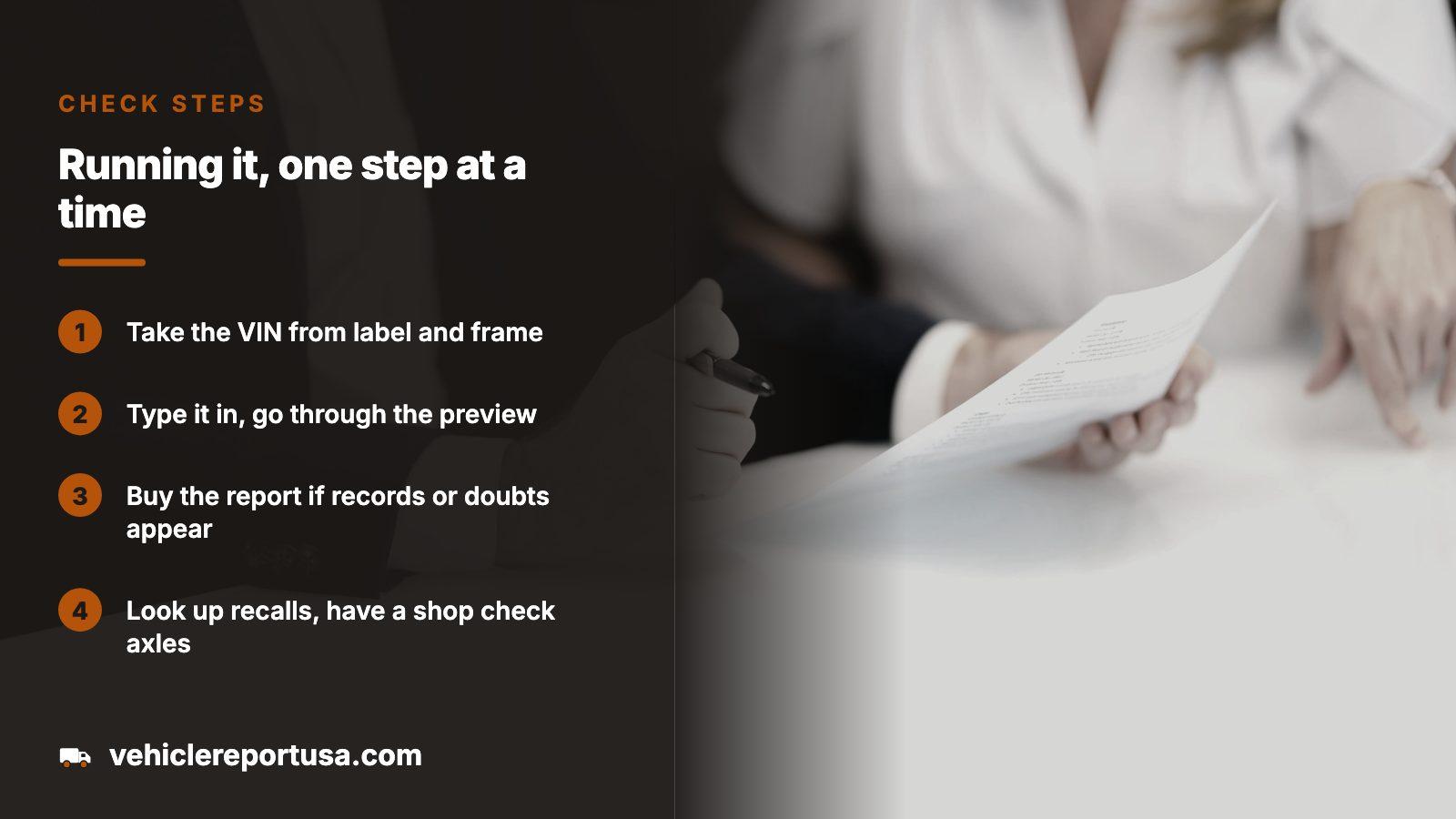
- Take the VIN from the label and from the frame, and make sure they agree.
- Type it into VehicleReportUSA and go through the preview.
- Buy the report if the preview shows a record or the seller's story has holes.
- Set each finding beside the title, bill of sale and any registration the seller can show.
- Look up open recalls for the maker, then have a shop check axles and brakes.
Pricing for a single report or a pack sits on the pricing page. A pack suits anyone comparing trailers from several sellers.
Red flags worth walking away over
- Label and frame stamping disagree, or the label shows glue marks and fresh rivets.
- The seller has no title or certificate of origin, or offers only a handwritten receipt.
- A brand, lien or theft entry appears that the seller never mentioned.
- Fresh paint, new aluminum skin or reworked floors on a trailer sold below normal prices.
- The maker's name is missing from the tongue, yet the seller calls it factory built.
Cloning is the crime to keep in mind. A federal case summary describes a ring that stole vehicles and fitted VINs lifted from other units of one make, model and year, so the paperwork looked genuine. A report on a cloned number can look clean, so if body style or length does not match the VIN's description, stop.
Paperwork: what a state may ask you for
Rules differ by state, so confirm yours with the motor vehicle agency. Texas offers a useful picture. Its DMV treats a manufactured trailer over 4,000 lb gross weight as one that must be titled. A new trailer comes with a manufacturer certificate of origin, which the DMV calls its birth certificate. A used trailer over that weight needs a certificate of title.
The same page says a factory trailer with missing papers cannot be registered as homebuilt, and that a kit company may appear as maker on a label. Applications go on Form 130-U. Other states use other forms.
After the report: decide, negotiate or leave
A clean preview, matching paperwork and a sound inspection are a reasonable basis to buy. A brand or lien is a reason to renegotiate or leave, depending on what it says and whether the seller can explain it. If the VIN itself is unclear, get that settled in writing before you pay.
Where this information comes from
- eCFR: 49 CFR 567.4 certification label — where a trailer's label goes and who may be named as maker
- Bureau of Justice Assistance: NMVTIS for consumers — brands, state differences, false negatives, total-loss and cloning notes
- Bureau of Justice Assistance: NMVTIS FAQ — which vehicle types the title database includes
- NHTSA recall 15V231000 — wheel stud recall touching Cargo Mate and Continental Cargo trailers
- Texas DMV: trailers — one state's title and certificate of origin rules
- NHTSA owner complaint 11111306 — owner experience, paraphrased
- NHTSA owner complaint 11032113 — owner experience, paraphrased
Sources and photos: Facts checked against the sources above in November 2026. Photos by Zoshua Colah, Carrie Allen www.carrieallen.com and Iain on Unsplash; diagrams by VehicleReportUSA.
Keep reading
- Where Is the VIN Number on a Trailer? Label, Frame and TonguePinpoints the label and the frame stamping.
- What If a Trailer Has No VIN Number? A Buyer's ChecklistWhat to do when the number is missing or painted over.
- Utility Trailer VIN Check: What the History Shows Before You BuyThe same check for open decks and dumps.
- Trailer VIN Lookup Specs: What the Decode Shows About Weight and PartsWhich build details a decoder returns for a trailer.
Frequently asked questions
Can I run a VIN check on a cargo trailer?
Yes, provided it carries a VIN. Put the number in for a free preview, then purchase a report if the trailer merits it. What comes back depends on whether the unit was ever titled, financed, insured, sold at auction or reported stolen, so some trailers return very little.
Where is the VIN on an enclosed trailer?
Check the front half of the driver's side, where the certification label belongs, and look for a number stamped in the frame near the tongue. The two should agree, and the label should look original to the trailer.
Does a cargo trailer have an odometer reading?
No. A trailer has no odometer, so that part of any history report stays blank. Judge wear from tires, hubs, floors, door seals and the axles, and compare that with what the seller says about use.
Is a clean cargo trailer report proof it is safe?
No. The Justice Department says reporting gaps can produce a false negative. Use the report together with the paperwork, a recall lookup and a hands-on inspection of axles, brakes, lights and the floor.
What if the trailer has no VIN?
Without a number there is nothing to search. Ask the seller for the title or certificate of origin, and contact the state motor vehicle agency about its process for assigning one. Do not pay until the ownership papers and the number agree.
Now check the car itself
The guide explains what to look for. The report shows what this VIN has on record.