THE SHORT ANSWER
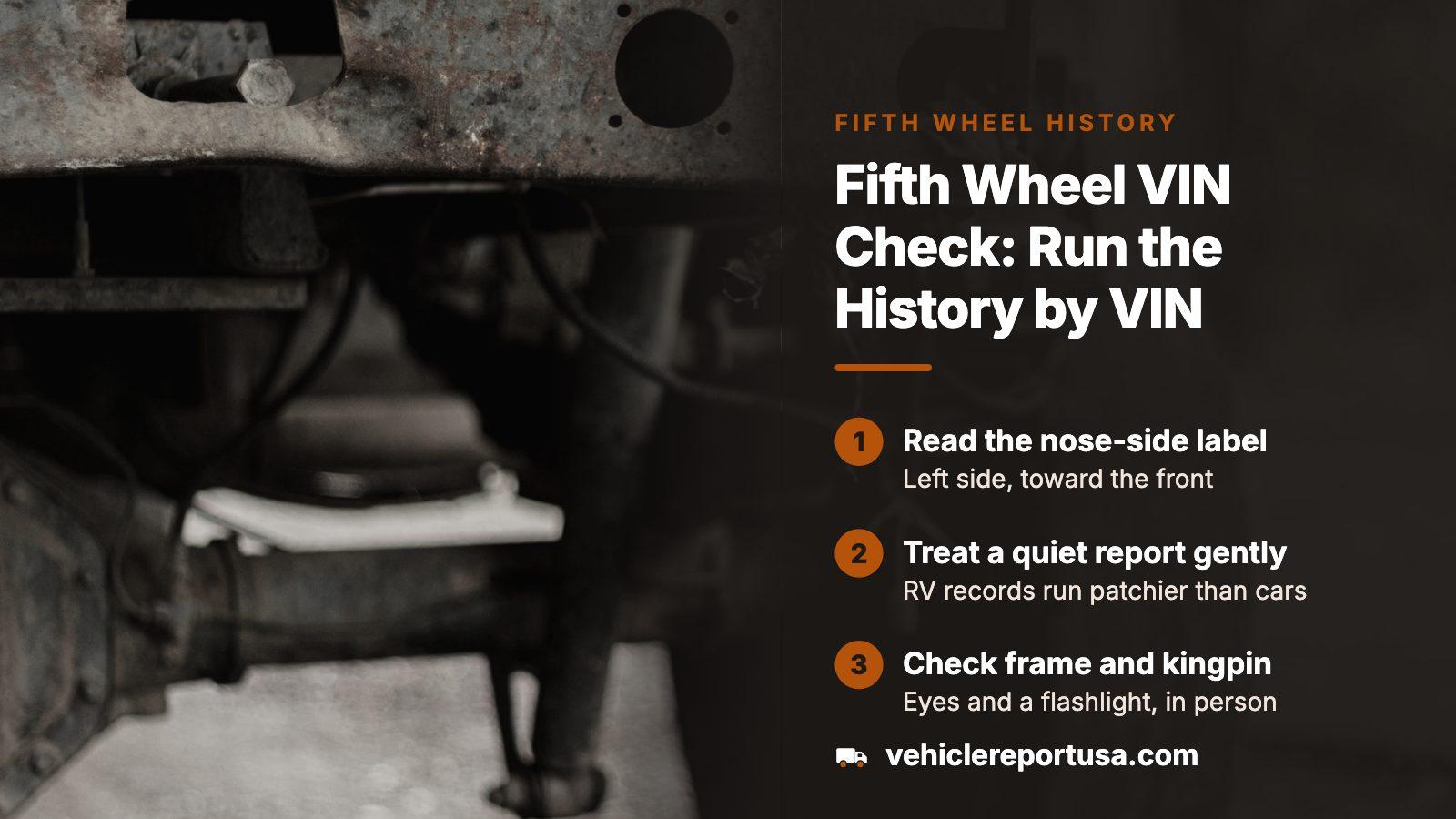
Copy the VIN off the federal certification label near the front of the fifth wheel's left side and enter it; the free preview decodes it. The paid report goes on to title, damage, lien, theft and recall records. RV coverage is patchier than car coverage, so a quiet report is encouraging rather than conclusive, and the frame and kingpin still need eyes and a flashlight.
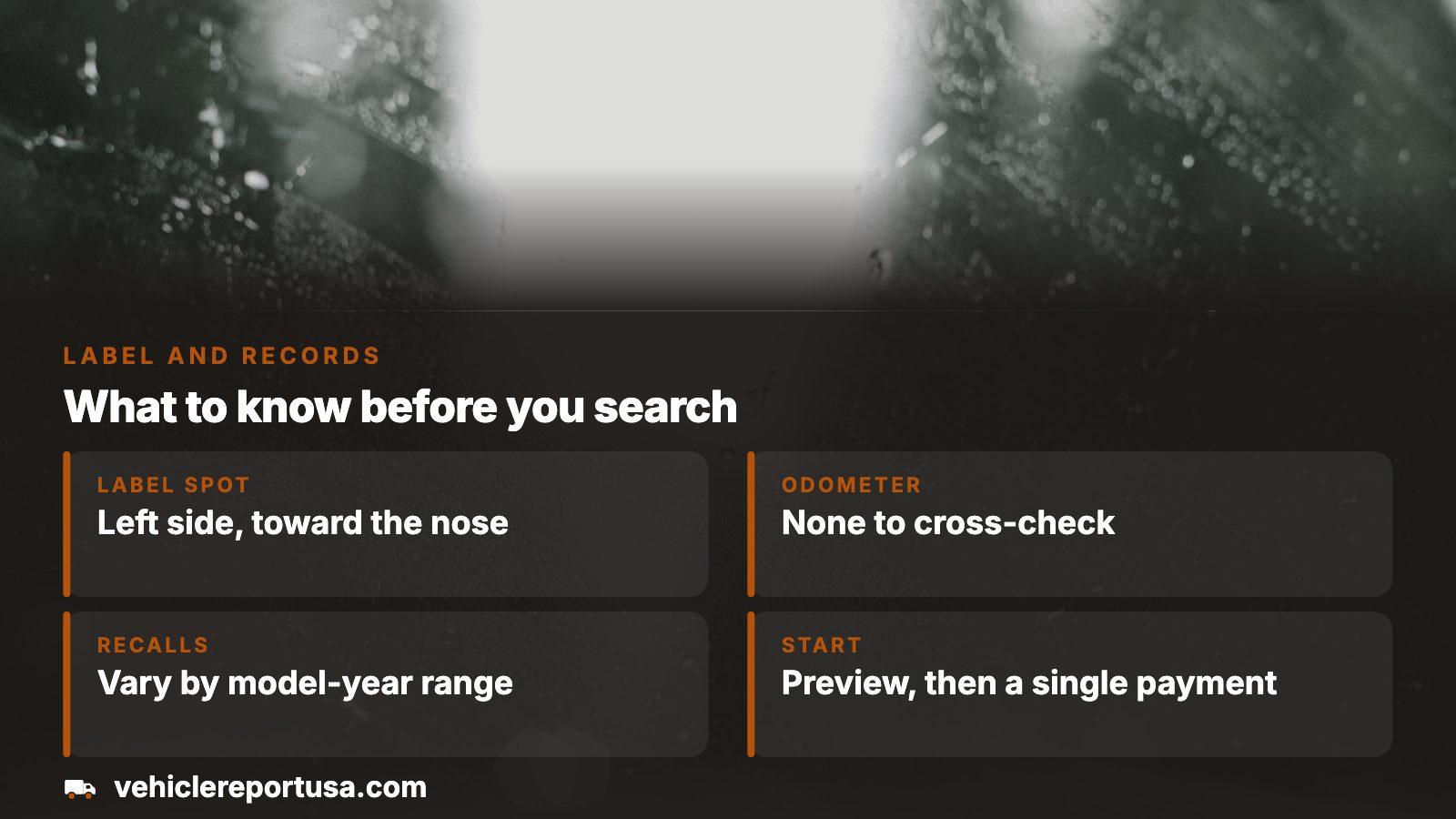
- Label location
- Left side, toward the nose
- Odometer
- None, so there is no mileage to cross-check
- Recalls
- Vary by model-year range, so check by VIN
- Cost to start
- Free preview, then a single payment
What a search on a fifth wheel turns up
Big towables are searched like any other vehicle: the VIN is the lookup key, and anything filed under it comes back. What differs is how much gets filed. Here is how each entry reads for a rig this size.
| Entry | Why it matters on a fifth wheel |
|---|---|
| Title brand | Salvage, rebuilt or flood wording that stays attached to the number across owners |
| Damage and salvage photos | Rear-end impacts, rollover scrapes or waterlines the listing skipped |
| Liens and impounds | A lender who still has a claim, or an earlier tow-and-storage episode |
| Theft and insurance | A stolen-unit flag or a paid total-loss claim |
| Open recalls | Maker campaigns nobody has completed on this specific unit |
| Use type | Rental, fleet or full-time-living history |
A report on a large camper is often short, for reasons covered next.
Why a clean result proves less than it does on a car
The Justice Department's page about the national title database states that submitting records is mandatory for common automobiles alone. A number of states also send in motorcycles and heavy equipment, yet campers are never named. It cautions that where reporting has holes, a search can return a false negative, for example a line reading no junk or salvage history.
That page adds that the national system keeps just a slice of what a state title file holds and sends buyers to the state record. For a fifth wheel this is sound advice: when the seller's state brands vehicles, request the title record from that agency and set it beside the report.
Read the absence correctly
No entries means nothing was reported under that number. It does not mean nothing happened. Pair the search with a title in the seller's name and a walk around the frame.
Where the number is and what it tells you
Federal rules place a trailer's certification label ahead of the midpoint on the driver's side, where someone standing outside can read it with nothing moved. On a fifth wheel, picture the nose cap on the left as you face the front. The label lists the maker, build month, weight ratings and the VIN.
A small wrinkle: a company that resells a trailer built by another, but builds its own and accepts the legal duties, can appear on the label as the maker. Badge and label may name different companies, which alone says nothing bad about the unit.
- Photograph the label head-on in daylight before leaving the lot.
- Read the title and registration number against it, one character at a time.
- Watch for odd rivets, a crooked plate or paint over the label.
- Put the number through the free preview and confirm make and year agree with the ad.
Recalls: why the model name is not enough
Take one Grand Design Solitude fifth wheel, model year 2020. NHTSA's recall data lists 3 campaigns against that year. One covers units built from 2017 to 2021 and concerns a propane line that can touch a refrigerator burner tube. Another covers 2013 to 2021 and involves a loose 110-volt wire in the refrigerator cabinet. The third, filed in February 2025, covers 2019 to 2024 and involves step treads that can break.
Those ranges overlap without matching, so whether a rig falls inside depends on its VIN, not its floor plan name or asking price. Each fix is performed by a dealer, paid for by the maker. A search by number shows whether the work was recorded; the seller's word that it was done does not.
Ask for the paperwork
When a campaign applies, ask the seller to produce the dealer invoice for the fix. Without paperwork, treat the work as undone.
What owners report about frames and kingpins
A fifth wheel puts a heavy load on one steel structure and a single coupling point. Owner complaints filed with NHTSA show what that can look like after a few seasons. These two are about the same model and year used above.
From an NHTSA owner complaint
One 2020 Solitude owner wrote that routine maintenance exposed three cracks in the frame on the passenger side, plus a split weld. No dealer was involved. The maker rejected the claim, and the frame supplier gave no assistance.
From an NHTSA owner complaint
A second owner of the same year described heavy frame flex, slide-outs rolling out during turns and trouble at the kingpin. A dealer diagnosed frame cracks, but the maker's own inspection reportedly found none, and the unit stayed unrepaired. The owner tied it to an NHTSA investigation.
Take from this that a history report cannot see a hairline crack. It can show a prior wreck or a brand, which tells you where to point a flashlight. Underneath the rig, look at welds, gussets and the pin box before you pay.
Warning signs worth acting on
- A brand on the title the seller never brought up, or a title from a state other than the seller's own.
- A lienholder on the report while the owner claims the rig is paid off.
- A decoded make or year that contradicts the listing.
- Auction or insurer damage photos for a unit sold as accident-free.
- Reluctance to let you photograph the label or hold the paper title.
- An open recall and no dealer paperwork showing it was handled.
One item is a reason to pause. Two at once justify walking away or renegotiating from a stronger position.
Running it from the lot
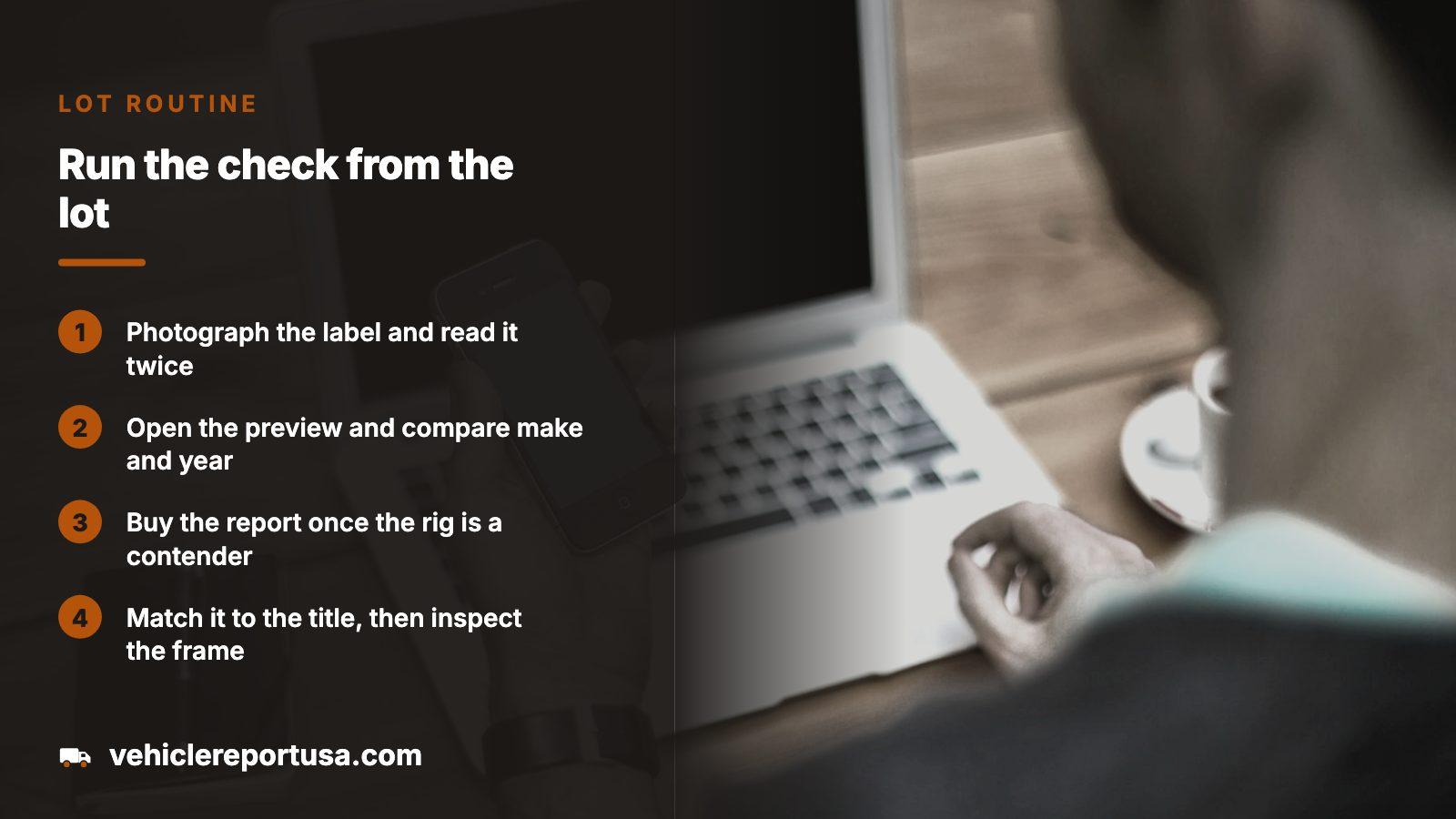
- Snap the certification label and read all 17 characters twice.
- Type the number into the search box and open the free preview.
- Compare the make, trailer type and year with the listing.
- Buy the full report once the rig is a real contender, then go through each section for brands, damage, liens and recalls.
- Match what you read to the title, then crawl under the unit to inspect the frame, pin box and slide mechanisms.
Starting is free. The report is a single purchase without any subscription; the pricing page lists the options, including packs for shoppers weighing several rigs against each other.
Where the check fits in the buying process
Run it after you like the floor plan and before you spend money on an inspection or a deposit. A bad history at that stage costs you a few minutes. The same finding after a deposit costs an argument.
If the number does not decode, or the label is missing, stop and read the guide on trailers with no VIN before going further. If the unit is a bumper-pull model instead, the travel trailer page covers the same steps for that style.
Where this information comes from
- NHTSA vPIC: Trailer Type Connection values — shows fifth wheel is a recognized coupling type in the decoder
- NHTSA recalls: Grand Design Solitude 2020 — source for the three campaigns and their model-year ranges
- eCFR 49 CFR 567.4: certification label — where a trailer's label goes and who may appear as maker
- NMVTIS consumer information (U.S. Department of Justice) — reporting scope and the warning about false negatives
- NHTSA owner complaint 11701651 — owner experience, paraphrased
- NHTSA owner complaint 11753457 — owner experience, paraphrased
Sources and photos: Facts checked against the sources above in November 2026. Photos by Zoshua Colah, Alejandro Escamilla and Cole Keister on Unsplash; diagrams by VehicleReportUSA.
Keep reading
- Travel Trailer VIN Check: Run the History Before You Buy the Camperthe same steps for a bumper-pull camper
- Where Is the VIN Number on a Trailer? Label, Frame and Tonguemore on finding and reading the label
- What If a Trailer Has No VIN Number? A Buyer's Checklistwhat to do when the label is gone
- RV VIN Recall Check: Chassis, Coach and Trailer Recalls Before You Buyhow to search open recalls on an RV
Frequently asked questions
Can I run a VIN check on a fifth wheel?
Yes. Fifth wheels carry a 17-character VIN like any trailer built for the road. Enter it, read the free preview, then decide on the full report. Expect thinner records than for a car, because reporting rules focus on common automobiles.
Does a fifth wheel VIN check show mileage?
No. A trailer has no odometer, so there is no reading to compare. Judge wear from the frame, tires, bearings and slide mechanisms instead, and use the report for brands, damage, liens and recalls.
Where do I find the VIN on a fifth wheel?
Check the certification label in the front half of the trailer's left side; federal rules require it to be readable from outside. The title and registration should show the same number, and any mismatch deserves a direct question to the seller.
Does a clean report mean the frame is sound?
No. A report records what was reported, not what is hidden in a weld. Owner complaints about cracked frames show damage can appear with no wreck on file. Inspect the frame and pin box in person before you pay.
How do I check whether a recall was completed?
Search the number with the maker or NHTSA, then ask the seller for the dealer repair order. Recall coverage differs by model-year range, so two units of the same model can have different results.
Now check the car itself
The guide explains what to look for. The report shows what this VIN has on record.